
The cuckold breeding kink is a specific erotic fixation on one scene: a wife or partner getting pregnant by another man while her husband or primary partner watches, knows, and submits to it. The pregnancy isn't an accident the story has to work around. It's the finish line.
Cuckold breeding fiction treats conception by a third party as the most permanent, public proof of a cuckold arrangement. The erotic charge comes from how completely that permanence seals the cuckold's surrender. The husband stays. The child is someone else's. Everyone involved understands exactly what happened.
This is one of the most intense corners of the broader cuckold and hotwife genre, and it has its own conventions, its own emotional logic, and its own history on the page.
It also sits close enough to real pregnancy risk that the responsible version of it, in fiction and especially in life, never pretends the stakes are imaginary. What follows is the full picture: what the term covers, where it came from, how the best authors actually build these scenes, and why readers keep coming back to a fantasy this heavy.
What Cuckold Breeding Actually Means
The name breaks into two parts that both matter. "Cuckold" names the husband or partner who watches his partner take another lover; the arrangement's whole emotional engine is his consent and his submission to it. "Breeding" is the specific fetish of impregnation, of sex with conception as the stated goal. Put them together and you get a dynamic where the other man's virility, his seed, and the resulting pregnancy are the visible trophies of the cuckold's arrangement.
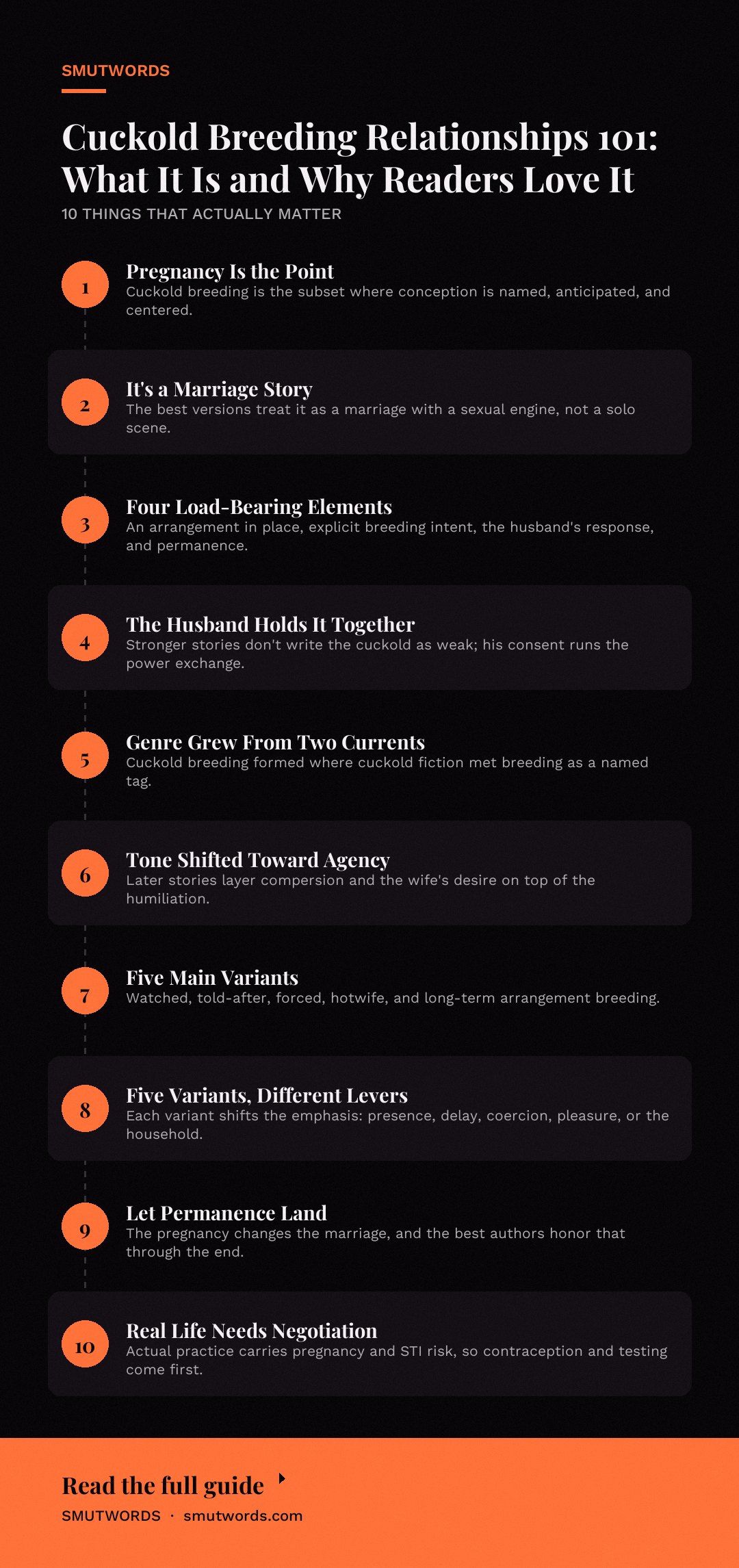
The short definition calls the pregnancy "the point of the scene." That's the dividing line. Plenty of cuckold stories include sex between the wife and her bull without ever touching reproduction. Cuckold breeding is the subset where conception is named, anticipated, and centered.
The husband may be present for the act, may be told about it after, or may watch his wife's body change over the following months. What makes it this kink and not another is that the child is the permanent, living outcome of another man's body doing what the cuckold's couldn't or wouldn't.
Several elements have to line up for a scene or book to count:
- A cuckold arrangement already in place. The husband knows and has, at minimum, agreed to his partner sleeping with someone else. Discovery without prior consent is a different (and much thornier) trope.
- An explicit breeding intention. The bull is trying to get her pregnant, or the couple has decided she'll carry his child. Conception is a goal in the narrative, not a background risk.
- The husband's awareness and emotional response. His jealousy, arousal, humiliation, or compersion is a load-bearing part of the scene. A story that ignores how the cuckold feels isn't really doing the work.
- The permanence. The pregnancy outlasts the sex scene. It changes the household, the marriage, and the future.
Common misconceptions are worth clearing up. Cuckold breeding is not the same as a stranger getting a woman pregnant by deception, and it isn't the same as a couple simply having a third for a night. It also isn't interchangeable with every alien or monster breeding story; those can share a conception focus but lack the husband-watching structure that defines cuckolding.
Readers sometimes assume the cuckold is written as pathetic or weak. In the stronger versions he's the one holding the whole arrangement together, which is where the power exchange actually lives.
Where Cuckold Breeding Comes From
Start with the publishing history, because that's where the term's real lineage sits. Cuckolding as an erotic theme has circulated in print and letters for well over a century, but the conception-focused version is younger and much more specific to modern genre fiction. The hotwife and cuckold subgenres solidified online, in forums, self-published erotica, and the serialized story sites that grew through the 2000s and 2010s. Breeding as a named kink matured alongside them in the same spaces.
Cuckold breeding emerged where those two currents met. Early cuckold stories mostly stayed on the jealousy and compersion of the act itself; pregnancy showed up occasionally as a consequence but rarely as the goal. As breeding became a recognized tag with its own audience, authors started building whole plots around conception. The wife's pregnancy test, the bull's claim, the husband's reaction to news he can't undo: those beats hardened into a recognizable formula by the mid-2010s.
The genre's emotional palette shifted too. Earlier cuckold writing leaned hard on degradation, with the husband framed as humiliated and diminished. Later cuckold breeding stories, especially those written for and by women, put more weight on the wife's agency, the household's negotiated rules, and the cuckold's own erotic investment.
The humiliation didn't disappear. It got layered with compersion, tenderness, and a marriage that survives the arrangement. That blend is what most readers mean by the term now.
Worth noting: cuckold breeding sits in a family with a lot of adjacent genre machinery. The Alpha/Beta/Omega dynamics framework borrows the same logic, where one partner's genetic claim and another's watching role structure the whole relationship. Nonhuman breeding stories do it too; the alien breeding trope runs on the same conception-as-claim engine, just with a different third party. Recognizing those relatives makes cuckold breeding's own boundaries sharper.
How It Shows Up in Erotica
Read enough of these books and the craft separates cleanly into versions that work and versions that fall flat. The ones that work build the arrangement before the breeding, give the wife interiority and desire, and treat the cuckold's emotional collision as the main event rather than a footnote.
The ones that fall flat rush to the impregnation and skip straight to anatomy, leaving the reader with a pregnancy plot and no marriage inside it.
The strongest cuckold breeding scenes tend to follow a recognizable emotional arc. First the negotiation or the established rules: what the couple has agreed to, what the husband has promised to witness. Then the anticipation, often weeks or months of the bull being invited in, the wife's body tracked and discussed, the cuckold's jealousy building alongside his arousal.
Then the breeding act itself, framed as deliberate. Then the aftermath, where the pregnancy test, the announcement, or the growing belly does the work of proving what happened.
Authors lean on several recurring variations. Here's how they typically split:
- Watched breeding. The husband is physically present while the bull impregnates his wife. The scene's tension is in his position: he's allowed to watch and told not to touch.
- Told-after breeding. The cuckold learns of the conception after the fact, sometimes from his wife, sometimes when she starts showing. The humiliation lands late and the reader feels his reckoning.
- Forced breeding cuckold. The arrangement is coerced or set as a condition, and the consent is complicated or the husband's resistance is part of the fantasy. This variant needs careful framing to stay legible as fantasy.
- Hotwife breeding. Emphasis on the wife's pleasure and choice, with the husband's role as supportive witness. Lighter on humiliation, heavier on the wife's appetite and the bull's virility.
- Long-term arrangement breeding. The couple, the bull, and sometimes the resulting child settle into a standing household dynamic, and the pregnancy is one chapter in a longer arrangement.
The better books share a few craft habits. They establish the couple's rules explicitly, because the reader needs to know what's allowed before it can be violated or honored.
Enjoyed this? Get a free book.
Join the list and we will send a complete free story straight to your inbox, plus new releases every week after that. No credit card, no catch.
They also let the wife have active desire rather than treating her as an instrument of the husband's fantasy. They let the bull be a character, not just a body, and give him a perspective that colors the marriage. And they hold the humiliation and the compersion in the same scene instead of picking one.
And they let the permanence land: the pregnancy changes things, and the best authors honor that change through the end of the book.
Where weaker versions go wrong is worth naming, because it's instructive. Some forget the cuckold altogether once the bull enters the room, turning a three-body dynamic into a solo breeding scene with an audience reference. Some rush the conception into the first chapter and skip the negotiations that give it weight. Some reduce the wife to a vessel for the husband's kink, stripping the interiority that makes the arrangement erotic in the first place.
The strongest stories keep all three partners legible and let the reader feel the marriage underneath the sex.
Some readers will find the emotional textures here familiar from other corners of the genre. The jealousy-and-desire tangle in the sharper cuckold breeding books has a lot in common with the conflicted heat of angry sex versus makeup sex, where a couple's friction and their sex life feed each other. The same instinct drives the reader who wants the arrangement's tension to be part of the pleasure.
Meanwhile the coyote-stamina, mate-guarding energies of shifter fiction show up too; territorial shifter tropes borrow the bull's claim-and-conquest logic, and pack dynamics often encode the same watched-partner-with-a-rival structure inside wolf hierarchies.
The breeding fantasy itself has a strong footprint across species-specific subgenres. Readers of elf romance will recognize the consenting-conception version of the same dynamic, and alien abduction romance frequently links abduction with forced conception. The emotional architecture is shared; the third party just changes shape.
Cuckold breeding keeps the third party human and the husband present, which is what gives it its particular bite.
On the real-world side, the responsible version of this kink in actual practice requires clear discussion of contraception, STI testing, and expectations between all three partners before anything happens. Real cuckold breeding involves actual pregnancy risk and actual STI exposure, and the negotiation that erotica fictionalizes as foreplay is the necessary first step in life.
That doesn't dull the fantasy; fiction is where the negotiation can be dramatized rather than enforced. But readers who carry the kink into a real dynamic should treat the negotiation as the load-bearing part rather than the sex.
Frequently Asked Questions
What is the cuckold breeding kink, exactly?
It's the erotic fixation on a wife or partner getting pregnant by another man while her husband or primary partner knows and watches. The pregnancy is the point of the scene, not a side effect. The kink's core is the permanence and visibility of the cuckold's arrangement.
Is cuckold breeding the same as hotwife breeding?
They overlap but differ in emphasis. Hotwife breeding usually centers the wife's appetite and choice, with a supportive husband. Cuckold breeding leans harder into the husband's jealousy, surrender, and the humiliation of the arrangement. Some books sit between the two.
Why do readers enjoy cuckold breeding stories?
The draw is the emotional collision: jealousy, compersion, arousal, and surrender in the same scene. The pregnancy makes the power exchange feel absolute and permanent, which is the fantasy the genre delivers. Readers want to feel the size of what's at stake.
Is cuckold breeding safe in real life?
It carries real pregnancy risk and real STI exposure, so it isn't something to improvise. Responsible practitioners discuss contraception, testing, and every partner's boundaries in advance. The negotiation is the necessary groundwork, not an optional preamble.
What are the common variants of cuckold breeding?
Watched breeding, told-after breeding, forced breeding cuckold, hotwife breeding, bull breeding, and long-term arrangement breeding are the main ones. Each shifts the emotional emphasis: presence, delay, coercion, the wife's pleasure, the bull's virility, or the gradual settling of the household.
What's the difference between cuckold breeding and alien breeding?
Alien breeding shares the conception focus but lacks the human husband-watching structure that defines cuckolding. Cuckold breeding keeps all three partners human and present. The alien version replaces the bull with a nonhuman third party, which changes the emotional engine entirely.
Final Thoughts
Cuckold breeding works best when the author treats it as a marriage story with a very particular sexual engine, not a solo impregnation scene with a husband tacked on. The reader wants the arrangement's rules, the wife's desire, the bull's claim, and the cuckold's reckoning all in the same room. When those four elements line up, the pregnancy lands as the permanent seal on a power exchange the reader can feel in their body.
When one goes missing, the story thins into anatomy.
If you're new to the subgenre and want a book that gets all four right, start with one of the most consistently recommended titles below. If you've been reading it for years and want more of the surrounding machinery, our guide to the alien breeding trope and our breakdown of pack dynamics pull on the same threads from different angles. The fantasy rewards the reader who wants the full emotional weight, not just the scene.





Loading comments…