
Most people who've had angry sex didn't plan it. The argument was about dishes, or a text message, or whose family you're visiting at Christmas. Voices got loud. Someone walked into the bedroom to cool off, and forty minutes later you're both on the floor with your underwear somewhere near the door and the actual fight not one bit resolved.
That's the situation this guide is about. Not the fantasy of it, not the porno version where the music swells. The real thing: why it keeps happening, what your body is actually doing, and the honest line between a release valve and a problem.
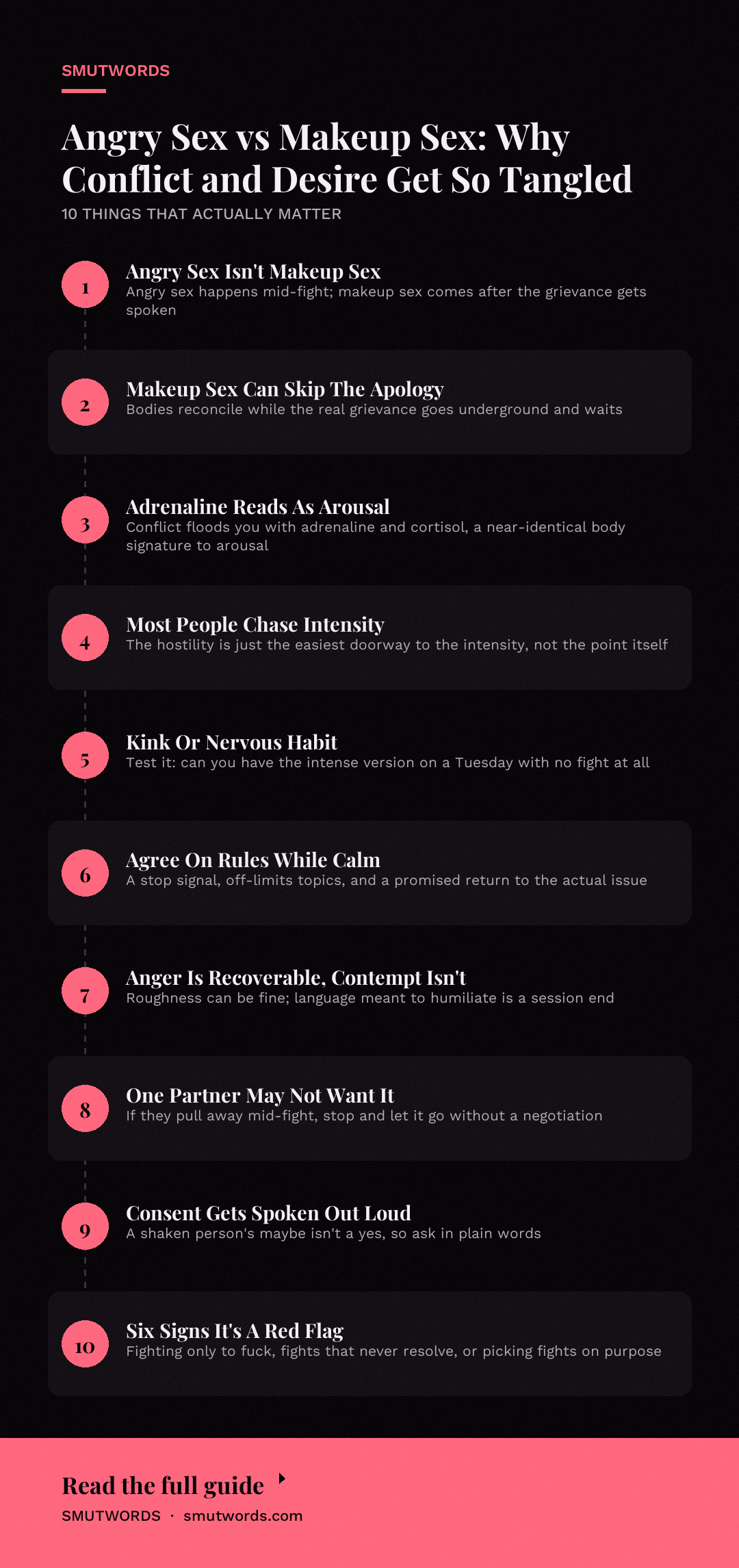
Angry sex and makeup sex get used interchangeably. They're not the same event, even when they happen back to back on the same evening. Pulling them apart matters if you want either one to stay something you choose.
Angry Sex and Makeup Sex: What's the Actual Difference
Angry sex is what happens while the conflict is still live. The adrenaline hasn't burned off and the grievance is still loaded. The sex is often fast, rough, a little careless with elbows and sheets. Someone's still mid-sentence from the fight.
Makeup sex happens after the thing gets resolved, or at least after you've both said the words that let the pressure out. The heat's different. It's relief, reunion, a physical version of the apology you already spoke out loud.
The easy mistake is assuming makeup sex is the healthy one and angry sex is the suspect one. In practice it runs the other way more often than people expect. Makeup sex can become a shortcut that skips the apology entirely: bodies reconcile while the actual grievance goes underground and waits. Angry sex at least stays honest about the fact that you're mad.
What neither one does is fix a thing. Sex as the resolution to a recurring fight is how couples end up having excellent hookups and a marriage that slowly rots. You'll see that dynamic played out all over the marriage in trouble shelf, where the reunion scenes are scorching and the plot knows perfectly well that the couple still hasn't said the important thing.
Why Tension Spikes Desire in the First Place
There's a physiological explanation and it's less romantic than the feeling. Conflict dumps adrenaline and cortisol into you. Your heart rate climbs, your skin flushes, your breathing changes. That's a near-identical body signature to arousal, and when you're already flooded with it, a familiar bare arm or a certain look can tip the whole system toward wanting someone.
Sex researchers call it arousal transfer: the physical buzz from one situation gets read by your brain as desire for whatever's in front of you at the time.
Then there's the psychological layer, which is where it gets more interesting. A real fight is a moment of high emotional stakes and genuine exposure. You're angry, which is a close cousin of vulnerable. Some part of you wants to be seen and reached in the middle of all that.
When both people are still in the room instead of storming out, there's an unspoken "we're still here" that the body can translate into wanting to be close, roughly and immediately.
Why tension becomes desire, in plain terms:
- Adrenaline and cortisol flood your system and mimic arousal physically.
- Heightened emotion strips away self-consciousness, which lowers inhibition.
- A fight is intimate: you're raw and exposed in front of each other.
- Rough sex can carry a fantasy charge of being overcome, which some people genuinely want.
- The relief afterward is chemical as well as emotional, a real drop in tension.
Notice how many of those are about intensity, not about being angry at your partner specifically. Most people who love conflict sex are chasing the intensity. The hostility is just the easiest doorway to it.
Is Angry Sex a Kink, or Just a Habit?
It can be either. There's a whole dynamic called primal play, where partners lean deliberately into roughness, biting, scratching, growling, the physical side of conflict without an actual grievance behind it. That's consensual from the start and negotiated like any other kink, and it scratches the same itch without anyone having to be genuinely furious.
Some people make a regular practice of it. Others of us just reach for it every few months when the tension gets thick.
Then there's the version that's less a kink and more a nervous habit. Couples who can't talk about money or jealousy or the amount of time someone's on their phone, who reliably blow up and then reliably fuck it out and never return to the actual subject. That pattern has a name in the clinical literature: the demand-withdraw cycle, and it's the thing to watch for.
The clearest test is whether you can have the intense version on a Tuesday afternoon, no fight required. If the answer is yes, you've got a preference. If the answer is that it only ever happens mid-argument, what you've really got is a communication problem in a very good outfit.
How to Have Angry Sex Without It Going Wrong
The part nobody tells you is that angry sex is one of the least pre-plannable practices there is. By definition it arrives when you weren't expecting it, which means all the usual consent conversations that work for kink play get skipped. So the work happens outside the moment. Let me get specific about how to do that.
Have the conversation when you're both calm
Pick a flat, boring evening with no fight on the horizon. Say something like: "I've noticed when we fight, we sometimes end up all over each other, and honestly I don't hate it. But I want to be able to trust that we both know what kind of fight that is and that either of us can put the brakes on. Can we talk about rules?"
That's a real opener. It names what's happening, asks for agreement, and leaves room for the other person to say they'd rather not.
What you want to agree on, specifically:
- A stop signal, one word or gesture, that halts everything immediately and is respected even when emotions are high. Use it if you're unsure about anything.
- Which topics are off limits for conflict sex. Whatever you're genuinely battling about that year is not the thing to wrap around sex. Pick one or two subjects that stay out of the bedroom.
- Whether you'll talk about the fight afterward and how soon. A promised return to the actual issue, later and calmer, keeps conflict sex from becoming how you avoid the real thing.
- What happens with birth control and protection, decided beforehand, not reached for in the middle of it.
- Permission for each of you to slow down or stop, restated out loud, no explanations required in the moment.
Write those down if it helps. A lot of couples find that agreeing on the terms makes the experience feel safer, which tends to make it better.
Enjoyed this? Get a free book.
Join the list and we will send a complete free story straight to your inbox, plus new releases every week after that. No credit card, no catch.
Stay alert to the difference between anger and contempt
Anger is recoverable. Contempt is not. If the sex is coming with eye rolls, "you're pathetic," comments about someone's body or family or worth as a person, stop it.
Roughness that leaves marks can be fine if it's agreed and checked in on afterward. Language designed to humiliate is a different animal, and one hit of it in a fight-sex situation will leave a mark that lasts longer than any bruise.
This is the safety catch that matters most. You can be rough, you can be loud, you can call each other things that are part of the dynamic you both chose. The instant someone uses the sex to land a genuine blow, that's a session end.
Sort out the physical risks
Adrenaline makes people bad at self-assessment. You push into positions and paces you wouldn't normally choose, with muscles already tense from an argument. Practical guards worth having in place:
- Set up your birth control before this ever comes up, not in the heat of an argument.
- Have water and easy-to-reach lube so a mid-session cramp or a too-fast start doesn't stall everything.
- Loosen your grip on wrists, throats. No pressure on the neck and no restricting breathing. And never rope, cuffs, or anything that restrains harder than a hand you can slip out of, because the person doing the restraining is running on adrenaline and stress, not the careful attention heavy bondage requires. Those are not edge cases. They're how people get hurt.
- Do a body check when you're done. Look at each other's wrists, thighs, everywhere. Speak up if something is sore or you don't remember it starting.
Angry Sex With a Partner Who Doesn't Want It
A crucial reframe: the sex that happens after or during a fight can be something one person wants and the other person doesn't, and the person who doesn't is not the problem. An argument makes people feel exposed and vulnerable, and some people want to be held, not flipped onto the bed. Some people are furious and want the anger acknowledged out loud, and having sex at that moment reads as being bulldozed past.
If your partner reliably pulls away when you reach for them mid-fight, that's your information. The move is to stop in the moment, say "okay, not now, that's fine," and let it go. Reach for them later without the fight attached, or find a different route. Conflict sex only works when both people are choosing it, and a fight is exactly when one person can be pushed into something they didn't choose.
This is where a lot of the heat in the dynamic can be rerouted on purpose. If you love being overcome or being chased, there's primal play, and there's the slow deliberate version, and there's pure fantasy on the page. You'll find a partner-led version of exactly this tension all over Whore of Wall Street, where the conflict and the desire are woven together by design and everyone knows the game.
When It's a Red Flag, Not a Release
You can enjoy angry sex for years and still be fine. The questions that should actually give you pause are these:
- You only ever have sex after a fight.
- The fight never actually resolves. You get each other off and the underlying issue comes back next week, unchanged.
- The sex is used as an apology or a punishment, and one person seems to have no say in it.
- There's a real power imbalance, or a pattern where one person's limits keep getting walked over in the moment.
- Someone feels afraid. Not nervous, not self-conscious. Afraid, with a tightening stomach when the argument starts because of what might follow.
- You find yourself picking fights on purpose.
If you recognize more than one or two of those, the sex isn't the problem or the solution. The communication is. It's worth naming out loud, at a calm moment, that you'd both like the conflict sex to stay in the background until the actual fights get shorter. If naming it is hard, that's the sign.
Reading Conflict and Tension in Fiction
Conflict sex lands so well on the page, and it's a mainstay of romance for exactly this reason: fiction can hold all the intensity with none of the real-world mess. A writer can give you the adrenaline, the fight, the rough reconciliation, and also guarantee it's all consensual and nobody wakes up with a bruise they didn't ask for.
If the dynamic is your thing, there's a whole library of it. The Free Use Taxi Service plays out a power-and-tension dynamic from the first page, and The Weekend Bull Rotation runs on the heat of wanting someone deeply while something else is at stake.
For a longer slow burn where the conflict is baked into the premise, Ceremonial Penetration Day takes a pressure-cooker setup and doesn't let up. And if you like your heat with a stranger-arrival charge, the blind date romance shelf is the place to land, which is the same rush of an unfamiliar face and a night that turns out unpredictable.
Readers who want the tension held at maximum amusement, where the friction between two people is basically the entire plot, will find a lot to like in the lumberjack romance aisle, or in the rockstar romance shelf.
And if you want to know how far into the wild end of that dynamic other readers go, the monster breeding romance shelf is a real education. For the quieter, closer-to-home version of the same friction, neighbor romance runs on proximity and unresolved tension rather than outright war.
A Note on Pressure and the Moment It Happens
One last practical thing that doesn't fit neatly anywhere else. In the actual moment of an argument, the decision to have sex arrives fast and the stakes feel enormous. Two rules make it survivable.
First, consent gets spoken out loud, in words a five-year-old could understand. "I want this, do you?" or "say yes and mean it." Anything less specific, anything that's just a body moving toward a body, doesn't count when both people are flooded with adrenaline. Someone who's furious and shaken isn't in a good place to have their "maybe" read as a "yes."
Second, either person can call the whole thing off at any point with no penalty. Having said yes and then changed your mind mid-way is a complete sentence. The other person's job is to stop, not to negotiate. If that doesn't happen on the first try, that's the whole conversation about whether this dynamic stays on the table.
For anyone who's never had a partner risk a joke about the argument afterward, here's the professional standard: after it's over, clean up (the fight, too), get water, and make one dry comment about the absurdity of the situation. It gives both of you somewhere to land.
Then, when you're both calm, go back to the actual thing you were fighting about, or agree on a time to do it. The sex can be wonderful and also not the answer, sometimes at once.
Final Thoughts
If you came here wondering whether it's fine to love this, the answer is yes whenever both of you are choosing it, talking about it when the fight is over, and coming out the other side with the actual argument still on the table. If you want a version where the conflict is furious and the hands are sure, start with Wetware Slave, which builds the tension into the premise and lets it burn.
Then read the argument you had last week out loud, together, once the adrenaline's gone. That's the part that makes the rest of it stay good.





Loading comments…