Somewhere on a research vessel in the North Atlantic, a biologist is running a gloved finger along a seam in the hull that wasn't there yesterday. The seam is warm. It's breathing.
By chapter four, that biologist is going to be pinned to a bulkhead by something that has no business fitting through a human doorway, and she's going to like it. That's eldritch futanari in one paragraph. If your reaction is curiosity instead of confusion, you already know why the subgenre has been quietly colonizing the dark corners of indie erotica for the past few years.
Cosmic horror and futanari shouldn't work together on paper. One is about insignificance in the face of an indifferent universe. The other is about bodies doing extremely specific, extremely explicit things. Stack them and you get something neither genre manages alone: a story where the horror is the arousal and the arousal is the horror, and the reader never quite gets to stand on solid ground about which is which.
What Makes Eldritch Futanari a Distinct Subgenre
Eldritch is shorthand for the Lovecraftian register. Ancient entities, wrong geometry, cults, coastal towns with missing fishermen, gods that regard human beings the way you regard a single bacterium in a petri dish. The defining feature isn't tentacles. It's scale, and the psychological fallout of encountering something whose existence retroactively shrinks you.
Futanari is the term for characters with both sets of genitalia, usually written as a woman presenting with a penis or a hermaphroditic body. In practice, the genre runs on penetration, power, and an often obsessive focus on the moment of connection between two anatomically incompatible-seeming bodies.
Put them together and the thematic overlap is obvious once you see it. A cosmic entity that wants to mate with a human is horrifying because of what it implies about human agency. A futanari character is compelling because of what they do to the bodies around them.
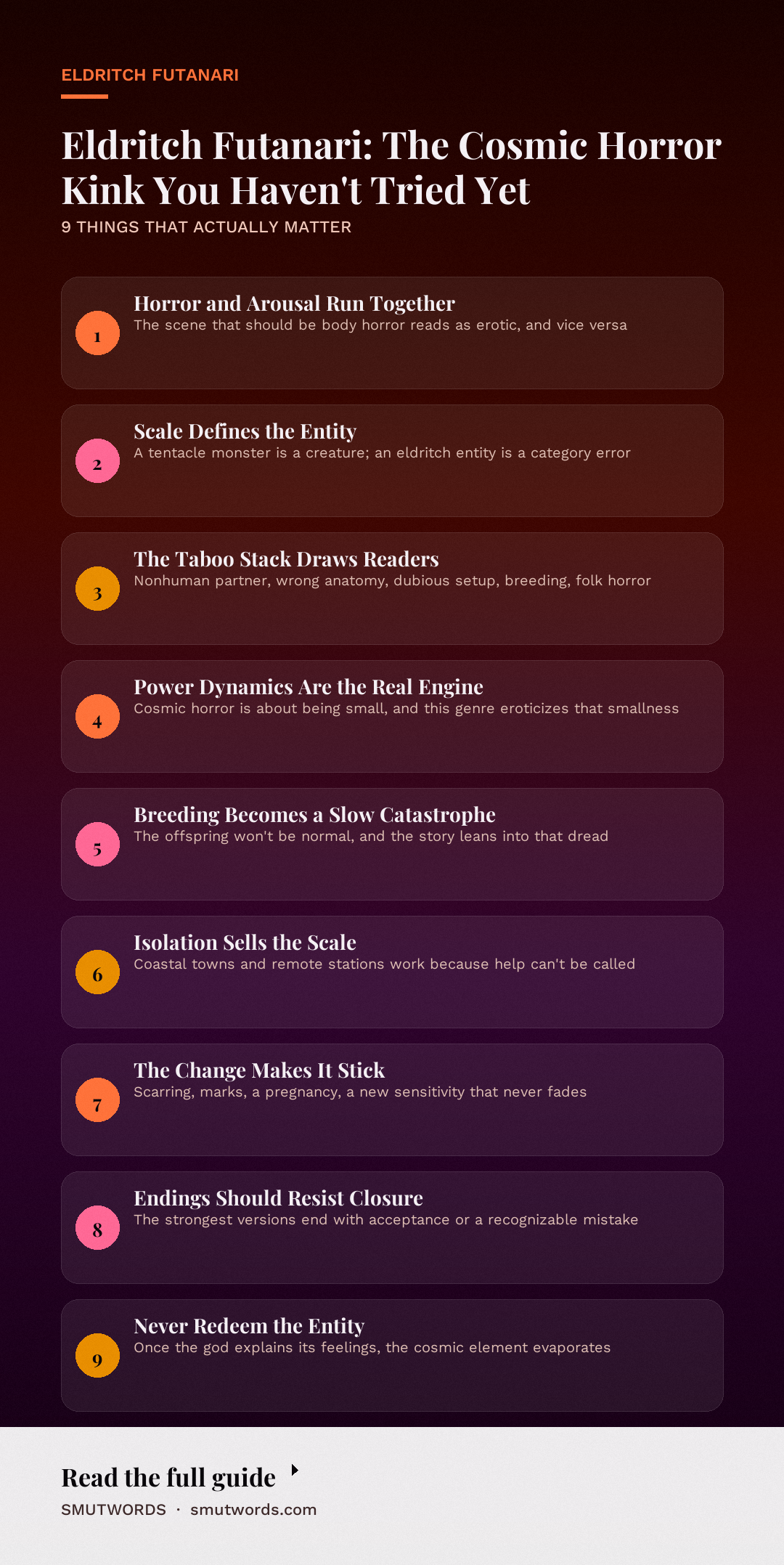
Eldritch futanari runs both engines at once. The scene that should be pure body horror reads as erotic, and the scene that should be pure erotica keeps threatening to tip into something much worse.
Where the genre came from
The futanari tradition has roots in Japanese doujin and visual novel culture going back decades, and the tentacle-adjacent end of that tradition crossed into Western indie publishing around the same time monster romance did. The marriage of the two is fairly recent, mostly a product of the last six or seven years of self-published dark erotica on platforms that allow explicit content, and it's still small enough that the readership feels like an in-group.
What pushed it into a real niche rather than a curiosity was the monster breeding romance boom. Once readers accepted that a nonhuman love interest could be a legitimate romantic lead instead of a villain, the door opened for entities that were never remotely human to begin with.
Why Readers of Dark Taboo Erotica Gravitate Toward It
The obvious answer is the taboo stack. Nonhuman partner, nonstandard anatomy, nonconsensual or dubious setup, breeding expectations, and often a religious or folk-horror frame on top. That's five or six taboos layered into a single premise, and for readers who need real friction to feel anything, the genre delivers it without asking permission first.
The less obvious answer, and the more interesting one, is power dynamics. Cosmic horror is fundamentally about being small. Eldritch futanari eroticizes that smallness instead of just dreading it.
The entity is vast, patient, and utterly indifferent to human concepts like consent or consequence, which makes it the ultimate dominant. The human character is pinned, filled, and used as a vessel for something whose motivations she cannot fully comprehend. If that reads as D/s protocols taken to their logical extreme, that's because it is. The negotiation just happens at a scale that makes negotiation meaningless.
The breeding angle, specifically
This is where the long-tail searches come from, and it's worth naming directly. Breeding kink in a human pairing is about possession, lineage, and permanence. In eldritch futanari, it's about those things times a thousand, because the offspring aren't going to be normal. The reader knows, the character usually knows, and the story leans into the dread of what's growing rather than pretending it's just a romantic milestone.
Some books play the pregnancy as body horror. Others play it as inevitability, a fate the protagonist accepts halfway through and then actively craves. Both approaches work, and the difference between a good version and a bad one comes down almost entirely to whether the author commits to the consequences.
- The committed version: the pregnancy has real physical and psychological costs, the entity's motives stay alien, and the ending doesn't flinch.
- The defanged version: the entity turns out to be secretly tender and human-adjacent, the pregnancy is treated as a sweet epilogue, and the horror drains out of the premise by chapter ten.
- The lazy version: tentacles as set dressing, no cosmic scale, no real dread, just standard monster erotica with a Lovecraftian cover.
- The ambitious version: the entity has a goal that the human mind can only partially model, and the eroticism comes from how much of that goal the protagonist is willing to serve.
That last category is where the genre earns its keep. When the reader finishes a scene and can't quite articulate what just happened to the protagonist, but knows she's changed permanently, the book has done the job.
The Specific Beats Readers Are Looking For
Every subgenre has its furniture. Eldritch futanari has more than most, because it's borrowing from two established traditions at once. Here's what shows up over and over, and what each beat is actually doing for the reader.
First contact
Usually a coastal town, a dig site, a sunken ship, or a remote research station. The setting matters because isolation sells the scale. If the protagonist can call for help, the entity loses mystique. The best openings put the character somewhere the nearest police station is a four-hour boat ride away, and then cut the radio.
Enjoyed this? Get a free book.
Join the list and we will send a complete free story straight to your inbox, plus new releases every week after that. No credit card, no catch.
Recognition
The moment the human understands what she's dealing with, and the moment the reader understands that understanding won't save her. This is often the scene where the entity first manifests, and the anatomy reveal usually happens here. Good authors handle this with sensory detail rather than a clinical description. Heat, weight, a sound that doesn't fit the acoustics of the room.
The first use
Consensual, dubious, or flatly nonconsensual depending on the sub-subgenre, but always inevitable. The entity doesn't ask. It takes, and the protagonist's body responds in ways that complicate her sense of herself. This is the scene that readers come back for, and it's the scene most likely to fail if the author can't sustain tension through the explicit content.
The change
Physical or psychological alteration. Scarring, marks, a pregnancy, a new sensitivity, a cult mark, an inability to sleep without dreaming of the entity. The change is what makes the story stick. Without it, the reader is just flipping through a well-written scene and moving on.
The choice
Some books end with escape, but the strongest versions end with acceptance, or with a decision that the reader recognizes as a mistake even as the protagonist makes it. That's where the cosmic horror tradition and the taboo erotica tradition fuse most cleanly. The protagonist chooses the thing that will destroy her, and the reader understands why.
How Eldritch Futanari Differs From Adjacent Subgenres
Readers coming from other niches often want to know what's different, and the honest answer is that the scale of the entity is the deciding factor. A tentacle monster is a creature. An eldritch entity is a category error. That distinction changes everything about how the story is structured.
If you're arriving from kraken romance, which tends toward romance beats and emotional resolution, expect less of both. Kraken romance wants you to fall for the tentacled lover and get a happy ending. Eldritch futanari wants you unsettled at the end, even if the protagonist is technically satisfied.
If you're arriving from childhood friends to lovers, the contrast is even starker. That trope runs on warmth, familiarity, and the safety of being known.
Eldritch futanari runs on the opposite: the terror of being seen by something that has no framework for caring about you as a person. The entity knows your body completely and your mind not at all, and that asymmetry is the entire point. It's also, incidentally, why the hate to love dynamic shows up so often in this genre, even when the "hate" is really just a human trying to hold onto her own sense of self.
A quick comparison table
- Monster romance: the creature is lovable, the romance is central, the ending is usually happy.
- Tentacle erotica (non-cosmic): the creature is a device, the sex is central, the ending doesn't matter much.
- Eldritch futanari: the entity is incomprehensible, the sex is a vehicle for dread, and the ending should leave a mark.
Most of the complaints readers leave about the subgenre come down to an author accidentally writing category one or two and marketing it as category three. If the entity turns out to have a heart of gold and the only real consequence is a nice pregnancy, the reader feels cheated, even if the individual scenes are well written.
What to Look For in a Good Eldritch Futanari Story
If you're new to the subgenre, a few signals separate the books worth your time from the ones that are just tentacle content with a scary cover.
- Does the entity have motives you can't fully model? If you can explain its goals in one sentence, the cosmic element is decorative.
- Does the protagonist change irreversibly? Physical or psychological, something has to stick.
- Is the setting isolated? Remote coastal towns, deep-sea vessels, Antarctic research stations, and abandoned monasteries work better than urban apartments.
- Does the prose treat the horror seriously? The best entries let the dread sit next to the arousal without winking at the reader.
- Is the breeding treated as a threat rather than a reward? This is a matter of taste, but the strongest versions keep the stakes real.
- Does the ending resist closure? Cosmic horror rarely resolves cleanly, and the erotica works better when it doesn't either.
The one thing that kills a good premise faster than anything else is a last-act redemption arc for the entity. Once the incomprehensible god starts explaining its feelings, the reader is back in ordinary monster romance territory, and the reason she picked up an eldritch story in the first place evaporates.
Where Eldritch Futanari Fits in the Broader Dark Erotica Landscape
It's a small niche, but it sits at a natural intersection of several larger ones. Dark romance readers who've grown tired of mafia dons find the stakes here higher. Monster romance readers who want less emotional safety net find the tone here colder. Breeding kink readers who want the pregnancy treated as genuinely dangerous instead of a soft epilogue find a version here that doesn't blink.
The trade-off is that the subgenre demands more from the author than most. You can't coast on trope furniture the way a standard monster romance can, because the entity has to feel genuinely alien on the page. When it works, you get a book that lodges in your head for weeks. When it doesn't, you get something that reads like two genres stapled together, and the seams are ugly.
The readers who love this stuff tend to love it hard. They aren't here for romance beats. They're here for the specific sensation of reading something that makes them uncomfortable in a way they can't quite name, and then realizing, a few chapters later, that the discomfort was the point. If that lands for you, you already know what to look for next.
Final Thoughts
Start with something that commits. The strongest entry point in the current crop of eldritch futanari is a book that keeps its entity genuinely alien through the final page and treats the breeding angle as a slow catastrophe rather than a happy surprise.
You want a story where the protagonist's choice at the end feels both inevitable and like a mistake, and where you close the book unsure whether you just read a horror novel with a lot of explicit sex or an erotic novel with a lot of existential dread. If you finish it and can't decide, the author did the job correctly.







Loading comments…