
Nobody gets off on the ten minutes before bed. You know the ten minutes. Teeth brushed, phone plugged in, one of you rolls over and puts a hand on the other's hip like you're checking a stove for heat. There's no anticipation foreplay in that, only prelude.
The good stuff starts hours earlier. Sometimes days earlier. And it starts in your head long before it starts in your pants.
Anticipation is the most underrated sex organ you own. More useful than your mouth, more useful than your hands, and completely free. This is the practical guide to running it on purpose.
What anticipation foreplay actually is
Any deliberate buildup that happens before physical contact. A text at 10 a.m. A hand on the back of the neck that doesn't travel anywhere. A sentence said in passing that doesn't get followed up until Thursday.
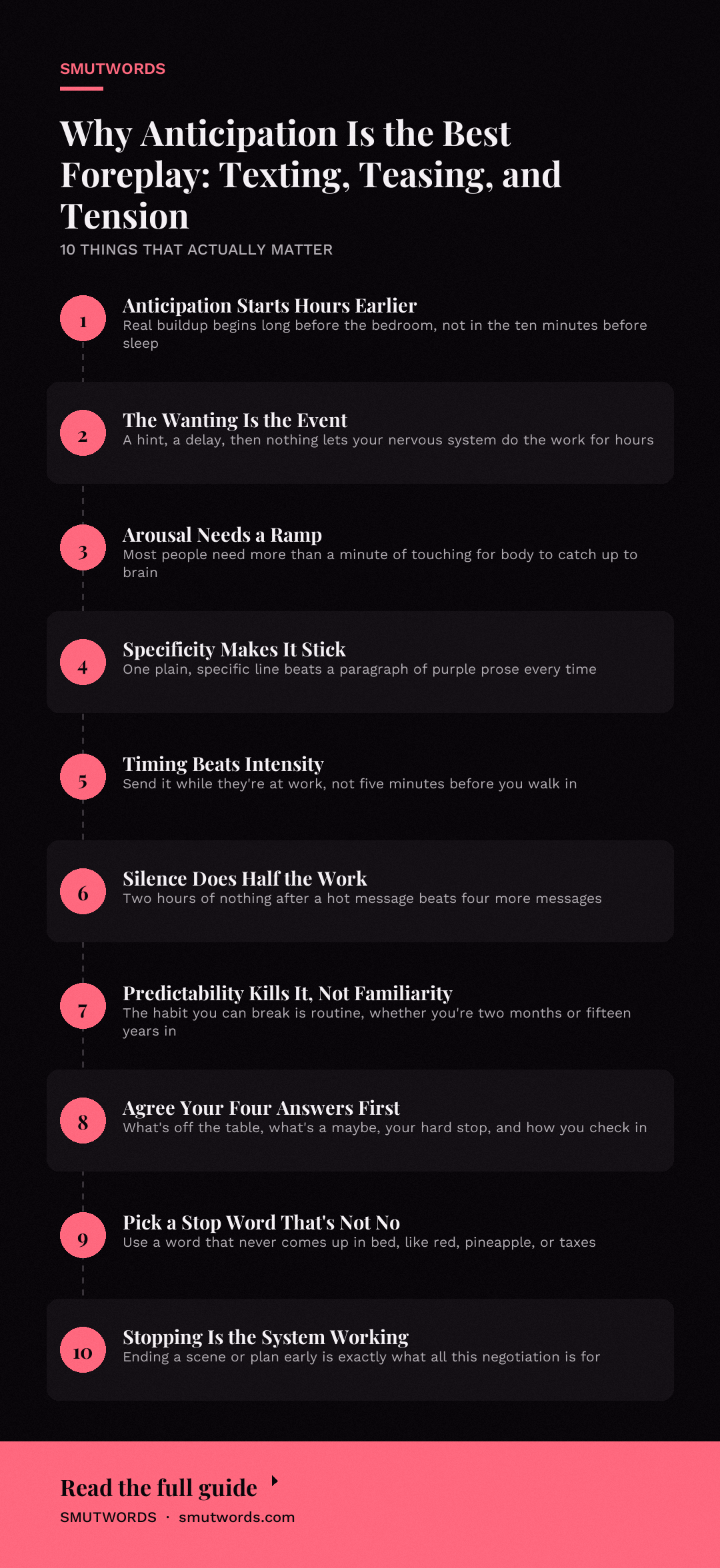
Your body does the rest. The wanting itself is the event. A hint of contact, a delay, and then nothing, and your nervous system spends the next six hours writing fanfiction about it whether you asked it to or not.
Why it works better than jumping straight in
Two reasons, and neither is mystical.
The first is that arousal has a ramp. Most people need more than a minute of touching before their body catches up to their brain, and most people who skip the ramp end up working harder for a worse result. Anticipation stretches that ramp over a whole day so that by the time you're alone, you're already most of the way there.
The second is context. When a partner says something specific at 2 p.m. and then goes back to their job, you can't stop turning it over.
You don't just desire them. You're thinking about them thinking about you.
That loop is where the real heat lives. It's also why D/s protocols explained lean so hard on small ritual moments: a title used in public, a specific phrase, a rule that only the two of you can hear.
How to start without it feeling like homework
The biggest mistake people make is treating buildup as a production. It isn't. It's two or three well-chosen signals dropped into an ordinary day, plus the discipline to not cash them in immediately.
Pick one channel. Text is the easiest, but it's not the only one: a note in a lunch bag, a voice memo, a hand on the back of the thigh at a dinner table with other people at it. Whichever channel you choose, keep it small and keep it sincere. A single line about what you're going to do to them later beats a paragraph of purple prose every time.
Timing beats intensity
Send it while they're at work, not in the driveway. The gap between the message and the reunion is where the whole thing cooks. If the message arrives five minutes before you do, you've just written a shopping list.
Be specific and be plain
"Thinking about you" is a nothing. "I'm not letting you come until I say so, and I've been thinking about that since my 11 a.m. meeting" is a small object they can carry around all afternoon. Specificity is what makes a sentence stick to the inside of someone's skull, whether the sentence is about their wrists or their throat or the exact noise you're planning to get out of them.
Build a day: a tiered example
Here's what a low-stakes version looks like. No props, no schedules, nothing that requires either of you to be an expert.
- Morning: one sentence, sent once, no follow-up. Something true about what you want.
- Midday: a photo of something neutral that means something to the two of you. Your hand on the table, a place you've been together. No nudity required.
- Afternoon: stop. Silence is a tool. Two hours of nothing after a hot message does more work than four more messages would have.
- Evening: first contact. Not sex. A hand on the waist over clothes, held for longer than usual, then removed.
- Later: whatever you actually want. You'll know it when you get there.
Everything above works whether you're two months in or fifteen years in. Familiarity doesn't kill anticipation. Predictability does, and predictability is a habit you can break on a Tuesday.
Stretching it across a week
Longer buildups ask for more structure, and structure is where people either get excited or get bored. The rule that keeps it alive: every day adds one thing, and the adding is the point. Nobody needs a spreadsheet.
Day one, a sentence by text at a random time. Day two, that sentence said out loud, in person, and then dropped. Day three, a hand somewhere it usually isn't: the back of the neck, the inside of the wrist. Day four, a short written note under a pillow with no instructions attached.
Day five is physical contact with a stated stop time. "I'm going to kiss you for two minutes and then I have to go put the laundry in," and then actually stop at two minutes. Day six, whatever the week has been building toward, negotiated in advance and with full permission to change it in the moment.
If that shape feels fussy at first, borrow a warmup from praise dynamic relationships: words of appreciation used as a build, said plainly, said often, said at odd hours. Praise and anticipation are close cousins in practice. Both work by making a person feel seen and wanted for specific things, not just generally.
Dialing it to your comfort level
Anticipation has no minimum intensity. Do the version that fits.
Enjoyed this? Get a free book.
Join the list and we will send a complete free story straight to your inbox, plus new releases every week after that. No credit card, no catch.
- Low: a text with no photo, a delayed callback to something they said months ago, a slow kiss that ends before either of you wants it to.
- Middle: specific dirty talk about a coming event, an outfit chosen in the morning for the evening, a held hand under a table with company present.
- Higher: explicit text during the workday, a stated denial that only holds for a few hours, a small dare carried out at home with a safe word agreed.
- Very high: a full week of agreed constraints, a scene planned in writing, rules that only apply on the weekend. Some of this overlaps with fiction territory, the kind of dynamic that sells The Weekend Bull Rotation, but in real life the negotiation always comes before the fun part.
The tier is not a status symbol. The person who runs a mild week well is having better sex than the person who runs an elaborate scene badly.
Talking it through before you start
You don't need a formal summit. You need four answers, and you can get them in five minutes in a car or over dinner.
- What's off the table entirely? Say it plainly so it can be avoided without anyone guessing.
- What's a maybe, and what turns it into a yes?
- What's a hard stop, the word you say and everything stops immediately with no discussion in the moment?
- How do we check in halfway? A pause, a question, a raised eyebrow. Pick something.
Say the stop word out loud once before you need it. It should not be your partner's name and it should not be "no," because "no" gets used in dirty talk and you need one word whose only meaning is stop. "Red" works. So does anything that would never come up in bed by accident, like "pineapple" or "taxes."
If a partner can't have this conversation with you, they can't have the scene it's for. That's the whole test. Two adults who can say "here's what I want, here's what I don't, here's how I'll tell you to stop" can do virtually anything within their own comfort. Two adults who can't say those four things should stay with the low tier until they can.
What to do when it goes wrong
Plenty will. Some of it is normal and some of it is a real signal.
Normal friction
The message reads as pressure instead of invitation. One of you is exhausted and the day's buildup now feels like a chore. Someone's body doesn't cooperate at the moment they expected it to.
None of that is failure. Anticipation only works when it's allowed to fizzle sometimes. Fizzling is not rejection.
Say so out loud. "I liked hearing that, I'm just too tired to do anything with it tonight" is a full sentence and lands fine. The next message gets easier because neither of you is treating a body's limits as a verdict on the relationship.
Real risks to take seriously
Certain things carry genuine risk and the anticipation version of them can make them worse, because buildup makes people push past what they'd otherwise respect.
- Public play. Someone besides your partner is involved whether you like it or not. Laws vary, strangers don't consent, and getting caught is a real consequence, not a spicy detail.
- Photos and messages. Anything sent can be screenshotted, forwarded, or recovered. Send what you'd be okay seeing on someone else's phone, or restrict it to text and voice.
- Denial stretched too far. A few hours is a game. A week of denial with no agreed endpoint or safety word is a mood crash waiting to happen. Set an end date, or at minimum a hard stop that ends the game.
- Anything involving the breath. Breath restriction during a scene carries genuine risk of injury or death and isn't something the two of you should attempt based on a text message and a bottle of lube. Holds, chokes, and breath play belong on the do-not-try-at-home list until you've done real research and have eyes on each other.
- Alcohol and buildup. The combination dulls every judgment call that makes a scene safe. Have a rule about drinking on scene nights and stick to it.
If a partner uses the buildup to pressure you into something you already said no to, the problem is the partner. You don't need a better stop word. You need a different conversation, or a different person.
When to stop mid-buildup
Stop the day if either of you says a hard no, if someone freezes instead of melting, if the situation changes (kids walked in, mood flipped, someone got bad news), if alcohol is doing the talking, or if you simply don't want to anymore. Any of those is enough. You don't have to justify it, and the other person doesn't get to negotiate.
Stopping is not a ruined week. Ending a scene or a plan early is exactly what the system is for. The person who feels worse about their partner stopping than their partner feels about anything is telling you something about themselves.
Looping in the fiction
Half the reason people love this genre is that the buildup is doing the heavy lifting while the characters refuse to admit they want each other. That slow burn is what makes childhood friends to lovers work as a structure: years of history, one sentence, everything changes. The tension isn't padding. The tension is the plot.
If you want to see the same principle stretched to extremes, the sci-fi stuff is worth a look. The Brood King's Legacy runs on a slow tectonic press between two people who keep not saying the thing. It's a solid read if your version of a hot week is watching two idiots circle each other for 300 pages before they touch.
Prefer the milder, more grounded version? What Is Kraken Romance? A Reader's Complete Guide covers a subgenre where the entire engine is distance and the eventual collapse of it.
Reading fiction about buildup is a decent way to figure out what you actually want from it, too. If your pulse is fastest in the moment before the characters kiss, that's your answer. Write it down and hand it to your partner.
None of this requires you to be a natural. The people who are good at it are precise and unembarrassed. They say things out loud in ordinary language instead of hoping the other person will guess.
Send one sentence today. Wait three hours before you send anything else. Notice what happens to the rest of your evening.
Final Thoughts
If you want a paperback to sit with in the waiting hours, start with Officer's Orders: Breed Her, which spends a lot of its page count on the specific pleasure of being told to wait. You'll learn something about your own patience.








Loading comments…