
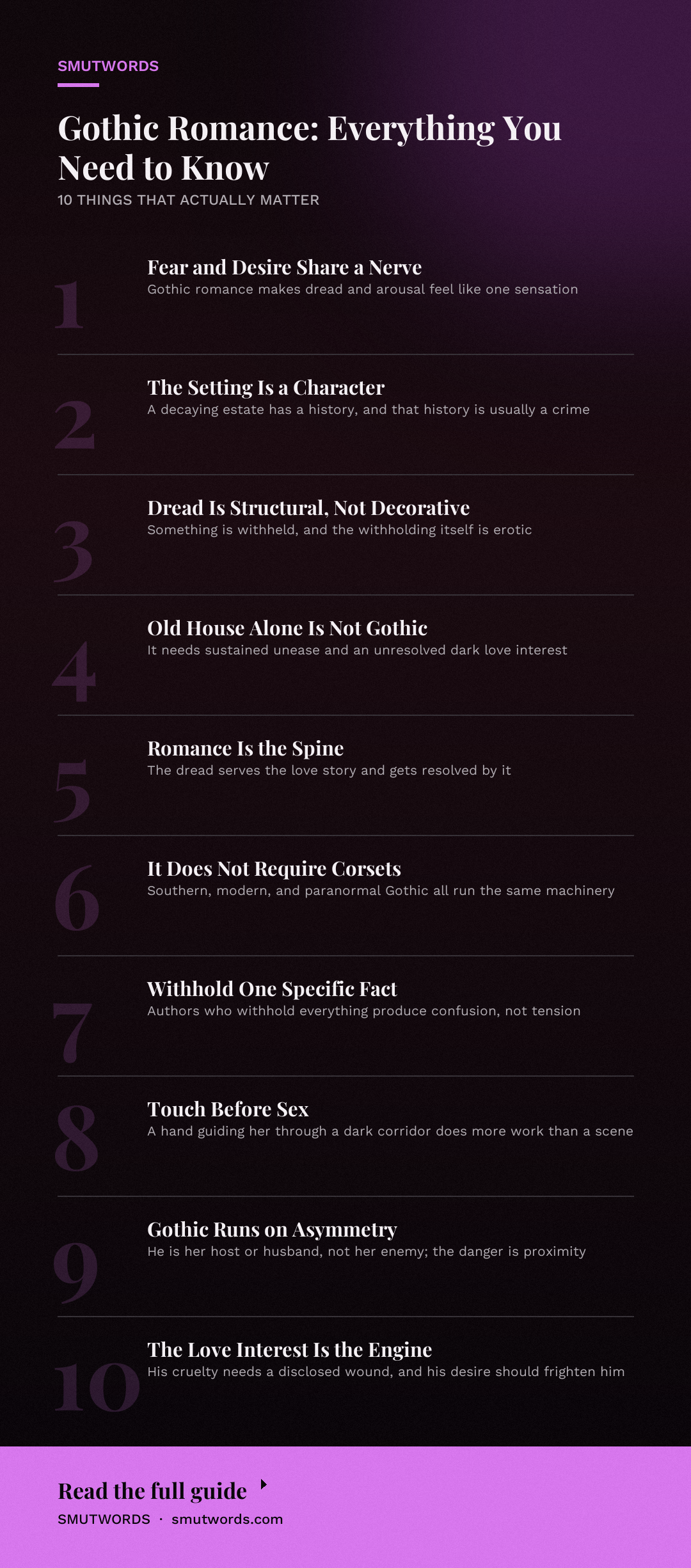
Gothic romance is the branch of erotic and romantic fiction where desire arrives wrapped in dread: crumbling estates, fog that swallows the road behind you, a love interest with a locked room and a reason to keep it locked, and the persistent suspicion that something in this house is wrong.
The genre's job is to make fear and arousal feel like the same sensation running through the same nerve. If you have ever finished a chapter unsure whether the hero was going to kiss the heroine or ruin her, you already know what gothic romance does better than any other mode in the genre.
This guide covers what the term actually means, where it came from in publishing, how authors build these books on the page, and how to tell a strong gothic from one that is only wearing the costume.
What Gothic Romance Actually Means
The name comes from the Goths, the Germanic tribes Rome spent centuries failing to subdue, and from the architectural style later named after them. Eighteenth-century critics used "Gothic" as an insult for anything medieval, barbaric, and excessive. Writers took the insult and ran with it. The castle, the abbey, the crypt, the ancestral manor: all of it signaled a story willing to traffic in superstition, violence, and appetite when polite literature was supposed to do none of those things.
Gothic romance keeps the architecture and adds a love story at the center. The setting is never wallpaper. A decaying estate is a character with a history, and that history is usually a crime. The love interest arrives already carrying guilt, secrets, or a family curse, and the protagonist's attraction to him is inseparable from her suspicion of him.
The dread in a gothic is structural, not decorative. Something is being withheld by someone, and the withholding itself is erotic. A locked wing. A name nobody says aloud. A first wife nobody will discuss.
The reader and the protagonist want in. The wanting is the plot.
What does not count matters just as much. A contemporary romance set in an old house is not automatically gothic. Neither is a paranormal romance with vampires and no atmosphere of menace. The gothic requires a sustained mood of unease and a love interest whose darkness is unresolved for most of the book.
If the dread evaporates by chapter five, you are reading a romance with a spooky cover.
Common misconceptions worth clearing up:
- That gothic means horror with a kiss. The romance is the spine, not the subplot. The dread serves the love story and gets resolved by it.
- That the love interest must be a villain. Brooding and dangerous, yes. Often morally compromised. Full villainy is a different shelf, closer to what you find in enemies to lovers territory.
- That it has to be historical. Victorian settings dominate the popular image, but Southern Gothic, modern Gothic, and paranormal Gothic all work the same machinery in different decades.
- That it has to be chaste. Historically, gothic novels were considered scandalous precisely because they let women want things. Modern gothic erotica is explicit and unbothered about it.
The short definition talks about atmosphere and dread intertwined with romance. The longer definition is about power: who holds the secret, who wants access, and what the protagonist is willing to risk to get it.
Where Gothic Romance Comes From
The genre's publishing history starts in 1764 with Horace Walpole's The Castle of Otranto, which pretended to be a medieval manuscript and fooled a chunk of its readership. Ann Radcliffe refined the formula in the 1790s with novels where the supernatural turns out to have a rational explanation and the heroine's terror is vindicated by plot. Her imitators went the other way and let the ghosts be real. Both branches still exist.
Jane Austen's Northanger Abbey, published in 1817, satirized the genre so effectively that readers have been arguing about it ever since.
By the time Jane Eyre landed in 1847, the template was fixed: orphaned or displaced heroine, isolated estate, brooding master with a secret, a woman in the attic, and a love that has to survive a moral catastrophe before it can be consummated. Wuthering Heights, published the same year, pushed the same ingredients toward obsession and cruelty and never really came back.
Bram Stoker's Dracula in 1897 folded the vampire into the gothic and made the monster a seducer with a formal address. That move is the reason paranormal Gothic exists as a category at all. The 20th century kept the furniture and changed the tenants: du Maurier's Rebecca in 1938 replaced the supernatural with psychological menace, and the second Mrs. de Winter has been standing in for every gothic heroine since.
The paperback boom of the 1960s and 70s turned gothic romance into a mass-market category with its own cover language: a woman in a nightgown fleeing a house, one lit window behind her. Those covers sold millions of copies and trained two generations of readers to expect exactly the ingredients this guide is describing. Kathleen Woodiwiss and the authors who followed her moved the genre's heat level up considerably, and the pendulum never swung back.
The last major shift is recent and ongoing. Paranormal Gothic absorbed the vampire, the ghost, and the fae and became one of the dominant branches of indie romance. Southern Gothic picked up the family curse and the small-town secret. And the "dark romance" boom of the 2010s borrowed the gothic's atmosphere wholesale while sometimes forgetting to bring the romance's resolution along with it.
If genuine history is thin anywhere, it is in the erotica side of the ledger. Explicit gothic has always existed, but it lived in small presses and imported paperbacks for most of the 20th century. What changed is that it stopped being a niche with its own covers and became a modifier that mainstream romance readers apply to books they were already buying.
How It Shows Up in Erotica
On the page, gothic romance is a slow-burn machine. The genre's core move is delaying physical consummation until the emotional stakes are unbearable, then paying off the delay hard. An author who puts the characters in bed in chapter three has to build the dread somewhere else, and most of the time it collapses.
What a strong gothic scene actually does:
- Uses setting as foreplay. A staircase, a guttering candle, a door that will not lock. The physical world keeps threatening exposure or offering privacy, often in the same paragraph.
- Withholds one specific fact. Great gothic romances are built around a single withheld piece of information the reader can feel the shape of. Authors who withhold everything produce confusion instead of tension.
- Leans on touch before sex. A hand at the small of the back guiding her through a dark corridor does more work than a full scene in a lesser book.
- Makes the love interest's desire feel dangerous to him. The best versions give the hero a reason to hold back that has nothing to do with propriety.
- Ends chapters on a threshold. A confession, a discovery, a door opening. The gothic chapter break is a cliff, not a pause.
Common variations authors use:
Victorian Gothic sets the story in the 19th century and uses the era's sexual double standard as fuel. The heroine is constrained by propriety and the hero is not, which is a power imbalance the genre either eroticizes or dismantles, sometimes both.
Southern Gothic trades the castle for the plantation house or the decaying family home and trades the ghost for the family's own buried crime. The heat in these books tends to be slower and the menace more social than supernatural.
Enjoyed this? Get a free book.
Join the list and we will send a complete free story straight to your inbox, plus new releases every week after that. No credit card, no catch.
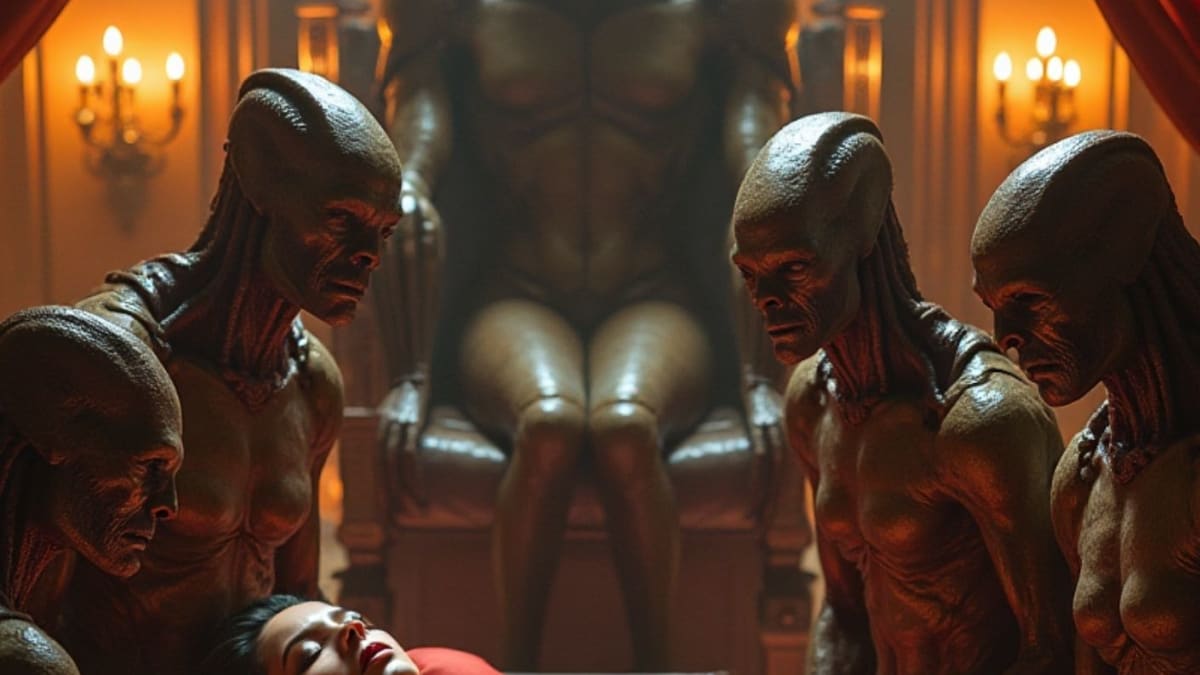
Paranormal Gothic makes the love interest literally inhuman: vampire, wraith, cursed immortal. This branch overlaps heavily with monster romance, though the gothic version usually keeps a human protagonist and a human-scale emotional problem underneath the fangs. Readers who like the inhuman-partner angle pushed even further should look at monster breeding romance, which takes the same "he is not like you" premise somewhere considerably wilder.
Gothic Erotica is the explicit end of the shelf. Same atmosphere, no fade to black, and often a willingness to let the power exchange be genuinely unequal for most of the book before it resolves. If the forbidden quality is what draws you, our guide to forbidden erotica maps the wider neighborhood this sits in. Office politics and holiday fake-dating run on very different engines, so don't expect those tropes to slot in here.
Gothic Horror Romance is the darkest variation, where the dread does not fully lift. These books are divisive for the same reason they are memorable: the happy ending, when it comes, costs something.
What separates a strong gothic from a flat one is almost always the love interest. A hero who is merely rude and handsome is furniture. A hero whose cruelty comes from a specific, disclosed wound, and whose desire for the protagonist frightens him, is the engine. This is why the trope pairs so naturally with a redemption arc romance: the gothic's whole structure is a man being dragged toward the possibility of being forgiven.
The flat version has other tells. Atmosphere described for paragraphs with no plot movement underneath. A heroine whose only trait is that she is curious. A mystery that turns out to be trivial.
A hero whose secret, once revealed, is not bad enough to justify three hundred pages of dread. And the most common failure of all: the author resolves the tension too early and then has nowhere to put the remaining hundred pages.
The strong version keeps four plates spinning at once: the mystery, the attraction, the external threat, and the protagonist's own reasons for staying when she should leave. Take any one away and the book deflates.
Worth noting how the gothic's atmosphere tools migrate into other subgenres. A remote cabin in the woods can carry the same isolation and menace as a manor house, which is part of why lumberjack romance reads as gothic-adjacent when it is written well. The machinery is portable. What matters is the withholding, the isolation, and the sense that the person you want is the person you should not trust.
Gothic Romance vs Enemies to Lovers
These two get confused constantly, and the confusion is worth clearing up because the fixes are different.
Enemies to lovers runs on active opposition. Two people on opposite sides of something, openly hostile, eventually discovering that the hostility is attraction. The conflict is between them and the reader can see both sides of it. For a full treatment, our enemies to lovers entry covers the mechanics.
Gothic romance runs on asymmetry. The love interest knows something the protagonist does not, and his power over her comes from that knowledge plus his position: master of the house, keeper of the estate, the man whose name is on the deed. He is not her enemy. He is her host, her employer, or her husband, and the danger is that he might be something worse.
You can absolutely have both. Plenty of gothic romances open with the characters as antagonists. But the gothic's specific charge comes from proximity and dependence, not from opposition. A protagonist who could simply walk out the front door is in a different book.
One more distinction worth making. Both tropes overlap with stalker romance in the "someone is watching" register, but the gothic watcher is usually watching from inside the house, and the protagonist often knows he is there. The dread comes from what he might do, not from his invisibility.
Frequently Asked Questions
Is gothic romance the same as dark romance?
They overlap but are not identical. Dark romance is defined by the moral darkness of the characters and often the absence of a conventional happy ending. Gothic romance is defined by atmosphere, isolation, and withheld information. A gothic romance can be light on the darkness scale and still be gothic; a dark romance can take place in a bright modern city and be nothing like it.
Do gothic romances have to be historical?
No. The Victorian setting is the most recognizable packaging, but Southern Gothic, modern Gothic, and paranormal Gothic all work. What the genre requires is isolation and dread, not corsets. Plenty of contemporary gothic romance takes place in a converted manor, a remote research station, or a small town where everyone knows something the protagonist does not.
What makes a good gothic love interest?
Specificity. A brooding man with no disclosed reason for brooding is boring by chapter four. The love interest needs a concrete history, a real reason to believe he is dangerous to the protagonist, and at least one moment where his control visibly slips. The secret does not have to be supernatural, but it has to be serious enough to justify the dread the book has been building.
Can gothic romance have a happy ending?
Yes, and most of the category does. The genre's tradition allows for endings where the mystery resolves, the threat lifts, and the couple survives together, though the cost is usually higher than in a standard romance. Gothic horror romance is the branch where that cost sometimes goes too far and the ending is bittersweet or worse.
How explicit does gothic erotica get?
As explicit as anything else in the genre. The gothic's historical reputation for restraint is a publishing accident, not a rule. Modern gothic erotica includes full explicit scenes, often with a power dynamic shaped by the same inequality that drives the plot. If you like the atmosphere but want the heat on the page rather than off it, you will find plenty.
What is the difference between gothic romance and paranormal romance?
Paranormal romance requires a non-human love interest, or at least a supernatural world, and the romance is usually about accepting that difference. Gothic romance requires a mood of menace and a withheld secret, and the supernatural element is optional. A book about a vampire in a modern apartment is paranormal. A book about a vampire in a crumbling estate who is hiding what he did to his last wife is both.
Final Thoughts
Gothic romance rewards patience more than any other branch of the genre. The books that do it well are not trying to get you to the sex scene fast. They are trying to make you suspicious of the person you are rooting for, and then make you want him anyway. That is a harder trick than it looks, and when it lands, nothing else in romance feels quite like it.
If you want a place to start, the ranked list below this article has our current picks from the catalog, sorted by how well each one handles the specific machinery described here. Start at the top. Read it with the lights low. Notice how long the author makes you wait, and notice that you are not impatient.






Loading comments…