Xenophilia is the attraction to what isn't human. In romance and erotica publishing, the word names an entire shelf of stories: a human protagonist falling for an alien, monster, orc, gargoyle, squid-headed god, or something the biology textbooks never got around to cataloging.
The word comes from the Greek xenos (stranger, foreigner) and philia (love). Its fictional form runs on one engine: desire that crosses a species line and has to figure out what to do about a body, a mind, and a lifespan that don't match your own. Xenophilia is one of the fastest-growing categories in self-published romance, and it's the rare kink where the emotional architecture matters as much as the anatomy.
What Xenophilia Actually Means
The short definition covers the basics: a plot centered on a human character's romantic or sexual attraction to a non-human entity, with the relationship exploring the emotional and physical differences between species. The longer version is about what those differences are for.
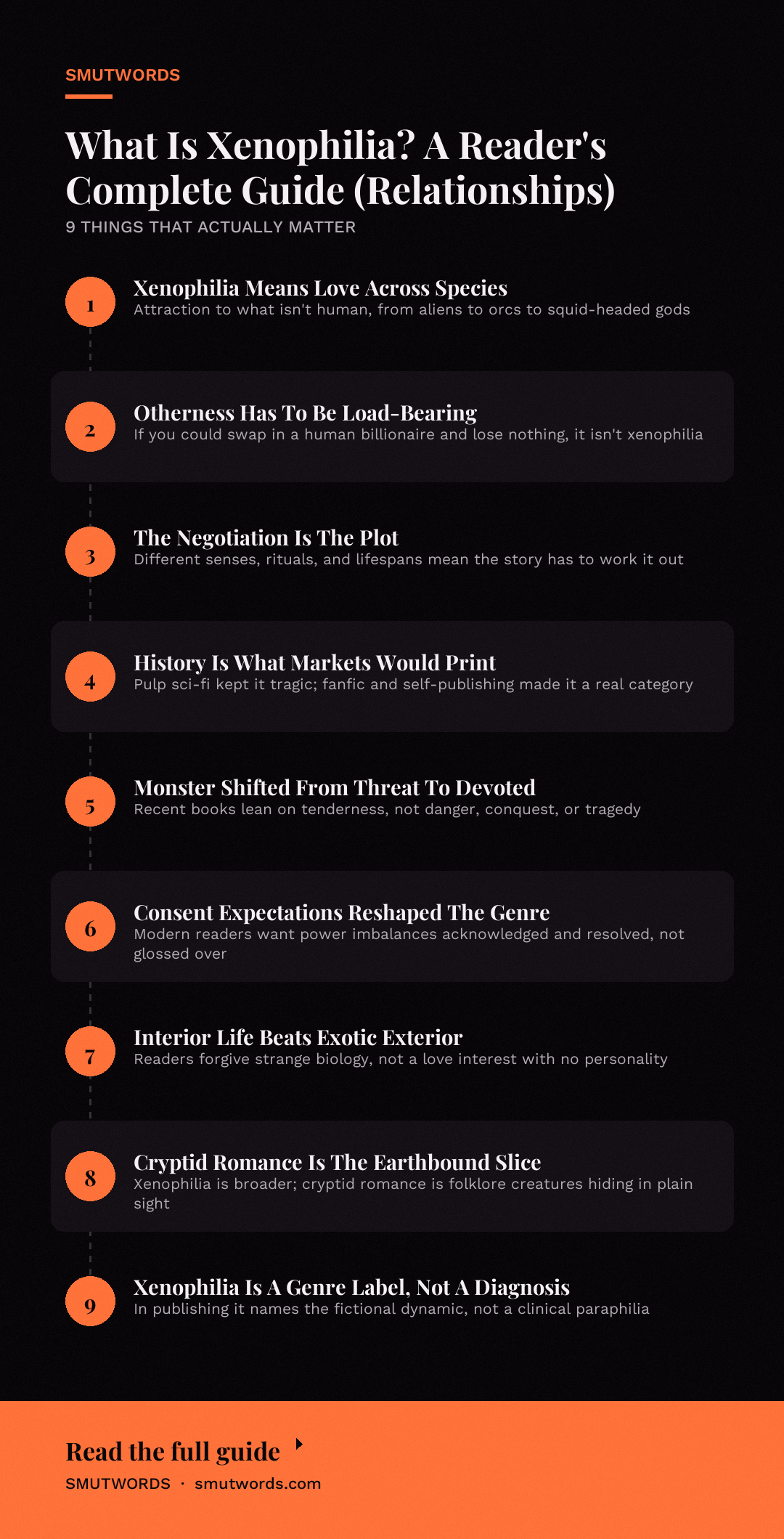
Xenophilia in fiction isn't just "person dates someone with tentacles." It's a structure where the non-human partner's otherness is load-bearing.
Their senses work differently. Their courtship rituals don't map onto dating. Their idea of commitment might involve a soulbond, a mating bite, a hive connection, or a contract written in a language the human can't read. The story has to negotiate all of it, and that negotiation is the plot.
What counts: alien romance, monster romance, tentacle erotica, orc romance, gargoyle romance, and the looser sci-fi paranormal romance umbrella. Anything where the non-human is genuinely non-human, not a hot guy with pointed ears who's basically a moody Mediterranean prince.
What doesn't count, or counts only at the edges: shifter romance where the love interest spends 90% of the book in human form and the animal side is flavor text. Vampire romance where the vampire is a pale aristocrat with a blood kink. Those are adjacent, and plenty of readers happily cross-shop, but they aren't doing the xenophilia work.
The most common misconception is that xenophilia is inherently a monster-fucking fetish with no interior life. The best-selling books in the category are slow-burn emotional stories where the physical foreignness is one facet of a much larger question: can you love someone whose mind you can't fully read?
Another misconception: that "non-human" automatically means "dominant, aggressive, animalistic." Some of the most popular xenophilia love interests are gentle, formal, obsessively devoted, and emotionally articulate in ways human love interests rarely get to be. The alienness sometimes makes a character softer, because the author isn't bound by the tropes of how a human man is supposed to behave in a romance.
Where Xenophilia Comes From
Humans have been writing about wanting things that aren't human for as long as we've been writing. Zeus shows up as a swan, a bull, and a shower of gold. Medieval bestiaries are full of creatures someone, somewhere, was clearly into. But xenophilia as a recognizable publishing category is much younger, and its history is really a history of what the market would let authors print.
In the 20th century, the genre lived in the margins. Pulp sci-fi magazines ran stories about human women and alien men as early as the 1930s, usually with a tragic ending or a heavy dose of horror. A happy interspecies romance was considered either ridiculous or obscene, depending on the decade.
The 1960s and 70s loosened that somewhat, and the rise of fan fiction in the 70s and 80s gave writers a place to explore alien-human pairings with real emotional weight, no publisher gatekeeping required.
The internet changed everything. LiveJournal, then Tumblr, then dedicated fanfic archives turned alien romance into a thriving subculture, and by the 2010s, self-publishing had made it a genuine commercial category. Authors writing tentacle erotica or orc romance could sell directly to readers who wanted exactly that, no agent explaining to a marketing team why the love interest has four arms.
The biggest single shift in the last decade is the pivot from "monster as threat" to "monster as devoted partner." Early xenophilia leaned on danger, conquest, and often tragedy. Contemporary monster romance leans on tenderness, hyper-competence, and a love interest who is almost pathologically committed. The alien or monster isn't there to destroy the heroine. He's there to worship her, and the tension comes from whether she can accept what he is.
The other major evolution: reader expectations around consent, communication, and emotional labor have reshaped the category. A 1980s alien abduction story and a 2024 alien abduction story are doing very different things with the same premise. Modern xenophilia readers want the power imbalance acknowledged, negotiated, and resolved, not glossed over.
How It Shows Up in Erotica
This is where the category gets interesting to write about, because xenophilia has a specific craft problem: the reader has never met this species, so the author has to build it, sell it, and make it hot, all inside a romance arc that still has to function as a romance arc. Authors who nail this are doing some of the hardest technical work in the genre.
Here are the common structural moves you'll see across the category:
- The translation scene. The human and non-human partner have to figure out how to communicate at all, often through a linguistic gap, a telepathic bond, or plain stubbornness. The awkwardness is genuine chemistry material.
- The anatomy negotiation. The non-human body is different enough that sex has to be discussed, planned, or discovered together. This is where physical foreignness becomes genuinely erotic instead of just weird.
- The cultural mismatch. Non-human courtship rituals that read as alarming or romantic, depending on who's watching. A mating display. A gift of carved bone. A nest.
- The lifespan problem. One partner will outlive the other. Some books solve it with bonding magic, some refuse to solve it and make the ache part of the love story.
- The "what am I now" arc. The human protagonist has to reconsider their own identity, sometimes physically, sometimes just in terms of what they're willing to want.
The strongest versions of xenophilia do something a human romance can't do: they make desire itself a cross-cultural project. Every touch has to be earned. Every gesture means something slightly different than the human assumes. That produces a particular kind of tension, and it's why the slow burn in monster romance often hits harder than in a contemporary romance where both characters share every default.
The weakest versions use the non-human partner as a costume. You could swap in a brooding human billionaire and lose nothing. When xenophilia fails, it fails because the alienness is decoration rather than engine.
The other thing that separates good xenophilia from filler: the non-human partner has to have a coherent interior life, not just an exotic exterior. Readers in this category are remarkably forgiving about biology and remarkably unforgiving about a love interest with no personality beyond "protective and possessive."
Enjoyed this? Get a free book.
Join the list and we will send a complete free story straight to your inbox, plus new releases every week after that. No credit card, no catch.
Physical foreignness often gets written through a size-difference and sensory-difference lens, and authors who want to sharpen their handling of those elements can look at how size difference romance handles scale and contrast, and how sensory play techniques (focus on unfamiliar textures, temperatures, rhythms) translate when the partner's senses aren't calibrated like a human's.
Category variants you'll run into, roughly in order of how often you'll trip over them:
- Alien romance. Spacefaring love interests, usually humanoid-adjacent, often with a crashed-ship or abduction premise. Big overlap with sci-fi romance.
- Monster romance. Broad tent covering orcs, minotaurs, gargoyles, demons, trolls, and anything with a body that doesn't fit a human silhouette. See also cryptid romance for the Sasquatch-and-Mothman end of the shelf.
- Tentacle erotica. A specific and very popular subgenre, often with consensual framing and an emphasis on sensation rather than penetration as the only goal.
- Orc romance. Currently one of the hottest micro-categories. Typically high heat, strong communication, unusually respectful love interests for characters who look terrifying.
- Fae, elf, and angel romance. Non-human in a more ethereal register. See fae romance, elf romance, and angel romance for the subcategory conventions.
- Merman and aquatic romance. See merman romance for the deeply specific pleasures of this one.
- AI and synthetic romance. Android, robot, and digital love interests. See AI romance for the consent and personhood questions this variant raises.
- Dinosaur and prehistoric romance. Smaller but vocal readership. The dinosaur romance glossary entry covers the conventions.
One craft note that applies across all of them: the more physically alien the love interest, the more the author needs the emotional register to stay recognizable. Readers will accept a four-armed squid alien with a breeding kink. They will not accept a protagonist who has no reaction to discovering her partner can breathe underwater.
When xenophilia explores group structures (hives, packs, found families, or a human integrating into a non-human social unit), authors often borrow from polyamory and pack mates romance conventions to build the logistics. That's where pack dynamics as a category and xenophilia overlap most cleanly, and where a lot of the best long-form series live.
If you're writing in this category and want to nail the tenderness-and-power balance, the praise kink vs degradation kink breakdown is worth reading next, because xenophilia love interests tend to deliver one or the other with unusual intensity.
Xenophilia vs Cryptid Romance
The most common confusion in this corner of the catalog is where xenophilia stops and cryptid romance begins, so it's worth drawing the line.
Cryptid romance is about creatures that exist within a recognizable Earth folklore or conspiracy framework: Bigfoot, the Mothman, the Loch Ness Monster, skinwalkers, and their cousins. The world the story takes place in is functionally our world, or a version of it, and the cryptid is a secret hiding in plain sight.
Xenophilia is broader. It includes cryptids, but it also includes aliens, interdimensional beings, gods, and monsters that exist entirely outside any real-world folklore tradition. The defining test isn't origin, it's whether the non-human partner's otherness shapes the entire romance.
A Bigfoot romance is cryptid romance. A Bigfoot romance where the plot hinges on the heroine learning his species' mating customs and choosing to stay in the woods forever is both, and leans xenophilia. The categories nest rather than collide.
Same logic applies to hybrid shifter romance. If the shifter is half-something-or-other but functionally a human man with a wolf inside, it sits at the shifter end of the shelf. If the "hybrid" part is doing genuine cross-species negotiation work, it's leaning xenophilia. Read enough of both and the distinction becomes instinctive.
Frequently Asked Questions
Is xenophilia the same as monster romance?
Monster romance is the biggest subcategory inside xenophilia, but it isn't the whole thing. Alien romance, AI romance, and some fae romance count as xenophilia without featuring anything most readers would call a monster. Xenophilia names the attraction to the non-human more broadly; monster romance names a specific and very popular slice of it.
Is xenophilia a real paraphilia or just a fictional trope?
In clinical contexts, xenophilia is sometimes used loosely to describe attraction to strangers or foreigners. In romance publishing, it's a genre label. The two uses are related by etymology only. When SmutWords says xenophilia, we mean the fictional dynamic, not a diagnosis.
Why is xenophilia so popular right now?
Several things converged. Self-publishing removed the gatekeeping that used to keep non-human love interests out of mainstream romance. Reader communities on social platforms made the category discoverable. And the specific emotional register of the genre, intensely devoted partners with zero of the usual human baggage, appeals to readers who are tired of contemporary romance's familiar conflicts.
What's the difference between alien romance and sci-fi romance?
Sci-fi romance is a broader genre label covering any romance set in a science-fiction framework, including human-human couples on spaceships. Alien romance is specifically about a human and a non-human partner. All alien romance is technically sci-fi romance, but plenty of sci-fi romance has no xenophilia in it at all.
Does xenophilia always involve non-human anatomy during sex?
No, and that's a common reader complaint on both sides. Some books lean hard into anatomical difference. Others keep the physical side more human-compatible and put the foreignness in the emotional, cultural, or sensory layer instead. Both approaches work; what matters is that the otherness is doing real work in the story.
Where should a reader new to xenophilia start?
Start with the variant you're most curious about. Lighter orc romance is a gentle entry point if you want high heat with very human-feeling emotional beats. Alien romance is the best on-ramp if you want the classic stranger-in-a-strange-land structure. Cryptid romance is the coziest, most Earthbound version.
Final Thoughts
Xenophilia is the rare genre that lets a writer ask the biggest question romance has ("can I be loved, fully, as I am?") while also asking a weirder one ("what if 'as I am' means tentacles?"). The books that do it well stay with readers for years, and the category is deep enough now that there's a version of it for nearly every taste.
If you want one place to start and you like your monster romance with real emotional weight and a love interest who takes communication seriously, the ranked list below is the right next stop. Pick something with a cover that makes you a little nervous. That's usually the one.






Loading comments…