
Fake dating is the romance trope where two people agree to pose as a couple for an audience: a wedding, a family dinner, a press tour, a green card interview. Then they spend the rest of the book failing to remember that none of it is supposed to be real. The agreement is always temporary. The feelings never are.
That gap between the performance and the truth underneath it is the entire engine. It is why fake dating has become one of the most reliably requested setups in contemporary romance and erotic romance alike.
Everyone involved knows the rules going in. Nobody expects to break them. The breaking is the book.
What Fake Dating Actually Means
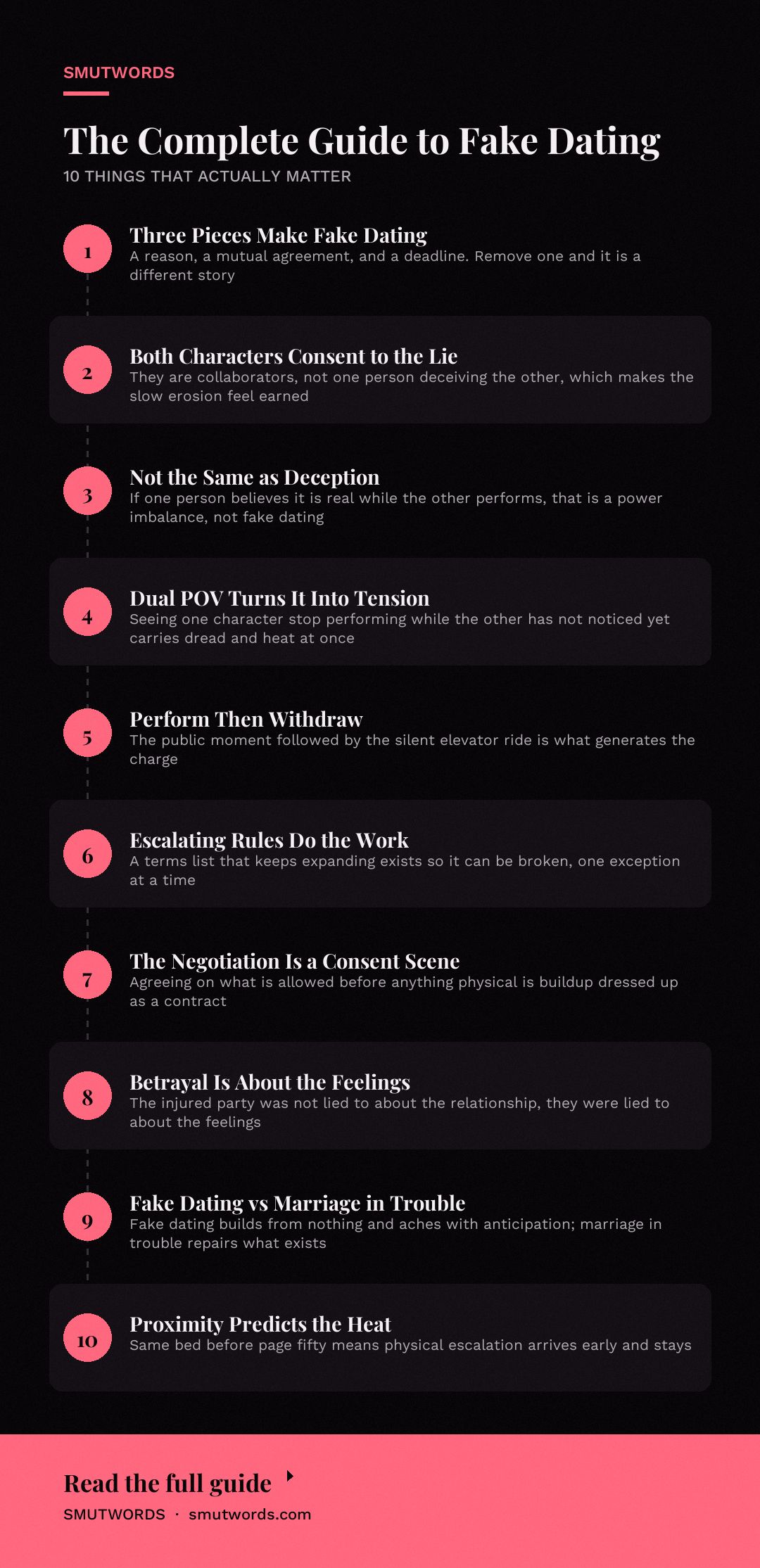
At its core, fake dating requires three fixed pieces: a stated reason the performance is necessary, a mutual agreement with terms, and a ticking clock that promises the arrangement will end. Remove any one of those and you have a different story. The reason creates the stakes, the agreement creates the shared secret between the two leads, and the deadline creates urgency.
What separates fake dating from a simple lie is participation. Both characters consent to the deception. They are collaborators, not one person deceiving the other, and that mutual buy-in is what makes the slow erosion of the pretense feel earned instead of manipulative.
The term covers a wide spectrum of commitments. At the lighter end you have a single evening of hand-holding at a work event. At the heavier end you get a full fake marriage with shared rent, a joint bank account, and a lease.
Some books stretch the fake relationship across months. Others compress it into one charged weekend.
What does not count matters just as much. A character who genuinely believes the relationship is real while the other person is performing is not fake dating; that is deception with a power imbalance, and readers respond to it very differently. A couple who agrees to date publicly while secretly sleeping together without romantic attachment is closer to a friends-with-benefits arrangement with a publicist.
And a marriage of convenience between two people who never pretended to be in love is its own separate tradition with its own emotional logic.
The common misconception is that fake dating is a comedy device. It can be, and plenty of the funniest examples lean hard into the farce. But the reason the trope keeps working past the joke is that pretending to want someone on purpose forces a character to notice what real wanting feels like when it arrives.
Where Fake Dating Comes From
The trope has roots in stage comedy and in the marriage-of-convenience tradition that runs through eighteenth and nineteenth century fiction, where two people marry for money, title, or protection and the affection arrives afterward. The specific modern shape, two unattached people performing coupledom for a social or professional audience, took hold in twentieth century film comedy before romance publishing made it a permanent fixture.
For most of its early publishing life, fake dating lived inside category romance, the shorter mass-market lines where a premise had to be legible from the back cover. The fake engagement to appease a grandmother. The fake boyfriend brought home for Thanksgiving. These books used the trope as a clock, a container for banter that had to resolve into sincerity by the final chapter.
Two shifts changed how the trope reads now. First, the rise of first-person dual point of view let authors sit inside both characters' heads at once, which turned fake dating into a tension machine. When you can see that one of them has stopped performing and the other has not noticed yet, every scene carries dread and heat at the same time.
Second, the publicity angle arrived. Fake dating got grafted onto celebrity romance and rockstar romance, where a publicist arranges a relationship to cover a scandal or sell an album, and the modern fake dating boom is inseparable from that career-driven version. The audience is not just a family anymore. It is the internet, and it never stops watching.
The genre has also gotten more honest about the physical stakes. Older versions kept the bedroom door firmly closed during the arrangement. Contemporary erotic romance routinely puts the characters in the same bed, the same hotel room, the same cramped apartment, and uses proximity as the accelerant.
The agreement says hands off. The sleeping arrangement says good luck with that.
How It Shows Up in Erotica
The craft problem with fake dating is that the reader already knows the ending. Two people will fall for each other. So the work is not suspense about whether, it is suspense about when and how badly it will hurt on the way there. Everything an author does on the page has to serve that.
Strong fake dating scenes share a structure. There is a public moment where the performance is required, then a private moment immediately after where the performance stops and the character has to sit with what just happened. The hand on the lower back at the party. The elevator ride up afterward where neither of them says anything.
That rhythm, perform then withdraw, is what generates the charge.
Weak versions skip the withdrawal. The characters perform and then immediately acknowledge their feelings out loud, which kills the pressure. The whole pleasure of the trope comes from watching someone refuse to name what they are feeling while their body keeps answering the question for them.
Enjoyed this? Get a free book.
Join the list and we will send a complete free story straight to your inbox, plus new releases every week after that. No credit card, no catch.
Authors get a lot of mileage out of escalating the terms of the agreement. A list of rules that starts modest and keeps expanding is one of the most effective devices in the trope. Here is how that usually unfolds:
- Physical contact clauses. Holding hands is fine, arms around shoulders are fine, kissing is only for when someone is watching. The list exists so it can be broken, and every exception gets negotiated in a doorway.
- Backstory briefings. They have to learn each other's childhood, allergies, first heartbreak, and worst habit well enough to perform convincingly to a mother or a reporter. That forced intimacy does more work than any kiss.
- Rehearsal. Practicing a kiss for the sake of realism, which is never about realism. The rehearsal scene is where most fake dating books put their first genuinely charged sexual beat, and the reason it lands is that both characters can tell themselves it was a technique question.
- The overnight. One bed, a hotel with a booking error, a guest room that does not exist. Physical proximity during sleep strips the performance away and leaves two people who cannot pretend they are only doing this for an audience.
- The public declaration that goes too far. One of them says something true in front of the crowd, off script, and now the lie has a witness who believed it.
The tension often borrows from other tropes without becoming them. A fake dating arrangement between two people who openly dislike each other reads as hate to love with a shared alibi, and the animosity becomes foreplay. A fake engagement between two people who grew up next door and never dated leans on childhood friends to lovers, where the performance is only a confession the characters are too scared to make honestly.
If you want to see how far the shared-alibi version can be pushed, the stag and vixen dynamic runs on a similar premise: two people performing a role for an audience until the role stops being a performance.
One of the more overlooked strengths of the trope is its negotiation scenes. Before anything physical happens, the two leads have to sit down and agree on what is allowed. That conversation is a consent scene dressed up as a contract, and authors who write it well get a full chapter of buildup out of a discussion about whether kissing is on the table.
Readers who respond to explicit, spoken-out-loud terms tend to respond to the whole trope, and the vocabulary overlaps heavily with what draws people to praise kink and degradation kink: the pleasure of a boundary named out loud right before it is crossed.
Hurt lands differently here too. When the arrangement is exposed, or when one character overhears the other call it fake, the betrayal has a specific flavor. The injured party was not lied to about the relationship, they were lied to about the feelings, which is worse. A good fake dating book earns its third act breakup by making the misunderstanding genuinely ambiguous rather than a phone call that could be cleared up in one sentence.
Heat level varies enormously across the trope, and readers should expect that going in. Some fake dating books are fully chaste and rely on glances and accidental touches. Others put the first sex scene squarely in the middle of the arrangement and use the "this is still just for show" lie as dirty talk.
The one reliable predictor is proximity. If the author puts the characters in the same bed before page fifty, expect the physical escalation to arrive early and stay.
Fake Dating vs Marriage in Trouble
These two get compared because both involve a relationship with a contract attached, and the confusion is worth clearing up because they deliver opposite emotional arcs.
Fake dating starts with no real relationship and builds one. The couple is pretending, the feelings are new, and the story runs forward from a false beginning toward a true ending. Marriage in trouble starts with a real marriage in genuine crisis, and the arc runs backward before it can run forward: repair after damage, not construction from nothing.
The practical difference for a reader is where the ache sits. Fake dating aches with anticipation, the almost. Marriage in trouble aches with grief, the already-had and possibly lost.
If you want the slow burn of two people learning each other under a deadline, reach for fake dating. If you want two people who already know each other's worst and have to decide whether to keep going, that is a different shelf.
Frequently Asked Questions
Is fake dating the same as a marriage of convenience?
No, though they overlap. A marriage of convenience involves a legal commitment made for practical reasons, and the couple usually is not pretending to be in love for an audience. Fake dating is a performance aimed at other people, and the commitment is emotional rather than legal, unless the book adds a fake engagement or fake wedding on top of it.
Why is fake dating so popular in romance?
It manufactures forced proximity and emotional deception at the same time. The characters have to spend time together, touch each other, and lie about why, which creates constant tension between what they are doing and what they are admitting. Readers get the slow burn of a real relationship built under artificial conditions.
How long does a fake dating arrangement usually last in a book?
Most run between a few weeks and a few months of story time, anchored to a wedding, a family visit, a press cycle, or a visa deadline. The end date is a structural necessity, since the characters need a defined moment when the arrangement is supposed to end so the author can complicate what happens when neither of them wants it to.
Can fake dating be dark or is it always a comedy?
It skews lighter than most tropes, but dark versions exist. Make the stakes financial, immigration-related, or tied to keeping custody of a child, and the performance carries real consequences. Darker fake dating usually pairs with a colder hero or a redemption arc for the character who proposed the arrangement in the first place.
What is the difference between fake dating and fake engagement?
Scale and stakes. Fake dating is the umbrella term and covers anything from one dinner to a full season of public appearances. Fake engagement adds a ring, a family announcement, and usually a wedding date on the calendar, which raises the pressure and makes the eventual fallout harder to walk back.
Does fake dating always end with the characters together?
In romance publishing, essentially always, because a genre romance requires the couple to be together and stable at the end. What varies is the cost of getting there. The best versions make the third act feel genuinely uncertain even when the reader knows the rule.
Final Thoughts
Fake dating works because it forces characters to act like they are in love before they have permission to feel it, and the friction between those two things is where all the heat lives. Pick up any book where the terms of the arrangement get renegotiated every fifty pages and you will see the machinery running at full speed.






Loading comments…