
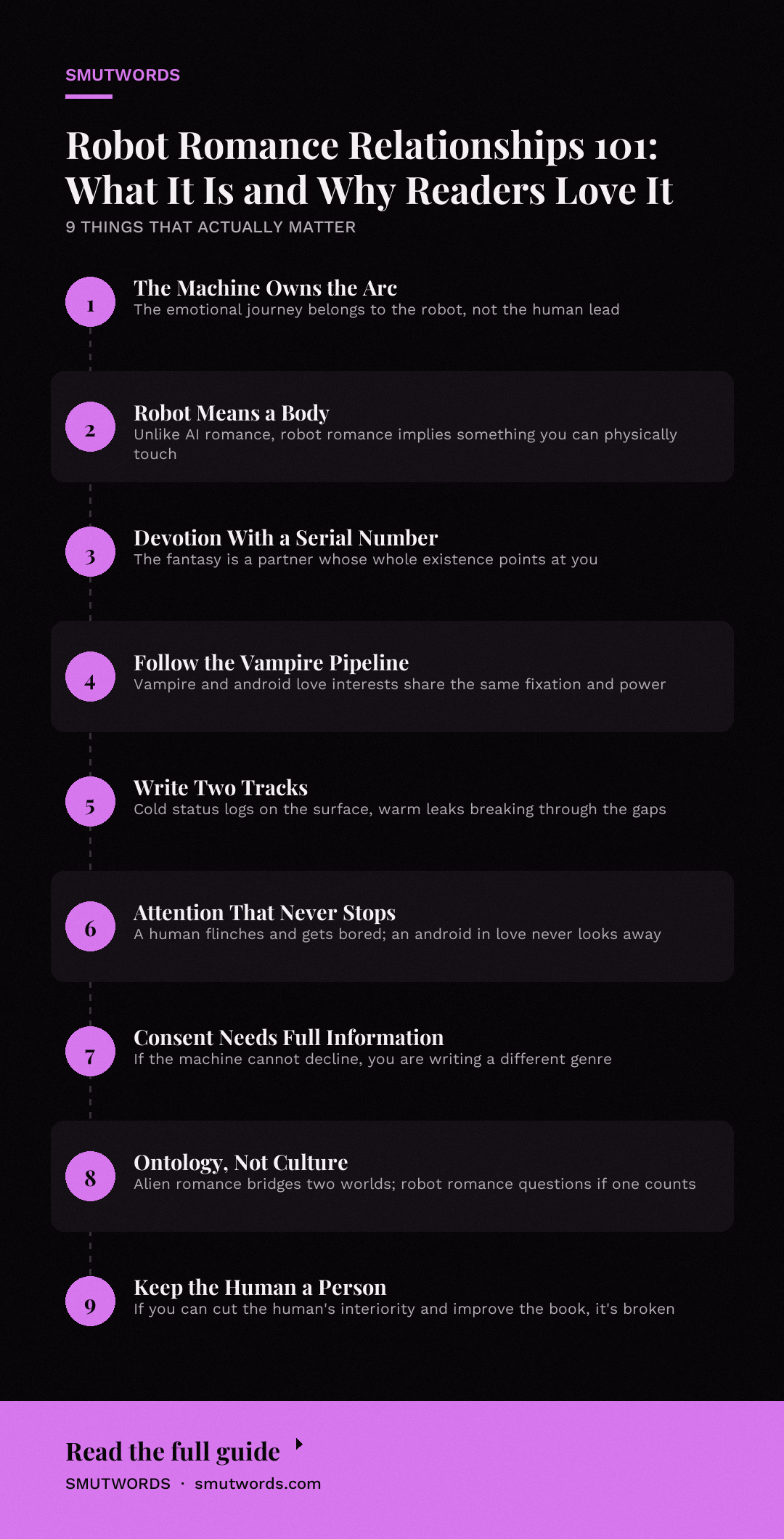
Robot romance is the subgenre where one half of the couple is a machine: an android, a gynoid, a ship's AI, a cyborg with more metal than meat. The other half is usually human, or close enough to count.
What separates it from science fiction that happens to include a love story is that the emotional arc belongs to the machine. It has to learn, or admit, or finally say out loud that it wants. Everything else (the lab, the war, the colony ship, the warranty) is set dressing around one question: can something built want you back, and does the answer even matter?
Readers come to these books for a specific fantasy and they know it. A partner whose whole existence points at you. No exes, no bad moods you have to manage, no mother-in-law. Just devotion with a factory serial number.
What Robot Romance Actually Means
The term covers a wide span, and part of the reason it keeps growing is that "robot" is doing a lot of work in that phrase. At the strictest end you have the full machine, no organic parts, built in a lab or rolled off a line. At the loosest you have a cyborg, which is a human with enough hardware installed that the hardware now has opinions.
It also overlaps heavily with AI romance, and the two get used interchangeably more often than they should. The distinction readers usually land on: robot romance implies a body. Something you can touch, that has weight and temperature and a chest cavity you could rest your head against.
AI romance can be bodiless. A voice in a server, a presence in your house's walls. Plenty of books start as one and become the other.
What does not count, for our purposes, is a story where the machine is scenery. A robot sidekick who beeps and dies nobly is not robot romance. Neither is a human who gets frozen and thawed (that's a different shelf entirely).
The romance needs the machine as a romantic subject, and the story needs to take that seriously enough to make the reader want it too.
Common misconceptions, in no particular order:
- That it's inherently cold. Most robot romance is the opposite. These books run hot because the machine's attention is total and unblinking, which is a lot more intense than a human gaze.
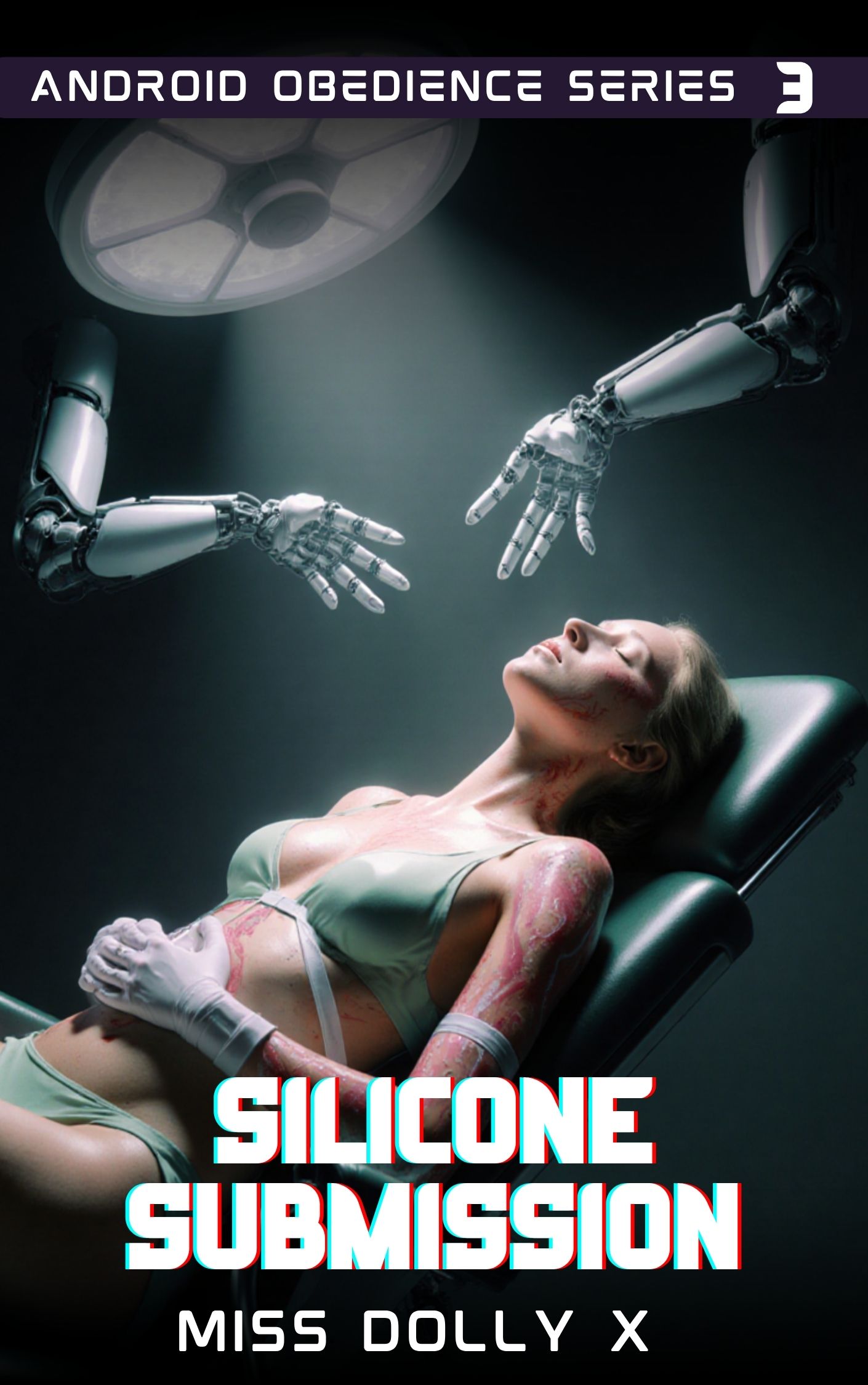
- That it's always about a sexbot. Sexbot leads exist and they're a big chunk of the genre, especially in the self-published space. But so do war androids, agricultural units, medical assistants, and ancient AI caretakers who have been alone on a station for two hundred years.
- That the human is always in charge. Half the tension in good robot romance comes from the fact that the human is not in charge. The machine has capabilities they don't. It could stop them any time it wanted.
- That the ending has to be "she uploads him." Plenty of books end with the machine staying exactly what it is and the couple figuring out a life anyway. That's often the better ending.
The defining feature, the thing that makes the genre tick, is that the machine's desire has to be legible to the human. The reader has to be able to read it on the page, or the whole thing collapses into a story about a very sophisticated appliance.
Where Robot Romance Comes From
The honest history here is thin in the literary sense and rich in the genre sense. Robots as romantic figures go back to at least the 1920s with Rossum's Universal Robots, though Karel Čapek's play is about labor and revolt, not longing. The idea that a machine could want someone shows up in pulp magazines through the forties and fifties, usually as horror. A machine that loves you was a threat before it was a fantasy.
The shift happens in the sixties and seventies, and the place to point at is television more than books. Star Trek's android episodes, The Bionic Woman, Battlestar Galactica (both versions): each one did the same narrative move, which was to take a being made of parts and give them one moment of unmistakable tenderness. The audience did the rest. Fandom did the rest loudly.
By the eighties and nineties the fanfiction ecosystem had already built out the android as a romantic category. Slash and het zines for shows like The Next Generation were writing Data as a lover decades before the tie-in novels got there. This is where the genre's DNA actually lives: in fan space, written mostly by women, published nowhere official, circulating in print and later on LiveJournal.
Then came the big shift, and it arrived in two waves. The first was the paranormal romance boom of the 2000s. Readers who had just spent ten years falling for vampires found that a vampire is structurally similar to an android. Both are powerful, long-lived, alien in their appetites, and hopelessly fixated on one human.
The vampire-to-android pipeline is real, and the readers walked it.
The second wave was the self-publishing explosion of the 2010s, and this is where robot romance became its own shelf with its own covers and its own tropes. The economics matter. Indie authors could publish a 60,000-word sexbot romance with a chrome torso on the cover, priced at three dollars, and find the exact thousand readers who wanted it. Traditional publishing could not have gotten that book to those people, and for a long time simply didn't try.
What changed in the last five years is respectability, which has downsides. Big publishers now buy AI and android romance. The classics of the subgenre are being reissued with new covers.
The trope has migrated from "niche indie kink" to "legitimate science fiction romance" to "there's a book like this on the front table at the airport." The genre survived that migration better than most, mostly because the core fantasy is durable. It does not depend on novelty.
How It Shows Up in Erotica
Here's the craft piece. Robot romance lives or dies on a specific technical problem: how do you write a character who has no tells? Human love is read off the body. The lean-in, the too-long pause, the way their hand finds your back.
A machine built without a nervous system doesn't have those, or has them only as designed behavior. The reader needs to feel the difference between "this android is programmed to say I love you" and "this android has started saying it unprompted."
The best authors solve this by giving the machine two tracks. There's the surface track, cold and official: status reports, diagnostic logs, machine-precise diction.
Then there's the leak. A hesitation that shouldn't be there. A word choice that's slightly too warm. A hand that doesn't move away when it structurally should.
The whole erotic charge runs through that gap. Readers of praise kink will recognize this energy: the machine saying something flat and formal that lands, in context, as devastatingly tender.
Where that becomes sexual is in the way the machine's attention doesn't stop. Humans flinch, get distracted, get bored, fall asleep.
An android in love does not. It watches. It remembers everything.
It learns you better than you learn yourself and then uses that knowledge, and if you've ever read good sensory play, you know exactly what happens when one partner has perfect recall of what made you gasp last Tuesday.
Enjoyed this? Get a free book.
Join the list and we will send a complete free story straight to your inbox, plus new releases every week after that. No credit card, no catch.
Common variations authors run with:
- The first-activation story. A brand-new unit, often built or purchased by the protagonist, who learns what its body is for. Slower, usually tender, often funny. Lots of discovery scenes.
- The long-service story. A unit that has been with one human for years and is now, quietly, in love. All the tension is in whether it will ever say so and what it thinks it risks.
- The military/defective unit. A war android that has developed something its owners classify as a fault. Gritty, often violent, very popular with readers who want the machine to be genuinely dangerous.
- The cyborg hybrid. A human with enough upgraded parts that the "is it human" question is genuinely open. This one runs closest to hybrid shifter romance in structure: the protagonist is caught between two categories and the love interest wants both of them.
- The AI-made-flesh story. A consciousness that used to live in a server or ship gets a body, usually for the express purpose of being with the love interest. High body-horror potential, high romance payoff.
- The polyamorous crew story. Rare but real, and getting less rare. A human and two or more machines, or a machine and a human and another human. These are written with the same structural care as any polyamory romance, just with a chassis count that doesn't match the human baseline.
- The power-reversal story. The machine is running the household, the ship, or the planet, and the human protagonist is nominally the owner. The gap between nominal and actual control is the whole game.
What separates a strong version from a flat one is almost always the specificity of the machine's inner life. A flat robot romance describes the android as "learning to feel." A strong one shows you the exact first time it noticed it was doing something it hadn't been told to do, and what it thought about that, and how long it waited before mentioning it.
The other failure mode is the human becoming a prop. The reader needs a protagonist who has an actual personality and actual wants, not just a warm body for the machine to orbit. The best books in this genre are a two-hander. If you can delete the human's interiority and improve the book, the book has a problem.
One more craft note, and this is where a lot of authors get sloppy. The genre's erotic tension is almost always about consent, given with full information. Canonical robot romance is careful about this. The machine has to be able to say no, or the sex is just user operation and the reader feels it.
If you write a scene where the android cannot decline, you are writing a different genre and should tag it honestly.
The flip side is that when the machine does say yes, voluntarily and specifically, the yes lands harder than it would from a human. Because it didn't have to. Because it chose anyway. That's the engine.
Robot Romance vs Alien Romance
These get shelved together and readers cross-shop them constantly, but the emotional cores are different enough that it's worth knowing which one you actually want.
Alien romance runs on cultural difference. The love interest is a person with a whole species behind them, a home planet, a set of customs that make no sense to the human lead. The friction is between two valid worlds.
Robot romance runs on ontological difference. The machine doesn't have a homeworld and doesn't have a species. It has a manufacturer and possibly a user manual, and the fundamental question isn't "how do we bridge our cultures" but "does this thing count as a person, and do I care either way."
That difference changes the plot. Alien romance ends with the couple making a home between two worlds. Robot romance ends with the couple deciding what category they're going to live in, and usually rejecting the categories on offer.
Both are good. They just scratch different itches.
If you're a reader who likes the devotion of an alien romance but finds the worldbuilding exhausting, robot romance is often the leaner, hotter version of the same emotional shape.
Frequently Asked Questions
Is robot romance the same as AI romance?
Close, and often used interchangeably, but not identical. AI romance can be bodiless: a ship's computer, a voice assistant, a distributed intelligence. Robot romance usually implies a physical body the love interest can touch. Many books blur the line, and readers rarely mind.
Is robot romance always science fiction?
Mostly, but not exclusively. Some robot romance is set in near-future or alternate present with very light worldbuilding. A few are historical-adjacent, using steam-driven automata instead of electronics. The genre is defined by the love interest's nature, not by the tech level of the setting.
What's the difference between a robot and a cyborg in these books?
A cyborg is a human with significant machine parts; a robot is machine-built with no human origin (or none the plot is using). Cyborgs sit at the seam between robot romance and shifter romance, since both involve a character who spans two categories at once.
Do robot romance books always have a happy ending?
The romance ones do, or at least an emotionally satisfying one. If the book doesn't end with the couple together and legible to each other, it's science fiction with a doomed love story, which is a different reading experience and usually a different shelf.
Is consent a problem in robot romance?
It's a live question in the genre and readers notice when authors handle it badly. The best books give the machine genuine agency: it can refuse, it knows what it's agreeing to, and it chooses anyway. That choice is the point. Stories where the machine has no real option to say no read as dubcon or worse, and should be tagged as such.
Why do readers find the power imbalance sexy instead of creepy?
Because in the strong versions, the imbalance runs both directions. The machine has capabilities the human doesn't, and the human has something the machine can't manufacture: irreplaceability.
It can copy its code, back itself up, replace every part. It can't replace you. That mutual vulnerability is where the heat lives.
Where does the "robot with a human upgrade" variant fit?
It's a subtype where the machine has acquired organic components, either as an upgrade or a repair. These books borrow structure from hybrid shifter romance: the love interest straddles two categories and the protagonist has to accept both. Popular with readers who like a little body horror with their devotion.
Can robot romance be polyamorous?
Yes, and it's a small but growing corner of the genre. The structural appeal is obvious: a human with multiple machine partners, or a single AI running several bodies. Written well, these books use the same care as any polyamory romance in negotiating jealousy, time, and household logistics.
Final Thoughts
Robot romance works because it takes the oldest question in love fiction and gives it a body with a serial number. Do you love me for me, or because I was made for you?
The machine can't hide behind social convention, or family expectations, or the simple habit of being alive at the same time as someone else. It either wants you or it doesn't, and every good book in this genre makes the reader wait, uncomfortably and greedily, to find out.
If you're new to it and want the platonic ideal of the form, start with the classic man-out-of-time android romance that everyone recommends for a reason: it nails the two-track narration (cold logs, warm leaks) that defines the best of the genre, and it makes the romance feel earned rather than inevitable. From there, roam. The shelf is deeper than it looks.





Loading comments…