
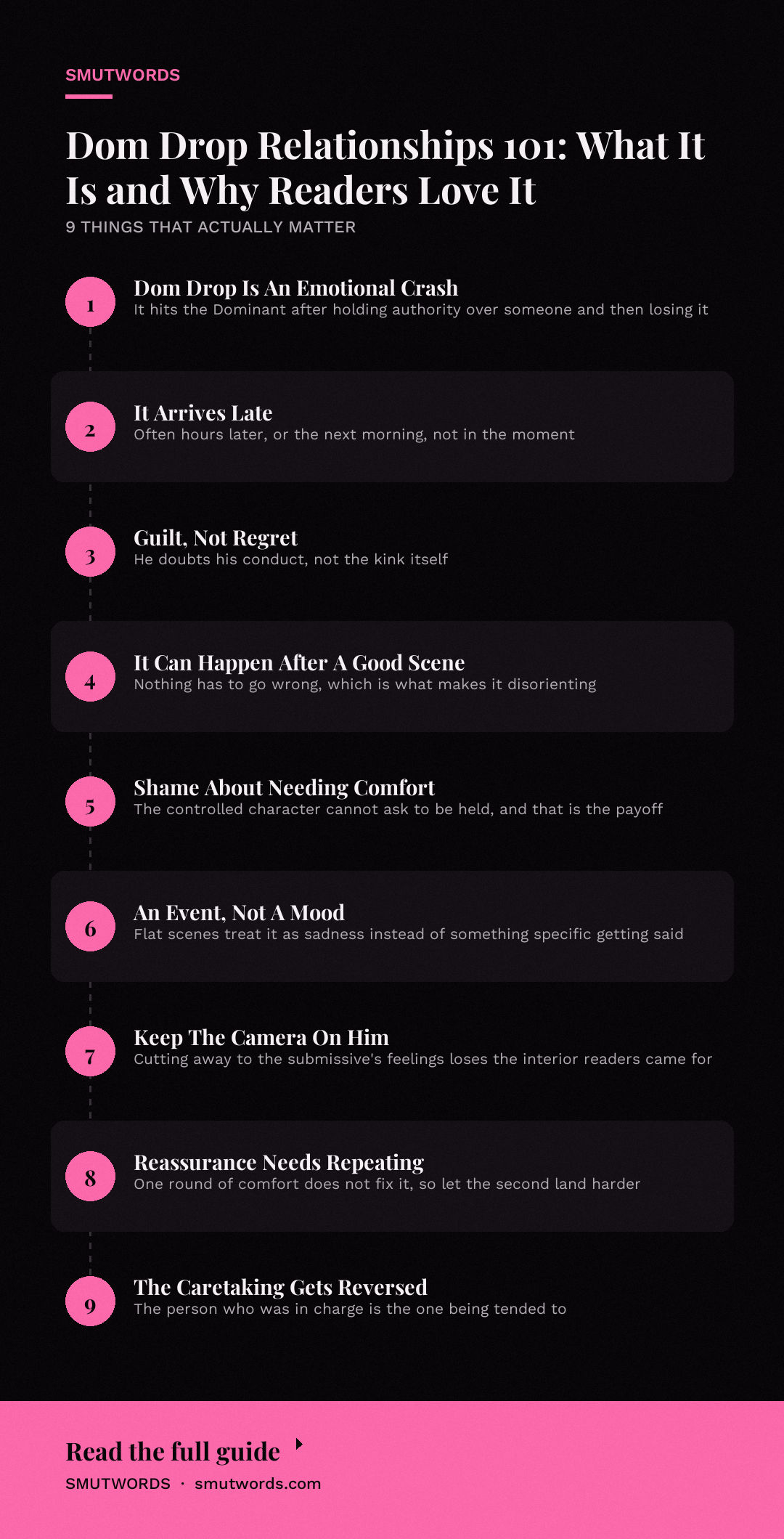
Dom drop is the emotional and physical crash that hits the person who was holding the reins. A Dominant finishes a scene, or a weekend, or six months of structured authority, and somewhere in the hours afterward the floor gives out.
Guilt arrives. Self-doubt follows. The memory of their own hand, their own voice, their own decisions gets replayed and suddenly looks monstrous instead of erotic.
In romance and erotica, dom drop is the moment the stern hero goes quiet and shaky and needs to be held by the person he just tied up. It is the mirror image of sub drop, and one of the most reliable ways a writer can turn a power exchange into a love story.
This guide covers what dom drop actually is, where the term came from, how it functions on the page, and where writers get it wrong. If you have ever finished a scene and felt like you did something unforgivable, or written a Dominant who does, this is for you.
What Dom Drop Actually Means
The short definition is an emotional crash after dominance. The real one is messier.
Dom drop (also called top drop, dominant drop, or post-scene crash) is a cluster of symptoms that tend to arrive together and tend to arrive late. It is not the same as being tired after sex. It is a specific kind of destabilization that comes from having held authority over another person and then abruptly not holding it anymore.
The name borrows directly from "sub drop," which describes the same crash hitting the submissive. Both are understood as the comedown from an intense neurochemical event: adrenaline, endorphins, and whatever else the body threw at the scene, all draining out and leaving a person flat. In real practice, the two are managed the same way, with check-ins, honesty about what happened, and aftercare that runs both directions rather than only toward the bottom.
What dom drop is not:
- It is not regret about the kink itself. A Dominant in drop usually still wants the dynamic. They are doubting their conduct, not their desires.
- It is not the partner's fault. Drop happens after a scene everyone enjoyed and consented to. That is part of what makes it so disorienting.
- It is not always dramatic. Sometimes it is just a guy who cannot sleep and keeps checking his phone to make sure she got home okay.
- It is not the same as sub drop. Overlapping symptoms, different origin. The submissive usually crashes from what was done to them. The Dominant crashes from what they did.
The timing is the detail writers most often get wrong. Dom drop does not usually hit in the moment. It arrives hours later, sometimes the next morning, occasionally two days out once the adrenaline finally lets go. That delay is what makes it narratively useful: it can land in the quiet chapter after the intense one.
Common symptoms, drawn from both real practice and the way the trope gets written:
- Guilt over specific things that were said or done, even ones the partner asked for
- Rereading the scene in memory and finding it cold or cruel instead of hot
- Anxiety about whether the partner was actually fine, no matter what they said at the time
- Exhaustion that no amount of sleep fixes
- Withdrawal, silence, and a sudden reluctance to touch
- Fear of their own capacity for causing pain
- Shame about needing comfort, which is its own spiral
The last one is the engine of the whole trope. A Dominant who has spent a scene being the one in control does not know how to ask to be held. That difficulty is where the emotional payoff lives.
Where the Term Comes From
Dom drop as a named phenomenon emerged from real-world kink communities, not from fiction. The term spread through BDSM education spaces, forums, and community writing in the 1990s and 2000s as practitioners started paying serious attention to the psychological aftermath of play. Sub drop was recognized first, because the submissive's crash is more visible. Top drop and dom drop followed as people noticed that the person holding the whip was having their own bad night.
In romance publishing, the term is much newer. For most of the genre's kinky history, the Dominant's inner life was a closed door. He was intensity and control and a hard jaw. The idea that he might need tending to afterward would have undercut the fantasy the books were built on, and for a long stretch of publishing, that was the point.
The shift arrived with the broader rise of kink romance as its own category, roughly in the 2010s, when readers started wanting the mechanics of the dynamic to make internal sense. Once authors began writing negotiation scenes, safewords, and aftercare as part of the heat rather than interruptions to it, the honest follow-up question became unavoidable: what happens to the person who did all of that when it is over?
Since then, dom drop has become near-standard in any romance that takes power exchange seriously. It shows up in contemporary BDSM romance, in darker mafia and captor stories, in shifter books where an alpha's territorial instincts double as dominance, and anywhere else a character spends a scene or a book being the one in charge.
In genres like pack mates romance or territorial shifter trope stories, dom drop often gets recoded as the alpha losing his grip after a mate-bonding scene, which is the same emotional beat in fur.
The term itself has crept from community vocabulary into reader vocabulary. Reviewers now ask for it by name. It appears in trope tags, in author newsletters, and in the comment threads under particularly devastating chapters. That is the clearest sign a kink-adjacent concept has crossed over from practice into genre furniture.
How It Shows Up in Erotica
Dom drop is a pacing tool before it is anything else. Heat scenes are built on escalating intensity. Drop is what you do with the other side of that curve.
Structurally, the beat usually runs like this. The scene itself goes long and hard. There is a brief, warm resolution, sometimes an aftercare scene in bed.
Then time skips forward. The Dominant is alone, or in a car, or awake at 3 a.m., and the mood has turned. The narrative voice narrows to his interior.
Something he did gets replayed in his head in the least flattering possible light. He does not call anyone about it.
The tension resolves when the partner notices. That noticing is the load-bearing moment. Whether the submissive is groggy, or recovering herself, or has to cross a room to get to him, the reversal of caretaking is the payoff.
Authors use several recognizable variations:
- The silent withdrawal. He goes quiet, answers in monosyllables, and the partner has to dig it out of him. This is the version closest to how dom drop presents in real life, where the guy genuinely does not have language for it yet.
- The self-punishing interrogation. He asks the partner to confirm, repeatedly, that it was fine. He needs to hear it more than once. Authors use this to let the submissive give reassurance in explicit, specific terms, which doubles as a praise kink versus degradation kink payoff for readers who want to watch affection get injected directly into an open wound.
- The "I should not have" spiral. He decides the whole dynamic is a mistake and starts to pull away on principle. This version drives a third-act breakup or a near-miss one.
- The caretaking role reversal. She runs him a bath. She makes him eat something. She holds his head. The scene is domestic, not sexual, and the intimacy is heavier for it.
- The alpha equivalent. In shifter books, drop often gets framed as an instinctive terror that he has damaged his mate, with the same physical symptoms and a stronger pull toward physical contact as the fix. The pack dynamics version often adds the complication that other pack members can smell the distress on him.
What separates a strong dom drop beat from a flat one is specificity. A writer who has the character say "I am fine, I am just tired" and means it has wasted the scene. The beat only works when the internal material is concrete: the exact sentence he said, the exact moment her breathing changed, the exact reason he is now sure he misread it.
Reciprocity separates them too. A dom drop scene where the submissive recovers instantly, dispenses a few lines of reassurance, and goes to sleep is a scene where only one character grew.
Enjoyed this? Get a free book.
Join the list and we will send a complete free story straight to your inbox, plus new releases every week after that. No credit card, no catch.
The strongest versions put both people in a vulnerable position at once: she is still shaky, he is newly shaky, and they have to take care of each other with whatever energy is left. That is the mutual-aid version of power exchange, and it is exactly what readers who love this trope are showing up for.
Another clean move is to let the drop arrive through a physical detail before it arrives in dialogue. He is holding a glass of water without drinking it. He has not showered.
He is standing in the doorway of the bedroom like he does not have permission to come in. The body tells the reader first, and the conversation lands harder when it arrives.
A practical note on where the beat goes. Dom drop can close a heat scene, run as its own chapter, or stretch across several chapters as a background hum. The last option is common in longer books. The Dominant is a little off for a while, and nobody understands why until someone connects it to what happened three chapters ago.
In a genre that reads as fast as romance does, that kind of slow-burn aftertaste can be the difference between a scene readers skim and a scene readers remember.
Writers working with rope, sensory work, or heavier play tend to find the drop beat lands best when the mechanics of the scene itself stay credible. If you are writing restraints, the rope safety guide covers the physical details that keep a scene from ringing false. If you are writing blindfolds, ice, or temperature play, the sensory play for beginners piece is a useful companion. The more real the scene feels, the more weight the drop carries.
Writers working with more than two characters have an additional lever. A dom drop beat in a group or polyamory setting can be split across partners, with one person handling logistics and another handling the actual holding. That division of labor is its own kind of intimacy scene.
What Makes a Flat Dom Drop Scene
The most common failure is treating dom drop as a mood rather than an event. The character is sad for a few paragraphs, someone says the right thing, everyone is fine. There is no discovery in that. Nothing gets said out loud that both people did not already know.
The second most common failure is making it about the submissive. If the drop scene keeps cutting away to how the other person feels about his feelings, the reader loses the thing they came for, which is the interior of the person who was in charge. Keep the camera on him long enough to be uncomfortable.
The third is resolving it too fast. Reassurance given once does not fix dom drop in fiction any more than it does in life. Let him need to hear it twice. Let the second time land harder than the first.
What Makes a Strong Dom Drop Scene
Strong versions share a few traits. He says one specific true thing about what he is afraid of. The other character listens without rushing to fix it.
There is a physical gesture that carries more than the dialogue does, often something small: a hand on the back of his neck, a forehead against his shoulder, a blanket pulled over both of them. And by the end, the dynamic has been quietly renegotiated. She is still his, and he is still in charge, but both of them now know the deal runs both ways.
If you write one dom drop beat and want it to land, write it in the smallest room in the house. The exchange tends to shrink when it gets honest, and a big setting flattens that.
Dom Drop vs Sub Drop
The two are the same phenomenon with different triggers, and the confusion is real. Sub drop comes from what was done to a person, often peaks with a sense of abandonment once the attention stops, and is usually discussed in terms of comfort, warmth, and reassurance. Dom drop comes from what a person did, peaks with guilt and self-scrutiny, and often arrives with an unwillingness to be comforted at all.
Because of that last difference, the care looks different. A submissive in drop usually wants closeness immediately. A Dominant in drop often needs to be talked into accepting it. The scene where someone has to insist on taking care of a person who is convinced he does not deserve it is the version of the trope that does the most work.
Frequently Asked Questions
How long does dom drop last?
It varies, but it typically runs from a few hours to a couple of days after the scene. In fiction, most authors compress it into the hours immediately following, or stretch it into a quiet subplot over a chapter or two. If a character is still in drop a week later with no stated reason, readers will start to wonder whether something else is going on.
Can a Dominant get dom drop after a scene everyone enjoyed?
Yes, and that is the normal case. Dom drop does not require anything to have gone wrong. The intensity of the scene and the suddenness of the comedown are enough on their own, which is exactly what makes the beat so effective in romance. The story gets to use the drop to deepen the relationship rather than to resolve a conflict.
Is dom drop the same as top drop?
Almost. Top drop is the broader term, used by anyone who was in a topping or controlling role, whether or not the dynamic is explicitly D/s. Dom drop refers specifically to a Dominant in a power-exchange relationship. In practice the two are used interchangeably, and both describe the same crash.
How do you write dom drop without making the character seem weak?
Do not frame the drop as weakness in the first place. The strongest version treats it as the reasonable response of someone who cares about the person they just put through something intense. Readers who love this trope are not looking for a Dominant who is secretly fragile. They are looking for a Dominant whose control was always aimed at taking care of someone, and who is now afraid he failed.
Does dom drop happen in shifter and paranormal romance too?
Constantly. It is one of the most common emotional beats in alpha-driven stories, including angel romance, fae romance, and alien romance, where an instinct-driven character has to reckon with the aftermath of dominance. The biology gets invented, the emotional arc stays the same.
What should the submissive character do during a dom drop scene?
Listen more than she talks, and do not rush to forgive him for something he has not been accused of. The best version of the scene gives her a chance to reframe the scene in her own words: what it was like for her, what she wanted, what she would want again. That reframing is what actually pulls him out, because it replaces his interpretation of the scene with hers.
Final Thoughts
Dom drop is where a power exchange stops being a performance and starts being a relationship. Writers who understand that get a beat almost nobody else in the genre can match: the moment the most controlled character in the book has to be held.
Want to see it done well? Next time you are browsing the SmutWords catalog, look for a BDSM or alpha romance where the lead goes quiet after the scene and stays quiet for a chapter. That quiet is the whole trope, and it is worth reading for.








Loading comments…