
Kitten play is a form of consensual roleplay where one person takes on the persona of a kitten: meowing, purring, nuzzling, curling up, pawing at their partner, sometimes wearing a collar or ears. The other person plays the owner or caretaker, feeding them, petting them, praising them, and in most erotic versions, directing them sexually.
It sits inside the larger umbrella of pet play, but kitten play has its own flavor. Where pup play tends toward pack energy and physical boisterousness, kitten play is usually smaller, softer, more indulgent, and deeply affectionate. The submission is real, but it comes wrapped in warmth.
What Kitten Play Actually Means
The name is literal. A character becomes a kitten, or close to one, and the partner handles them like a beloved animal. The physical vocabulary is specific and it matters: meowing, purring, kneading, headbutting, rubbing against a leg, curling up in a lap, sleeping at the foot of the bed. Erotica leans hard on these because they read as instantly legible on the page.
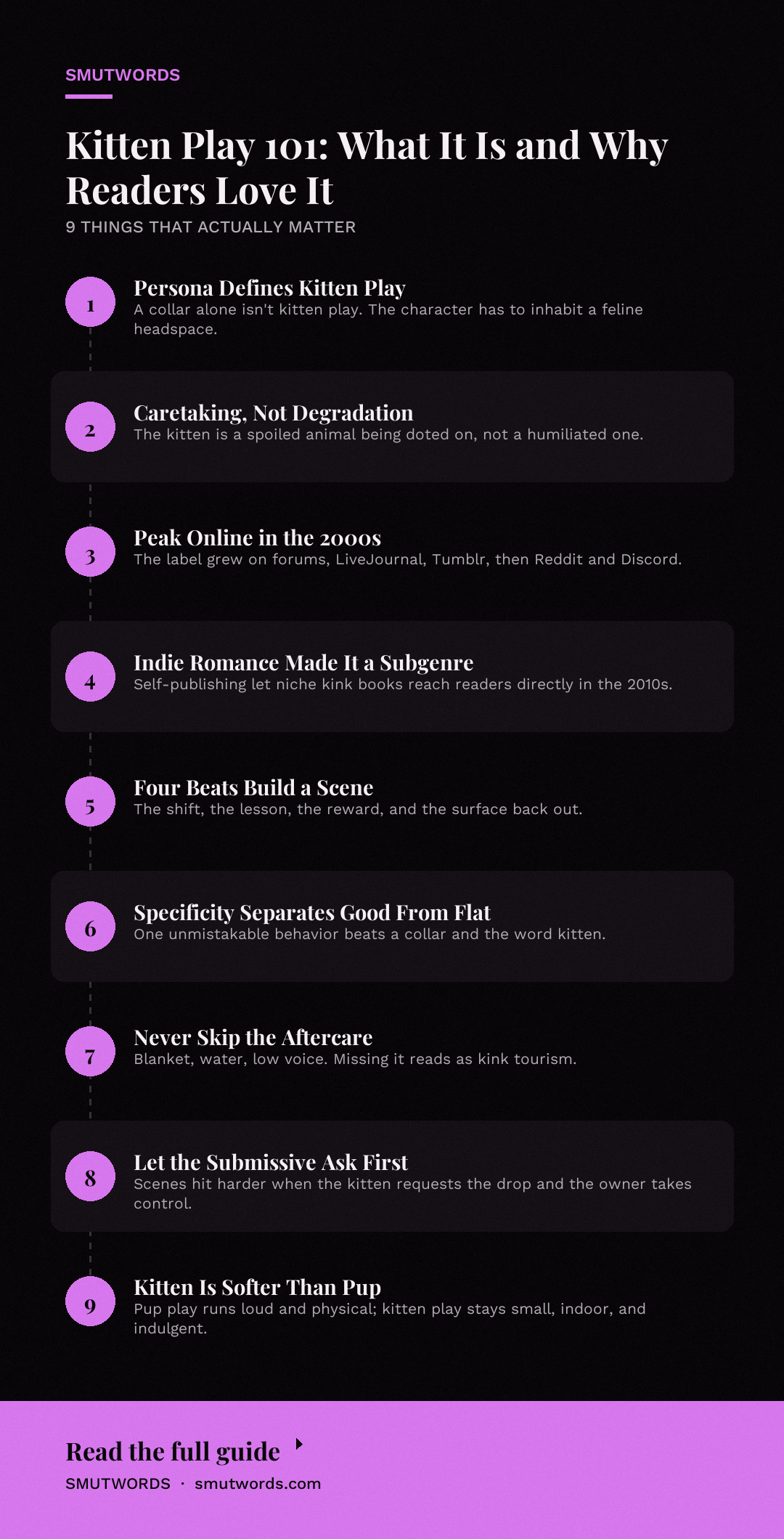
What counts as kitten play and what doesn't is looser than people assume. A collar and leash alone isn't kitten play; that's just collar and leash. Kitten play needs the persona. The character has to be inhabiting a feline headspace, even a light one, for the scene to earn the label.
Common misconceptions cluster around three things. First, people assume it has to be a full lifestyle: a 24/7 dynamic, a dedicated room, professional-grade gear. Most published kitten play is a scene or a running game between two people who are otherwise ordinary adults.
Second, people assume it's degradation. The mode is often the opposite: adoration, indulgence, praise.
Third, and most important, readers sometimes assume kitten play means the submissive partner is diminished or humiliated. In strong writing, the character is being doted on. They're a spoiled animal, not a discarded one. (There's a real difference between degradation kink, which is its own kink with its own vocabulary, and the caretaking dynamic typical of kitten play.)
Kitten play also overlaps with pet regression, but they aren't identical. Regression is a mental state, often non-sexual, where a person settles into a younger or simpler headspace. Kitten play is a role with a sexual and scene-driven center for most readers. The overlap gets used deliberately in fiction when an author wants a character who both regresses and submits.
Where Kitten Play Comes From
Kitten play as a named kink is recent, but the ingredients are old. The broader category, pet play, has been documented in kink subcultures since the mid-twentieth century, and it shows up in early fetish photography and personal ads. Pony play had its own organized niche in the 1970s and 80s. Pup play built a large community through the leather scene before the internet expanded it.
Kitten play as a distinct label followed later, and it grew fastest on the early 2000s internet: forums, LiveJournal, Tumblr, and eventually dedicated subcultures on Reddit and Discord.
In erotica specifically, the trope is much older than the label. Victorian and Edwardian erotic writing had plenty of scenes where a woman is described as a pet, treated as one, praised like one. Mid-century romance used the same material with different vocabulary. What changed is that those scenes stopped being metaphorical and became an explicit dynamic characters opt into.
The biggest shift happened in the 2010s, when indie romance and self-publishing made it possible to write short, niche, kink-forward books directly to a dedicated readership. Kitten play went from a subplot device in darker BDSM romance to a full subgenre with its own tropes. Writers started using "kitten" as an endearment rather than a curse. The tone shifted with it: older portrayals leaned toward dominance and punishment; newer ones lean toward caretaking, praise, and playfulness.
The caretaker/owner framing is the most recent evolution. In much of the current catalog, the dominant partner's main job is tending: brushing hair, putting on the collar, fixing a meal, watching the kitten sleep. The control is still there, and it's still erotic, but it's reframed as care rather than force. That's the version most readers mean when they search for kitten play today.
How It Shows Up in Erotica
On the page, kitten play scenes are built from small concrete behaviors. The author has to translate an animal's instincts into human gesture without making it silly. The best writers do this by giving the kitten a specific vocabulary of motion: slow blinks, headbutts into a palm, kneading a thigh, a purr that starts as a hum in the throat and turns wet against an ear.
The scene's real engine is the attention economy. Every kitten action requires a response from the owner. Praise, correction, a stroke on the hair, a bite. That back-and-forth is what makes kitten play scenes readable at length; without it, the scene collapses into description.
A strong kitten play scene usually has all four of these beats:
- The shift: the moment the character drops into the persona. Collar going on, a specific word, a gesture from the owner.
- The lesson: a rule the kitten has to learn or break, which gives the scene its tension.
- The reward: the physical scene. Praise, touch, food, sex, or all four in a specific order.
- The surface: the climb back out. A blanket, water, a slow voice. Missing this beat is the most common failure in published kitten play.
Common variations authors use across the genre:
- The new collar. A first-time kitten whose owner is teaching them the rules. Slower, sweeter, lots of discovery.
- The stray. A character acts out the abandoned-animal role: wary, hungry, difficult to trust, slowly won over.
- The spoiled housecat. Already trained, already doted upon, returning to the owner after a gap. Leans on domesticity and jealousy.
- The rival kittens. Two or more submissives competing for one owner's attention, which slides toward harem romance when the household expands.
- The switch. A character who is a kitten with one partner and an owner with another. Structurally interesting and rare to find done well.
What separates a strong version from a flat one is specificity. Bad kitten play writing uses the word "kitten" and a collar and calls it done. Strong writing gives the reader one behavior that feels impossible to confuse with any other character in the book: an owner who only ever scruffs them at the back of the neck, or a kitten who always purrs when being lied to.
The flat version also skips the aftermath. Readers who love kitten play scenes almost always love the recovery scenes: wrapped in a blanket, being fed, being spoken to gently. Without that, the scene reads as kink tourism. With it, it reads as an actual relationship.
Enjoyed this? Get a free book.
Join the list and we will send a complete free story straight to your inbox, plus new releases every week after that. No credit card, no catch.
The scene's power also depends on who initiates. A kitten play scene is far more erotic when the submissive partner is the one asking to go down, and the dominant partner then takes control of the descent. That order creates a specific tension: the submissive offering themselves to a role they don't control once they're inside it.
Related dynamics show up as dials an author can turn. Heavy leash and restraint work borrows from shibari if you want the physical vocabulary. Aggressive kitten play (biting, struggling, being pinned) edges into feral play and rough sex. Sweeter kitten play stays inside the caretaker/owner lane and never leaves the bedroom.
Setting matters to the reader more than authors sometimes acknowledge. A kitten play scene plays differently in an isolated cabin than in a metropolitan apartment, and the SmutWords piece on cabin romance versus city romance settings is a useful companion read if you're writing one. The cabin gives you privacy and the weather. The city gives you the risk of being caught.
A note on the real-world mechanics, because good fiction has to acknowledge them. Kitten play involves a consensual power exchange and an altered headspace, which means limits should be agreed before the collar goes on, a safeword should exist, and both partners should plan for aftercare as the scene ends.
Skilled authors either show this explicitly or gesture at it in a way the reader can feel. Readers who are in the kink themselves notice when it's missing and they stop trusting the book.
If you're still figuring out which role in a kitten play dynamic appeals to you, the SmutWords guide on whether you're dominant, submissive, or switch is worth reading before you browse for books. A lot of readers discover they want to be the owner after assuming they'd be the kitten, or the reverse.
Kitten Play vs Pup Play
The two are the closest pair in the pet play umbrella, and readers confuse them constantly. The difference is mostly in tone and physical scale. Pup play is bigger, louder, more physically driven: heavier gear, rougher play, pack energy. Kitten play is smaller, quieter, more indoor. Purring and curling up instead of barking and wrestling.
Pup play scenes also tend to emphasize obedience and physical training. Kitten play scenes emphasize indulgence and being spoiled. Both have a dominant partner who's in charge, but a puppy story is likelier to involve work and a kitten story is likelier to involve laziness as a reward.
Neither is better; they're different moods. Writers sometimes blend them, which usually reads as a book trying to serve two audiences and works best when one side is clearly the primary.
Where pup play and kitten play genuinely overlap with a third dynamic is when there are multiple pets for one owner. At that point you're structurally close to kink as a crowd dynamic, and reading about an orgy isn't far off the mood when the household gets big enough. The distinction worth holding on to: kitten play is usually two people. The moment it's more, the book has changed genre or expanded scope.
Frequently Asked Questions
Is kitten play the same as pet play?
Kitten play is a subtype of pet play, the broader category that also includes pup play and pony play. Every kitten play scene is pet play, but not every pet play scene is kitten play. Kitten play specifically involves feline behaviors and a smaller, more affectionate register.
Do you need a collar and leash to do kitten play?
No. Gear is a common prop and it reads well on the page, but the dynamic is defined by the persona and the caretaking, not the equipment. Plenty of scenes use nothing more than a name and a tone of voice. Many readers prefer a light-touch version for exactly that reason.
Is kitten play always sexual?
No. Some kitten play happens as non-sexual regression or as a way for a partner to decompress. In published erotica, kitten play usually leads to sex or runs alongside it, but the kink itself can stand on the relationship without a sex scene.
What is kitten headspace?
Headspace is the mental state a submissive partner enters during play. In kitten play it means a character who thinks in simpler, more instinctual terms: needs, comfort, attention. Writing headspace well is one of the harder technical parts of the trope, because the character has to sound different without becoming unreadable.
How do you write aftercare in a kitten play scene?
Keep it concrete and quiet. Water, a blanket, a low voice, a hand on the back of the neck, the collar coming off. The character should come back to themselves slowly. Skipping this beat flattens the scene more than any other single mistake.
What's the difference between kitten play and degradation?
Different modes. Degradation involves consensual humiliation and being reduced; kitten play involves being indulged and cared for. Some writers combine them, but the default tone of kitten play is affection and praise rather than belittlement.
Final Thoughts
Kitten play sits in that narrow hallway between submission and tenderness, and the best books in the trope live there without apologizing for it. Readers come for the collar, stay for the head scratch, and leave remembering the blanket scene more than the sex. When you're ready to pick a book, look for one that gives the character room to drop into the persona and come back out of it with help. That's where the trope earns its keep.





Loading comments…