
Most people who type "am i dominant or submissive" into a search bar at 2am are not looking for a test with a score at the end. They're looking for permission to have a hunch.
Maybe you noticed you get a specific kind of quiet in your head when someone tells you what to do, or that your whole body goes alert when a partner looks at you like they're about to give an instruction. Maybe you've read enough of this site's back catalog to notice which scenes you reread and which ones you skip. That's data. The question underneath the question is usually: does this mean something about me, or am I just curious?
Short answer: it can be both, and neither one locks you into a label for life. Read on and we'll walk through what these roles actually describe, how to tell which one fits, and how to test a hunch without turning your next date into an audition.
What dominant, submissive, and switch actually mean
Strip away the leather-and-candles imagery for a second. In plain terms, dominant describes someone who gets charged up by taking the lead: setting the pace, giving direction, deciding what happens next, and having that authority received willingly. Submissive describes someone who gets charged up by handing that control over, following direction, and letting someone else hold the reins for a while. Switch means you can move between the two depending on the person, the mood, or the day.
None of those definitions require whips, rope, or a dungeon. A dominant can be the person who decides where you're eating dinner and means it. A submissive can be the person who asks their partner to pick the outfit, the movie, and the schedule for the weekend. The kink lives in the exchange of control, not in the props.
It's about the charge, not the chore list
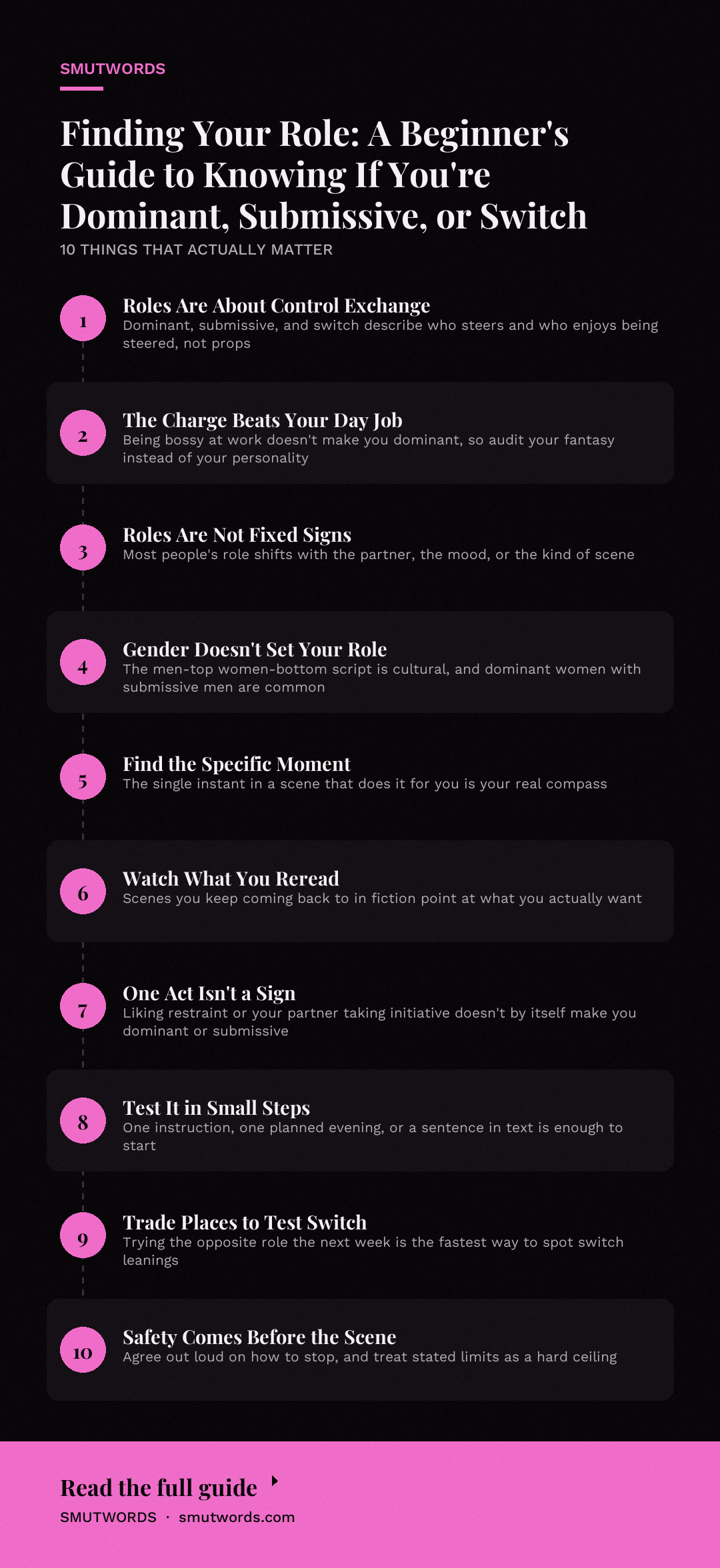
Here's the distinction that trips people up. Lots of us are bossy at work, run households, manage other people's calendars. Being in charge all day doesn't make you a dominant, and being exhausted by it doesn't make you a submissive. The role lives in where the erotic or emotional charge sits, and that can be the exact opposite of your day job.
Plenty of dominants spend their workweek taking orders from a manager and come home hungry to be the one deciding things. So when you're asking yourself whether you're dominant or submissive, don't audit your personality. Audit the fantasy. The question is which version of you shows up in the scenes you actually replay in your head.
The idea that roles are fixed is mostly internet noise
Roles get treated like astrology signs online: you're a Leo, you're a sub, done. That framing is convenient for memes and useless for real people. In practice, most folks' role is contextual.
You might lean dominant with one partner and submissive with another. You might be a dominant who only wants to top in certain kinds of scenes and wants to be on the receiving end of entirely different ones.
Gender has even less to do with it. The assumption that men top and women bottom is a cultural script, and it collapses the second you talk to actual kinky people. Plenty of dominant women run scenes with submissive men; plenty of submissive men are six-foot-two and built like a door.
The fiction on this site is full of that reversal, and so is real life. If your gut keeps insisting that your role has to match your gender, that's worth noticing as a script you were handed, not a fact about your body.
Labels are descriptive, not binding contracts
A label like "submissive" or "switch" is a shortcut for a conversation. It tells a partner roughly where to start, not where you have to end up. You're allowed to try a label on, notice it fits badly, and set it down. You're allowed to use "switch" as a placeholder for years while you figure out the finer details.
A plain-English self-assessment: questions worth actually sitting with
Forget the online quizzes that ask whether you prefer cats or dogs and spit out "you're a brat." Here are the questions that tend to actually surface an answer, best answered slowly, ideally with a notebook and a slightly embarrassed laugh.
- What's the specific moment in a scene that does it for you? Not the whole dynamic, the moment. Someone giving an order? Someone following one? Someone choosing you and taking responsibility for the outcome? That moment is your compass.
- When you imagine a partner looking at you a certain way, are you being told what to do, or deciding what to do to them? Notice which one makes your chest tighten in a good way.
- What do you secretly want to be asked to do? The want that makes you a little embarrassed is usually the honest one.
- When you think about a partner trusting you completely, does that feel powerful or exhausting? Power that feels like a burden tends to point toward the other side of the slash.
- What scenes from fiction or your own head do you reread? If you keep coming back to a dynamic, there's usually a reason. The mummification guide covers the appeal of total restraint in fiction and in play, which can be a strong signal for one end of the slash, for example.
Write the answers down and sit with them. Patterns show up over a week that don't show up in a single hot minute of wondering.
Reading the signs in yourself
Once you've got some notes, look for actual evidence rather than vibes. Dominant leanings often show up as a hold-your-breath feeling when given authority, difficulty letting someone else be in charge even when you want to, or a specific tenderness that blooms when a partner trusts you with something.
Submissive leanings often show up as a quiet relief when a decision gets taken off your plate, a habit of scanning a leader's face for instructions, or a hunger to be told you've done it right.
Switch leanings look like this: reading a submissive scene and thinking "that looks nice," then reading a dominant scene and thinking the same thing. Or a mood that shifts depending on who's in front of you. If both make your brain light up, that's information, and it doesn't make you indecisive. It makes you a switch, which is a perfectly stable place to be.
The jealousy kink and non-monogamy guide touches on how flexible dynamics hold up when multiple partners or shifting roles are in the mix, which is often the switch's real world.
What doesn't count as a sign
Liking very specific physical things on their own doesn't make you anything. If you like being held down, that can be a kink for restraint, and it can just be a thing you like during sex, without any dominant or submissive meaning attached. Liking it when a partner takes the initiative in the bedroom also doesn't automatically make you a submissive. The role question is really about who's steering and who's enjoying being steered, not about any one act.
One more false signal: a history of being the one who makes plans because nobody else will. That can look like dominance from the outside and be pure exhaustion from the inside. If taking control makes you resentful, that's a different thing entirely from erotic dominance.
Enjoyed this? Get a free book.
Join the list and we will send a complete free story straight to your inbox, plus new releases every week after that. No credit card, no catch.
Low-pressure ways to experiment before you commit
You don't need a collar or a contract to test a hunch. The first step is smaller and cheaper.
- Try it in text with someone you trust. One sentence: "I think I might be into being told what to do in the bedroom, and I want to see how that feels. Can we try a small thing?" It doesn't need to be a grand confession. It can be a question.
- Choose one low-stakes scene. The dominant partner picks the evening's plan, start to finish, and the submissive partner goes along with it and says how it felt afterward. Nothing kinky has to happen. What matters is the exchange of decisions and the conversation after.
- Trade places the following week. Whatever you tried, try the opposite and compare. This is the single most efficient test for a switch.
- Use fiction as a screen for desire. Read a scene together, or separately, and talk about which part made your attention sharpen. Reading Weekend at the Bull's is a decent prompt for talking about authority, and The Caregiver's Covenant is the softer, caretaking side of the same coin. Neither requires you to already know what you are.
- Try it alone first. Solo exploration, whether with a toy, a journal, or reading material, is a legitimate way to test a hunch. If a fantasy lands hard in private, that's real information.
Notice what we're not telling you to do: we're not telling you to jump straight into a heavy scene to "see if you like it." The monster breeding romance end of the fiction spectrum is a good read precisely because it keeps that intensity firmly on the page while you're still deciding whether you want anything in real life.
What "small" actually looks like
Small means a single instruction in the bedroom, or one evening where one person decides the plan. It means trying one thing and talking about it the same night, not one thing and letting it sit for a week while you worry. If the trial makes you feel weird or bored, that's an answer. If it makes you want to do it again tomorrow, that's a stronger one.
The point of experimenting at low stakes is that you can always stop. If you'd like a fiction primer on roles that shift and negotiations that are explicit, Free Use Airport Lounge runs on consent rules laid out loud, which is itself a useful model for how to talk about a dynamic before you try one.
Bringing it up with a partner
You don't have to declare a label on the first date. Start with an observation about a specific scene or experience rather than an identity announcement. "I noticed I really liked it when you made the call at dinner" is easier to receive than "I think I'm submissive," and it gets you the same information.
Ask before assuming. A partner who takes the lead in bed might have zero interest in being dominant outside it, and a partner who's shy in the kitchen might be the one who wants the reins. Roles in kink don't map neatly onto everyday personality, so the conversation is worth having even if you think you already know the answer.
One thing to be ready for: some partners will hear "dominant" or "submissive" and picture a whole lifestyle they're not signing up for. Say what you actually want in specific terms. "I'd like you to decide where we eat on Fridays and take my clothes off without asking" is something a partner can picture and respond to. A label alone is harder to meet.
The risks worth naming
This is the part where a guide that respects you stops pretending. Discovering a role is low-risk. Acting on it carelessly is not.
If you're trying submission with a partner, the real danger isn't the power exchange, it's skipping the conversation about what happens when you want to stop. Any scenario that restricts your ability to say stop, or that requires you to be restrained in a way you can't get out of quickly, carries genuine physical and emotional risk and should only be explored with someone experienced, informed, and using gear you've both checked. Don't start there.
Dominance carries its own risk: a dominant who gets swept up in the power can push further than the submissive actually agreed to. Keep checking in, and treat the submissive's stated limits as a hard ceiling, spoken aloud, not hinted at. The person with less power needs more checking on, not less.
A scene that ends badly can take a long time to recover from, and the recovery isn't optional.
What to do when it goes wrong
Stop the scene, name what felt bad, and talk it through before you try again. If a partner pressures you past a stated limit, that's not a dynamic, that's a problem, and stepping out is the correct response.
A disagreement about roles, or trying a scene and disliking it, can usually be worked through. Being ignored or overridden when you say no cannot. It's the difference between a scene that didn't land and a partner who isn't safe to play with.
The blind date romance style of letting a stranger take control is great fiction; in real life a new partner doesn't get that kind of authority until they've earned it in small steps.
Where to go next, and what to read
You don't need to arrive at a final label. Most people who ask "am i dominant or submissive" end up with something more complicated by the end of the year, or they settle into a label that has caveats stitched to it. Both are fine.
If you're someone who likes a world where power is literally built into the setting, The Living Gene Vault and Shared by Android Twins push the authority-and-obedience dynamic to its narrative extreme, which is a lot of fun to read while you're deciding how much of that you'd want to try in the real world.
For a primer on the kink that underlies a lot of self-discovery, the blue balls kink guide covers a specific dynamic some people find clarifying, and massage roleplay is a low-pressure first scene because the roles are simple and the stakes are small.
One last note on language: if you find yourself drawn to the more elaborate corners of the genre, whether it's cyberpunk romance or group marriage setups or a childhood friends to lovers dynamic where history does the negotiating for you, the interest itself is a clue. What kind of scene gets your attention, and who's in charge in it, will tell you more about your own leanings than any quiz.
Final Thoughts
You don't need to have it figured out before you start. The first step is one honest sentence to a partner, or one honest sentence in a notebook, about a scene that stays with you. If you want a story to test that sentence against, start with Egg Drop Ritual: A Gothic Paranormal Sci Fi Erotic Tale and pay attention to which character's shoes you'd rather be in. That'll tell you more than a quiz ever will.





Loading comments…