
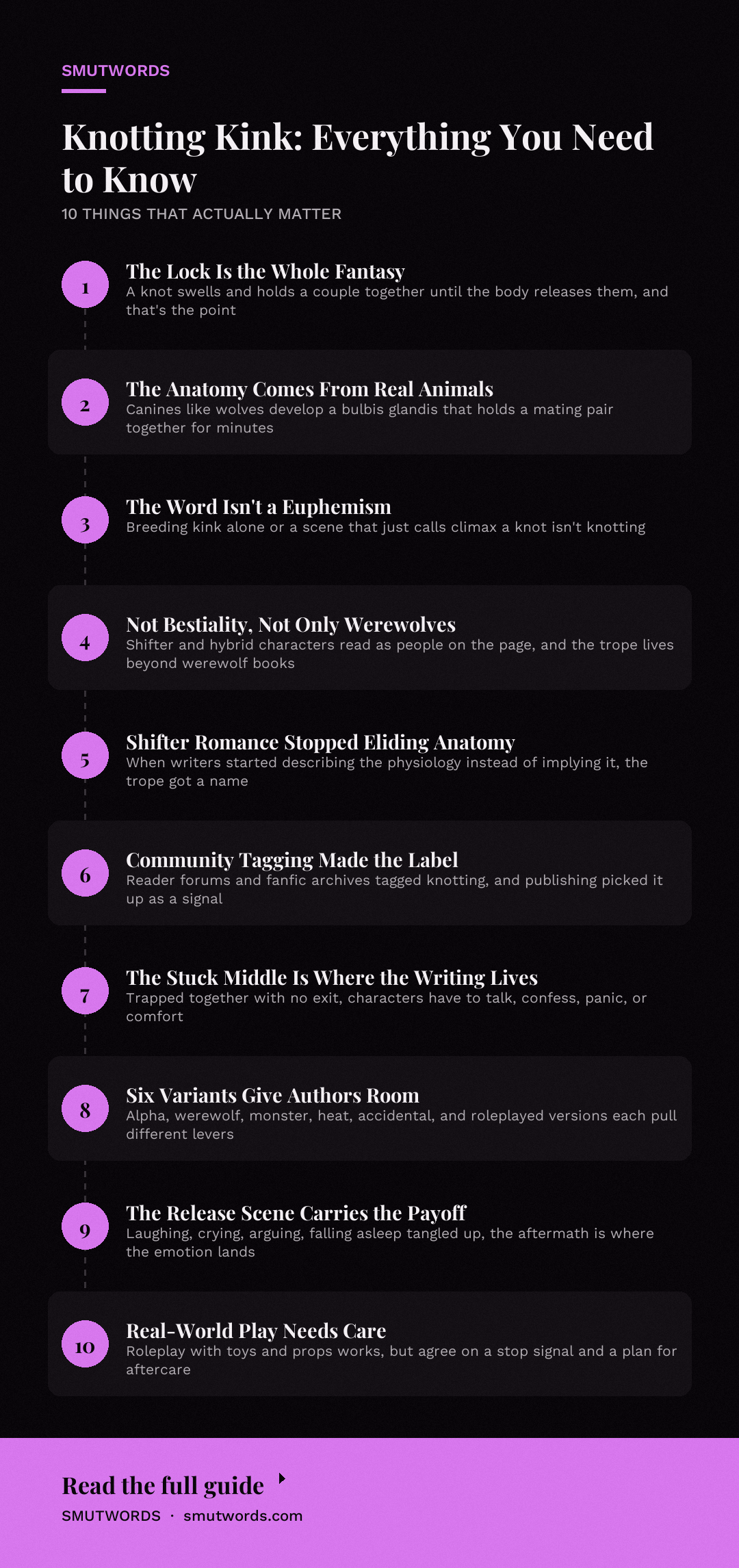
The knotting kink is a sexual fantasy built around one very specific physical event: during sex, a character with animalistic traits swells at the base of the penis into a bulbous "knot" that locks them inside their partner until the swelling goes down. It's most common in shifter and monster romance, where the anatomy signals something primal and permanent.
Being physically unable to pull apart until the body decides the encounter is over. That's the engine of the whole fantasy. The claim is the point.
What the Knotting Kink Actually Means
In the real animal world, the anatomy is genuine. Canines like wolves and dogs develop a bulbis glandis, a swelling structure at the base of the penis that expands during intercourse and holds the animals coupled together for a stretch of minutes. The word "knot" comes straight from that biology.
What counts as knotting kink in fiction is fairly specific. A character needs non-human or partially human anatomy, an animal shift, monster blood, alien biology, something that produces the swelling. The knot has to form during penetration, and it has to hold the couple locked together for a period neither of them controls.
What doesn't count: ordinary large-penis descriptions no matter how dramatic, breeding kink on its own, or any scene that just uses the word "knot" as a euphemism for climax. The physical lock is the whole point. Take away the inability to separate and you've written a different fantasy wearing a fur coat.
Common misconceptions are worth clearing up. The knotting kink is not the same as bestiality fantasy, because the characters involved are shifted or hybrid beings who read as people on the page.
It's also not automatically about pain, though the stretch and the sudden lock get written that way often. And it isn't only for werewolf books. The werewolf stuff dominates the search results, but that's not the whole shelf.
Where the Knotting Kink Comes From
The publishing history is younger than the biology. Knotting as a named trope in English-language erotica grew out of two streams that merged in the 2010s: online werewolf and shifter romance, and monster romance coming up from indie and self-publishing.
Shifter romance had existed for decades, with the possessive alpha who marks his mate and loses control under the full moon. For a long time those books implied animal intensity without spelling out animal anatomy. The shift happened when writers stopped eliding the physiology and started describing it. Readers who wanted the full instinctual picture found it, and the trope got a name.
Omegaverse played a role too. The alpha/beta/omega structure, which spread through fanfiction and then into original publishing in the 2010s, normalized writing about heat cycles, mating bonds, and bodies that behave on instinct rather than permission. Once readers accepted heats and ruts as furniture, a knot was a small additional piece.
The term's spread as a searchable kink label happened mostly through community tagging. Reader forums, fanfic archives, and romance communities started tagging "knotting" so people could find it, and the label leaked back into publishing as a marketing signal. Books began advertising knots in their blurbs during the monster romance boom of the late 2010s and early 2020s.
What's evolved most is the audience. Knotting started as a fringe detail in shifter books built for readers already deep in the subgenre. Now it shows up in cozy monster romances, in alien romances, and in contemporary-adjacent fantasy where the male lead happens to shift.
The intensity survived the move into the mainstream. The shame about it did not.
How Knotting Shows Up in Erotica
Scene construction around a knot has a rhythm, and the books that do it well know the rhythm. There's a build where the partner feels the swelling start. There's the moment of full lock, which is usually where the involuntary sounds go. There's the stretch of time afterward, potentially long, when neither character can move away.
Then release, and whatever tenderness or horror follows. That middle stretch is where the good writing lives. A knot forces the characters into an enclosed scene with no exit, and an author has to fill it with something besides more thrusting.
Enjoyed this? Get a free book.
Join the list and we will send a complete free story straight to your inbox, plus new releases every week after that. No credit card, no catch.
Dialogue, confession, panic, comfort, the sudden intimacy of being stuck together and having to actually talk. Some of the strongest knotting scenes in the genre run on conversation.
The variants give authors a lot of room to work:
- Alpha knotting: the standard shifter version, where a pack leader's knot signals a claim he can't retract and doesn't want to.
- Werewolf knotting: heavier on moon cycles, scent, and the transformation mid-scene, often edging toward primal play energy on the page.
- Monster knotting: knots on tentacled, scaled, or otherwise non-canine creatures, often paired with monster cock kink and written with more anatomical invention.
- Knotting heat: the knot tied to a heat or rut cycle, so the lock happens because the body has hit a biological peak, adding a loss-of-control layer.
- Accidental knotting: the couple didn't plan for it, sometimes barely knows each other, and the enforced closeness becomes the engine of the whole relationship.
- Reverse or roleplayed knotting: human characters who stage the scenario with a toy or a condom designed for it, less common but growing.
Strong versions treat the knot as a plot engine that changes the relationship, not a fetish toy dropped in for a paragraph. If the lock happens and nothing about the characters shifts, the scene reads as mechanically weird. If the lock forces a confession, a panic, or a decision, it's doing real work.
Weak versions share a few symptoms. They describe the swelling in the same terms every other book uses (thick, bulbous, heated, straining) and stop there. They let the lock pass with nobody caring. They forget the partner's experience entirely and write the whole thing from the knot-owner's satisfaction, which flattens the possessiveness and the vulnerability that readers are actually here for.
The flat version also tends to skip the aftermath. The release scene is where a lot of the emotional payoff sits, whether it's the characters laughing, crying, arguing, or falling asleep still tangled up. Cutting away at the lock is like ending a kiss at contact.
Knotting pairs naturally with other dynamics. It's a natural fit with captive-romance structures where one character can't leave, and if that's your flavor, the captive romance guide covers how the genre handles enforced proximity. It also overlaps with degradation kink when the possessiveness gets verbal, and with friends with benefits when two characters who weren't supposed to be serious get locked together and have to reconsider.
Frequently Asked Questions
Is knotting kink real?
The anatomy is real in canines and some other animals, where a swelling at the base of the penis holds a mating pair together for a span of minutes. In humans it doesn't happen, which is why knotting in erotica always involves a shifted, hybrid, monster, or otherwise non-human character, or a toy designed to simulate the effect.
What is a knot in shifter romance?
It's the swelling at the base of a shifter's penis during sex, described in a scene as forming, locking, and eventually subsiding. Authors use it to signal instinct, claim, and a period of enforced closeness, and it often shows up in the first sex scene between a couple as the moment their relationship stops being casual.
How long does knotting last in erotica?
There's no standard. Some books run the lock for a few paragraphs, others for most of a chapter, and a few turn it into a whole night. The length usually maps to how much emotional work the author wants to do while the characters can't leave each other's company.
Is knotting the same as breeding kink?
No. Breeding kink is about the intent to conceive or the fantasy of it, and it can happen in any scene with any anatomy. Knotting kink is about the physical lock. Plenty of knotting scenes involve no breeding at all, and plenty of breeding scenes involve no knot, though the two get combined often because they both pull on instinct and possession.
Why do readers like knotting so much?
The lock does something in fiction that few other devices do: it forces a couple into physical closeness neither of them can end early. That produces possessiveness on one side and total vulnerability on the other, and the emotional honesty that comes out of being stuck together is a shortcut to intimacy that reads as instinctual rather than chosen.
Can humans do knotting in real life?
Roleplay versions exist using toys and props designed to mimic the swelling and the lock, and some couples stage the scenario with bondage or a plug that stays in place. Any real-world play needs an agreed stop signal and a plan for aftercare. The intensity of the scenario can blur emotional limits fast.
Final Thoughts
The knotting kink works best when the author treats the lock as a plot event rather than a decoration, and the books that get it right tend to be the ones where the enforced closeness breaks something open between the characters. If you want a starting point, look for a shifter romance that lingers in the aftermath. The release scene is where you'll find out whether the author understands what the knot is for.




Loading comments…