
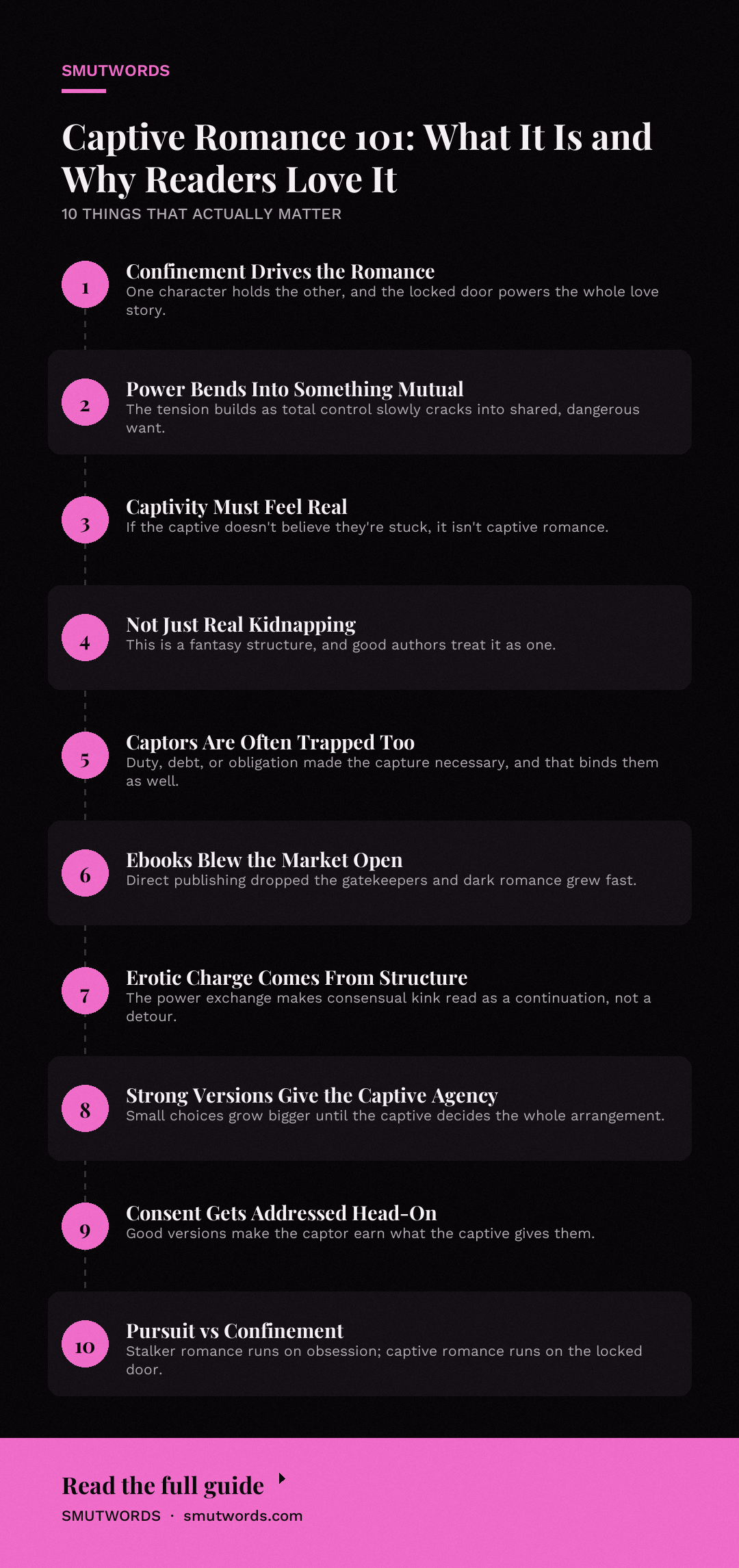
Captive romance is the subgenre where one character takes another and holds them, and the story makes you want the two of them to end up together anyway. The captive is kept against their will: in a cabin, on a ship, behind a locked door, in a palace, on a ship crewed by aliens. The captor has all the power.
The tension comes from the way that power starts to bend, then break, then something dangerous and mutual grows in the gap. If you search for the best captive romance books, you get offerings that run from dark and brutal to surprisingly tender. This guide covers what the trope actually is, where it came from, how it works on the page, and how to tell a good version from a flat one.
What Captive Romance Actually Means
The name is literal. One protagonist is confined by the other, and the confinement is the engine of the romance. Strip away the cell or the ship or the remote estate and the emotional machinery is a power imbalance so total that the usual social rules cannot apply. Everything the captive wants, including food, heat, and permission to leave, runs through the captor.
The genre calls this a trope, but it functions more like a pressure chamber. Put two people in forced proximity and let one of them hold the key, and every conversation carries weight. There are no neutral interactions between them.
A meal is a negotiation. A wound being tended is a surrender dressed up as care. The smallest kindness becomes enormous because the baseline is captivity.
What counts and what doesn't
A captive romance needs the threat of real restraint: physical confinement, or a credible threat that makes escape impossible, whether that's leverage over the captive's family or a collar with a tracker in it. The confinement can be short or long. It can be brutal or cushy. But the captive must believe, at least at the start, that they are not free to go.
What doesn't count: a short kidnapping that resolves in a chapter before the romance begins. A bossy billionaire who merely controls the schedule. A warden-and-prisoner scenario with no erotic or romantic charge between them, which is just a thriller. The trope requires that the locked door and the growing desire are the same problem.
Common misconceptions
The biggest one is that captive romance is a roundabout way of describing real kidnapping. It isn't. It's a fantasy structure, and the good authors know it. The captive in these stories is almost always competent, sharp, and fighting back.
The captor is often compelling precisely because they are trapped too, by duty, by debt, by an obligation that made the capture necessary in the first place. The second misconception is that it's all dark. It runs a wide range. Some captive romance is genuinely dark and graphic about the captivity and the sex.
Some is light and almost playful, closer to a bedroom game stretched across a novel. The category is broad, and the subgenre tags tell you which one you're getting.
Where Captive Romance Comes From
The captive-and-captor plot is older than the novel. The Greeks had it. Shakespeare had it. But as a recognizable romance trope, with all the kinky machinery, it took shape in the twentieth century and then accelerated wildly with ebooks.
The modern publishing history runs through the romance paperback boom. Captive narratives showed up in historical romance constantly: the pirate captain with a lady in his cabin, the Highland laird who takes a bride to secure land, the sultan and the slave girl. The captivity was the setup for proximity, and the proximity did the romantic work.
These were mainstream bestsellers. The trouble was only in the marketing language.
Science fiction and fantasy pushed the trope further out. Captive romance merged with speculative settings and picked up the alien captor, the cyborg warlord, the fae king who steals a bride. Genre mixing let the captivity be total without the modern reader having to think about the phone call the captive would make in a real kidnapping.
There's no phone. There's no police force with jurisdiction over the holding cell on a spaceship, a fact that cyberpunk romance and most alien romance takes full advantage of.
Then ebooks happened. Digital publishing removed the bookstore gatekeepers and the cover of respectability, and the captive romance market exploded. Authors published directly, readers found each other in review spaces and fan communities, and subgenres with dedicated readerships grew fast. The dark romance category crystallized, and captive romance became one of its pillars.
The word dark started appearing on covers in the 2010s, functioning as an honest label. Dark romance promised the reader that the captivity would be real and the captor would be genuinely dangerous, and the reader could decide for themselves whether to open it. This is how modern captive romance is marketed: the subgenre tag is the warning label and the invitation at the same time.
The trope itself has never gone out of fashion; it keeps finding new skins, the most recent being alien captors, fae captors, and the increasing overlap with monster breeding romance.
How It Shows Up in Erotica
On the page, a strong captive romance does a few things consistently well. It makes the captivity feel real: the captive has a routine, a room, a set of rules, a schedule. It makes the captor's power legible: the reader understands exactly what the captor controls and exactly why.
And it builds the erotic charge out of that structure rather than around it. There's nothing hotter in this trope than a rule that the captive chooses to obey when the alternative is punishment, and the moment they realize they wanted to obey.
The sex is where the trope's logic pays off. Physical restraint, kneeling, blindfolds, being told to undress: all of this reads differently in a captive romance because the power exchange is already so total that consensual kink feels less like a genre convention and more like a continuation of what was already happening.
The captive who starts to ask for things, to offer, to initiate, is crossing a line the reader has been watching from page one. Submissive readers and writers tend to recognize this move fast, and if you're new to the role stuff there's a useful primer on knowing whether you're dominant, submissive, or switch that maps the dynamic neatly onto the fiction.
The setting carries a lot of the load. A captive romance in a remote cabin uses the isolation as its whole logic: no neighbors, no road, no escape. That's why the cabin and the big city produce opposite romantic fantasies, which is the argument in cabin in the woods vs big city romance. Captive stories overwhelmingly want the cabin, the ship, the estate, any place where being found is impossible.
Enjoyed this? Get a free book.
Join the list and we will send a complete free story straight to your inbox, plus new releases every week after that. No credit card, no catch.
Common variations authors use
The trope fractures into a lot of subcategories quickly. Readers search for these by name, so authors tag them:
- Stockholm syndrome romance: the psychological version, where the captive's attachment to their captor is the central knot, examined seriously and often slowly.
- Forced proximity captivity: the captive is confined with the captor for a logistical reason (weather, a broken vehicle, a shared mission), and the confinement becomes the whole book.
- Pirate captive: historical, shipboard, swashbuckling, with all the cabin-door energy that implies.
- Alien captor: science fiction setting, often with mating-bond or breeding logic attached, and a captive who is being "kept" for reasons the captor only half understands.
- Royal captive: a princess, prince, or noble taken as leverage or political pawn, confined in a palace where the luxury and the lock on the door coexist.
- Revenge capture: the captor takes the captive to punish or use, and the revenge motivation gives way to something torn and mutual.
Some of these overlap heavily with other tropes. A stalker romance has the obsession but typically not the confinement. A soldier romance often uses the rescue-of-a-captive setup. The building blocks interchange.
What a strong version does vs a flat one
A strong captive romance gives the captive real agency inside the cage. The captive gets to choose things. The choices are small at first (which book to read, whether to eat), grow bigger (whether to kiss back, whether to plot an escape), and eventually force a decision about the whole arrangement. The reader feels the captive's power growing because the story tracks it scene by scene.
A flat captive romance takes the captive's compliance for granted. The captive is passive through the middle.
The captor's motivations are vague. The escape attempt never seriously threatens anything. The sex happens because it's time for it, not because the power structure demanded it. Readers clock this fast, and the reviews say so.
The consent question
The hardest craft problem in the trope is consent, and the best writers address it directly rather than avoiding it. The strongest captive romances usually use one of a few routes. The first is to build a real negotiation into the story: the captive is offered terms, and the terms are binding.
The second is to have the captor draw a clear line they won't cross, and hold it, so the reader knows exactly what's on the table. The third is to make the captive's arousal or desire legible before any sex happens, so the reader sees the want underneath the power.
This is where the difference between a fantasy done well and one done lazily is most obvious. Bad captive romance treats the power imbalance as an excuse to skip consent. Good captive romance makes the imbalance the subject: the captor has to keep proving they deserve what the captive gives them. A captor who never has to earn anything isn't a captor; they're a placeholder.
Other influences that blend in
The trope isn't a closed system. Captive romance picks up texture from neighboring subgenres all the time. A reality TV romance can use confinement in a villa or a locked-down production set.
A blind date romance can use a locked room as its opening gambit. A ghostwriter romance can trap a writer in a remote house with the subject of the book.
Setting matters enormously here, and it's worth reading the trope against the broader genre. The remote-estate version of captive romance is one of the purest examples of a book whose entire erotic charge depends on where it's set. If that sounds like the kind of thing you want more of, the complete guide to celebrity romance and the green card marriage guide both show how forced-proximity structures work when the confinement is legal or contractual rather than literal.
Captive Romance vs Stalker Romance
These get searched together and readers do confuse them, but they're distinct. Stalker romance centers on obsession and pursuit without necessarily removing the protagonist's physical freedom. The stalker wants to be seen by the object of their obsession; they follow, watch, insert themselves. The protagonist can technically leave, call the police, or move, and choosing not to is part of the erotic charge.
Captive romance removes physical freedom. The captivity is the structure, not the symptom.
The line gets blurry in a lot of books (a stalker who eventually kidnaps, a captor who began as a stalker), but the mechanism is different. Stalker romance runs on pursuit and attention. Captive romance runs on confinement and power.
Frequently Asked Questions
Is captive romance the same as dark romance?
Not the same, though they overlap heavily. Dark romance is the umbrella category for books with genuinely dangerous dynamics, morally compromised protagonists, and often graphic content. Captive romance is one trope that commonly lives inside dark romance, but captive stories can also be lighter and more romantic. Check the subgenre tags before you buy.
Why do readers like Stockholm syndrome romance?
The appeal is the fantasy of being desired so completely that someone would take away your options to keep you. The captive is the most wanted person in the book. The attachment that grows during the captivity feels, to the reader, like proof of how total the desire is. It's a fantasy structure, and readers are usually explicit about knowing that.
Does captive romance always end happily?
The vast majority of books in the trope are romance novels, and romance as a category requires a happy or at least hopeful ending. Some dark romance in this space ends with the couple together but damaged, in a way that's honest about what the captivity cost them. A small number of books end on a darker note, but the category tag on the cover usually tells you which you're getting.
What's the difference between forced proximity and captivity?
Forced proximity means the two characters can't get away from each other, for any reason: weather, work, a shared mission, a broken elevator. Captivity means one character is preventing the other from leaving. Forced proximity can be mutual and consensual. Captivity always involves a power imbalance where the captive can't walk out.
Are captive romance books usually explicit?
The trope runs the full heat range, but the center of the market is explicit. Dark romance and alien romance captive books tend to be very explicit, with detailed sex scenes and kink. Historical pirate captive books can be anywhere from closed-door to fully explicit. Check the reviews for heat-level mentions, because the cover doesn't always tell you.
What's the difference between captive romance and monster breeding romance?
Monster breeding romance uses captivity frequently as a setup, but its core is the mating or breeding logic, with a nonhuman captor whose biology drives the plot. Captive romance doesn't require any breeding plot at all. The overlap is common enough that readers who like one often like the other, but the genre tags are distinct.
Final Thoughts
Captive romance works when the story earns the surrender. The captive has to be someone worth keeping, and the captor has to be someone the reader can understand, even if they can't quite approve. Pick a book that takes the power seriously and builds the desire inside the constraint.
A good place to start is a dark contemporary with a remote setting and a captor whose motives are genuinely complicated, because the cabin, the locked door, and the slow, tense middle chapter are what the category does best. Give the constraints their full weight and the payoff lands. That's what the best captive romance on the shelf is doing, and it's why the trope keeps finding new readers.




Loading comments…