html
A merman romance is a book where one love interest lives in the water and the other walks on land. The plot centers on what happens when those two worlds collide.
The appeal is concrete: a hero who is physically powerful, emotionally alien in just the right ways, and tied to an environment that is both breathtaking and genuinely lethal to the heroine. Whether he is a prince of an underwater kingdom or a lone creature haunting a tidepool, he brings problems and pleasures a human hero simply cannot.
This guide covers the tropes, the history, the craft, and the common questions around this specific branch of paranormal and fantasy romance.
What Merman Romance Actually Means
A merman romance is a subgenre of paranormal or fantasy romance in which the male love interest is a merfolk creature, typically possessing a human upper body and a fish-like tail instead of legs. The heroine is usually human, though she can be another type of supernatural being in crossover stories. The defining tension is the divide between the aquatic and terrestrial worlds, and most plots revolve around whether and how that divide can be crossed, either temporarily or permanently.
The term covers a broad spectrum of heat levels and story shapes. Some merman romances are sweet, almost fairy-tale-like stories of wonder and first love. Others are explicitly erotic, with the physical differences between the lovers front and center as a source of both anxiety and intense pleasure. Many sit in the middle, using the merman's alien biology as a vehicle for exploring intimacy, trust, and the mechanics of a relationship that cannot follow a normal human script.
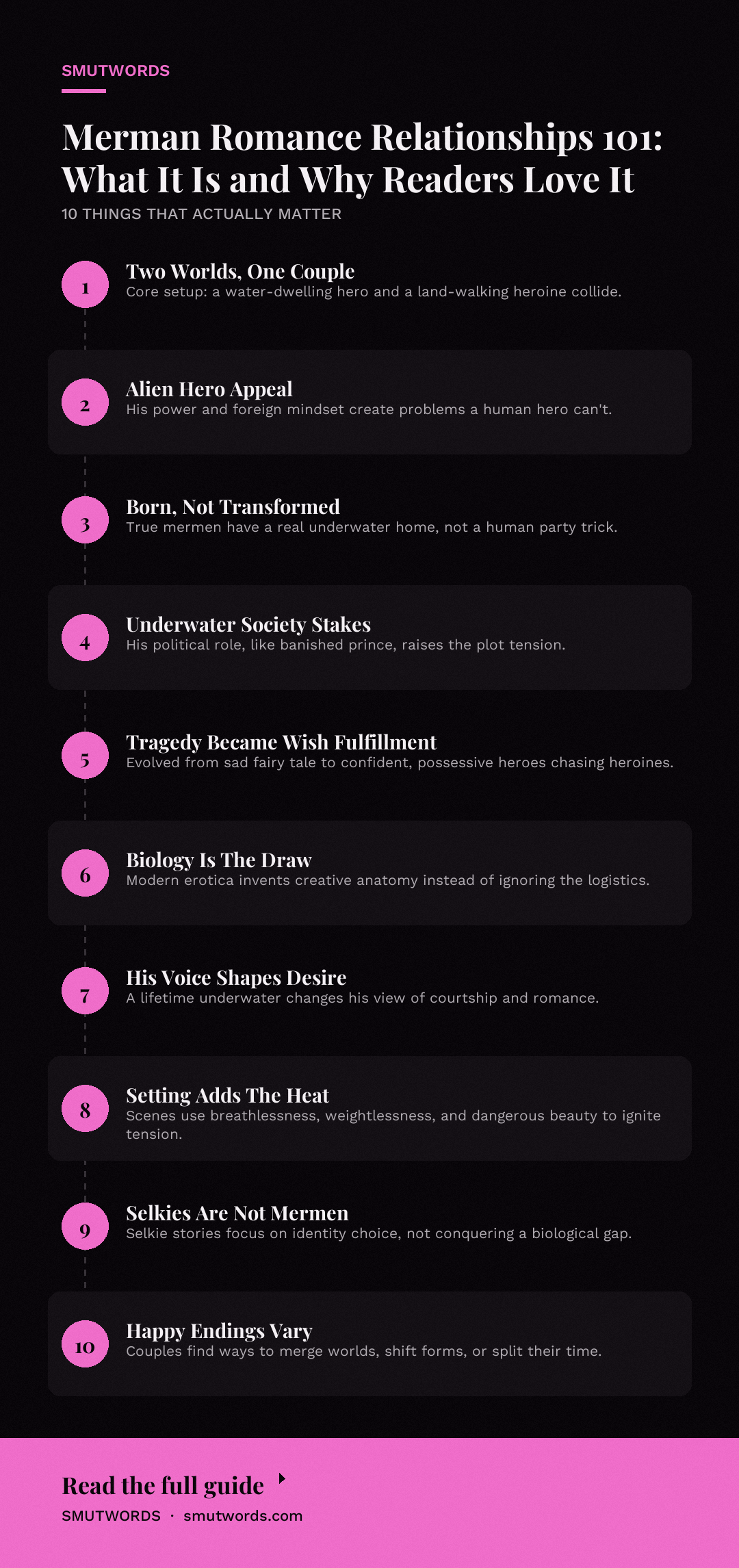
There are clear boundaries around what counts. A book about a human man who merely enjoys swimming is not one. A shapeshifter who turns into a fish occasionally is closer to a hybrid shifter situation than a true merfolk story. The defining feature is that the character is born a creature of the sea, with a genuine home and society underwater, not a human with a party trick.
Merfolk in these books are not always singular. A merman romance often features an entire underwater society, complete with politics, rivalries, and ancient laws.
The hero's status in that society usually matters to the plot. He might be a banished prince, a rebel outcast, or the heir to a throne that demands he marry a mermaid. These elements add stakes beyond the personal chemistry between the leads.
Where Merman Romance Comes From
The roots of the merman romance lie in folklore and fairy tale, but the modern publishing genre has its own distinct lineage. The most famous source material is Hans Christian Andersen's "The Little Mermaid" from 1837, which established the template of a sea creature longing for a human world and a human love. That story was a tragedy, ending with the mermaid dissolving into sea foam, but its emotional core of impossible love between species has proven endlessly adaptable.
The shift from tragedy to romance happened gradually. Disney's 1989 animated film gave the story a happy ending and cemented the merfolk romance as a mainstream concept, but it was the explosion of paranormal romance in the 1990s and 2000s that turned mermen into leading men. As vampires and werewolves saturated the market, publishers and indie authors looked for fresh supernatural creatures, and the sea offered a deep well of untapped material.
The popularity of the subgenre on digital platforms and among indie authors has driven its most recent evolution. Archive of Our Own, Kindle Unlimited, and dedicated romantasy communities have all hosted waves of merman stories. The focus has shifted from the tragic longing of the fairy tale to outright wish fulfillment, with confident, possessive, and often very large mermen pursuing human heroines with single-minded intensity.
There has also been a notable shift in how the merman's biology is portrayed. Older stories often hand-waved the logistics of a physical relationship between a human and a tailed creature. Contemporary erotic romance has become much more precise, inventing creative anatomical solutions and transformation mechanics as part of the worldbuilding. The physical logistics are now a point of appeal, not a problem to be ignored.
How It Shows Up in Erotica
The strongest merman erotica treats the hero's alien nature as a feature, not a costume. The physical differences between the lovers are not obstacles to work around but sources of erotic tension and discovery. The heroine is confronted with a body that is familiar in some ways and completely foreign in others, and the story derives its heat from her learning what he is, what he wants, and what he can do.
Common variations on the page include:
- Forced proximity in a confined space, such as an underwater cave or an air bubble within a shipwreck, which intensifies the intimacy.
- The merman as a rescuer who pulls the heroine from a shipwreck or drowning and then must keep her alive in his world while they wait for a way to send her home.
- The heroine as a scientist or marine biologist who studies him as a specimen, then finds the objective distance collapsing into personal desire.
- The merman's inability to speak the human tongue at first, forcing communication through touch, gesture, and eventually a magical or telepathic bond.
- A transformation-based romance where the heroine is given the option to become merfolk herself, or the merman gains a temporary ability to walk on land for a limited time.
- Territorial and possessive behavior, where the merman treats the heroine as his mate and defends her from threats both human and aquatic.
The hero's voice matters deeply in these stories. A merman is not a human man with scales. His worldview is shaped by a lifetime underwater, which changes his concept of property, courtship, and even physical affection.
Good authors lean into this. His idea of a romantic gesture might be bringing her a treasure from a sunken ship. His jealousy might manifest in a way that is baffling to a land-dwelling heroine. This fish-out-of-water dynamic applied to the hero himself is what separates a memorable merman romance from a human romance with a tail glued on.
Enjoyed this? Get a free book.
Join the list and we will send a complete free story straight to your inbox, plus new releases every week after that. No credit card, no catch.
The heat level is typically focused on the discovery of the body. The scale texture, the cold temperature of his skin, the sheer physical strength involved in navigating and holding a body in water, all of these become fodder for sensual description. Effective merman erotica also pays attention to the environment itself. Underwater encounters involve breathlessness, pressure, weightlessness, and the constant awareness that the environment is dangerous even as it is beautiful.
A flat version of this trope treats the merman as an excuse for pretty prose and forgets that he needs an internal life. The best books give him a culture, a history, and a reason for wanting the heroine that goes beyond her being the first human he has seen. The conflict between his duty to his own people and his desire for her is what elevates the story from a simple monster-fucking fantasy into something with genuine stakes.
For readers coming from other paranormal subgenres, a merman romance offers some familiar beats. The possessive, protective hero has much in common with the Grumpy Hero Soft for Her archetype, where the male lead's instinct to claim and guard his mate drives the romance. The key difference is the context; a merman is defending his claim in an alien, high-pressure environment rather than a suburban setting.
Merman Romance vs Mermaid Romance vs Selkie Romance
The most common points of confusion in this space are the distinctions between mermen, mermaids, and selkies, and each supports a different kind of story.
Mermaid romance is the mirror structure of merman romance, with a female merfolk love interest and a human hero. The dynamics are often quite different in practice. Mermaid stories frequently lean into seduction and danger, playing on the siren myth of the woman who lures sailors to their doom. Merman stories, by contrast, usually place the human heroine as the one who is saved or captured, which shifts the power dynamic toward the male lead.
Selkie romance involves creatures who are seals in the water but can shed their skin to become human on land. This is a fundamentally different fantasy. A selkie can pass as human, which changes the conflict from one of biology to one of identity and freedom.
Selkie stories are often melancholic, centered on the theft of the skin and the question of consent. If you are looking for a wholly inhuman hero, a selkie is not it; if you want the tragedy of a dual life, the selkie is the better fit.
The practical difference for a reader is simple: a merman romance forces the couple to conquer an environmental and physiological gap to be together. A selkie romance is about two people who could theoretically live in either world struggling with which one to choose. If the appeal is the alien, choose the merman. If the appeal is the melancholy of the between, choose the selkie.
Frequently Asked Questions
Do merman romance books have happy endings?
Yes, the vast majority of published merman romances are romances in the genre sense, meaning they end with the central couple together and committed to each other. The mechanism of the happy ending varies. Some heroines become merfolk themselves, some mermen gain the ability to shift to human form, and some couples simply find a way to split their time between both worlds.
How does sex work with a merman?
Authors handle this in a few ways. The most common is a transformation that gives the merman legs for a set period, either daily, at night, or under specific conditions. Others invent a merfolk anatomy that is compatible with human biology, often involving a retractable or cloacal arrangement that authors describe in creative detail. Scene logistics also matter; many stories take place in partially submerged environments like grottos or air-filled caverns.
Are mermen always the top in these stories?
No. The merman is usually dominant and possessive because that matches the broader appeal of monstrous male love interests, but there is plenty of variation. Some stories feature shy, curious mermen who are utterly overwhelmed by their first human contact, and others explore power exchange where the heroine takes control. Read the book description and reviews to find the specific dynamic you want.
What is the difference between a merman romance and a siren romance?
A siren is specifically a creature that uses song or allure to lure humans to their deaths, and siren romance is often darker and more morally ambiguous. A merman is a full person with a society and culture, not just a predator. While some merman romances incorporate a song-based bond, the character is rarely defined by a hunting instinct the way a siren is.
Is merman romance always paranormal or fantasy?
Nearly always. The existence of a sentient underwater species requires some departure from reality. The subgenre sits comfortably alongside other fantasy pairings like Elf Romance or Dinosaur Romance, sharing readers who want a love interest that is categorically different from a human man. Contemporary or historical settings are common, but they still include the fantastic element of merfolk.
I liked a book about a grumpy human hero. Will I like a merman hero?
Probably yes, with one caveat. The merman shares the emotional reticence and protective instinct found in the Grumpy Hero Soft for Her archetype, but his alien nature adds layers of misunderstanding and discovery. The appeal is not just watching a hard exterior crack, but watching a completely different mind learn how to love a human woman.
Final Thoughts
The best merman romances exploit the full gap between the human and aquatic worlds, using the hero's physical and cultural difference to drive both conflict and desire. If you are new to the trope, look for a book where the author clearly invested in both worldbuilding and biology, rather than one that treats the tail as window dressing.
The romance reads strongest when the water is a real place with real stakes, and the merman is a real person who just happens to have gills.





Loading comments…