
He is the one who scares everyone else in the room. The one whose resting face reads like a threat, whose answers come out clipped, whose patience runs out in under a minute.
Then the heroine walks in, and his voice drops half a register to something almost gentle. He offers her his jacket, his last slice of pie, the better half of his sandwich. He is still the same man, but she gets a version of him no one else even suspects exists.
That is the grumpy hero soft for her in its purest form. A romance trope built on the fantasy of being the single exception to a difficult man.
The appeal isn't that he changes. He doesn't, except for her. The fantasy hinges on exclusivity: everyone else gets the storm, she gets the quiet after it.
This guide covers how the trope works on the page, where it came from, why it lands so hard for so many readers, and how authors stack the emotional payoff without flattening the hero into a plush toy.
What Grumpy Hero Soft for Her Actually Means
The trope requires two visible states in one character. In public, around colleagues, family, strangers, the grumpy hero is short-tempered, sarcastic, withdrawn, or openly hostile.
He does not do small talk. He does not do favors. His default answer to most requests is a variation of no. Then the heroine appears, and a switch flips.
He is still not chatty or bubbly. He simply dials the edge back and reveals a protective, tender side that exists nowhere else in his life.
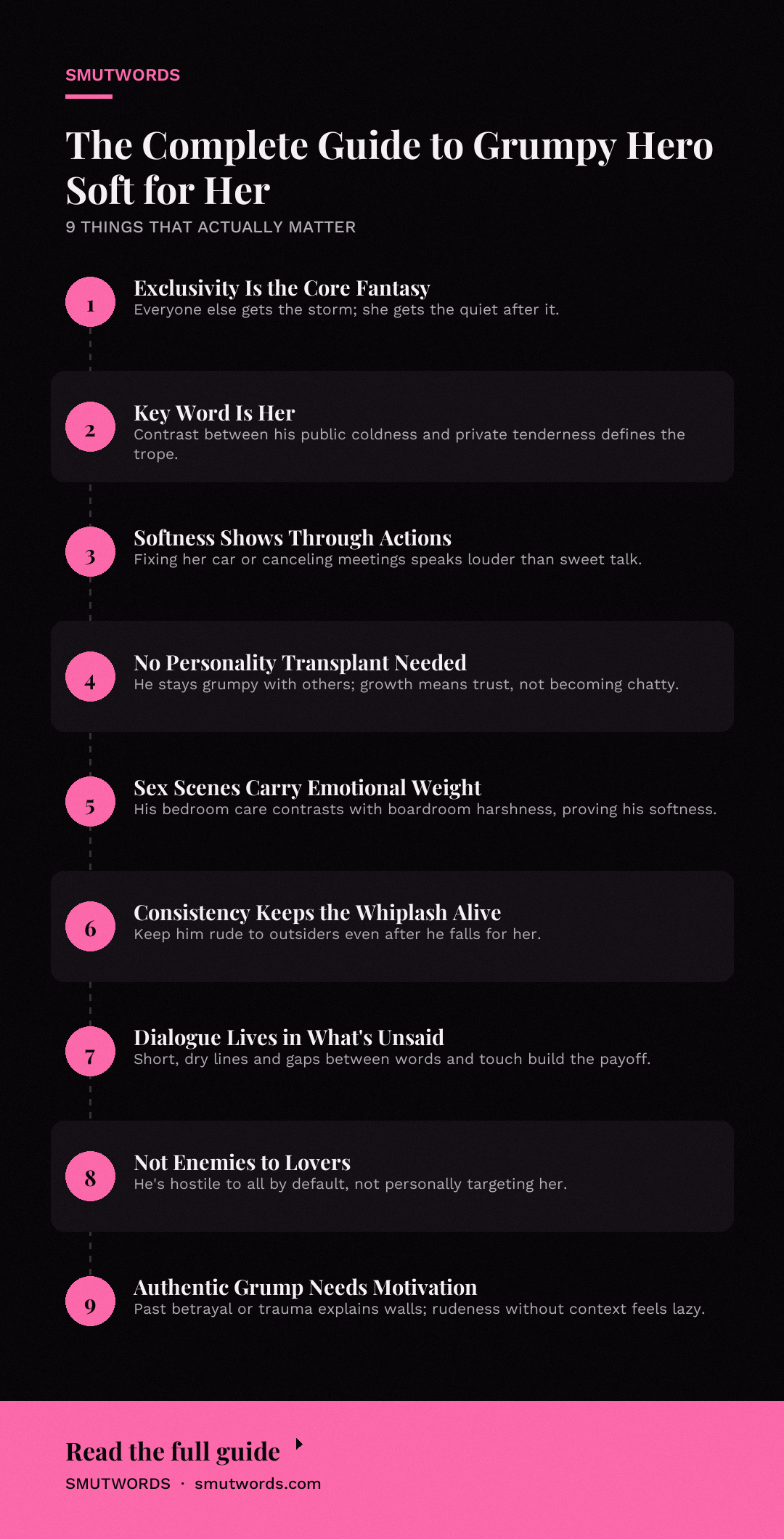
The key word in the name is her. A hero who is rude to everyone including the heroine until she fixes him is not this trope; that is a redemption arc.
A hero who is vaguely antisocial but equally soft for every friendly person he meets is not this trope either; that is just shy. The grumpy hero soft for her needs a visible contrast between how he treats the world and how he treats the heroine specifically. He snaps at the barista and then remembers she likes her coffee with extra cinnamon and orders it before she can speak.
Common misconceptions muddy the definition. He does not have to be cruel, just cold. Grumpiness runs a spectrum from rude billionaire to taciturn mountain man, and the trope accommodates both. He also does not have to be verbally affectionate.
Many of the strongest versions show his softness through actions: fixing her car, canceling a meeting when she is sick, stepping between her and any threat including his own family. The emotional reward for the reader is watching the heroine notice these cracks and realize she is the only one who gets to see them.
The trope also does not require him to change his fundamental personality. The worst executions of this trope have the hero suddenly become a sweet-talker by chapter ten. The best ones keep him grumpy with everyone else while allowing the heroine and the reader to see the man underneath. He can still grow, but the growth is about trust and vulnerability, not personality transplant.
Where Grumpy Hero Soft for Her Comes From
The brooding hero is as old as romance fiction itself. Charlotte Brontë's Mr. Rochester in Jane Eyre (1847) is an early template: harsh, mocking, secretive, and yet clearly gentler with Jane than with anyone in his social circle.
Emily Brontë's Heathcliff takes the template darker, while Jane Austen's Mr. Darcy gives the archetype its most famous social awkwardness. These nineteenth-century forebears established the core bargain: a difficult man whose affection means more because it is rare.
The modern grumpy hero soft for her congealed as a named trope in the late 2000s and 2010s, driven by the rise of bookish internet culture. Reader communities on Goodreads, Tumblr, and later TikTok began cataloging patterns, and the grumpy/sunshine pairing emerged as one of the most popular shorthand labels.
Publishing followed demand. Contemporary romance, paranormal romance, and romantic suspense all started stocking their shelves with heroes who glared at the world and melted for one woman.
The trope's lineage runs through several adjacent archetypes. The historical rake with a wounded past maps directly onto it. The tortured alpha of 1980s and 1990s category romance, think Judith McNaught or Johanna Lindsey heroes, contributed the possessive protectiveness.
The 2000s paranormal boom added literal beasts, shifters, and vampires who were hostile to humanity but devoted to their mates. Today the trope dominates in billionaire romance, where wealth and power amplify the grumpiness, and in monster romance, where the hero may actually be a creature whose soft side is even more surprising. For more on that last category, our guide to human/monster romance relationships breaks down why the contrast lands so hard when the hero isn't even human.
What shifted over time is the heroine's role. In older versions she often served as a healer, tasked with drawing out his pain through patience and love. Modern versions give her more agency and more edge. She can be grumpy herself in a double-grump pairing, or she can be a sunshine character who simply refuses to be intimidated.
The expectation that she fixes him has faded. The expectation that she earns his softness through being genuinely good for him remains, but she no longer has to accept mistreatment as the price of admission.
The term itself is a product of the fan-driven labeling era. Readers needed a way to search for the specific emotional dynamic they craved, and "grumpy hero soft for her" became shorthand that bypassed plot description entirely. A reader does not care if the grump is a duke, a CEO, or a werewolf. She wants the moment where his walls crack.
How It Shows Up in Erotica
Erotica and steamy romance handle this trope with a specific structural logic. The grumpiness establishes stakes and tension early. Then the softness pays off the promise.
A flat version of this trope gives the reader the grump and the softness but no connection between them. The hero is angry in chapter one, sweet in chapter two, and the emotional math never adds up.
A strong version makes the softness feel earned, incremental, and therefore devastating. The classic erotic structure goes something like this:
Enjoyed this? Get a free book.
Join the list and we will send a complete free story straight to your inbox, plus new releases every week after that. No credit card, no catch.
- Establish how unpleasant he is with everyone, usually in the first chapter, through an interaction with a waiter, an employee, or a family member.
- Introduce the heroine into his space and let her be the one person who does not flinch at his mood.
- Show a first crack: a small concession, a reluctant favor, a moment where his voice softens before he catches himself.
- Build physical tension where the same hands that are rough with paperwork are careful with her.
- Deliver the emotional confession, which does not have to be verbal. It can be the way he stays the night when she is sick or brings her food without being asked.
- Use sex as the ultimate proof of his softness: he is demanding in the boardroom, but in bed he watches her face, checks in, puts her pleasure above his own.
Sex scenes in these books carry an outsized share of the emotional work. The grumpy hero who is verbally stingy often becomes almost reverent in intimacy.
He says her name like it costs him something. He slows down when she asks. He holds her after, a behavior that the reader knows is reserved for her alone.
The contrast between his public aggression and his private tenderness is the erotic engine. This is why so many grumpy hero novels pair a dominate-in-public man with a heroine he surrenders control to in private, or at least treats with a care that borders on worship.
The dynamic has real overlap with femdom and hotwife fiction in that regard, where the power shift in the bedroom is the whole point. Our breakdown of where femdom and hotwife tropes overlap digs into how that reversal plays out.
Variations on the trope keep it fresh. The grumpy single father soft for the nanny adds a second layer of tenderness because the reader watches him be gentle with his child first. The grumpy soldier soft for her leans into trauma and the fear of intimacy. The grumpy boss soft for his assistant plays with power asymmetry. The grumpy monster soft for his human mate takes the contrast to an extreme: a creature who has never known gentleness discovers it only for her.
In every case, the narrative question is the same. When will he stop fighting his own softness?
Successful execution depends on consistency. The hero must stay grumpy with outsiders even as he warms to the heroine. Authors who let his public rudeness evaporate the moment he falls in love cheat the reader out of the contrast.
The best books keep scheduling a status reminder: a scene where he is horrible to someone else, then immediately tender with her, so the reader feels the whiplash repeatedly.
Dialogue is where most versions live or die. Grumpy heroes need a voice that is short, dry, and unexpectedly funny. Their affection comes through in what they do not say as much as what they do. When he tells her she looks fine when she is clearly stunning, and then he cannot stop touching her, the reader feels the gap between his words and his hands.
When he finally says something openly affectionate, it lands with the force of a confession because the reader knows how rare it is for him.
Grumpy Hero Soft for Her vs Enemies to Lovers
The most common point of confusion is between this trope and enemies to lovers. They share a surface similarity: both feature friction between the couple. The difference is directional.
In enemies to lovers, the hostility is mutual and personal. They actively dislike each other, trade barbs, sabotage each other, and only gradually realize the heat between them is attraction.
The grumpy hero soft for her has no personal vendetta against the heroine. He is hostile to everyone by default, and she simply refuses to take it personally. He was never her enemy, just her inconvenience.
A grumpy hero can overlap with an enemies to lovers plot, especially in arranged marriage or forced proximity stories, but the two tropes answer different questions. Enemies to lovers asks, "How do two people who hate each other fall in love?" The grumpy trope asks, "What does it mean to be the one person a difficult man chooses to let in?" Both deliver tension and payoff, but the grumpy version sells exclusivity where the enemies version sells transformation.
When a reader searches for one and finds the other, the disappointment is real. A heroine who spends the book fighting a hero who is deliberately cruel to her is not experiencing the soft-for-her dynamic. She is experiencing hostility that happens to resolve.
The grumpy hero may be rude, but he is never cruel to the heroine specifically. His softness is visible from early on, even if he fights it. Enemies keep their hostility pointed at each other for much longer.
Frequently Asked Questions
What is the difference between grumpy/sunshine and grumpy hero soft for her?
Grumpy/sunshine describes a pairing dynamic where one partner is grumpy and the other is upbeat. The grumpy hero soft for her is a subset of that pairing, focusing specifically on the grumpy character's transformation into tenderness only for the heroine. A grumpy/sunshine book can feature a grumpy heroine and a sunshine hero, or two grumpy people, while the soft-for-her trope always centers his exclusive softness.
Why is the grumpy hero so popular in romance novels?
Readers enjoy the fantasy of being uniquely chosen by someone who does not give affection freely. His approval, trust, and tenderness feel more valuable because they are rationed. The contrast between his public harshness and his private devotion creates emotional stakes that a universally kind hero cannot match.
Does the grumpy hero have to become nice by the end of the book?
No. The most satisfying versions keep his fundamental personality intact. He may grow more comfortable expressing affection toward the heroine, and he may soften his edges with close friends, but he should stay recognizably grumpy with the outside world. A full personality transplant undermines the trope's core appeal.
What makes a grumpy hero feel authentic instead of just rude?
Authenticity comes from motivation. A good grumpy hero has reasons for his walls: past betrayal, trauma, social anxiety, or a profession that rewards emotional distance. His behavior should show cracks that hint at the softer interior. Rudeness without context reads as the author being lazy rather than the character being wounded.
Can a heroine be grumpy too in this trope?
Absolutely. Double-grump pairings are increasingly popular. The trope works whenever one character has a visibly softer interior reserved for the other. If both are grumpy with everyone but gentle with each other in private, the exclusivity doubles and the emotional payoff intensifies.
Is this trope only in contemporary romance?
No. It appears across every subgenre. Historical romance gives the brooding duke, paranormal gives the growling shifter, sci-fi gives the stoic alien commander, and fantasy gives the cursed beast. The setting changes, the emotional logic does not.
Final Thoughts
The grumpy hero soft for her works because it promises a reward that feels exclusive. He gives the world nothing and gives her everything, and that asymmetry makes the reader feel like she is the heroine. The best versions keep him complicated, keep his tenderness hard-won, and never let the reader forget that she sees parts of him no one else does.
If you want to study the trope at its peak, pick up one of the many contemporary romance novels built entirely around this dynamic and watch how the author doles out his softness in increments. Then read the smutty bits twice. The contrast does the heavy lifting there too.







Loading comments…