
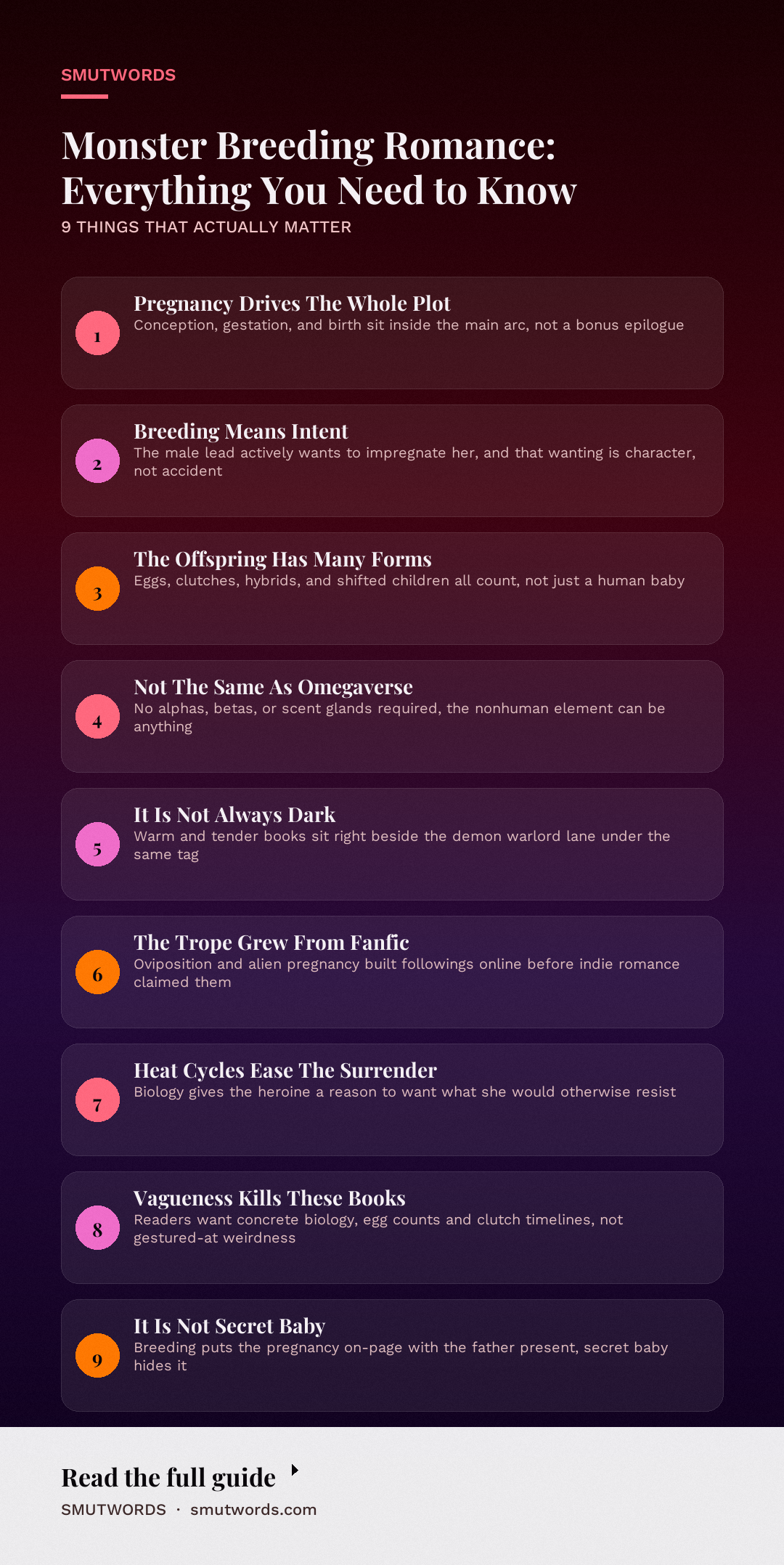
Monster breeding romance is a subgenre of monster romance where pregnancy, breeding, and offspring sit at the center of the plot rather than arriving as a tidy epilogue. The heroine is impregnated by a nonhuman creature, a shifter, a demon, an alien, or something older and stranger, and the resulting pregnancy drives the stakes, the conflict, and the emotional arc of the book.
If you have ever finished a monster romance and thought the heat was good but the aftermath got skipped, this is the corner of the genre that refuses to skip it.
What Monster Breeding Romance Actually Means
The term describes books where the biological consequences of sex with a nonhuman partner are the point. The creature is fertile, the heroine is receptive, and the story follows what grows from that: a pregnancy, a clutch, a brood, a bond that cannot be undone.
The word "breeding" carries specific weight here. It signals intent. In a breeding romance, the male lead usually wants to impregnate the heroine, and that wanting is part of his character, not an accident of plot. He is driven by instinct, by a species imperative, by a heat cycle, or by a possessive need to plant something permanent inside her.
That does not mean every monster breeding romance ends with a baby in a bassinet. Some end with eggs. Some end with a shifted child, a hybrid, a thing that should not exist and does. The offspring is central, but its form is wide open.
What does not count: a monster romance where pregnancy shows up in the last chapter as a bonus. That is a monster romance with a pregnancy epilogue. The breeding subgenre puts conception, gestation, and birth (or laying) inside the main arc, with real page time and real consequences.
Common misconceptions worth clearing up:
- It is not the same as omegaverse. There is heavy overlap, and many omegaverse books are breeding stories, but monster breeding romance does not require alphas, betas, or scent glands. The nonhuman element can be anything.
- It is not always dark. Plenty of these books are warm, funny, and tender. A shy tentacled gardener who desperately wants a family is as valid as a demon warlord.
- It is not a pregnancy fetish by default. Some readers are here for the pregnancy, some for the claiming, some for the creature. The trope serves all three.
- "Monster" is doing real work. The partner is visibly, physically nonhuman. A moody billionaire with fangs in one scene is not a monster.
Where Monster Breeding Romance Comes From
The honest history of this trope lives in publishing, not in folklore. Monsters have impregnated humans in myth for millennia, but the specific shape readers recognize today formed in online fanfiction communities through the 2000s and 2010s, where writers paired nonhuman characters with human ones and let the biology get weird.
Oviposition, tentacles, and alien pregnancy all developed dedicated followings in fandom spaces first. Writers experimented with anatomy, gestation, and hybrid offspring because fanfic rewards exactly the kind of detail traditional publishing used to cut. A reader who wanted the eggs on the page could find them.
The Kindle Unlimited boom of the mid-2010s and after pulled that audience into indie romance. Authors writing monster romance realized readers were not just tolerant of breeding plots, they were searching for them by name. Covers changed, blurbs changed, and the trope moved from subplot to selling point.
The last several years brought a visible split. One lane went dark, with non-consent, captivity, and breeding as conquest. Another lane went soft, with devoted mates, negotiation, and domestic tenderness after the heat fades. Both are thriving, and both get shelved under the same tag.
The biggest shift is respectability inside the genre itself. A few years ago, breeding was a secret search term. Now it is a category with its own bestseller lists and its own conventions about what a satisfying ending looks like. If you are new to the wider genre, the best SmutWords books for monster romance beginners is a good place to calibrate before going straight for the breeding shelf.
How It Shows Up in Erotica
On the page, a monster breeding romance runs on a specific engine: the physical reality of a nonhuman body doing something a human body cannot. The craft is in the specifics.
Strong versions get concrete fast. How many eggs. How long the clutch takes. What the heat does to her body and her judgment. What his species calls the bond.
Vagueness kills these books. A reader who came for breeding wants biology, and the difference between a flat scene and a great one is usually a writer who committed to the weird details instead of gesturing at them.
The heat cycle is the most common on-ramp. It gives the heroine a biological reason to want something she would otherwise resist, which is the entire appeal of enemies to lovers energy aimed at a creature instead of a rival duke. The heat removes the polite hesitation and gets the characters into the room.
Fated mates does similar work from the other direction. If the bond is real and inescapable, then the breeding is not a mistake, it is a destiny, and the heroine can surrender to it without the story losing her agency. The best authors still give her a genuine choice inside that structure, even if the choice is only about how she meets it.
Common variants you will run into:
Enjoyed this? Get a free book.
Join the list and we will send a complete free story straight to your inbox, plus new releases every week after that. No credit card, no catch.
- Oviposition: eggs instead of a fetus. Often gentler in tone than it sounds, with the laying treated as intimate and careful.
- Tentacle breeding: the creature's anatomy does the work, and the scene focuses on texture, restraint, and multiple points of contact.
- Shifter pregnancy: the partner is a wolf, bear, dragon, or similar. The pregnancy raises hybrid questions and often a pack or clan plot.
- Alien pregnancy: science fiction framing, gestation timelines that are not human, and offspring that may not be humanoid.
- Demon breeding: the darkest lane. Binding, contracts, hell, and a mate who is monstrous to everyone but her.
- Knotting and heat: the physical mechanics of mating are described in detail and the bond is often permanent.
What makes a flat version flat is almost always the same problem: the breeding is an event instead of a relationship. A good book makes the pregnancy reorganize the couple's life. He has to learn what she needs; she has to decide what she is willing to become.
The nursery, the nest, the hoard of soft things he builds for her: all of that is characterization disguised as set dressing.
The protective angle matters too. A monster who is terrifying to the rest of the world and tender with her is the emotional core of the trope, and that is a cousin to the appeal of a redemption arc romance, where a dangerous figure earns his place through devotion rather than apology.
If you read for dominant, controlling male leads generally, the alphahole meaning breakdown covers the human version of this dynamic, and it is useful for spotting which authors are actually writing a monster versus a man in a rubber suit.
Monster Breeding Romance vs Secret Baby
These two get confused constantly, and the confusion costs readers good recommendations. They share a pregnancy, but they use it completely differently.
A secret baby story hides the child. The heroine conceives, the father leaves or never knows, and the child resurfaces years later as a revelation that forces the couple back together. The pregnancy is a plot device stored off-page.
Monster breeding romance does the opposite. The pregnancy is on-page, often in explicit biological detail, and the father is present and invested, frequently possessive about it. There is no concealment because the whole point is the claiming. If the heroine is hiding a hybrid baby from the creature who put it there, you are reading a secret baby story wearing a monster costume.
Ask one question to sort them: does the story want you to watch the breeding happen, or does it want you to discover the result? Watching means breeding. Discovering means secret baby.
Frequently Asked Questions
Is monster breeding romance the same as omegaverse?
No, though they overlap heavily. Omegaverse is a specific worldbuilding system with alphas, betas, omegas, and scent-based biology. Monster breeding romance only requires a nonhuman partner and a pregnancy that matters to the plot. Many omegaverse books are breeding books, and many breeding books have no omegaverse elements at all.
Do monster breeding romances always end with a baby?
Usually, but the offspring does not have to be a human infant. Eggs, clutches, hybrids, and shifted children are all common. Some books end mid-pregnancy with a bonded pair and a settled future, which readers generally accept as a complete arc as long as the breeding itself is resolved.
Is this trope always dark?
Not at all. The dark lane exists and is popular, but a large share of the category is warm and even sweet: a lonely creature who wants a family, a heroine who chooses him deliberately, and a domestic aftermath full of nesting and care. Tone varies more than the tag suggests.
Can I read monster breeding romance if I do not want pregnancy content?
Probably not this specific trope, since the pregnancy is the plot. If you like nonhuman partners but want the focus elsewhere, read general monster romance instead. If you want the claiming and possessiveness without the offspring, look for fated mates books that end at the bond.
What is oviposition, exactly?
It is the variant where the creature deposits eggs rather than impregnating the heroine with a fetus. The eggs are typically laid later in the book, and the scene is often written as intimate and physically detailed. It is one of the most-searched variants within the trope.
Are these books standalone or series?
Both. Standalones are common in the softer lane. Series are common in the darker and more worldbuilt lanes, often following a clan, pack, or ship where each book pairs a new couple. Starting with book one is usually best when the species biology carries across installments.
Final Thoughts
Monster breeding romance works because it takes the highest-stakes thing a romance can do, create a permanent bond with a future attached, and makes it literal, physical, and strange.
The best entry point into the whole category is the SmutWords monster romance starter list, which sorts the softer and darker lanes clearly enough that you can pick your first book without guessing. If you are also curious who is actually writing these books, the SmutWords authors guide is worth a read before you start collecting favorites.





Loading comments…