
An alphahole is the male love interest who opens the book acting like the worst man you've ever met and closes it as the only one you'd want. He's arrogant, controlling, frequently cruel in the early chapters, and utterly convinced he doesn't need anyone. Then the heroine walks in, and every possessive instinct he has locks onto her with terrifying focus.
The alphahole meaning in romance is specific. He is not a villain. He is not abusive by authorial intent, and he is not a soft boy hiding under a leather jacket. He is a genuinely hard man whose emotional armor cracks for exactly one person, and the entire book is the sound of that crack widening.
The term itself is a portmanteau, "alpha male" welded to "asshole," and it has become one of the most searched and most misunderstood character types in contemporary romance. This guide covers where the type came from, what separates a well-written alphahole from a lazy one, how he shows up on the page in explicit fiction, and why readers keep coming back to a man who has to be dragged kicking and snarling into love.
What Alphahole Actually Means
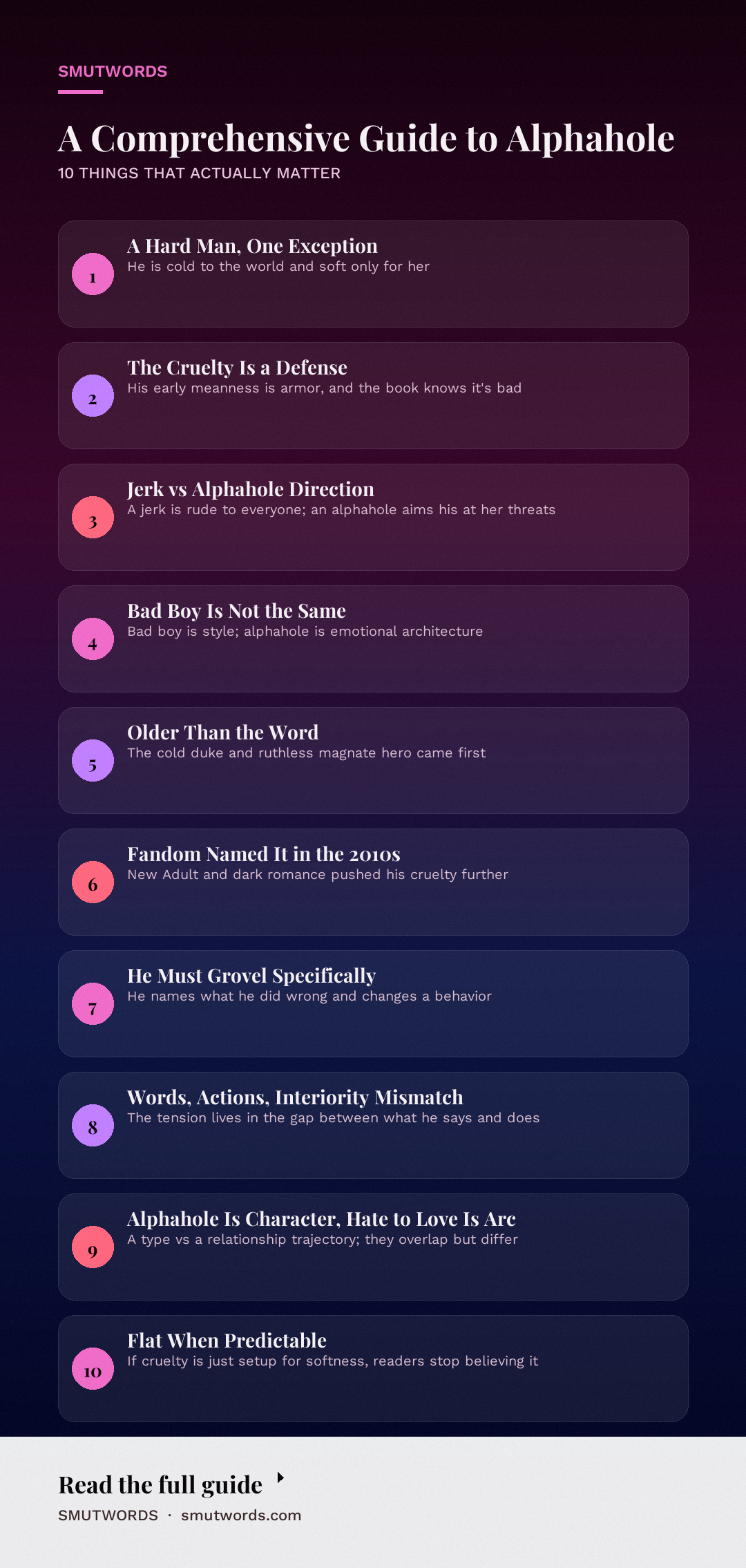
An alphahole is a dominant, emotionally closed-off male lead whose cruelty in the first act is a defense mechanism, and whose possessiveness and protectiveness toward the heroine are the tell that he is already gone for her.
The "hole" half of the word is doing real work. It flags that his behavior in early chapters is bad, that the narrative knows it's bad, and that the reader is meant to hold that against him until he earns his way out.
What separates an alphahole from a generic jerk is the direction of his aggression. A jerk is casually rude to everyone, including the heroine, and never changes. An alphahole's hostility is pointed, strategic, and usually aimed at anyone who threatens her. He'll humiliate her in a boardroom and then destroy a man who looked at her wrong in a parking garage, and the second behavior is the one that reveals his actual position.
Several things don't count, and readers are strict about this:
- Genuine cruelty with no redemption arc. If he never softens, never apologizes, never reveals the wound underneath, that's an abusive love interest, not an alphahole. The genre demands the payoff.
- A cinnamon roll in disguise. If his bark is worse than his bite from page one and the heroine can tell immediately, he's a grumpy hero. Alphaholes make the heroine genuinely unsure whether he hates her.
- A villain the author forgot to redeem. An alphahole has to want the heroine in a way that costs him something. A villain who wants her the way he wants a merger is a different character entirely.
- Dominance in bed alone. Alphahole is about how he moves through the world and how he treats her outside of sex. Plenty of dominant love interests are warm, generous, and communicative. That's not an alphahole.
The most common misconception is that alphaholes are interchangeable with bad boys. Bad boy is about style: tattoos, motorcycles, a criminal past, a refusal to follow rules.
Alphahole is about emotional architecture: the specific combination of dominance, arrogance, and possessiveness wrapped around a wound he won't name. A bad boy can be an alphahole, but he's just as likely to be a sweet, emotionally available man who happens to ride a motorcycle. The two terms overlap without being the same thing.
Where Alphahole Comes From
The alphahole as a recognizable type is older than the word. In the classic romance canon, he shows up as the brooding, high-handed duke, the cold earl who needs an heir, the ruthless shipping magnate from the 1980s category romances.
Those books delivered a dominant, emotionally unavailable hero who treated the heroine badly until the final chapter, when his hidden devotion was revealed and the whole thing was reframed as love. Readers ate it up. Publishers published millions of copies.
The word "alphahole" itself is a product of internet romance fandom, emerging in the 2010s alongside a wave of New Adult and dark romance titles that pushed the hero's early cruelty much further than the old category romances ever dared.
Where a Harlequin Presents hero might be cold and presumptuous, the new alphaholes were openly hostile, sometimes violent in ways the genre framed as protective, and frequently engaged in explicit power struggles that ran through every chapter. Blogger and Goodreads culture needed a shorthand for this very specific archetype, and the portmanteau stuck.
What has shifted most is the accountability. Older alphaholes were often forgiven by narrative fiat. He was cruel, then he said "I love you," and the book ended.
Contemporary versions demand more. He grovels. He names the specific thing he did wrong.
He changes a behavior, not just a mood. The modern alphahole might be the CEO who publicly humiliated his assistant in chapter three, and by chapter twenty-five he is on his knees in her apartment, having lost a deal that mattered to him because he chose her over it. The apology has to match the wound.
The rise of dark romance and the mainstreaming of the anti-hero pushed the type further still. It also created a backlash, and readers now routinely debate whether a given book's alpha has crossed from compelling into unforgivable.
That debate is part of the genre's health. The alphahole works when the reader understands exactly why she's forgiving him, and doesn't work when the book tries to skip that step.
How It Shows Up in Erotica
On the page, an alphahole book runs on a specific engine: proximity and friction. The heroine is forced into his orbit, usually by circumstance (a job, a contract, a forced marriage, a shared business) and the proximity gives him constant opportunities to be awful, watchful, or both.
Every interaction is loaded. He says something cutting. She holds her ground. He watches her walk away and something in his chest does a thing he refuses to name.
A strong alphahole scene almost always has three layers running simultaneously. There's what he says, which is cold or contemptuous. There's what he does, which is possessive or protective in a way his words contradict. And there's what the prose reveals about his internal state, usually through a limited third person voice that lets the reader see the gap between his behavior and his feelings.
The reader is meant to be inside that gap. When the words, actions, and interiority all point the same direction, the character flattens into a plain asshole or a plain sweetheart. The tension lives in the mismatch.
Authors handle the turning point in a few recognizable ways, and each produces a different flavor of the same trope:
- The injury or danger arc. The heroine is threatened, and the alphahole's mask drops completely. He physically inserts himself between her and the threat, handles the problem with unnerving efficiency, and then has to sit with how exposed he just made himself. This version pairs naturally with enemies to lovers structures, where the external threat gives both characters permission to stop fighting long enough to notice each other.
- The forced vulnerability. He's injured, sick, or backed into a corner that requires her help. Stripped of his usual control, he says or does something honest, and the whole book recalibrates. This is where so many alphaholes become physically and emotionally needy for the first time, and the sex that follows tends to be raw and disarmed.
- The grovel arc. He does something bad enough to lose her, and the back half of the book is him earning her back. The crucible here is that his apology has to be specific. A vaguer "I'm sorry" reads as hollow, and readers will say so in the reviews.
- The slow thaw. No single dramatic event, just page after page of small cracks in the armor, until he's suddenly telling her something he's never told anyone. This version requires a stronger voice and more patience from the author, and it produces the most quietly satisfying alphaholes.
Sex scenes in alphahole books tend to lean dominant and possessive. He's controlling in bed the same way he's controlling everywhere else, but the crucial difference is that in bed the control is welcome and mutual, and it lets him express the hunger he can't admit to in daylight.
Enjoyed this? Get a free book.
Join the list and we will send a complete free story straight to your inbox, plus new releases every week after that. No credit card, no catch.
A well-written alphahole sex scene often has a moment where his composure breaks, where he says something he didn't plan to say, and the heroine clocks it. That break is the whole point of the trope.
What makes a flat alphahole? Predictability. If every cruel line is clearly just a setup for a soft line later, the reader stops believing the cruelty.
The strong versions let the meanness land with real weight, allow the heroine to be genuinely hurt, and let the man earn his way back through sustained effort. The weak versions rush the redemption, or worse, offload the responsibility onto the heroine to "see through" his behavior without him doing any work.
The trope also intersects with a whole family of related dynamics. Alphaholes often appear in revenge romance, where his pursuit of the heroine is tangled up in a grudge he's nursing against her family. They show up in marriage in trouble stories, where the marriage collapses because of his emotional unavailability and has to be rebuilt.
They're common in prince/princess romance, where royal protocol and a cold upbringing supply the armor, and they can appear in unexpected settings like lumberjack romance, where the isolation of a small town or a mountainside cabin gives the man a plausible reason to have never learned how to be soft.
The bedroom dynamics that accompany alphahole books can also bleed into broader kink territory. Readers who like the possessive, claiming energy will often find the same charge in a fluid bonding discussion, where the exclusivity is the point, or in an impregnation kink storyline, where his possessiveness extends to wanting to mark her in the most permanent way available.
The secret baby trope often pairs with an alphahole precisely because his reaction when he finds out is the emotional explosion the whole book has been building toward.
For readers who want the possessive energy in a different register, musician romance often swaps corporate power for creative ego, and the best hotwife books for beginners explore possessiveness from a completely different angle, where the alpha has to learn to share rather than claim.
Alphahole vs Hate to Love
The two are close cousins and readers mix them up constantly. Hate to love describes an arc between two characters who begin the book actively disliking each other and end up in love. It's about the relationship's trajectory, and it can apply to any pairing, including sweet ones.
Alphahole describes a character type. You can have an alphahole who isn't in a hate to love story (the heroine might be drawn from page one), and you can have a hate to love story with no alphahole in it at all (both leads can be perfectly nice people who simply clash).
When they overlap, the combination is potent. An alphahole who also hates the heroine produces a book that leans harder on friction than almost any other configuration, and the payoff lands correspondingly harder.
When they don't overlap, the alphahole is a man who is awful in general but not to her specifically, or awful to her while clearly already obsessed. Both work. They just hit different notes.
Frequently Asked Questions
Is an alphahole the same as a toxic love interest?
Not exactly. An alphahole is a specific character type within romance, and the term assumes the book is doing the work of redemption, growth, and accountability. A toxic love interest is a broader category that includes alphaholes who never earn their ending, plus plenty of characters who aren't alphaholes at all. The word "alphahole" is descriptive of the archetype; "toxic" is a judgment on execution.
Why do so many readers find alphaholes attractive?
The fantasy is specific: a man who is hard, guarded, and untouchable in every other context, and who is soft only for her. The appeal isn't the cruelty. It's the promise that her presence is the thing that changes him. It's the same emotional logic behind every "I can fix him" story, but in romance the fixing is mutual, he does the work, and the reward is a love that feels earned rather than freely given.
Do alphaholes only appear in dark romance?
No. They're most visible in dark romance and contemporary romance with a possessive hero, but the type shows up across almost every subgenre, from historicals to paranormal to small town. The intensity dial varies, but the core architecture (arrogant, closed off, possessive, secretly devoted) travels.
What's the difference between an alphahole and a grumpy hero?
A grumpy hero is rude in a soft, low-stakes way, and the heroine usually clocks the kindness underneath almost immediately.
An alphahole pushes further. His early behavior is genuinely hurtful, and the reader is not supposed to see the softness until the book lets her. Grumpy is a mood. Alphahole is a structure.
How much grovel is enough to redeem an alphahole?
Enough that the heroine's decision to take him back feels earned to a skeptical reader. Some authors go heavy on the grovel, with multiple chapters of him proving his change. Others use a single, devastating, specific apology that lands harder because it's not hedged.
The amount matters less than the specificity. He has to name what he did, say why he did it, and show her a different behavior going forward.
Can an alphahole be the heroine?
Yes, though it's less common. The type is gendered male by convention and by the word itself, but the same architecture (dominant, emotionally closed off, possessive, secretly devoted) can be written into a female lead, and readers are increasingly happy to see it. The term "alphahole" is usually reserved for the male love interest, but the dynamic translates.
Final Thoughts
The alphahole works when the author has the patience to let him be genuinely difficult, and the nerve to make him earn the heroine back with actions rather than a single well-timed confession. The trope rewards specificity: the sharper his cruelty, the more precise his grovel has to be.
If you want to see what a well-executed alphahole looks like on the page, the ranked list of books below this article is the place to start. The top pick is a clean example of a man who starts the book as the worst decision the heroine could possibly make and ends it as the only one she'd make again.








Loading comments…