
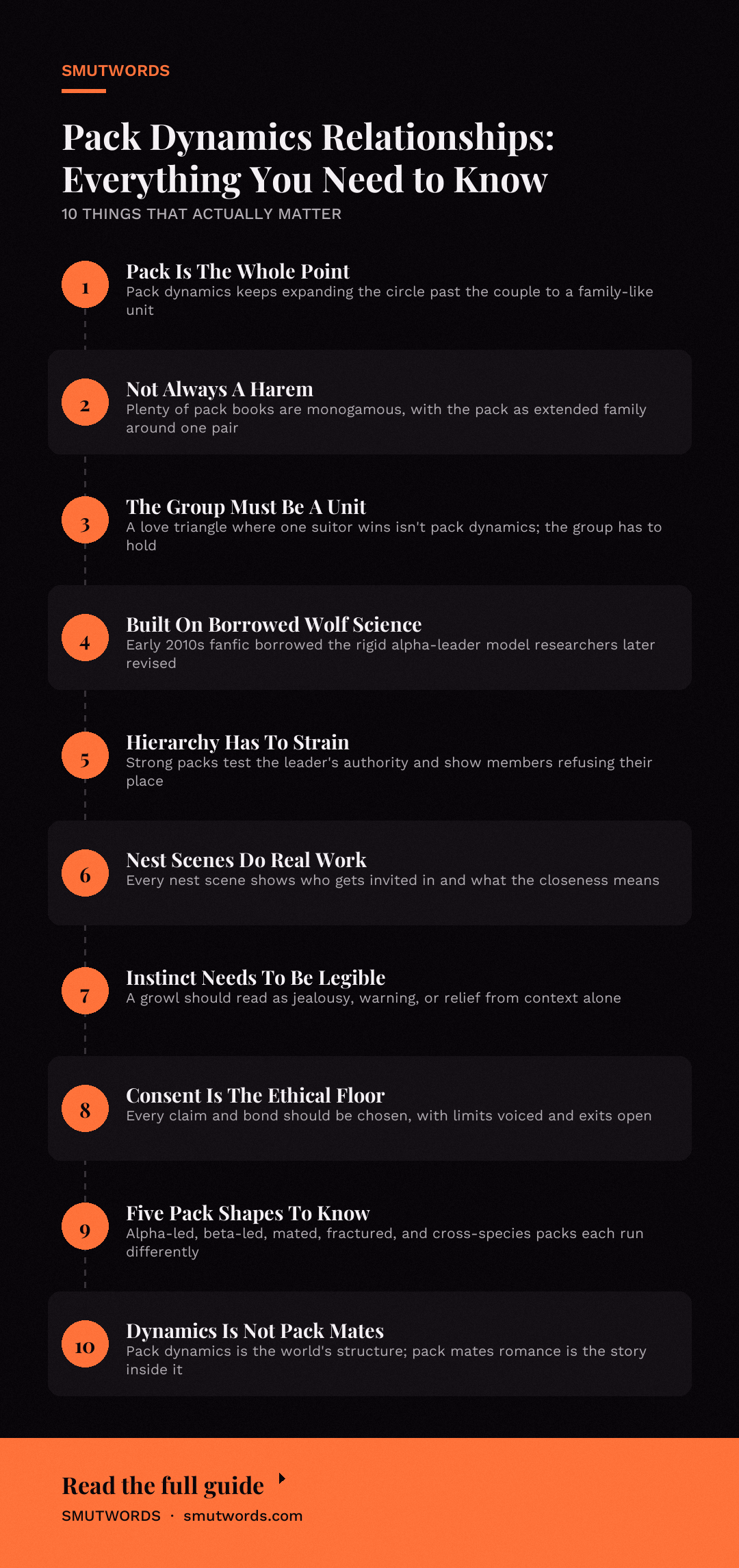
Pack dynamics is the social architecture of omegaverse romance: the rules, bonds, and hierarchies that hold a group of alphas, betas, and omegas together as something closer to a family than a couple. Where most romance novels end at the pair, pack dynamics novels keep expanding the circle.
A pack can be two people or eight. It can be a traditional wolf-style hierarchy with a single dominant leader, or a chosen family of misfits who vote on what to eat for dinner. What unites every version is the same promise: nobody in this group is going to be left alone, and nobody is going to be turned away for wanting too much.
The term shows up in review after review for a reason. Readers who are tired of romances where the couple has to fight the entire world alone find something almost unbearably satisfying in a book where the world itself rearranges to make room for them. Pack dynamics is the machinery that does the rearranging.
What Pack Dynamics Actually Means
The word "pack" gets borrowed from wolf biology, though the science of real wolf packs has never been the point. In alpha/beta/omega dynamics, a pack is a bonded social unit built around complementary instinctual roles. Alphas typically carry dominance, protectiveness, and a strong drive to claim. Omegas carry heat cycles, heightened scent sensitivity, and a tendency to be fiercely guarded by the pack.
Betas occupy the widest range: they can be leaders, peacekeepers, caretakers, or the steady emotional center that keeps the whole thing from tipping into chaos.
What counts as a pack varies enormously across authors. A pack can be biologically related, or it can be assembled from strangers who recognize each other by scent and instinct. It can be legally recognized in the story's world, or it can exist entirely outside any official structure.
What does not count as pack dynamics is a simple love triangle where multiple suitors compete and one wins. Pack dynamics require that the group itself becomes a unit, with all its members holding a place in the social structure. Even when one relationship is central, the pack is a character in its own right.
The most common misconception is that pack dynamics always means a harem or reverse harem. Plenty of pack books are strictly monogamous, with the pack serving as extended family and support system around a single bonded pair. Others are polyamorous by design, and the group romance is the whole point. Both exist under the same umbrella, and the umbrella is broad enough to hold them.
Where Pack Dynamics Comes From
Pack dynamics as a recognizable trope in published romance is younger than most readers assume. Omegaverse itself grew out of fanfiction in the early 2010s, spreading through Supernatural, Teen Wolf, and other fandom spaces before migrating into original fiction.
Those early stories borrowed wolf-pack social structures from popular science writing of the 1990s, which described wolf packs as rigid dominance hierarchies built around a single alpha leader. Actual wolf researchers have since thoroughly revised that model, but it was already baked into the fiction by the time anyone corrected the record. Romance kept the myth because the myth was more useful than the truth.
The pack element evolved separately from the alpha/omega biology element. Early omegaverse stories often focused on a single pair and the biological intensity binding them. As the subgenre matured, authors began asking what happens after the pairing, and pack dynamics filled that space. A bonded pair with nowhere to go became a bonded pair joining a larger family, with all the social negotiation that implies.
Two publishing shifts accelerated the trend. First, indie publishing gave omegaverse authors direct access to readers and the freedom to write non-traditional relationship structures at length. Second, the rise of reverse harem and why-choose romance created an audience already primed for group dynamics, and many of those readers crossed over into pack books because the emotional appeal was identical. The result is a subgenre where pack dynamics can anchor a single novel, an eight-book series, or a sprawling shared universe.
Shifter romance carried a parallel version of the same idea. The territorial shifter trope has been building pack hierarchies into paranormal romance since the 1990s, and many readers move between the two subgenres without noticing the seam. The vocabulary overlaps heavily even when the worldbuilding sets them apart.
How It Shows Up in Erotica
The craft question with pack dynamics is always the same: how does an author make a group feel like a single organism rather than a cast list? The answer almost always comes down to structure, and structure is what separates a strong pack book from a flat one.
The hierarchy has to mean something
A pack with an alpha, a beta second, and a handful of others is doing the equivalent of introducing a group of coworkers and expecting readers to track them all. The authors who pull it off give every position real stakes. The alpha's authority has to be tested at least once. The beta's role as mediator has to be dramatized, not just described.
A flat version of this trope introduces a hierarchy and never lets it strain. A strong version puts the hierarchy under pressure and shows what happens when a member refuses their place, or when the leader's decision is wrong and the pack has to negotiate a different answer.
The nest is a scene, not a decoration
The shared nest is where pack life becomes physical on the page. Nests in omegaverse can be as simple as a pile of blankets and as elaborate as a climate-controlled room built for heat cycles, and the best authors treat every nest scene as an opportunity.
Enjoyed this? Get a free book.
Join the list and we will send a complete free story straight to your inbox, plus new releases every week after that. No credit card, no catch.
A nest scene lets the reader see how the pack touches each other, which members are invited in, whose scent dominates the bedding, and what the physical closeness means to each person present. Sensory texture works especially well here, and the principles in this guide to sensory play for couples apply directly to any author writing a scene that's about fabric, warmth, and contact.
Instinct is a language, not an excuse
Pack books lean hard on instinctual behavior: scenting, claiming, growling, hovering. The good ones make those behaviors legible. A growl can mean jealousy, warning, or relief, and the reader should be able to tell which by context. When instinct is used as a shortcut to justify any behavior, the scene loses its charge because nothing is at stake.
Common pack variations
- Traditional alpha-led pack. A single dominant leader runs the group. Conflict usually comes from succession, or from an omega who refuses to accept the leader's claim.
- Beta-led pack. The steady voice runs the show. These books tend to be quieter and more emotionally driven, with the beta as the engine of the relationship arc.
- Mated pack. Every member is bonded to every other member, often through a soulbond. These scenes prize group intimacy and the discovery of how the whole pack fits together.
- Fractured pack. The group exists but is broken or failing. The plot is the slow rebuild, and the romance runs through the repair work.
- Cross-species pack. Shifters, elves, angels, or other beings form a pack by choice across species lines. These books use the pack to explore chosen family.
What makes a strong version work
The pack books that stay with readers are the ones where every member has a distinct relationship with every other member, and where the group's dynamics change from the first page to the last. A pack at chapter one should not be the same shape as the pack at chapter thirty. The strongest versions push the pack through a real test (a rival pack, a member's departure, a leader's failure) and show the group adapt as a unit.
Consent is the other line that separates good from flat. The best pack books build negotiation into the dynamic itself, so that every claim, every bond, and every mating is something the members actually choose. The fantasy of instinct overriding modern isolation works precisely because the people in it remain free to say no.
That is the emotional engine, and it is also the ethical floor. Fictional dynamics of dominance and submission should always mirror real-world consent, with every pack member free to voice limits and leave if they choose.
Pack Dynamics vs Pack Mates Romance
These two terms get used interchangeably, and they are not the same thing. Pack dynamics describes the structure of the group: the hierarchy, bonds, and social rules that hold it together. Pack mates romance is a narrower label for the specific relationship arc between pack members, usually focused on the bond between two or more mates within an established pack. Think of pack dynamics as the world, and pack mates romance as the story that happens inside it.
In practice, most pack mates romance uses pack dynamics as its scaffolding, and most pack dynamics books include at least one pack mates romance at the center. The distinction matters mostly to readers searching for one or the other. If you want the group structure and how it changes, you want pack dynamics. If you want a focused relationship between two members already inside a pack, you want pack mates romance.
Frequently Asked Questions
What is pack dynamics in omegaverse romance?
It's the system of relationships and hierarchy that holds a group of alphas, betas, and omegas together as a family-like unit. Pack dynamics covers who leads, how members bond, how conflict is resolved, and what the shared nest means to everybody in it. It's the group half of the omegaverse equation.
Does pack dynamics always mean a polyamorous relationship?
No. Plenty of pack dynamics books are monogamous, with the pack acting as extended family and support structure around a single pair. Others are polyamorous and center the group relationship. Both are common, and the subgenre tags usually make the difference clear before you start reading.
What does "mated pack" mean?
A mated pack is one where every member is bonded to every other member, usually through a soulbond or a formal claim. These books treat group intimacy as the central romance rather than a side element. Mated pack stories often include heat cycles, scent-marking, and nest-building as recurring scenes.
Why do readers love pack dynamics so much?
The appeal is built-in family and belonging. A pack offers unconditional acceptance and protection, and the instinct-driven closeness of the bond gives the story an emotional intensity that modern solo isolation can't match. The fantasy is being known and kept by a group that chose you and won't let go.
Is there a difference between pack dynamics and pack mates romance?
Yes. Pack dynamics describes the structural rules and bonds of the group. Pack mates romance describes the romantic relationship arc between members inside the pack. Many books use both, and readers searching for one often find the other.
How do consent and power fit into pack dynamics?
Pack dynamics often involves a hierarchy with a leader and submissives, and the strongest versions make that hierarchy consensual at every level. Members should be able to voice limits, renegotiate their role, and leave if they choose. When a book treats the hierarchy as an excuse for coercion, the dynamic stops being erotic and starts being a problem.
Final Thoughts
Pack dynamics is the romance subgenre that figured out a very specific reader hunger and then built a whole architecture to feed it. The group is the point. The hierarchy, the nest, the scent, and the bonds exist to make a reader feel, for a few hundred pages, that a whole crowd of people would show up if anything happened to them.
If you're new to the trope and want a book that handles the full structure well, start with a fractured pack story. The group is broken at the open, the hierarchy is up for grabs, and the romance has to do the work of rebuilding a family from scratch. That's where pack dynamics shows everything it can do.




Loading comments…