
What Sensory Play for Couples Actually Involves
Most people come to sensory play for couples through a single object: a silk scarf, a feather from a craft store, an ice cube. Then they run out of ideas. Or they try too much at once and the whole thing collapses into giggling and a vague sense that they're doing it wrong.
Good news: sensory play is the most forgiving entry point into kink that exists. Nobody gets bruised, nobody needs a safeword check mid-tie, and if the blindfold is crooked you just take it off.
Here's the honest version. Sensory play is about controlling what a partner feels, and just as importantly, what they don't feel. It's the deliberate sequencing of touch, texture, temperature, and sensory input (or the removal of it) to build anticipation, to make ordinary sensation feel strange and heightened, and to slow everything down until a room with the lights off feels enormous.
This guide covers the tools, the pacing, the safety checks that actually matter, and the parts people skip: how to bring it up without making it weird, and how you'll know when to stop.
Why People Like It (And What It Does to a Brain)
When you take away sight, hearing, or the ability to move predictably, the brain reallocates attention. Touch gets louder. A fingertip dragged down a forearm is suddenly a different event. This is why a blindfold is the most common first sensory tool and why so many people keep using one for years.
The other thing sensory play does is hand over control in a way that's legible. One person chooses the feather, the ice, the warm oil, the amount of pressure, the timing. The other person receives it. That's a clean, contained exchange of power, and if you like that dynamic even slightly in fiction you'll probably enjoy it physically.
If the whole dominant-partner thing appeals to you conceptually, a book like She Made the First Move: A Dominant Wife Awakening gets at the psychological texture of someone discovering they like being in charge. Reading is a fine place to explore the idea before you try it. So is a classic boss/employee romance, which runs the same power exchange with a desk between them.
The Starter Kit: Textures Worth Owning
You don't need a store. A house has most of this already. But if you want a curated set, here's what's actually worth the money and why, with notes on each.
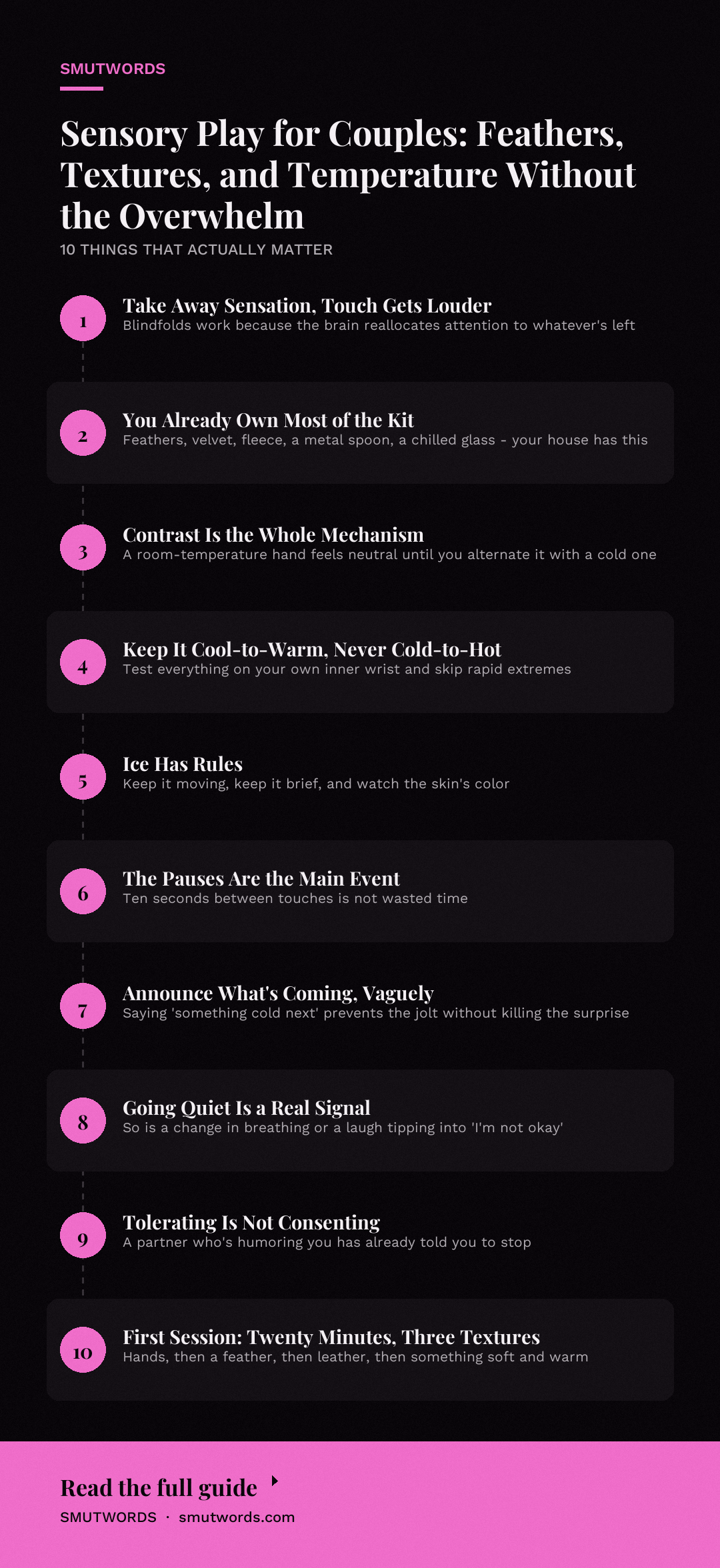
- Feathers. The beginner default, and for good reason: feather-light touch activates the fine tactile nerves that register tickle and anticipation. Pinion feathers are stiffer and more tickly; marabou is so soft it works almost as a tease, dragging rather than tickling. Two of each is plenty.
- Soft leather or faux leather. A strip of leather dragged across skin reads as something with substance. Good for deeper pressure, for comparison after a feather, for that slow drag over the shoulders.
- Velvet or satin. Smooth and slightly temperature-holding. Satin against skin has no drag at all. Velvet has a nap and a direction. Run velvet the wrong way and it's a different tool.
- Bristle brushes. A soft pastry brush, a silicone basting brush. These are for edges: fingertips, the inner curve of the wrist, the backs of knees. Do not go near anything with actual stiffness. A sturdy bristle brush is not a sensory toy.
- A fleece mitt or plushie. Underrated. Broad softness, warm, good for the cool-down.
- Ice. Temperature play with actual ice comes with real risk (see below), but a chilled glass or a metal spoon run under cold water gets you most of the effect with none of the meltwater anxiety.
- Metal. A cool steel kitchen spoon, a butter knife (flat side only), a set of cheap metal chopsticks. Metals conduct temperature fast, so they feel dramatic even at body temperature.
- Wax. No. We're not touching this in a beginner guide. Hot wax requires specific low-melting-point candles and a whole set of safety rules. That's a different article, a different evening, and ideally a different level of experience. If you want to know how wax works, do actual research before you buy a candle, and do not practice with a scented pillar candle from the living room.
Notice what's not on that list: things with edges, things that pinch, things that get hot. Those live in impact and temperature-play guides, which are a later conversation.
Temperature Contrast: The Highest Reward, The Highest Risk
Temperature play produces the biggest reaction for the least effort. Cool water, warm water, cool metal, warm breath.
Contrast is the whole mechanism. A hand at room temperature feels neutral until you alternate it with a hand covered in ice. Suddenly both hands are events.
Here's the safe way to run it:
- Keep it cool-to-warm, never cold-to-hot. A chilled spoon, a room-temperature glass, a body-warm hand. Avoid anything that would be described as "very cold" or "hot" against skin, and avoid rapid transitions between extremes.
- Test everything on your own inner wrist first. Your wrist is close to the sensitivity of other high-nerve areas. If it's uncomfortable for you, it goes back in the kitchen drawer.
- Ice has rules. A single ice cube dragged quickly across intact, unbroken skin is the usual starting point. The danger is time: ice pressed against skin for more than a few seconds, ice held in one spot, ice on skin that's already a little raw. Cold injuries are real. Keep the ice moving, keep it brief, and watch the skin's color.
- No temperature play on anything already irritated. No ice on freshly exfoliated skin, no warm things on places that are red or warm to begin with, nothing hot near the mouth, eyes, or genitals.
- Never combine temperature extremes with restricted circulation. That means no tight cuffs and ice together. If you're into restraint and want to add temperature, do restraint first, cool down completely, then add temperature separately. The combination is a book trope for a reason: it looks great in fiction, where nobody's skin actually gets damaged. In real life, keep them in separate sessions until you know each other's bodies well.
If you've read the bondage-heavy alien stuff, you'll recognize this exact problem. Bound to the Galactic Alpha runs on a binding protocol that's miles past what anyone should attempt with a partner on a Tuesday, which is part of the fun of reading it. The physical version has to stay much tamer.
Sensory Deprivation Without the Overwhelm
The word "deprivation" scares people. What it actually means in practice is usually just a blindfold and headphones, or a blindfold and earplugs, or in extreme versions (a heavy blanket, mummification if you know what you're doing) the total removal of light, sound, and mobility.
If mummification is on your list, that's advanced territory. It requires knowing how to monitor a partner's breathing and skin color, a pre-agreed way to signal that doesn't require speech, and a timer. It appears in fiction because it produces a very particular kind of submission. It is not a first-date activity and it's not a solo one either.
For most couples, sensory deprivation looks like this: blindfold on, headphones playing something steady, and then the textures and temperatures arrive without warning.
The pacing rule is simple. Anything that's going to land, land it slowly. Pause more than you think you should.
The urge to fill the silence with chatter or to run through the whole kit in ten minutes is the single most common beginner mistake. Ten seconds between touches is not wasted time. It's the main event.
How to Bring It Up Without Making It Weird
The conversation is easier than most people expect. You don't need a formal sit-down with an agenda. Bring it up the way you'd bring up any taste: "I read something about sensory stuff and I'm curious, would you be up for trying a blindfold and some feather stuff sometime, just to see." That's it. It's not a big ask and it doesn't commit anyone to anything.
The follow-up questions matter more than the opener:
- Is there anywhere off-limits? (For most people there's at least one body part they don't want cold things near, or don't want touched at all during this.)
- What do you do if you need it to stop? Agree on a word, a hand squeeze, or actually just saying "stop" and being believed.
- What's the vibe you want? Ticklish, relaxing, tense, something else? Sensory play is not one thing, and a session geared toward relaxation looks very different from one geared toward tension.
- What's the duration? A blindfold plus textures for twenty minutes is a very different evening than an hour of escalating intensity.
If you're the one who tends to keep going because it seems to be going well, plant the habit of checking in out loud. "More, same, or stop?" is a complete question. So is "I'm going to do something cold next." Announcing what's coming doesn't ruin the surprise if you're vague about it. It prevents the jolt of someone getting ice on the back of their neck with zero warning.
If you struggle with saying no during a scene, or your partner does, How to Say No in Kink: Scripts for Turning Down a Scene Without Wrecking the Vibe is worth reading before your first session, not after.
When to Stop: The Real Safety Checks
The stop signals are non-negotiable and they're the part of the guide that matters most, so here they are plainly.
Enjoyed this? Get a free book.
Join the list and we will send a complete free story straight to your inbox, plus new releases every week after that. No credit card, no catch.
Stop immediately if your partner says stop, uses the safeword, squeezes your hand the agreed number of times, or goes quiet in a way that feels wrong. Going quiet is a real signal. So is a change in breathing. So is a laugh that's tipping into "I'm actually not okay."
Stop and check the skin if you see redness that doesn't fade quickly after you stop touching, a mark that looks like a burn, or a color change near an area you've been using ice on. If it's still angry after ten minutes, treat it like a burn and run it under cool water for twenty minutes. If it looks worse than that, get it looked at.
Stop and restart from scratch on another day if the mood has changed. A partner who started enthusiastic and is now humoring you is not consenting. They're tolerating. Those are different things, and you can usually tell which one you're getting within a few minutes of paying attention.
Stop the session and check in if either of you feels weird, sad, or unaccountably emotional afterward. Sensory arousal can open up a lot of feeling and it doesn't always close cleanly. Ten minutes of lying together with a blanket and no agenda does more than most aftercare advice. It's just the two of you, no tools, no theatricality.
That's the entire safety section. No hidden chapter. The risks of most sensory play (blindfolds, feathers, sound, gentle textures) are genuinely low. Mostly minor discomfort and the occasional startled yelp.
The risk climbs when you add temperature extremes, binding, or anything that takes awareness of the partner's state away from the person in charge. If your version of a session has the giving partner unable to see the receiving partner's skin or hear them clearly, you've added risk and you should build in checks. Three minutes is a reasonable interval for "how are we doing?"
Fiction That Gets the Dynamic Right (And Some That Doesn't)
If reading is how you do most of your exploring, a few titles that land the sensory, power-exchange texture well:
A take-charge dynamic that leans heavily on touch and control shows up in Free Use Massage Parlor. The whole book is essentially a long sensory scene that knows what it's doing.
Soles of Devotion is more specific than it sounds. The foot and body-worship angle is a sensory kink dressed in a whole novel, and it's worth reading if you like the idea of attending to one body part in exhaustive detail, which is exactly what a good texture session does.
If raw, unfiltered physicality is more your register, Cum Drunk Confessions is frank and turned up. And if a control dynamic with actual stakes is what you're after, Breeder Class: Human 001 runs an institutional power fantasy that's a lot more extreme than any blindfold-and-feathers evening you're about to have, which is the point.
If you like your kink with exhibitionist edges, or you're interested in the shame-and-thrill question that sensory play sometimes opens, A Comprehensive Guide to Exhibitionism is a clean place to think through what's actually appealing and what's just the idea of being watched. The sensory version of that is much tamer: a blindfold makes everything feel more observed even when nobody's there.
A Simple First Session That Doesn't Try Too Much
If you want something concrete to try, this is the plan we'd start with. Twenty minutes, one blindfold, three textures, no temperature on the first run.
Blindfold on. Spend the first five minutes with just hands, warm and dry. Slow strokes on the arms, the hands, the neck, the face. Nothing on genitals.
The point is to establish touch as the baseline so the tools feel like an escalation when they arrive.
Then a feather up one arm and down the other, slowly, so slowly the person can track it. A pause.
Then the leather strip, dragging across the shoulders and the back. A pause. Then the velvet or the fleece, soft and warm, on the places that got cold.
Keep the pauses in. Use them to check in.
When twenty minutes is up, take the blindfold off, turn the lights low, and don't immediately talk about what just happened. Let it sit.
On a second session, you can add a cool spoon and a warm hand alternating, or swap the blindfold for earplugs so the silence does the work. Each of those is one small addition, not five. Additive sessions teach you what each partner actually responds to, and the responses are usually not the ones you'd have guessed.
The thing that separates good sensory play from the disappointing version has nothing to do with the tool collection. It's the pacing and the attention. Anyone with an ice cube and a scarf can run a session. The people who keep coming back to it are the ones who figured out that ten seconds of nothing is doing more work than the scarf was.
Final Thoughts
If you want one book that gets the texture of an escalating control-and-touch dynamic right, start with Free Use Massage Parlor. Read it before your first session. It'll remind you how much of the heat comes from pace and attention rather than the props, and it's a much more fun way to study than rereading this article with a scarf in your hand.




Loading comments…