
Partner swapping is a consensual arrangement in which two or more couples trade sexual partners, usually with everyone involved knowing about it in advance and agreeing to it. The swap can happen in the same room, in separate rooms, or across a longer stretch of time, and the terms get worked out by the people doing it.
In erotica, partner swapping is the machinery that produces a very specific charge: watching the person you love want someone else, and surviving it, and liking it. The couple stays the unit. The sex is what moves around.
That tension between security and novelty is the whole engine, and it's why the trope has held a permanent spot in erotic fiction for decades. Readers don't come to a swap scene for the logistics. They come for the moment one partner looks across a room and sees their other half mid-something with a stranger, and has to sit inside the feeling that produces.
What Partner Swapping Actually Means
The term covers a wider range than most readers assume. At its core, partner swapping describes any negotiated exchange of sexual partners between couples, but the specific shape of that exchange matters enormously to how a story reads.
Soft swap means the exchange stops short of full penetrative sex with the other couple. Oral, hands, mutual masturbation, heavy making out: physical but bounded.
Full swap means penetration is on the table. Same-room swapping keeps everyone in visual range of each other, which is where the voyeuristic charge lives. Separate-room swapping removes the watching and changes the emotional math entirely, often toward jealousy and confession rather than performance.
What doesn't count is anything non-consensual, coerced, or hidden. A story where one partner is ambushed into a swap, or where the arrangement is a cover for an affair, is telling a betrayal story. That's a legitimate thing to write, but it's working with a different emotional load than partner swapping as a kink.
The kink version requires knowledge and agreement on all sides. Remove those and you've moved into territory better described by other terms.
A few persistent misconceptions are worth clearing up:
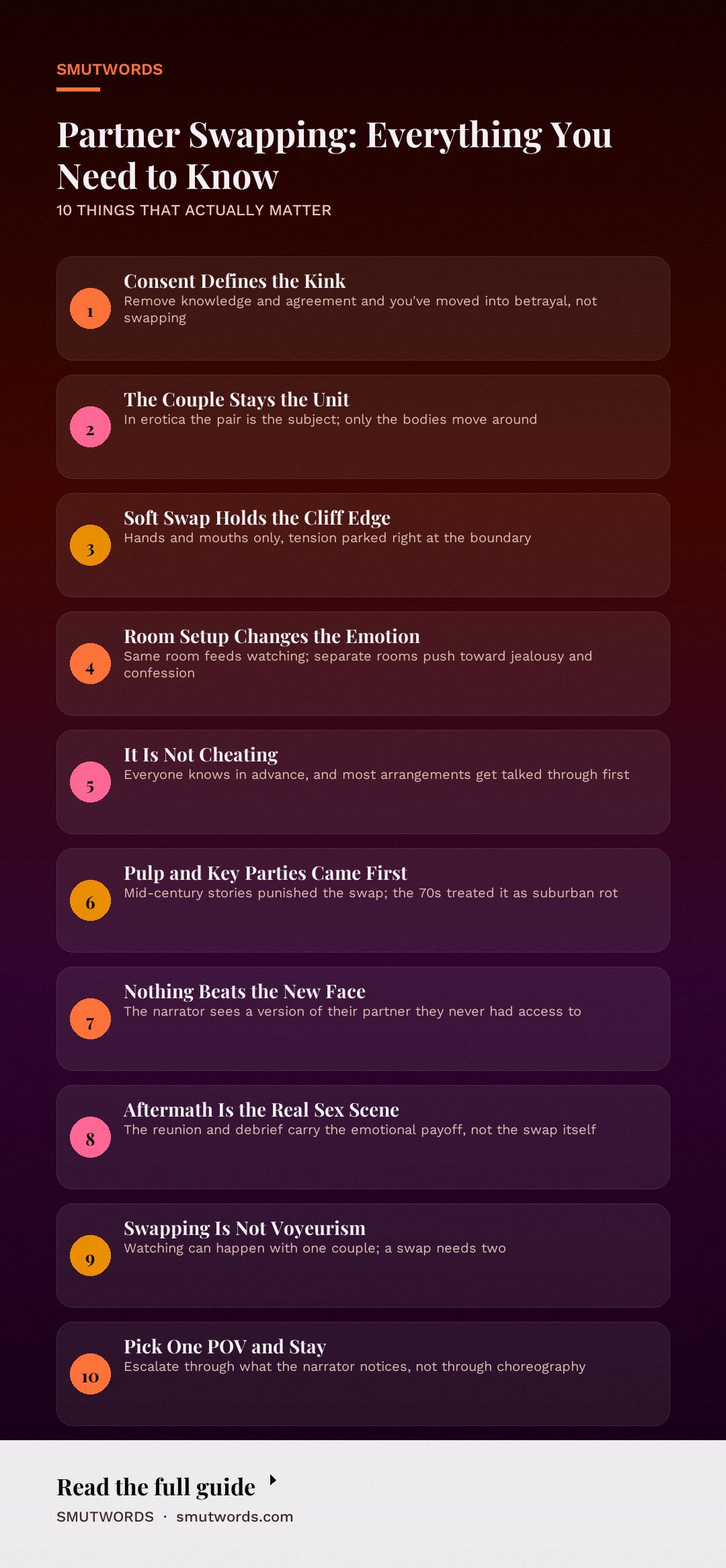
- Partner swapping is not the same as cheating. The defining feature is consent. Every participant knows, and most arrangements get talked through long before anything happens.
- It is not a sign that the couple is in trouble. In fiction and in practice, people swap from stability, not desperation. The bond is the launchpad.
- It is not always about the other person. A huge portion of the appeal is what the swap does to the original couple, not what it does with the newcomers.
- It is not exclusively heterosexual. M/M and F/F swap dynamics exist across the genre, though straight-couple configurations dominate published erotica by volume.
That last point matters for how the category gets read. Partner swapping in erotica is mostly a story about a couple, told through the bodies of other people.
Where Partner Swapping Comes From
The modern partner swapping story is descended from two separate lineages that merged somewhere in the mid-twentieth century. The first is the wife-swap narrative that ran through pulp paperback erotica in the 1950s and 60s, where the swap was almost always framed as a moral crisis.
Somebody's marriage was about to be tested. Somebody was going to learn something about themselves. The sex was the point, but the anxiety was the marketing.
The second lineage is the suburban key party, which became a recognizable trope in American fiction and film through the 1970s. The key party formalized the swap into a game with rules: couples arrive, keys go in a bowl, women draw, whoever's keys they pull goes home with them. It was tidy, transactional, and built for narrative. A writer could put twenty characters in a room and let randomness do the plotting.
Neither of those eras wrote partner swapping as something healthy. The pulp novels punished it. The 70s films treated it as a symptom of suburban rot. The genre spent decades insisting that swaps were what happened when a marriage was already hollow, and the sex was just the visible crack.
The shift happened gradually through the 1990s and 2000s, as erotica began writing the dynamic as a deliberate, negotiated pleasure rather than a moral failure. Communication entered the scene. Couples started talking before, during, and after. The swap became something a strong couple did on purpose, and the conflict moved from "will this destroy us" to "what does this reveal about us."
That's the version dominating published erotica now. The tension hasn't gone away, it's just relocated. Instead of waiting for the marriage to collapse, readers watch two people who trust each other discover something new about what they want.
The modern swinging scene inherited a lot of that history, and the two terms still overlap heavily in fiction. Swinging is the broader lifestyle. Partner swapping is the specific act.
How It Shows Up in Erotica
On the page, a partner swapping scene is a tension management problem. You have multiple bodies, multiple sightlines, and one emotional core you're trying to charge and discharge. The writers who do this well know exactly whose head they're in, and they never lose track of it, even when the scene technically involves four people.
The most common structure is the witnessing partner's POV. The narrator watches their partner with someone else, and the entire scene is filtered through that watching.
Their hands. Their noises. The face they make that the narrator has never seen them make before.
That last detail is gold, and good writers find it every time. The swap works because the narrator sees a version of their partner they didn't have access to before, and that's what makes the scene erotic rather than just busy.
Point of view shifts are where the danger lives. If you're going to move between heads, you need a reason, and the reason should be emotional, not just choreographic. Cutting to the other partner mid-scene to show their reaction is a legitimate move. Cutting to the other partner because you don't know how to escalate the current one is a dodge, and readers feel it.
The variations authors reach for most often:
Enjoyed this? Get a free book.
Join the list and we will send a complete free story straight to your inbox, plus new releases every week after that. No credit card, no catch.
- Same-room, eyes-on: All four people in one space. Maximum voyeuristic charge. Requires careful blocking so the reader can track who's touching whom.
- Separate-room, reconvened: The couples split up, then come back together. The reunion scene is where the real emotional payoff lives. Everything that got stirred up gets processed, often physically.
- Soft-swap first-timer: The couple agrees to just hands and mouths. The cliff edge is the whole point. What happens when one of them wants more, and the other is watching.
- Established lifestyle couple: They've done this before. The scene is about what's new this time, not whether they can survive it.
- Swap with an ex or a rival: The other person is loaded with history. Very different pressure, often darker.
- One-way swap, one watches: Technically closer to voyeurism, but frequently shelved under swapping in erotica because the couple dynamic drives the plot.
- Swap as fantasy only: The couple talks it through, gets off on the idea, never does it. Some of the best partner swapping writing never leaves the bedroom.
What makes a strong version work is the anchor. The couple has to feel real before anything happens, or the swap reads as a stunt.
Give the reader a reason to care about these two, then show them choosing each other inside the middle of the chaos. The choice is the scene. The bodies are the setup.
What makes a flat version is a swap with no stakes. If the couple's bond is vague and the partners are interchangeable, you've written a four-person sex scene with no specific charge, and readers will skim it. Swap writing earns its intensity from the vulnerability of the people doing it, not the positions they end up in.
The other craft problem is pacing. A swap scene has a natural arc: negotiation, escalation, the moment of first contact with the other person, the peak, and the aftermath. Skipping negotiation makes the scene feel forced. Skipping aftermath leaves the reader holding tension the story never discharged.
Aftermath is where partner swapping scenes actually get their emotional payoff. The reconvening. The debrief. The specific, hungry way a couple reaches for each other once everyone else is gone.
Some of the best-written versions treat this part as the real sex scene and the swap as the extended foreplay. That move works, and it works because the couple is the actual subject of the story.
There's a real craft debt to stories about possession and jealousy here too. A swapping scene gives a writer permission to explore possessive feeling without having to resolve it into a tidy monogamous ending.
Some couples in erotica reclaim each other through swap. Some discover the swap is the thing they were missing. Some watch each other and find a fresh appetite for what they already had, in the same way a scene built around makeup sex uses conflict to charge a reunion.
Tonally, partner swapping stories can run anywhere from light and playful to genuinely dark. The key party format lends itself to comedy and social satire. The intimate two-couple format lends itself to drama and slow-burn jealousy. The first-timer format is the most common one in published erotica because it's the most flexible: you get the negotiation, the nerves, the moment of commitment, the scene itself, and the reunion, all in one arc.
Partner Swapping vs Voyeurism
These two get confused constantly, and it's worth separating them because they do different work.
Voyeurism is about the act of watching, and it can exist with zero swap. One person watches, the watcher gets off, nobody else's partner changes hands.
A partner swapping scene frequently includes voyeurism, but the swap is defined by the exchange, not the watching. You can write a hardcore voyeurism story with one couple and a window. You can't write a partner swapping story without at least two couples.
In practice, most erotica that gets tagged as partner swapping is doing both at once, and that's fine. The distinction matters when you're tagging, recommending, or searching. If you want the watching without the exchange, you want voyeurism. If you want the exchange as the organizing principle, you want swapping, and the watching is usually along for the ride.
Frequently Asked Questions
Is partner swapping the same as swinging?
Close but not identical. Swinging is the broader lifestyle and includes parties, single-person setups, and repeated arrangements. Partner swapping specifically describes a pair-for-pair exchange. In erotica the terms get used almost interchangeably, but if you're searching, swapping tends to return more couple-centric stories.
What is a soft swap versus a full swap?
Soft swap means everything stops short of penetrative sex between the swapped partners: oral, hands, mutual touching. Full swap means penetration is on the table. The distinction matters in a scene because soft swap puts the tension at the cliff edge and holds it, while full swap delivers the act and needs to find its charge elsewhere.
Why is partner swapping so popular in erotica if most readers aren't in the lifestyle?
Because the fantasy isn't about the lifestyle, it's about the feeling. Readers want the vulnerability of watching someone they love be desired, and the reassurance of being chosen anyway. That emotional structure works whether or not the reader has ever been near a key party.
Can a partner swapping story have a happy ending?
Yes, and most modern ones do. The genre largely abandoned the punitive endings that dominated mid-century pulp, where swaps got punished with divorce or tragedy. Contemporary erotica usually closes on the couple stronger than they started, either recommitting or continuing the arrangement with new trust.
How do you write a partner swapping scene without losing the emotional thread?
Pick a POV and stay there through the escalation. Let the narrator's relationship to their partner be the filter for everything happening. Escalate through what the narrator notices, not just through physical choreography. Save the reunion scene and give it as much page time as the swap itself.
Does partner swapping overlap with cuckolding?
They share a family tree but diverge on the power dynamic. Cuckolding usually centers on one partner's humiliation or submission through watching. Partner swapping is more symmetrical, with both partners in the exchange. You'll find overlap in the same-room, eyes-on configurations, but the emotional core is different.
What are the essential beats of a partner swapping scene?
Negotiation, first contact, escalation, peak, reunion. The negotiation and reunion are the beats that most distinguish swapping from generic group sex writing. Skip them and the scene reads as an orgy with a couple in the middle. Keep them and the swap lands.
Final Thoughts
Partner swapping works in erotica because it stages a real question with a real body: can the person I love want someone else and still come back to me. The genre's best answers are usually some version of yes, and the getting there is where the heat lives.
If you want a next read that lives inside that question rather than skipping past it, look for the slow-burn first-timer variety over the established-lifestyle ones. The negotiation beats. The moment one partner sees the other and has to decide what to do with the feeling. That's where the writing earns the swap, and it's where the best stories in the catalog are built.








Loading comments…