
Competition romance is a love story built on a contest. Two people want the same prize, only one of them can have it, and somewhere between the qualifying round and the final score they end up in bed together (or against a wall, or on the floor of the practice room). The rivalry is the engine of the plot; the romance is what the rivalry keeps generating.
Readers come for the clash of skilled people operating at their ceiling and stay for the moment that professional friction turns physical, then emotional. Every win and every loss lands differently because someone you love is on the other side of the scoreboard.
It's a staple of contemporary romance and a frequent crossover into sports romance, workplace romance, and small-town baking-and-brewing stories. The term shows up in bookstore category tags, reader group request threads, and publisher metadata because the trope is instantly legible: two rivals, one trophy, a lot of unresolved heat. What makes a competition romance actually work is craft, and that's what this guide is about.
What Competition Romance Actually Means
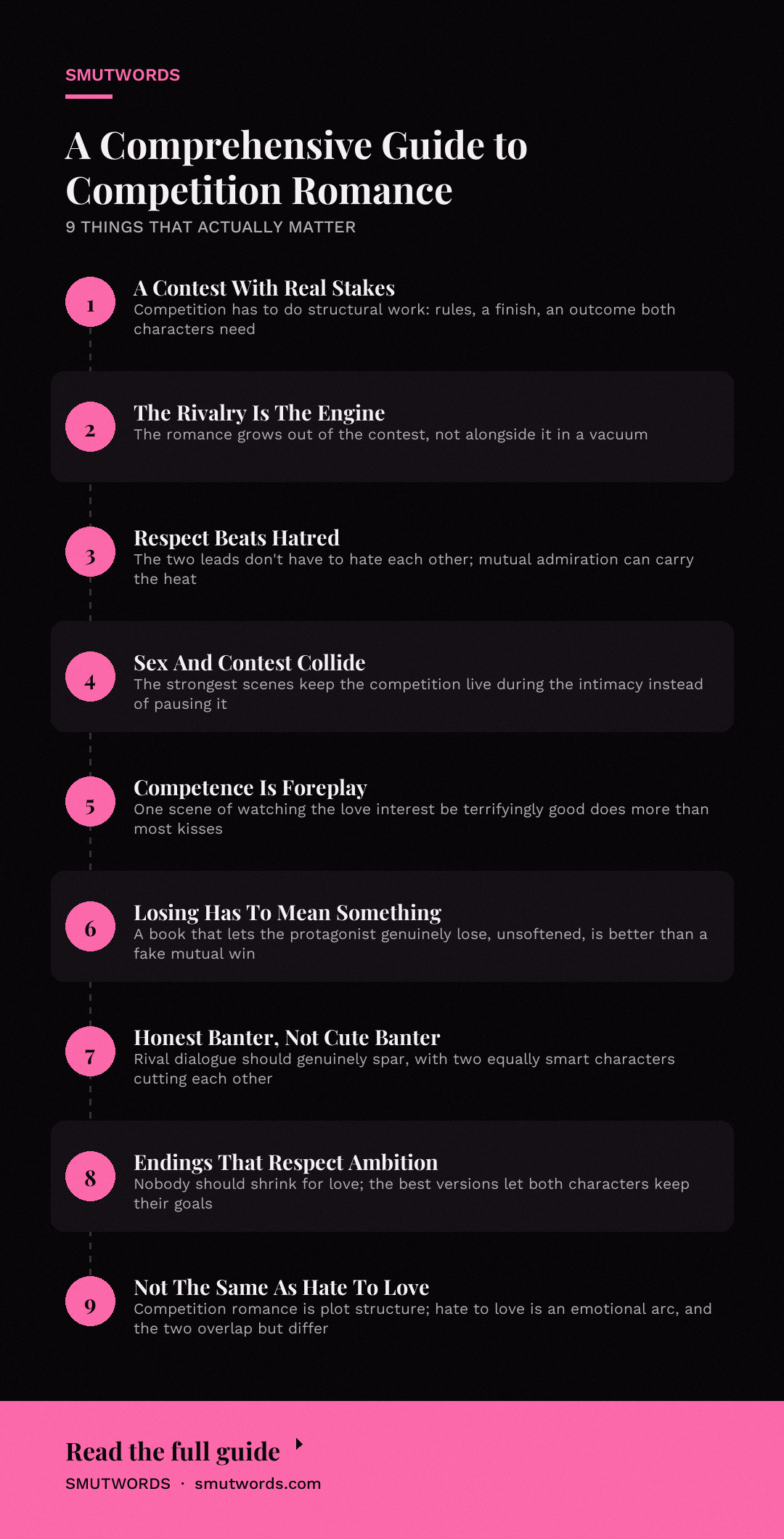
The name is literal. "Competition" does real structural work in the book: there is a defined contest with rules, a start and finish, an outcome that matters to both characters. The romance is threaded through that structure rather than happening in a vacuum. Take the competition out and the plot collapses.
What counts: anything where two characters are formally pitted against each other during the central arc of the love story. Athletic rivalry, culinary showdowns, art or design competitions, business pitches for the same contract, academic tournaments, dance-offs, magazine bake-offs, an inherited estate both heirs are fighting for, a promotion only one of them gets. The contest doesn't need to be televised or public. It needs stakes both people care about.
What doesn't count: books where the characters are merely in the same field and mildly competitive, with no formal structure. That's professional rivalry romance and it overlaps heavily, but competition romance proper has a scoreboard. Similarly, a book where two people happen to be on opposing teams but the contest isn't the spine of the plot is more accurately tagged sports romance or workplace romance. The competition has to do narrative labor.
Common misconceptions are worth clearing up since they show up constantly in reader group threads. Competition romance doesn't require the two leads to hate each other. Plenty of the strongest examples feature two people who respect the hell out of each other and find the rivalry hot mostly because of that respect.
The trope also doesn't require the contest to be the setting of the sex scenes. The competition can wrap around the intimacy, not host it.
And the enemies-to-lovers frame is common but not mandatory. Competition romance has its own logic and can run from loathing to mutual admiration to long-lost friends gambling on a reunion. The defining element is the structured contest, not the emotional starting point.
Where Competition Romance Comes From
The trope has been legible in English-language romance for well over a century, and its migration from pulpy serials to category romance to the modern mass-market has been gradual. The recognizable modern shape, though, arrived in stages.
The mid-twentieth-century screwball comedy left a very clear DNA inside the genre: two witty, competent people in professional opposition, cracking wise and falling in love. Category romance absorbed that formula and began publishing explicit rivalries starting in the 1980s.
Early examples leaned on business and journalism, with dueling columnists or competing restaurateurs as common setups. The rivalry was usually resolved by the hero either winning and then "giving it up" for love (a plot move that has aged badly) or by some contrivance that let both characters have the win.
The 1990s and 2000s brought more genre variety. Sports romance began publishing rival teammates and rival coaches in volume. Cooking competitions in the wake of the Food Network boom showed up across contemporary romance, then exploded after reality baking shows normalized the format.
Publishing itself turned into a recurring setting: dueling novelists, warring book editors, agents competing for the same manuscript, which put a particular kind of meta-pleasure into the genre. The dark romance adjacent corners of the category picked up the trope too, with criminal underworld rivalries providing the contest.
The most significant recent shift is in how the ending is built. The 1980s-90s version often resolved the rivalry by having one character step back or give up the prize for love, treating career ambition as a flaw to be loved out of.
Modern competition romance is likelier to find a third path: an outcome where both characters succeed on compatible terms, or where the loss is genuinely painful but doesn't undercut the romance. The best current examples treat career ambition as a value the reader should admire, not a problem the love interest is supposed to fix.
Self-publishing and the subscription platforms accelerated the trope's tuning. Readers who requested "rivals to lovers, forced proximity, one bed" could find hundreds of examples within a season, and indie authors responded by refining what worked: faster burn, sharper banter, more explicit scenes, and endings that respected both characters' competence.
How It Shows Up in Erotica
The craft question with any competition romance is how the rivalry and the sex feed each other. This is where the best versions separate from the competent-but-flat ones.
Rivalry gives you a ready-made charge because two people investing in the same goal are already paying close attention to each other. That attention is the raw material. The erotica writer's job is to route the attention through the body.
Where the heat actually comes from
The strongest competition romance scenes put the characters in close quarters with the contest still live between them. A shared hotel room the night before the final round. A cooldown after a brutal practice. A handshake that lasts three seconds too long after a loss.
The sex is intense because it's happening within the context of a competition neither can set down. Strong versions do something specific: the sex scene changes the contest. Characters who sleep together and then have to face each other across the mat, the stove, the pitch, on stage, in the same pitch meeting, are competing under the strain of what just happened.
Weak versions let the sex scene exist in a bubble; the competition is paused, everyone has a nice time, then competition resumes as if nothing has changed. That pause kills the tension.
Enjoyed this? Get a free book.
Join the list and we will send a complete free story straight to your inbox, plus new releases every week after that. No credit card, no catch.
Common variations authors use
A few recognizable forms of the trope, worth knowing as a reader or a writer:
- Workplace rivalry romance: competing for a promotion, a client, or a project lead. Often structured as a season-long pitch-off or performance review cycle. The contest is private to the company and low-stakes externally, which lets the emotional stakes dominate.
- Enemies-to-lovers competition: the rivalry is established first as genuine antipathy, and the respect builds slowly across the contest. Overlaps with hate to love but is specifically structured around the contest's arc.
- Fake rivalry competition: one or both characters pretend to be rivals for some public reason (a publicity stunt, an industry expectation, covering up that they're actually already involved). Useful for comedy and for characters who don't want to admit what they feel.
- Forced proximity during a contest: retreats, residencies, shared training facilities, tournament housing. The contest is the reason they keep ending up in the same room. The physical closeness does the seduction work.
- Second chance competition: former rivals or exes whose contest brings them back into orbit years later. Their history is the setup; the current competition is the engine. Ties in naturally with childhood friends to lovers when the shared history predates the rivalry.
- Reality-show contest: dating-competition structures, cooking-show formats, survival shows. Whatever the public fiction, the private reality is the two contestants sneaking off together. This structure overlaps with free use in the sense that the camera is always watching, though the kink and the setting are entirely different.
The craft moves that make it work
A few things separate the books that get recommended in reader groups from the ones that get returned. The first is that the contest has to be legible. Readers need to understand what winning means, what each character stands to lose, and how the scoring works. Books that wave vaguely at "a contest" leave the emotional stakes unanchored.
The second is banter with teeth. Rival dialogue should genuinely spar; both characters should be smart, cutting, and equal. Banter that only exists to be cute reads as flirting. Banter where each line proves the other person sees you exactly, for better and worse, is the thing this trope runs on.
The publisher's personal assistant romance guide covers a similar dynamic from the professional-hierarchy side; the common craft problem in both genres is unequal power landing as tedium instead of tension.
The third is competence as foreplay. The best competition romance gives the reader at least one scene of watching the love interest be genuinely, terrifyingly good at the thing. They win and it's not fair, they hit a note or a stroke or a line that shouldn't be possible, and the protagonist realizes they are attracted to watching someone else succeed. This scene does more seduction work than most kiss scenes.
The fourth is that losing has to mean something. If neither character can lose without the book collapsing, the ending will always feel cheap. A book that lets the protagonist actually lose, and doesn't soften it, and then finds a way for the romance to survive and deepen, is a much better book than one that engineers a mutual victory the reader sees coming from chapter three.
The fifth is that the final confrontation needs a body in it, not just a conversation. A hand at the back of the neck during the final round. Eye contact across a plate of food one of them didn't want to send back.
The physical vocabulary of the rivalry should be as developed as the emotional one.
What to look for in the good ones
Not every book tagged competition romance will deliver all of the above, but readers can screen for the ones that will:
- A contest with actual stakes. Money, a career, a chance at a specific thing one character has wanted for years. If the prize is abstract, the book will feel vague.
- Balanced skill. Both characters need to be credible rivals. If one is clearly better from page one, the contest is decoration.
- Scenes where sex and competition collide. Even one scene where the contest is still live during the intimacy.
- A rival who reads as a real person. Strong competition romance books give the rival their own full plot, not just their role as love interest.
- An ending that respects ambition. Both characters should get to keep their goals. A book where the protagonist has to sacrifice career for love is a book that has solved the wrong problem.
- Specific setting. The training facility, the restaurant, the recording studio. Books set in a generic "industry" tend to be forgettable.
Competition Romance vs Hate to Love
The two terms show up together so often that readers use them almost interchangeably, and they're distinct. Competition romance is a structural framing: the plot contains a contest, which is what makes the two characters interact. Hate to love is an emotional arc: they start with antipathy and end in love, whether or not there's a scoreboard.
A competition romance can run on pure mutual respect with no hatred at all. Think two master chefs who have admired each other for years. A hate-to-love romance can have no competition in it. Think two people who can't stand each other as roommates.
The overlapping subset, which is large, is enemies-to-lovers competition, where the hate fuels the rivalry and the rivalry is the contest. If a reader is asking for one and you point them at the other, expect them to come back annoyed.
The distinction matters for tagging and for the reading experience. A book tagged competition romance sets expectations about plot shape; a book tagged hate to love sets expectations about emotional arc. The strongest books are tagged both, but only when both apply.
Frequently Asked Questions
What is a competition romance novel?
It's a romance novel where the central plot is built around a contest between the two leads. They're both trying to win the same thing, and the rivalry is what brings them into the same space, forces them into proximity, and drives the attraction. The competition usually resolves near the end of the book alongside the romantic resolution.
Is competition romance the same as enemies to lovers?
No. Enemies to lovers describes an emotional arc that moves from hostility to love. Competition romance describes a structural situation with a contest at its center. The two overlap heavily in practice (many enemies to lovers books are also competition romances) but neither requires the other, and the strongest examples often involve mutual respect rather than hatred.
What's the difference between competition romance and workplace rivalry romance?
Workplace rivalry romance is a subset of competition romance where the contest happens at work, usually a promotion, a pitch, or a project lead. Competition romance is the larger category and includes sports, arts, culinary, academic, and any other competitive setting. Workplace is the most common setting for the trope, but plenty of competition romance happens outside an office.
Do competition romance books always have a happy ending?
Yes, in the genre sense. Romance has a hard requirement for a happily-ever-after or happy-for-now ending. What varies is how much losing happens along the way and whether the contested prize is shared, split, or genuinely won by one character without tanking the relationship. Some of the best examples let the protagonist lose the contest and still get a satisfying romance.
Can a competition romance be a second chance romance too?
Yes, and the combination is common. Two former rivals, exes, or former friends whose contest brings them back into the same arena years later. The competition then functions as the mechanism for reconnection, while the history supplies the emotional ground. These books are often longer and more emotional than first-time-rivalry examples because the characters already know each other well enough to hurt each other badly.
Is forced proximity required for a competition romance?
No, but it's extremely common and often does the heavy lifting. Competitions naturally force the characters into shared spaces: tournaments, residencies, pitches at the same conference, a shared hotel floor. If the book has a competition but the characters never have to be in the same room, the trope may be underused.
Final Thoughts
Competition romance works because the trope lets a romance novel do something hard: make two people's ambitions feel compatible with falling in love. The best versions refuse to make anyone smaller to make room for the relationship. They let the scoreboard stand, let the rivalry stay hot, and find a way for both characters to keep what they wanted.
If you want a starting point, look for books that let the losing contestant keep their dignity, and read the scene where one character watches the other win something they wanted for years. That's the whole trope in one moment.





Loading comments…