Pegging is a sex act in which a woman wears a strap-on harness and anally penetrates a male partner. In erotica, it has become one of the most loaded scenes a book can stage: a man on his hands and knees, a woman holding the dildo steady, a power exchange running in the opposite direction from almost everything else on the shelf.
Search for pegging in romance and you will find it threaded through dark romance, contemporary BDSM, mafia books, and small-town stories where the heroine runs the hardware store. The act is specific. The dynamic is not.
The short glossary version covers the mechanics. This guide covers everything around them: where the word came from, why male submission reads as romantic rather than humiliating, how authors write a pegging scene that lands, and what the books that handle it well do differently from the ones that use it as a punchline.
What Pegging Actually Means
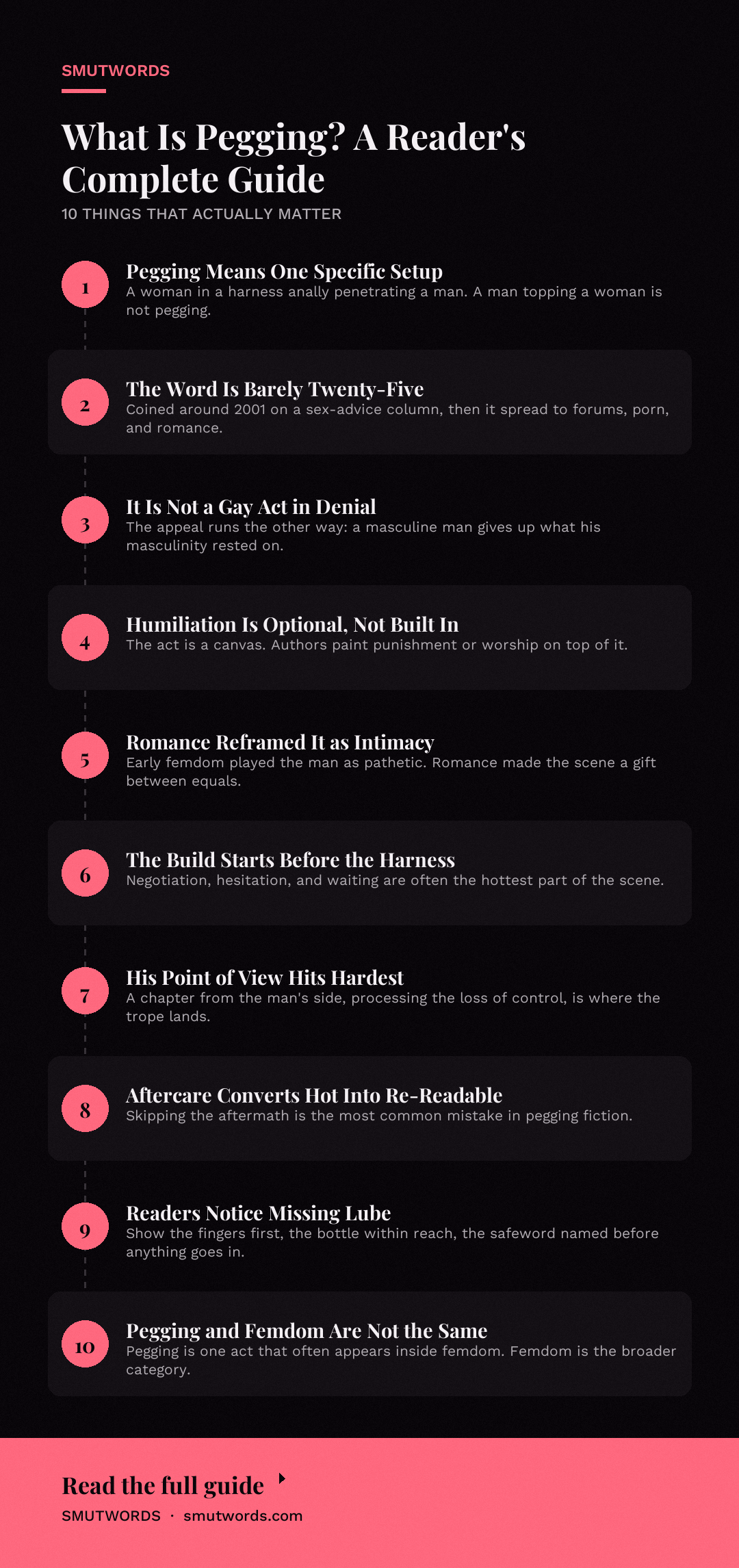
The word names one specific configuration: a woman penetrating a man anally with a strap-on. A dildo held by hand, a harness with a dildo, a double-ended toy, or a harness with a vacuum-lock attachment all count. A woman using her fingers, a plug, or a prostate massager on a male partner is anal play, and plenty of readers use pegging loosely as an umbrella for it. Strictly speaking, the harness and the penetration are what make the term.
The gendering matters to the term's history and to the trope. Pegging describes a woman on the giving end and a man on the receiving end. Two men having anal sex is not pegging.
A woman pegging a woman in the ass with a strap-on sits at the edge of the definition: same equipment, different configuration, and most readers file it under strap-on play instead. Nobody polices this at the door, but when a book tags a scene pegging, the reader expects a man in the harness's path.
Where the name comes from
The term is modern and its origin is unusually well documented for a sex word. It surfaced in the early 2000s in a column on Dan Savage's sex-advice site, coined when a reader asked what to call the act. It spread fast through internet forums, then into porn categories, then into romance.
The word is barely old enough to drink. Every pegging scene you have ever read belongs to a genre tradition less than twenty-five years old, which is why the conventions are still forming in front of readers.
What does and does not count
- Counts: a woman in a harness anally penetrating a man, with or without simultaneous prostate stimulation, with or without penetration of the woman herself.
- Counts, loosely: a woman using a handheld dildo on a man's ass, or a woman topping a man with a plug and calling the scene pegging in dialogue.
- Does not count: a man penetrating a woman anally. That is anal sex, and the power dynamic runs the other way, which is the whole point of the distinction.
- Does not count: femdom scenes with no anal penetration. A dominatrix can be fully in charge of a man without a strap-on anywhere in the room.
Common misconceptions
The biggest one is that pegging is a gay act performed by straight men in denial. In fiction and in life, the appeal usually runs the opposite way: a man who is otherwise conventionally masculine, often aggressively so, gives up the one thing his masculinity was supposedly built around. The scene works because of who he is going in, not despite it.
The second misconception is that pegging has to be humiliating.
Plenty of scenes play it as punishment or degradation. Plenty play it as worship, tenderness, or a private ritual between two people who trust each other absolutely. The act is a canvas. The tone is painted on top.
Where Pegging Comes From
As a word, pegging is a 2001 invention. As a scene in erotic writing, it is older than that, and its publishing history is short, sharp, and easy to trace.
Pre-internet erotic fiction had strap-on scenes, usually in femdom and lesbian erotica, usually with a dominatrix in black leather and a man groveling. The tone was humiliation-forward and the scenes were rare. Fetish magazines and underground comics carried the rest. There was no shared vocabulary, so the act had no shelf to sit on.
The 2001 coinage gave readers a search term, and search terms build markets. By the mid-2000s, pegging had its own porn category and its own forum threads.
By the 2010s it had become a recognized tag in self-published romance. The shift that mattered most was tonal. Early femdom pegging scenes framed the man as pathetic. Contemporary romance reframed the same act as intimacy.
The strongest version of the reframe: the man is powerful everywhere else in the book, and he lets the heroine see him like this because she has earned it. The heroine stays desirable, often stays feminine in presentation, and the scene reads as a gift exchanged between equals rather than a defeat. That is a romance-genre invention, and it is the reason pegging migrated from the fetish margins onto the mainstream bestseller lists.
Publishing data backs up the shift. Pegging scenes now appear across mafia romance, small-town romance, paranormal romance, and the kind of dark romance that treats power exchange as the whole engine of the plot. In a why choose romance, pegging a single hero out of a group becomes a way to give one man a private, exclusive moment with the heroine that the others cannot share. That structural move alone has driven a noticeable slice of the recent output.
How It Shows Up in Erotica
The craft questions for a pegging scene are mostly about preparation, point of view, and tone. Get those three right and the scene carries enormous emotional weight. Get them wrong and it reads like a checklist item crossed off in the third act.
The build has to start long before the harness
Strong pegging scenes spend pages earning the moment.
The heroine notices the hero's reaction to a toy in a drawer. He admits something he has never said out loud. She offers, he hesitates, she waits. The negotiation is often the hottest part, because it is where the reader watches a powerful man decide to be vulnerable with his body.
Weak scenes skip to the buckle. A sudden strap-on in the final chapter with no groundwork reads as a plot device, and readers clock it instantly. If the book hasn't planted the desire, the scene has nothing to release.
Point of view does the heavy lifting
Most pegging scenes in romance are written from the woman's POV, and that is the genre's biggest missed opportunity. A first-person chapter from the man's side, on his knees, processing the loss of control in real time, is where the trope hits hardest. Books that alternate POV and give the hero the pegging scene tend to be the ones readers quote back at each other in reviews.
Enjoyed this? Get a free book.
Join the list and we will send a complete free story straight to your inbox, plus new releases every week after that. No credit card, no catch.
Whichever side the author picks, sensory detail beats choreography. The harness tightening around the hips. The cold snap of lube against skin. The specific sound a man makes when he stops bracing and lets it happen.
Readers want the moment the resistance drops. Everything before it is setup.
Variants authors actually use
- Pegging as worship: the heroine treats the hero's body like something precious. Slow pace, eye contact, reassurance, and the power exchange is soft. This version dominates contemporary romance and is the one readers recommend to friends who want to try their first pegging book.
- Pegging as punishment: the hero has done something and the heroine puts him in his place. Common in mafia and dark romance. Works best when the reader believes the punishment is also pleasure, and the hero knows it.
- Pegging with prostate play: the scene builds to an orgasm the hero has never had before, and the book treats it as a revelation. Writers handle this badly by making it sound like a science lecture. Handle it well by keeping the prose in the hero's head and his reaction on the page.
- Reverse pegging: used inconsistently across the genre, usually meaning the man in the harness and the woman receiving, or a scene written to invert the standard setup. Tag carefully if you are publishing; readers expect the standard configuration under the plain pegging tag.
- Public or group pegging: staged at a party, a club, or a scene with an audience. This is where the trope crosses into orgy territory and the power dynamic gets multiplied by witnesses.
What makes a strong version work
The best scenes are about trust, and they make the trust visible. The hero says a word and everything stops. The heroine checks in before she moves. The safeword gets established before the scene and sometimes gets used.
A book that shows one moment of a man saying no and being immediately, tenderly obeyed has said more about the relationship than ten pages of penetration.
The second marker is that the heroine stays fully herself. She is not a cardboard dominatrix in a corset. She is the same woman she is in every other chapter, now holding a dildo and enjoying what it does to him.
The best pegging heroines laugh a little, get a little nervous, and take enormous pleasure in his pleasure. That reads as romance. A cold prop in heels reads as a device.
The third marker is aftermath. The scene ends, the harness comes off, and the book stays with the couple. Aftercare scenes, where the heroine reassures the hero or the hero processes what he just gave up, are what convert a hot scene into a re-readable one. Skipping them is the most common mistake in pegging fiction.
Practical realism readers notice
Readers who have actually done this are the harshest critics, and they will leave reviews. A scene that skips lube, or has the hero take a full-size harness on the first thrust with no warm-up, reads as fantasy in a way that breaks immersion. Even fantasy wants its physical logic internal.
Books that handle it well show the unglamorous steps: the conversation about pace, the fingers first, the bottle of lube within reach, the hero's safeword established before anything goes in. None of that kills the heat. It builds it, because it makes the scene feel real enough to imagine yourself into.
If the scene crosses into rougher territory, with restraint, force of pace, or more aggressive roleplay, the same principle applies: the boundary is named before the scene starts, and the characters honor it. That rule sits at the heart of free use kink too, and the two share the same underlying craft problem: making the negotiation as hot as the act.
Frequently Asked Questions
Is pegging always dominant and submissive?
No. Plenty of scenes run it as a dominant woman and a submissive man, which is the classic configuration. But others play pegging as a joint experiment between equals, with no power exchange at all beyond who is wearing the harness. The act sets up a physical reversal; the characters decide whether that reversal is a game, a punishment, a gift, or a private joke.
Can pegging be part of a vanilla relationship in a book?
Yes, and some of the best scenes are written exactly that way. A couple with no BDSM framework, no collars, no formal dynamic, decides to try it. The negotiation is awkward and funny, the first attempt goes sideways, and the book treats the whole thing as intimacy rather than initiation. Readers who don't identify with kink communities often prefer this framing.
What is the difference between pegging and anal sex in romance?
Anal sex in romance usually means a man penetrating a woman, and the trope conventions around it tend to center her vulnerability. Pegging reverses the configuration and the power. It is a woman penetrating a man. That reversal is why the term exists as a separate tag and why readers search for it specifically.
Why do readers search for male submission in pegging scenes?
Because the vulnerability reads as trust when it runs the other direction from the rest of the book. A hero who is in control of everything in his life choosing to give that control to the heroine for one scene is a stronger display of devotion than anything he could do with his hands. Publishing has learned this over a decade of bestsellers, and the market has responded.
Does pegging in a book require the heroine to be cruel?
No, and the trend in recent years runs toward tenderness. Some authors lean into humiliation as a kink and it works for those readers. Others build the scene around reassurance, praise, and the heroine telling the hero exactly how good he is. Read the reviews before you buy if the tone matters to you; the range is wide.
Is pegging the same as femdom?
Pegging is one act that frequently appears inside femdom dynamics. Femdom is a broader category, covering any scene where the woman holds authority, with or without penetration. A book can be femdom without a strap-on, and a pegging scene can happen without any other dominant/submissive framing. The terms overlap without being identical.
Final Thoughts
Pegging earns its place as one of the most emotionally loaded scenes in contemporary erotic romance because it asks both characters to be braver than the plot requires. The heroine has to want this and say so. The hero has to give up the thing that made him untouchable.
When a book gets that exchange right, the scene stops being a scene and becomes the hinge the whole romance turns on.
If you are new to the trope and want a starting point, look for contemporary romance that tags male submission openly and puts the negotiation on the page. The first attempt is often messy, the characters are nervous, and the aftermath is where the book lives. Start there and you will know within a chapter whether this is your shelf.
Readers who want the darker register, where pegging sits inside control, punishment, and power that has been fought for, will find plenty to work with in dark romance. The scene shows up there often, usually as the moment the hero's worst fear and the heroine's deepest want turn out to be the same thing.






Loading comments…