
Blood play is a kink where blood itself carries the erotic charge: the sight of it, the taste of it, the moment a body opens and something private comes out. It can mean cutting, piercing, biting until blood is drawn, or simply the metallic smear of it across skin during an intense scene.
In erotica and romance, blood play shows up most often in two places: vampire fiction, where feeding is the whole erotic engine, and human edge play, where two people negotiate something most intimacy in fiction never touches. It is one of the oldest charged images in the genre and one of the least understood.
What Blood Play Actually Means
The clinical name is hematolagnia, from the Greek for blood plus the suffix for a fixation. The term covers a wide range, from a reader who finds a sharpened fang scene hot to a practitioner who arranges a sterile lancet and a negotiation sheet. The name is old, the kink is old, and the range inside it is larger than most readers assume.
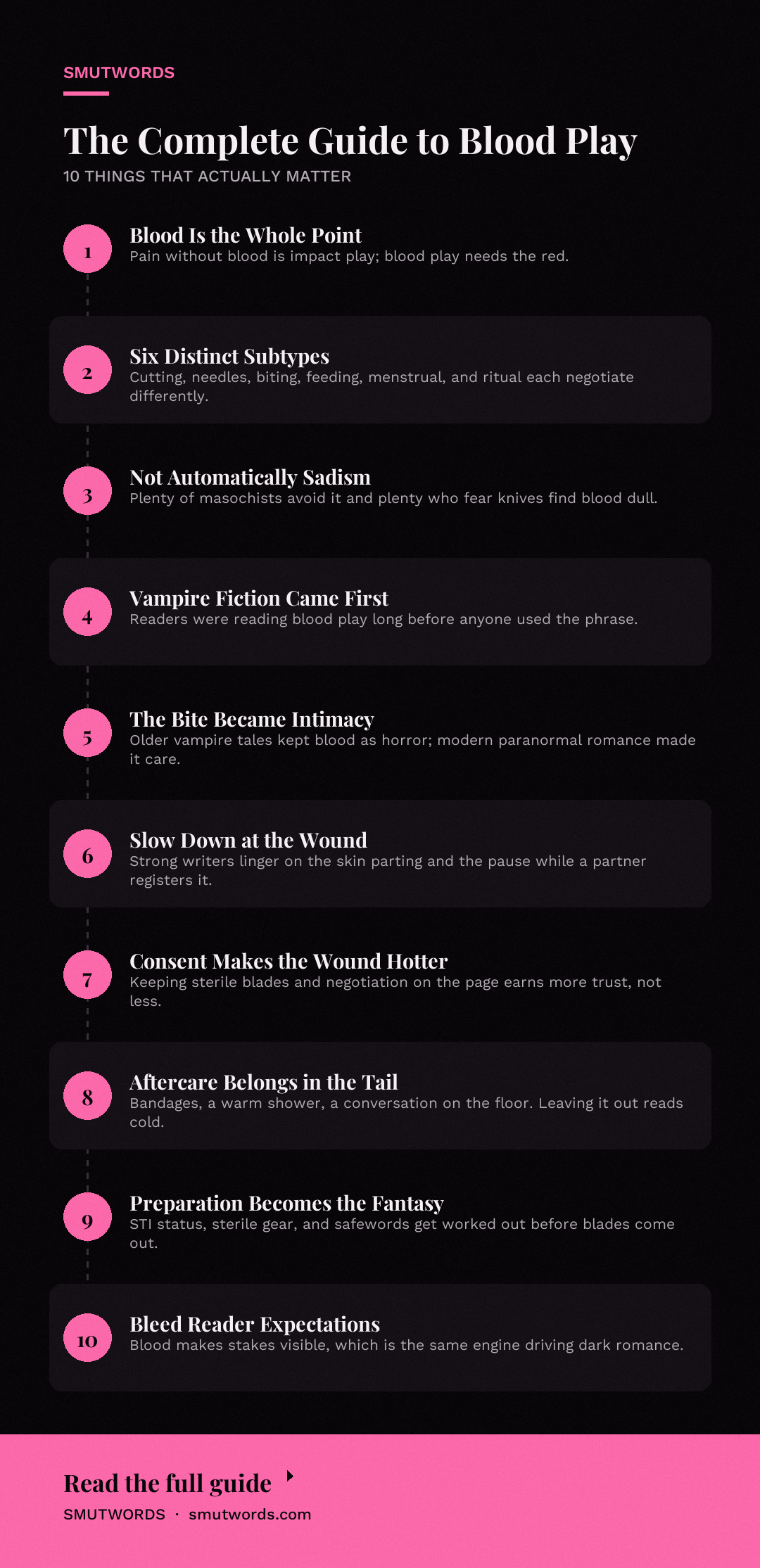
Blood play counts as blood play when blood is the point. Pain without blood is impact play. Sharpness without blood is knife play. Blood play needs the red: the cut that beads, the puncture that wells, the bite that paints a mouth.
Practitioners separate it into subtypes, each with its own negotiation.
- Cutting play: deliberate shallow incisions, often decorative or ritual, made with sterile blades after explicit negotiation.
- Needle play: sterile hypodermic needles through skin, sometimes in patterns, frequently photographed, closely adjacent to piercing kink.
- Biting: human mouths on human skin, hard enough to break it. The staple of vampire romance and a common first taste of real-world blood play.
- Vampire or feeding scenes: roleplay built around the fang-and-throat fantasy, usually staged with stage blood or a controlled pinprick.
- Menstrual blood play: sex during a period with blood treated as the erotic focus rather than an inconvenience, which carries a cultural taboo heavier than the physical risk.
- Blood as ritual: blood used to mark a scene, a collar, a contract, or an anniversary, so the substance becomes a symbol as much as a sensation.
Common misconceptions pile up fast. Blood play is not automatically sadism: plenty of masochists avoid it, and plenty of people who flinch at a knife find blood boring. It also gets conflated with horror aesthetics, which miss the trust at the center.
And it gets mistaken for a purely fictional fetish, as if every reader of it stays on the page. Some do, some do not, and the fiction is worth judging on its own terms either way.
Where Blood Play Comes From
Vampire fiction is the obvious ancestor. The erotics of the bite predate the modern novel, and the nineteenth-century vampire tale made it explicit enough that readers noticed. By the twentieth century, the feeding scene was a romance set piece: the throat, the surrender, the mouth at the neck. Readers were reading blood play long before anyone used the phrase in a romance blurb.
The kink's own publishing history is younger. Real-world blood play circulated in kink zines and leather-community writing from the 1970s onward, described in the practical, negotiated language of edge play. It stayed on the periphery of mainstream erotica for decades because it was hard to stage in a scene and easy to get wrong. Body modification and piercing subcultures carried a lot of its visual language into the mainstream.
Then came the vampire boom of the 2000s. Paranormal romance put feeding scenes back in front of mass readers, and the kink borrowings came with them. The shift worth noticing is what changed in the presentation: older vampire fiction kept blood in the register of horror, and modern paranormal romance keeps it in the register of intimacy. The bite is now an act of care, a sign of ownership, or a consummation.
Human-partner blood play in contemporary romance is younger still. In the last ten years it has moved from the darkest end of dark romance into the mainstream of it, appearing in mafia books, in tattooed antihero books, in anything that wants to prove how far two people will go for each other. Readers who once came for the fangs now come for the shard of glass, the kitchen knife, the bite that leaves a scar.
How It Shows Up in Erotica
On the page, blood play lives in the sentence where the body finally gives. Strong writers slow down exactly there: the skin parting, the first bead, the pause while a partner registers it. The shock is in the partner's reaction more than the wound. What an editor reads for is that pause.
There are recognizable dark romance variations worth knowing as a reader. Vampire feeding scenes usually put the blood in the mouth, which makes arousal, hunger, and the bond between characters the same act. Edge-play scenes keep it between fangs-free humans and draw the power from who holds the blade.
Ritual scenes (blood mixed into ink, blood on a collar) make meaning rather than sensation. Menstrual blood scenes, rarer and still more taboo, usually reframe a body's ordinary function as a private, erotic fact.
The strongest versions share something. They keep the equipment and the negotiation on the page. When a character lays out sterile blades or asks for limits first, the scene earns more trust, not less. The mechanics of consent make the wound hotter, and the writers who understand that write better blood than the ones who skip straight to the wound and the poetic gore.
The flat version does the opposite. It makes blood a decoration, a shortcut to "dark" without any of the cost. Blood as the only shorthand for edge, with no character processing and no aftercare, is the equivalent of an unscored fight scene.
Enjoyed this? Get a free book.
Join the list and we will send a complete free story straight to your inbox, plus new releases every week after that. No credit card, no catch.
Contrast that with how good attention works elsewhere in the genre: the aftercare in a strong blood scene is the same kind of choreography that makes wet and messy fetish writing land. The cleanup is part of the sex.
Pacing matters too. A scene where three wounds happen back to back blurs into one. A scene that lets one cut breathe, then delays the next, has a pulse.
And the strongest books put the aftermath in the scene's tail: bandages, a warm shower, a conversation on the floor. That beat is the literary twin of aftercare, and books that leave it out feel oddly cold even when the sex was hot.
For anyone modeling a scene on how others do it, the useful comparison is the fluid bonding discussion. Both require a conversation about verified safety before the first touch, and both read better when the conversation is on the page. A scene that skips the negotiation for the sake of speed tends to feel like a scene that skipped the plot.
Blood Play vs Domspace and Bondage Kinks
Blood play gets compared most often to the fever that builds on the giving side of a scene. Domspace is the altered, high-focus state that tops report, and blood play is a shortcut into it for some and a way out of it for others. The difference is that blood play asks for physical wounding, while domspace is a state of attention. One is the act, one is the headspace it can produce.
The other comparison that holds up is mummification, which is not about cutting at all but shares the core appeal: the surrender of a body into someone else's hands. The reader who loves the immobilized helplessness of mummification often loves blood play for the same reason. Both are about being handled completely, and both live or die on how much the character trusts the handler.
Read the real-world side of any of those, and one theme recurs: preparation becomes part of the fantasy. Practitioners meet their partners at munches before the first scene. They work out STI status, vaccination, sterile equipment, cleanup plans, and safewords in conversation long before blades come out. Fiction can compress that to two lines or stretch it across a chapter, but the honest version includes it somewhere.
Frequently Asked Questions
Is blood play the same thing as vampire roleplay?
No. Vampire roleplay is a fantasy frame that often includes blood play, but blood play exists between human partners with no fangs involved. The overlap is real, and readers often arrive through vampire fiction, but the kink stands on its own without the supernatural costume.
Is it safe to write or read blood play? Is it safe to do it for real?
Reading and writing are safe. Real-world blood play is edge play and needs sterile equipment, verified STI status and vaccination for both partners, explicit negotiation of limits, agreed safewords, and a cleanup and aftercare plan before anything starts. It is not a spontaneous activity.
Why is blood play so common in dark romance?
Dark romance runs on stakes, and blood makes stakes visible. A cut on the page is a permanent marker that risk was accepted, which is the same engine that drives the genre's other extremes. It also suits the genre's interest in ownership and surrender, since a wound is a mark another person leaves behind.
Does blood play always involve pain?
No. Some practitioners report sharp sensation with the cut, others feel only pressure and the visual charge. For many readers, the pain is a side note and the real turn-on is the sight of blood, the idea of being opened, or the trust in being cut by someone safe.
Is hematolagnia a real medical term?
It is a real term from older sexology writing, used to describe a fixation on blood. Modern kink communities mostly use blood play or blood kink. The old word still shows up in search results and glossary entries, so treat the two as describing the same range.
Can blood play be part of a healthy relationship?
For some couples, yes, with negotiation, honesty about limits, and a safety plan. The red flags are the same as for any edge play: one partner pushing, broken promises about safety, or secrets. If you are curious, talking to community members at a munch before a first scene is smarter than improvising at home.
Final Thoughts
Blood play's appeal is simple to state and hard to fake. It is the one intimacy where the cost is visible, and the fiction that gets it right makes you feel that cost in the same sentence as the heat.
When you finish this guide, read a book where the negotiation and the wound share the page. Captive Prince by C.S. Pacat, which builds a whole relationship out of controlled injury and loyalty, is the place to start if your tastes lean toward the human edge of the practice.





Loading comments…