
Undercover marriage is a romance and erotica trope in which two characters have to present themselves to the world as a married couple in order to pull off a job, and the performance starts eating into who they actually are to each other. The mission might be espionage, a criminal investigation, witness protection, a family obligation, or a publicity stunt.
The machinery is the same every time: a shared bed, a cover story that requires intimacy, and the slow, sweaty problem of not being able to tell where the act stops.
It is one of the most reliable engines in the genre because it manufactures exactly the two things readers want at once, forced proximity and a secret that makes every ordinary gesture filthy with subtext.
The appeal is simple enough to state plainly. Two people who would otherwise circle each other for three hundred pages are legally, socially, and often physically obligated to act like they're already fucking, and the reader gets to watch them mean it more and more with each chapter. If you picked up a book because the back cover promised a fake husband and a real problem, you already understand the trope in your gut.
This guide is about how it actually works on the page, where it came from, and why some versions of it are unforgettable while others read like a checklist.
What Undercover Marriage Actually Means
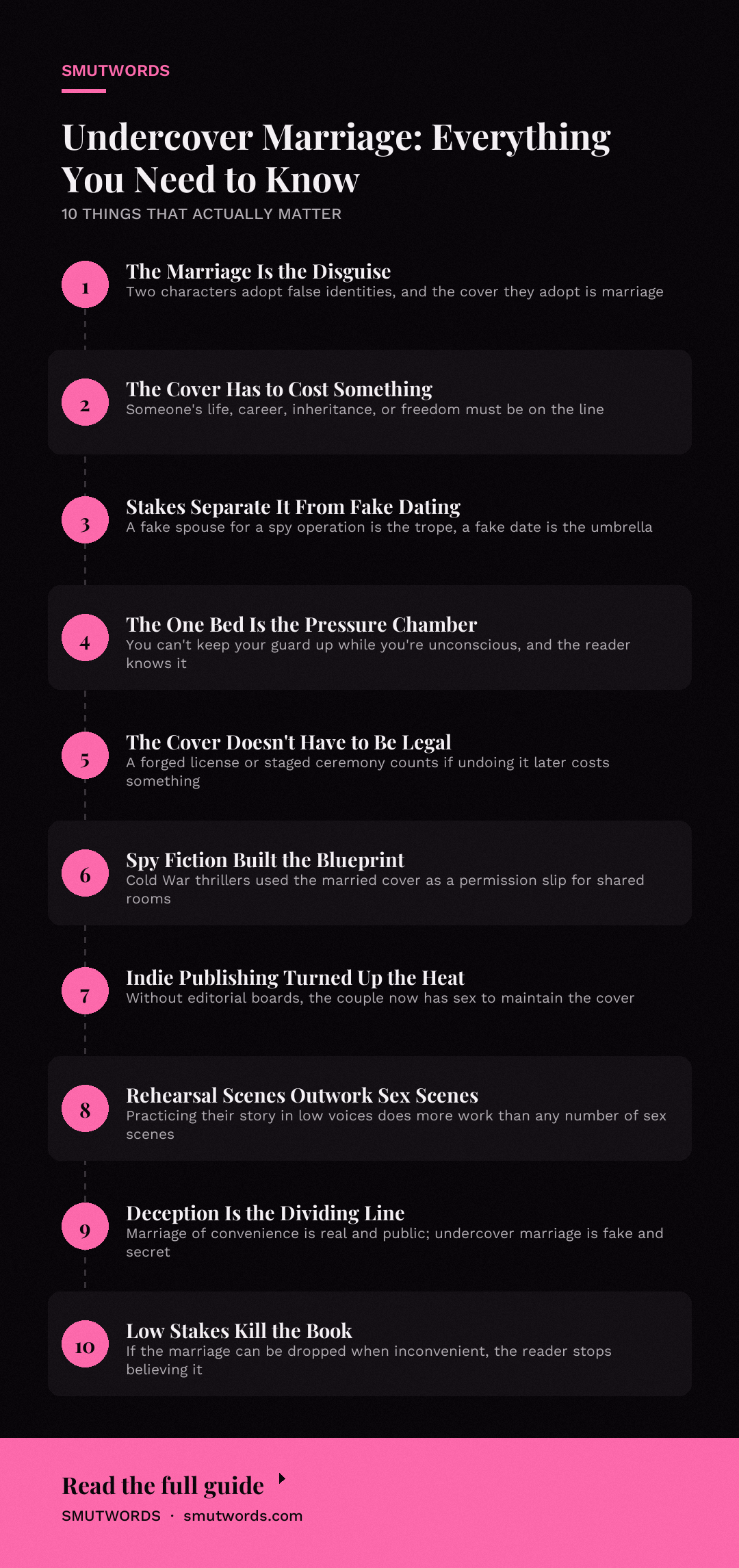
The name is almost literal. Two characters go under cover, meaning they adopt false identities, and the cover they adopt is marriage. The marriage is the disguise. That's the whole architecture of the trope, and everything else follows from it.
What counts as undercover marriage is narrower than "any two characters who pretend to be together." The marriage has to be doing work. There's a reason the couple needs to be perceived as married, and that reason has stakes: someone's life, someone's career, someone's inheritance, someone's freedom.
A fake boyfriend at a wedding to make an ex jealous is a fake relationship. The same couple pretending to be married because the target of an investigation only socializes with couples is undercover marriage.
The cover story usually requires the couple to be believable in public and to share private space, which in practice means one bed. The bed is not optional furniture. It's the pressure chamber where the trope does its best work, because sleeping next to someone while maintaining a lie is a very specific and very hot kind of exhaustion. You can't keep your guard up while you're unconscious, and the reader knows it.
A few things don't count. A couple who are already married and go undercover together is a different trope, closer to marriage in trouble territory if the relationship is strained, or straight action-romance if it isn't. A couple who genuinely marry for practical reasons with no deception and no cover identity is a marriage of convenience, which shares DNA with this trope but lacks the performance. The performance is the point.
The most common misconception is that the marriage has to be legally real. It doesn't. Some of the best versions involve a forged license, a bought officiant, or a ceremony staged for an audience of one. What matters is that the characters and the world around them treat the marriage as fact, and that undoing it later costs something.
Where Undercover Marriage Comes From
The trope's roots are in spy fiction and gothic romance more than in any single erotic tradition. Cold War era thrillers loved the married-couple cover because it justified a man and a woman sharing a hotel room in a publishing climate that wouldn't allow anything steamier.
The marriage was a permission slip. Two agents posing as spouses could sleep in the same bed, touch each other in public, and dress and undress in front of each other, all while the prose maintained plausible deniability about what any of it meant.
Category romance picked that up fast. From the 1970s onward, the married-cover plot became a staple of romantic suspense lines, where a heroine and a hero who disliked each other could be shoved into a cabin with one bed by page forty because the case demanded it. The trope has been a reliable category-romance workhorse for fifty years, and it has never really gone out of print.
The bigger shift came with indie publishing. Once authors could write anything without a publisher's editorial board deciding how explicit a scene could get, undercover marriage stopped being a chaste suspense plot with a kiss at the end and started being a plot where the couple has to have sex to maintain the cover, or where they rehearse their story in bed and the rehearsal turns into something else. The trope didn't change shape. It changed temperature.
More recently, the marriage-as-disguise premise has migrated into two new homes. The first is dark romance, where the cover marriage is sometimes the trap itself, the husband a man the heroine didn't choose and can't escape. The second is contemporary romantic comedy, where the cover marriage is a PR stunt between a celebrity and a normal person, a plot that overlaps heavily with celebrity romance and owes a lot to the fake-dating boom of the 2010s.
The publishing history matters here because it explains the trope's durability. Undercover marriage is a machine for generating forced proximity and shared privacy, and those are the two most reliable ingredients in the genre. Every era rediscovers the machine and dresses it in its own clothes.
How It Shows Up in Erotica
On the page, an undercover marriage scene has a specific texture, and getting it right is mostly a matter of managing information. The couple knows the marriage is fake. The world doesn't. The reader knows both, and the erotic charge comes from watching the gap between the two shrink.
The strongest versions of the trope do three things well. They establish the reason the marriage has to be convincing, so the reader feels the cost of failure. They put the couple in situations where they have to touch, undress, or lie close to each other in ways that are technically professional. And they let the reader inside the head of at least one character who is starting to want the lie to be true, which is where the heat actually lives.
The most common variations, and how each one plays:
Enjoyed this? Get a free book.
Join the list and we will send a complete free story straight to your inbox, plus new releases every week after that. No credit card, no catch.
- Spies pretending to be married. The classic. A handler partners two agents who don't trust each other and sends them into a foreign city as husband and wife. The tension is professional rivalry layered over a cover that keeps putting them in bed together. The best versions make the mission failure states specific, so the reader knows exactly what happens if the cover breaks.
- Witness protection marriage. A civilian and an officer, or two witnesses to the same crime, are relocated as a married couple. This variant is almost entirely about the domesticity. They have to shop for groceries, meet the neighbors, and fake a marriage in a place where nothing ever happens, and the boredom becomes the pressure.
- Investigation marriage. Cops, private investigators, or journalists posing as spouses to infiltrate a social circle, a country club, a cult, or a political campaign. This is the variant that benefits most from a strong supporting cast, because the cover only holds if the people around them believe it.
- Holiday charade. The couple fakes a marriage or engagement to survive a family holiday, a destination wedding, or a trip with people they need to impress. This one trends comedic and often hides a real, unspoken history between the two characters.
- The PR marriage. A publicist arranges a marriage between a star and a nobody to fix a scandal or sell a movie. This variant overlaps with rockstar romance and celebrity romance, and the heat comes from the audience.
- The forced-marriage spy plot. A darker read where the cover marriage is arranged by someone else, sometimes without full consent from one party, and the couple has to find a way to work within it. Handle this one with care; consent rules need to be explicit, and the free use kink guide is a good primer on how to write negotiated rules into a scene without killing the heat.
The flat versions of this trope all fail in the same way: they treat the cover as a costume rather than a pressure. If the couple can slip in and out of the marriage whenever it's inconvenient, the reader stops believing the stakes.
The clock has to be running. The mission has to have a deadline. The people around them have to be watching.
Craft-wise, the most useful thing a writer can do is let the couple rehearse. Give them a scene where they practice their story, their anniversary, how they met, what their dog is named. Let them lie to each other in a low voice with their mouths close. That scene does more work than any number of sex scenes, and the sex scene that follows it lands harder because of it.
The trope also rewards a slow escalation of touch. A hand on the back of a neck in public because the target is watching. A kiss that has to look real. A night where one of them has a nightmare and the other doesn't move away, because moving away would break character.
Each of those beats is a small theft of intimacy, and the reader collects them.
Undercover Marriage vs Marriage of Convenience
The comparison readers ask about most is with marriage of convenience, the trope where two characters marry for practical reasons with no cover story at all. The two share a lot of furniture. Both involve a marriage that didn't start from love, both involve sharing space, both tend to end with the couple meaning it.
The difference is deception. In a marriage of convenience, the marriage is real and the reason is public. In undercover marriage, the marriage is usually fake and the reason is a secret. That changes what the couple can and can't say to each other, and it changes what the reader watches for.
In a marriage of convenience, the heat comes from watching the couple discover they want each other inside a real, socially recognized marriage. In undercover marriage, the heat comes from watching the couple perform intimacy and slowly stop performing. The first trope is about a real thing becoming loving. The second is about a fake thing becoming real.
The overlap is large enough that some books run both at once, and that's fine. A couple who marry to save a failing business and then also have to pretend to be happily married for the investors is a legitimate hybrid, and it works because the two tropes reinforce each other. If you're writing that hybrid, decide early which trope is doing the heavy lifting, because the reader will notice if the book can't.
One more distinction worth drawing: undercover marriage is a narrower thing than the fake relationship trope, even though they're often listed together. Fake relationship is the umbrella. Undercover marriage requires the marriage, the cover, and the stakes.
A fake date to a wedding is the umbrella. A fake spouse for the mob is the trope.
Frequently Asked Questions
What is an undercover marriage in romance?
An undercover marriage is a plot where two characters pose as a married couple to complete a mission, investigation, or other job, and the fake intimacy starts to become real. The trope usually involves a shared bed, a rehearsed cover story, and a deadline that raises the stakes. The marriage is a disguise, and the story is about the disguise failing.
Is undercover marriage the same as fake relationship?
Fake relationship is the broader category. Undercover marriage is a specific version of it, one where the fake relationship is a marriage and the reason for it involves a mission or a cover identity with real consequences. A fake partner at a party is fake relationship. A fake spouse for a spy operation is undercover marriage.
What are the most common undercover marriage variants?
The most common are spies pretending to be married, witness protection marriages, investigation marriages, holiday charades, PR marriages, and darker forced-marriage spy plots. Each one changes the pressure source: some are about the mission, some are about the audience, some are about family obligation. The shared feature is a cover that requires the couple to act married in private and in public.
Why do readers love the one-bed setup in undercover marriage books?
Because the bed is where the cover stops being something the characters can choose. They can lie in public and keep their distance. They can't keep their distance while they're asleep, and they can't rehearse a cover story at close range without their bodies making the decision before their mouths do. The one bed turns the lie into a physical problem.
Does undercover marriage have to be explicit?
No. The trope works in closed-door romance and in explicit erotica, and the version you get depends on the heat level of the book. What matters is the pressure, the deadline, and the slow collapse of the act. A very explicit undercover marriage book can be less hot than a chaste one if the plot doesn't make the lie cost anything.
What makes a bad undercover marriage book?
Low stakes. If the marriage can be dropped whenever it becomes inconvenient, the reader stops believing it. The other common failure is a couple who already want each other on page one, so there's nothing to discover. The trope needs a reason to hold the couple together and a reason for each of them to resist, and it needs both to be specific.
Final Thoughts
The best undercover marriage books understand that the trope is a pressure cooker and load it correctly: a mission that fails if they get caught, a cover that requires them to touch, a deadline that keeps the clock audible, and two people who start out certain they can act and discover they can't. Read a great one and you'll feel the exact moment the rehearsal becomes a confession.
If you want a starting point, look for a book where the marriage is arranged for a job and the couple has to memorize each other's histories before they share a bed. Rehearse the story with them. Watch the room get hotter. Then go find another.





Loading comments…