
Six months without sex in a long-term relationship feels less like a pause and more like a closed room. You walk past the door, you know what's in there, and the longer you don't open it, the heavier the handle gets.
That's the thing about sex after a dry spell: the actual absence is rarely the hard part. The hard part is the pressure you've built up around ending it. Which is why the first move back into intimacy tends to go sideways when you treat it like a big production instead of a reset.
The good news, and this holds whether the gap is three months or three years, is that desire doesn't vanish and it doesn't need a grand gesture to come back online. It needs the pressure taken off, some structure, and two people who are honest about where they're starting from. What follows is the practical version, no candles required.
Why a dry spell happens (and why it's usually not about you)
Dry spells have a hundred unglamorous causes. A newborn who won't sleep, a job that ate the year, a stretch of depression meds that flattened everything, a bout of illness, grief, a fight that never really got resolved and then quietly calcified into distance. New parents get hit hardest and least talked about. One partner's libido drops off a cliff and the other reads it as rejection when it's really exhaustion.
Sometimes the cause is mechanical and dull: mismatched schedules, a bedroom that became the laundry room, or a body that changed and nobody said anything about it. Whatever the origin, the pattern that keeps a dry spell alive tends to look the same. Someone initiates, it lands flat because the timing is awful, both people take the miss personally, and the next initiation feels heavier than the last.
Repeat that four or five times and you've trained each other to stop trying. Naming the cycle out loud with your partner is half the work. The moment you can both say "we're not bad at this, we just got out of the habit and let it scare us," the handle gets lighter.
The initiation problem, and why grand gestures backfire
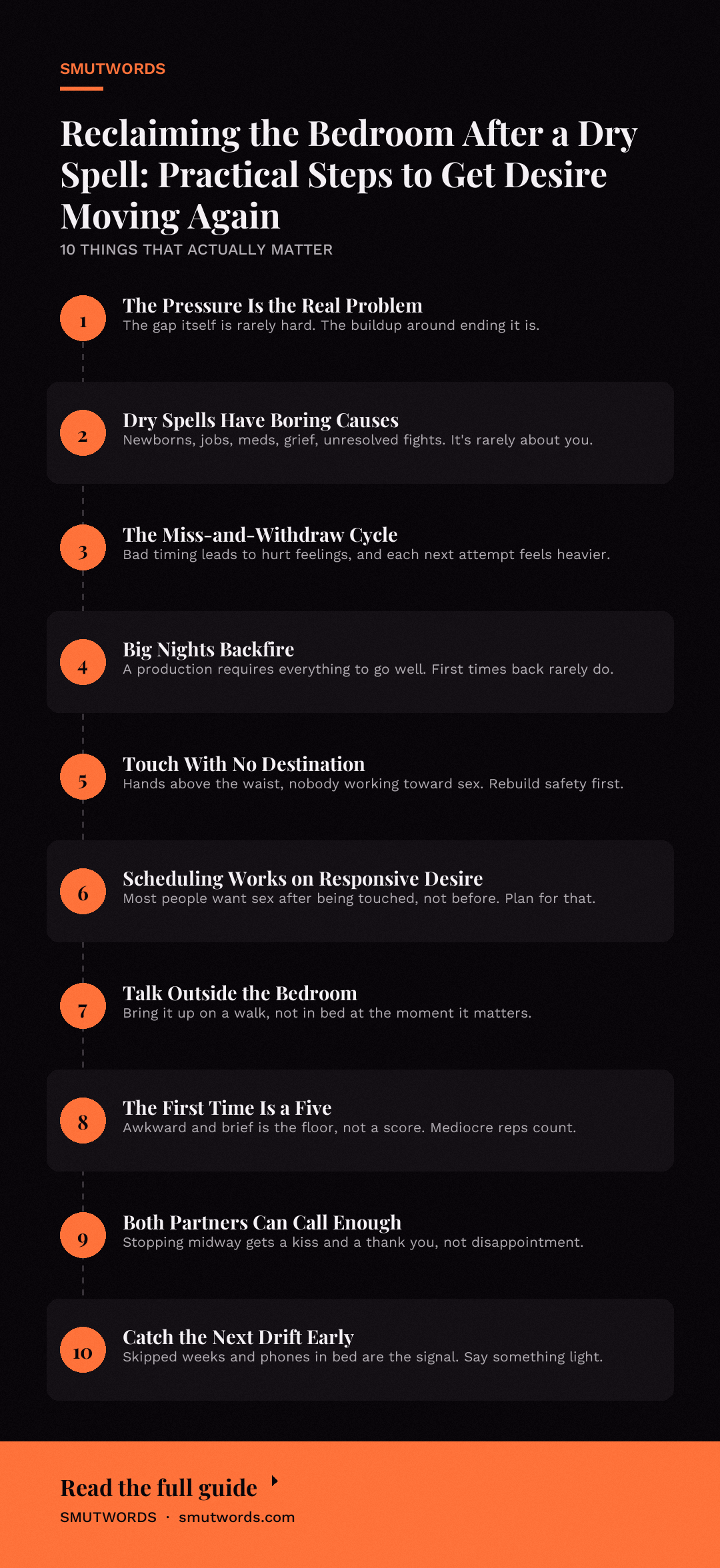
Most people try to end a dry spell with a big night. Fancy dinner, new lingerie, a hotel. It almost never works, because a big night requires everything to go well, and the first time after a long gap rarely does. Anxiety spikes, performance wobbles, one person cries, and now the memory of the attempt has become its own obstacle.
The fix is to drop the goal of "tonight we have sex" and replace it with "tonight we touch each other, and whatever else happens, happens." That single reframe does more than any product or technique.
Start with touch that has no destination
Pressure-free touch is the foundation, and the trick is to make it just structured enough that it actually happens. Pick a low-stakes setting, a Sunday morning in bed or twenty minutes on the couch after the dishes, and set one rule: hands stay above the waist, and nobody is working toward sex. Not yet. This gives your nervous system a way to re-learn that your partner's hands are safe and pleasant before it has to perform.
You can make it a real exercise. One person touches, the other just receives and gives feedback. "Lighter." "There." "Too much." Twenty minutes, then swap.
This is where language about your own body gets rebuilt after months of not using it. If it feels clinical at first, good, that's the point. You're a beginner again at a thing you used to be fluent in, and beginners get to be clumsy.
What counts as "touch" here
Literally anything. Back rubs, scalp scratching, lying tangled while you watch something, holding hands in bed instead of on the sofa. A lot of couples rediscover that they stopped touching each other at all outside of sex, which made sex carry the entire weight of their physical connection. Take the weight off and the whole system relaxes.
Scheduling sounds unsexy and works anyway
Everybody resists the calendar until they try it. Spontaneous desire is a thing some people have; the rest of us run on responsive desire, which means wanting sex tends to follow being touched, not precede it. Scheduling works because it puts the touch on the calendar where responsive desire can actually get going, instead of waiting for a fire that a tired Tuesday night will never start.
It doesn't have to be "sex at 9pm Thursday." Put a loose block on the calendar. "Thursday after the kids are down, phones in the other room, an hour for us." Then treat the hour as protected, whatever ends up happening in it.
Some weeks it's sex, some weeks it's a long make-out like you're seventeen, some weeks you talk for the whole hour and that counts too, because the streak is about keeping the door open, not about a tally.
Keep the plan specific enough to be real. "We'll see" is how you end up back on your phone. Give it a start time, agree on whose job it is to clear the time and turn off the screens, and then actually show up.
Have the conversation outside the bedroom
Do not bring any of this up in bed at the moment it matters. Compromised timing is where the worst version of the conversation happens. Instead, pick a calm, uncharged moment, a walk or a Saturday coffee, and say what you want without accusing anyone of anything.
Some openers that work better than "we never have sex anymore":
- "I miss feeling close to you. I don't need it to look like it used to, I just want to start finding our way back."
- "I want to try touching each other again without any pressure for it to go further. Does that sound good to you?"
- "I've been putting pressure on myself about this too, so let's take the goal off the table for a while."
Then listen. If your partner's on medication that's killed their libido, or they're exhausted, or there's something they haven't told you yet, you want to hear it. What you're building here is a shared project, and both people need to be signing onto it openly. If one partner is genuinely not there yet, rushing them is the surest way to set the whole reset back another six months.
Enjoyed this? Get a free book.
Join the list and we will send a complete free story straight to your inbox, plus new releases every week after that. No credit card, no catch.
Lower the bar deliberately
The most useful thing you'll read about sex after a dry spell: the first time back is often a five out of ten, and that's completely fine, because it's a floor, not a score. Expect awkwardness. Expect it to be brief. Expect your body to not feel like it did last time you used it seriously.
None of that means you've regressed. You're rebuilding a skill, and skill-building is full of mediocre reps.
Give yourselves permission to stop. Midway through, either person can say "I'm done for now, this is plenty," and the response is a kiss and a thank you, not disappointment. The couples who recover fastest from long gaps are the ones who let the awkward attempts exist without turning them into a problem to analyze.
What to do if a body doesn't cooperate
Erections come and go, arousal lags, lubricant is your friend and not an admission of failure. Have it within arm's reach before you need it. If anxiety is the blocker, slow down and go back to pressure-free touch instead of pushing through, which tends to make the anxiety stick. Bodies are not on command and treating them like they should be is how performance anxiety gets set in cement.
A workable first-month plan
Here's a month that gets the momentum going without making everyone crazy:
- Week one. Two sessions of pressure-free touch, hands above the waist, no destination. Twenty minutes each.
- Week two. Same, plus one honest conversation outside the bedroom about how each of you is feeling about the whole thing.
- Week three. A scheduled block on the calendar, permission to explore further than the waist, and an agreement that either person can call "enough" at any point without it being an issue.
- Week four. Whatever kind of intimacy you both actually want, with zero requirement that it scale up from last week.
Adjust as needed. Some couples need two months of pressure-free touch before anything else feels right, and there's no prize for going faster. The month is a container, not a race.
Keeping the door open once you're through it
The dry spell ends, the streak resumes, and then a stressful quarter quietly starts a new one. Every couple cycles through this. What protects you is noticing the pattern before months pass: a couple of skipped weeks, a stretch where conversation got shorter, a phone that came to bed.
Say something early and lightly. "We got out of the habit again. Can we put a block on Sunday?" That's a much shorter conversation than the one after a year of silence, though that one is survivable too.
Lower the stakes every single time. A quickie counts. A shower together that doesn't go anywhere counts. Cuddling that turns into nothing counts, because it keeps the door unlatched.
Where fiction fits in
None of what's above requires outside help, but a lot of readers find that fiction is a low-pressure way to kick-start their own interest without another person's expectations attached. Reading something that catches your imagination is private and blameless, and it can start the engine before you're in the room with someone.
If you like the charged, high-stakes version of intimacy on the page, that's a legitimate way to prime your own curiosity. The fantasy doesn't have to resemble your life to do the job.
Some readers find the sheer riskiness of a scenario is what gets them out of their heads, whether that's Free Use War Zone or something more slow-burn like a celebrity romance. The gap between what turns you on and what you actually want in bed is exactly where fiction is supposed to live, and you can let it roam without acting on any of it.
Others use the opposite approach: something warm and familiar, like the reunion in a second chance mate trope, which is essentially the fictional version of exactly this problem, right down to the long gap and the cautious first touch.
When to stop and get help
Nothing here is a substitute for medical care, and there are real signs that the dry spell has a physical or psychological cause worth addressing with a doctor or therapist. Get help if:
- Sex becomes painful for either person, or pain is why you've stopped.
- One partner's desire dropped suddenly and stayed there, especially alongside a medication change, depression, or a major life event.
- You or your partner avoid touch altogether and it's causing genuine distress.
- There's resentment, contempt, or unresolved conflict sitting under the whole thing. That's a couples-therapy job, not a scheduling job.
None of that is failure. Plenty of dry spells have a root cause that gets fixed with a doctor's appointment or a few sessions with a therapist rather than a new routine. The routine helps; it just isn't magic.
The one thing that genuinely backfires: trying to power through with willpower and a mood board. Wanting sex after a dry spell is a nervous-system project, and it responds to patience, a lowered bar, and someone making you feel wanted without an agenda. Give it a month before you judge the results. Give it two, honestly, because no two bodies reset at the same speed.
Final Thoughts
Read The Weekend Bull Rotation if you want a fantasy to prime the pump without touching the pressure around your own relationship. If you'd rather start with something that models the slow return to closeness, the reunion arc in the Second Chance Mate Trope guide walks the same cautious road, and reading it while your own first month is running can take the edge off the pressure.
Take the hour, turn off the phone, and start with a hand on a shoulder.








Loading comments…