
The second chance mate trope is a romance plot where two characters who were once bonded as fated partners, usually in a shifter or paranormal setting, find each other again after a separation, a rejection, or a betrayal that should have ended things for good. They get a second shot at the bond, and the story lives or dies on whether they earn it.
That is the whole engine: history that hurts, a connection that will not quit, and a reunion that has to be fought for on the page. It is one of the most reliable emotional machines in paranormal romance, and readers come back because the payoff is enormous when it lands. This guide covers what the trope actually means, where it came from, how strong authors build it, and where it goes wrong.
What Second Chance Mate Trope Actually Means
The name carries two pieces. "Second chance" is borrowed straight from contemporary romance, where it describes any couple with shared history who reunite after a breakup, divorce, or long estrangement. "Mate" comes from the shifter romance tradition, where wolves, bears, big cats, and increasingly hybrids recognize a fated partner on sight or scent.
Put them together and you get a specific beast: two people who already belonged to each other, lost it, and now have to reclaim it. The mate bond does the heavy lifting. It is the reason the connection cannot just be switched off, even after years apart or an act that would end any ordinary relationship.
What counts: rejection and reunion, forced proximity after a long absence, a hero who walked away and now has to grovel, a heroine who was cast aside and now holds the power, a bond rediscovered after memory loss or a faked death, a pair separated by pack politics and dragged back together by circumstance.
What does not count: a fated mate discovered for the first time. That is the standard mate trope, not the second chance one. The distinction is shared history. If they were never bonded before, there is no second chance.
Common misconceptions worth clearing up. This is not the same as enemies to lovers, though the two overlap when a rejected mate turns hostile. It is not a plain second chance romance with a werewolf pasted on. The mate bond has to matter, as leverage, as a source of pain, as an involuntary pull, or as a problem the characters have to solve.
And it is not always about sex, though sex is usually where the reconciliation gets physical. The trope shows up across the full spread of shifter and creature romance, from standard wolf packs to more exotic territory like hybrid shifter romance and even merman romance, because the underlying logic (a fated bond that survives separation) travels anywhere a non-human instinct can override human good sense.
Where Second Chance Mate Trope Comes From
The honest history here is publishing history, because the trope as readers know it is a relatively recent genre invention. Paranormal romance exploded as a mass-market category in the 2000s, and by the 2010s the shifter subset had settled into a recognizable formula built on fated mates, alpha packs, and mating bites.
Independent publishing did the rest, flooding the market with wolf and bear romance and, crucially, letting authors push the drama much further than traditional publishers would.
The rejection scene is the hinge. Somewhere in the independent web serial and Kindle Unlimited boom, authors figured out that a rejected mating bond generated an instant, enormous emotional response, and that bringing the rejecter back to grovel was even better. The "rejected mate" subgenre grew directly out of that discovery, and the second chance mate trope became the umbrella that catches it.
Over time, the trope has shifted. Early versions leaned on angsty heroines and dominant, unrepentant heroes who mostly got forgiven. Contemporary versions are more likely to give the rejected party real power, real choice, and a hard road for the groveling party.
The current crop of bestsellers is far more interested in accountability. The hero who abandoned his mate has to earn his way back, and the story does not let him off easy.
The trope also spread sideways into adjacent corners of the genre. Alien romance has its own version, the bond that turns out to be more than biology, and the reconciliation-with-a-fated-partner structure shows up in non-shifter settings too, including some of the more unusual creature niches like kraken romance. Wherever a fated bond exists, separation and reunion can follow it.
How It Shows Up in Erotica
The craft question is simple to state and hard to pull off: how do you make a reunion feel earned? The strongest versions of this trope are built scene by scene around that problem, and it is where an editor's eye starts sorting the good from the disposable.
Every strong version has a recognizable skeleton. There was a bond. Something broke it, and the break has to be specific: a rejection, a lie, a choice made under pressure, a false accusation, a betrayal by a third party.
There is a period of absence that reshapes both characters. Then something forces them back into contact. And then the actual work of reconciliation begins, and the story has to show that work rather than summarize it.
Common variations authors use:
- The rejected mate. One character publicly rejects the bond, and the reunion story is the long climb back. This is the most popular version and the one that produces the biggest grovel.
- Forced proximity. Pack obligations, a mating trial, a mission, or a shared living situation drags the pair back together before either is ready.
- Power reversal. The abandoned mate returns stronger, richer, or higher ranked, and the old dynamic has to be renegotiated on different terms.
- The slower burn. The bond rekindles over chapters and the sex comes late and means something.
- The fake death and reappearance. A presumed-dead mate returns, and everything the surviving partner built has to be torn down or rebuilt around the truth.
- The enemy pack reunion. Two mates from rival packs, separated by politics, find each other again when a war forces an alliance.
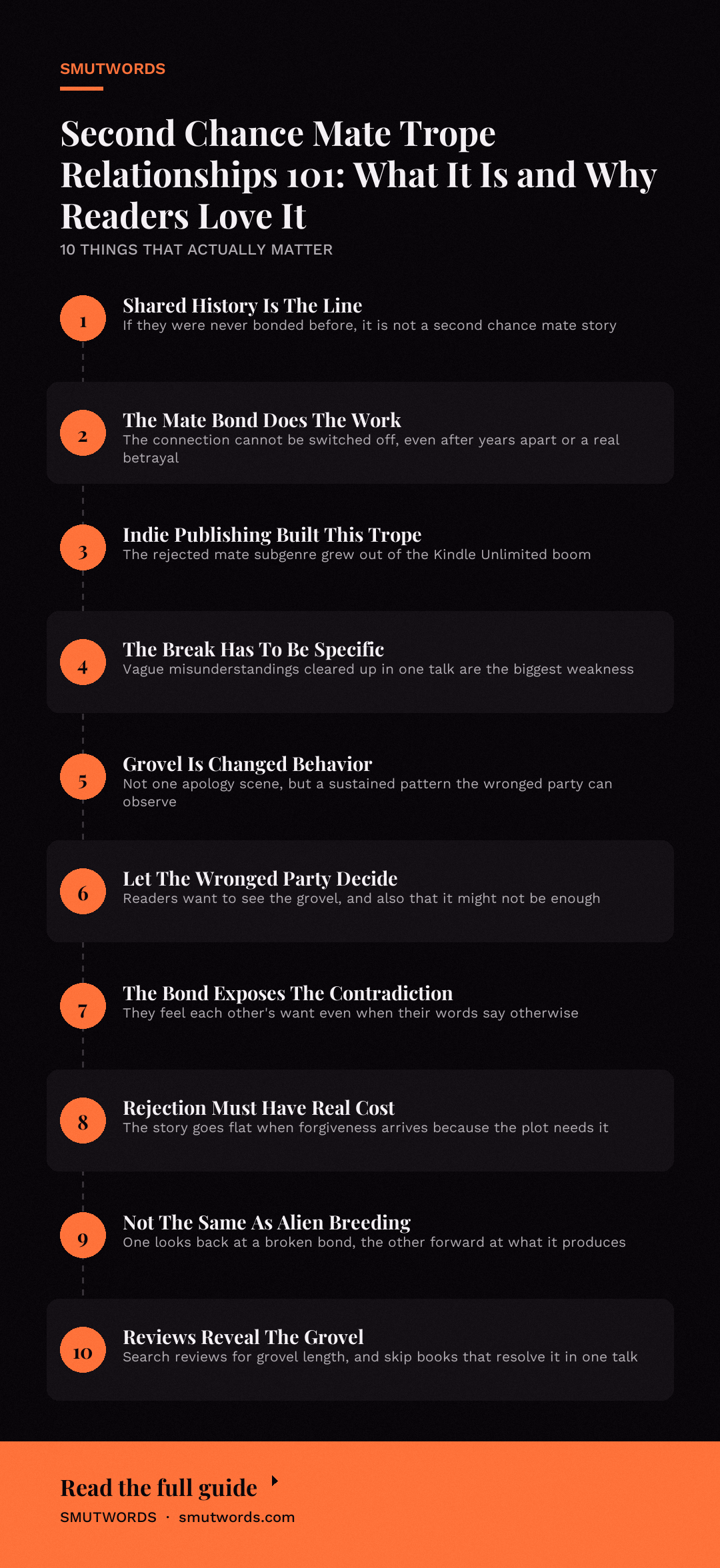
What makes the strong versions work is specificity of the break and honesty about its consequences. The reader has to believe the separation was real and that the characters were genuinely changed by it. Vague misunderstandings that could be cleared up in one conversation are the single biggest weakness in the weakest examples. The best versions make the separation unavoidable the first time and the reconciliation hard the second.
Enjoyed this? Get a free book.
Join the list and we will send a complete free story straight to your inbox, plus new releases every week after that. No credit card, no catch.
Then there is the grovel, and the grovel is where the trope either earns its reputation or collapses. A good grovel is not a single apology scene. It is a pattern of changed behavior, sustained over chapters, that the wronged party can actually observe and decide what to do with.
The strongest versions let that party take their time. The reader wants to see the grovel, and the reader also wants to see that it might not be enough.
Sex is where the reconciliation usually gets physical, and the trope hands the author a very specific tool: the mate bond. A bond that never broke means the characters can feel each other's want even when their words say otherwise. Good authors use that gap between what the body says and what the mouth refuses to.
The sexual tension is built on that contradiction, and the first time they touch again should carry the weight of everything that came before.
Certain adjacent craft patterns show up again and again. The possessive streak in these heroes overlaps heavily with the touch her and die trope, and the best authors separate genuine protectiveness from the hollow control version. The quieter beat, where a hard-edged mate softens specifically and only for the person who left, is the same instinct behind the grumpy hero soft for her trope.
In the reconciliation scenes, the language the characters use on each other does a lot of heavy lifting. A well-placed verbal reward can land harder than a physical one, which is why some of the best reconciliation scenes lean on the mechanics of praise kink.
Less common but effective: a version that lets the wronged party control the physical reconciliation, deciding when and whether touch happens. That variation flips the expected power dynamic and tends to produce some of the most satisfying chapters in the genre. Structurally, it borrows a lot from the honesty and negotiation culture of the broader Alpha/Beta/Omega dynamics corner of the genre, where bond logic and consent are often forced to sit together on the page.
Where the trope goes flat: when the rejection has no real consequence, when the grovel lasts one chapter, when the wronged party forgives because the plot requires it rather than because the story earned it, or when the mate bond is used as a shortcut to skip the emotional work. The bond can compel proximity. It cannot manufacture a real reconciliation.
Second Chance Mate Trope vs Alien Breeding Trope
These two get confused because both sit in the fated-partner territory of monster and creature romance, and both involve a bond the characters cannot simply walk away from. The difference is in what the bond is for.
The second chance mate trope is built on a history that already happened. The couple were bonded, they lost each other, and the story is the reunion. The alien breeding trope is built on a first contact, often a forced or negotiated one, where the bond is new and the driving question is whether it will produce the offspring or the arrangement the plot demands.
One trope looks backward at a broken bond. The other looks forward at what the bond will produce.
They can overlap (a rejected mate who was a captive first, say), but the emotional engine is different. Pack politics can complicate the comparison too, since a pack's rules often decide who gets to reject whom and what the rejection costs. That machinery is why the trope so often lives inside a structured shifter society.
Frequently Asked Questions
What is the second chance mate trope in romance?
It is a plot in which two characters who were previously bonded as fated mates reunite after a rejection, betrayal, or long separation and have to rebuild the relationship. The bond never really broke, so the story is about the reconciliation rather than the first discovery. It is most common in shifter and paranormal romance.
What is a rejected mate book?
A rejected mate book is a specific subset of the second chance mate trope in which the rejection happens on the page and the reunion follows. The rejected character is usually the protagonist, and the plot follows their recovery, their return, and the grovel of the character who rejected them. It is the most popular version of the trope.
Is second chance mate the same as second chance romance?
Second chance romance is the broader category: any couple with a shared past who reunite after a breakup or estrangement. The second chance mate trope adds a fated bond, usually a paranormal one, that makes the connection harder to escape. The mate element raises the stakes and limits the characters' options.
Why do readers love the grovel in these books?
Because the grovel is the visible proof that the earlier pain mattered. Readers are not actually after revenge; they want to see the wronged party receive something real. A sustained grovel across chapters, where the offending character's behavior changes, delivers that payoff in a way a single apology cannot.
What is the best way to find good second chance mate books?
Look for reviews that mention the grovel specifically and how long it lasts, and avoid books where the rejection is resolved in a single conversation. Shifter-specific community recommendations tend to be more reliable than generic romance lists. The strongest versions are usually tagged as rejected mate rather than simply fated mates.
Final Thoughts
The second chance mate trope works when a story treats the broken bond as broken and makes the characters work, chapter by chapter, to build something that survives. Find the version that commits to the grovel and does not let the wronged party off easy. You will see exactly why the trope keeps getting rewritten and keeps selling.





Loading comments…