
Veteran romance is a love story built around a protagonist who has served in the military and is now trying to live as a civilian, usually carrying wounds the service left behind. The wounds can be physical, psychological, or both, and the central relationship has to survive contact with them. It's one of the most reliable emotional engines in contemporary romance. It's also one of the easiest to get wrong.
This guide covers what the term means in publishing, where the trope came from, how authors execute it on the page, and what separates a veteran romance that earns its ending from one that coasts on a prosthetic leg and a thousand-yard stare.
The genre has grown enormously since the mid-2000s. It now covers everything from small-town homecoming stories to darker romantic suspense. Readers come to it for vulnerability wrapped in competence, for the specific ache of watching someone who survived something enormous learn to be gentle with themselves.
If you want the full map of how soldier stories work more broadly, the soldier romance glossary entry covers the active-duty side. Veteran romance starts where that story ends.
What Veteran Romance Actually Means
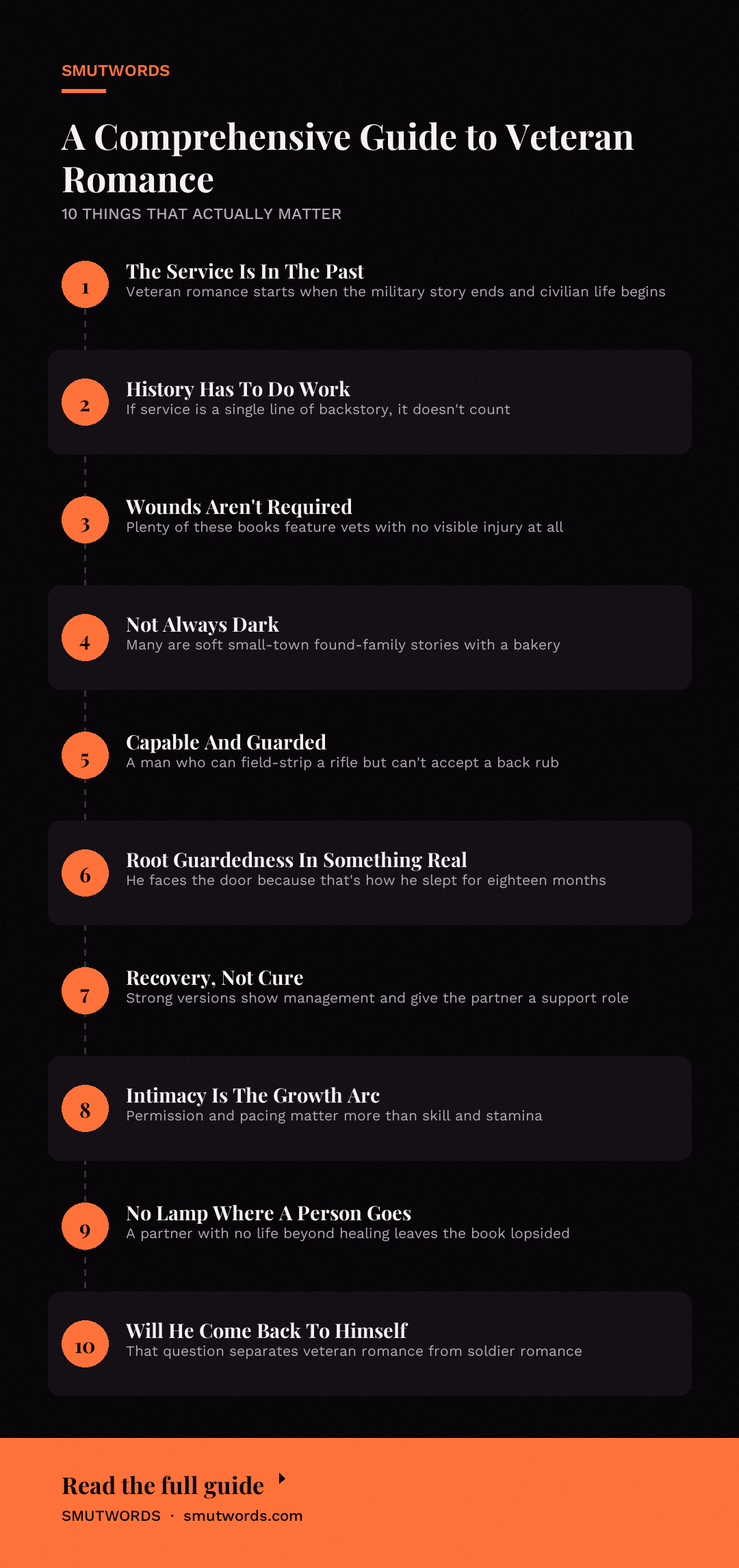
The defining feature is timing. The military service is in the past tense. The protagonist has come home, been discharged, retired, or medically separated, and the book is about what happens next. That structural fact shapes everything else about the subgenre.
Conventionally the term covers any romance where a main character is a former service member, across every branch and every era. The war can be Iraq, Afghanistan, Vietnam, Korea, or something fictional. The veteran can be twenty-four and freshly out or fifty and long retired. What counts is that military identity is part of who the character is and part of the obstacle between them and love.
What doesn't count, strictly, is a story where the love interest is currently deployed and the plot happens while they're serving. Those books exist in huge numbers and they're wonderful, but they belong under soldier romance, not here. A story where a character served briefly and never thinks about it again, where the service is a single line of backstory, also doesn't really qualify. The military past has to do some work in the present.
Readers sometimes assume the trope means a wounded veteran specifically. Wounds are common, and the label gets used interchangeably with the broader category, but plenty of veteran romances feature a character with no visible injury and no diagnosed condition. Some of the strongest ones are about someone who came home physically intact and still doesn't fit into civilian life.
Another common misconception: that veteran romance is inherently dark. Many are. Many are soft, small-town, found-family stories with a gruff man and a bakery. The trope describes a character's history, not a tone.
Where Veteran Romance Comes From
The trope's real history is a publishing history, and it tracks closely with the mainstreaming of the romance genre itself. Veterans have appeared in popular fiction since at least the nineteenth century, but as a distinct category within romance, the modern version crystallized in the years after 2003, when the wars in Iraq and Afghanistan pushed military service back into everyday American conversation.
Returning service members were suddenly everywhere in the news, and romance publishers noticed. The mid-2000s and early 2010s saw an avalanche of books about Marines and SEALs coming home to small towns. Many of these were part of broader romantic suspense lines, and the veteran was often also a security contractor, a rancher, or a sheriff's deputy. The military past supplied the competence and the trauma; the civilian job supplied the setting.
The PTSD-focused version of the trope matured considerably over that decade. Early entries often treated post-traumatic stress as a plot device to be cured by the right woman. Later books, especially those written from the 2010s onward, got more granular about treatment, therapy, medication, and the ongoing nature of recovery. Authors began writing vets who improved without being fixed, which is a much harder and much better story.
Indie publishing changed the trope's geography. Small-town veteran romance exploded as a self-published category, and it developed a set of recognizable settings: the mountain town, the ranch, the coastal community where everybody knows everybody. Readers who wanted a veteran hero could find a hundred of them in a single series with matching covers. You can see the same small-town gravitational pull in lumberjack romance, which shares the plaid, the isolation, and the competence-porn appeal.
The most recent shift is toward female veterans and toward vets who aren't officers or special operators. There are more books now about women who served, about enlisted soldiers rather than elite units, and about older veterans whose service was decades ago. The trope has gotten roomier as the readership has asked for it.
How It Shows Up in Erotica
On the page, veteran romance runs on a specific tension: the protagonist is extremely capable and also extremely guarded. That combination is the engine. A man who can field-strip a rifle in the dark and cannot accept a back rub is a whole book in one sentence.
The craft challenge is making the guardedness feel like a real consequence of service rather than a convenient reason to withhold information for three hundred pages. The best versions root the behavior in something concrete. He doesn't sleep with his back to the door because the author needed him to be mysterious. He does it because it's how he slept for eighteen months.
Common variants and how they play out
- Wounded veteran. Visible injury, often a lost limb or a spinal injury. The intimacy plot usually involves the protagonist's fear that their body is now unacceptable, and the partner's job is to demonstrate, physically and repeatedly, that it isn't.
- PTSD-focused veteran. The obstacle is internal and invisible. Nightmares, hypervigilance, dissociation, avoidance. Strong versions show management rather than cure, and give the partner a role as support rather than therapist.
- Homecoming romance. The plot is the return itself. The whole book spans the first weeks or months back, and the love story is tangled up with re-learning a town, a family, or a person who changed while they were gone.
- Veteran and civilian partner. The classic pairing. The civilian partner often has their own ordinary-world competence, and the good books let them be an expert in something without making them naive about everything else.
- Veteran plus revenge plot. Darker romantic suspense where the protagonist comes home and goes after someone. Treated well, the revenge line and the love line are the same question about whether violence is still who they are. See revenge romance for how that structure works.
- Veteran plus former flame. Often childhood friends to lovers where the friendship broke when one of them enlisted. The reconnection carries years of unresolved feeling.
- Female veteran. Growing fast. Frequently involves a protagonist who had to overperform in a male-dominated environment and now has to unlearn that in a relationship.
What makes one of these work
The strongest veteran romances make the intimacy itself the site of the character's growth. Sex scenes do heavy lifting here. A veteran who has spent years treating his body as a tool has to learn to let it be a place where nice things happen. That's a real arc, and it's much more interesting than a scene where his skill and stamina simply blow the civilian love interest's mind.
The best scenes tend to be about permission and pacing. Asking before touching a scar. Stopping when the protagonist freezes. Letting the partner set the speed.
That's where the emotional payoff lives. It's also why these books often work better at a high heat level. The vulnerability is measurable.
Enjoyed this? Get a free book.
Join the list and we will send a complete free story straight to your inbox, plus new releases every week after that. No credit card, no catch.
The dynamic overlaps with the grumpy hero who softens for exactly one person, one of the most reliable structures in the genre. Our breakdown of why everyone loves the grumpy hero soft for her covers the mechanics. The veteran version is a specific flavor: the softness is guarded because being soft once cost him something.
What makes one fall flat
Two failure modes dominate. The first is trauma as decoration. The author wants the aesthetic of damage, the scars and the nightmares, without writing the ongoing work of living with it. You can feel the difference within a chapter: a real vet character has routines, opinions about them, and days that are worse than others.
The second is a partner who exists to heal. If the civilian love interest has no life, no problems, and no function except to say "you're safe now," the book has a lamp where a person should be. The good versions give the partner their own history and let the veteran be useful to them in return. That reciprocity is what makes it a love story rather than a rescue.
A newer third problem is a plausible-sounding but sloppy depiction of military service. Readers of this trope are often veterans themselves or partners of veterans, and they notice when a discharge date doesn't square with the timeline, or a rank doesn't match the job. A little research goes further here than in almost any other subcategory.
The role of the physical reunion
Because the trope is about coming home, a lot of these books hinge on the first time the two leads touch after a separation or a long period of loneliness. Authors who understand the trope spend real page time on that moment, delaying it, making it earned, and letting it land. It's the same instinct that drives a good blind date romance: the anticipation is the point, and the payoff has to be worth the wait.
Some authors push the physical reunion into kink territory, using power exchange as a structured way for the veteran to give up control safely for the first time in years. Others go the opposite direction and make the scene almost unbearably gentle. Both work. What matters is that the author has thought about what this specific man or woman actually needs, not what the genre usually delivers.
Veteran Romance vs Soldier Romance
These two get confused constantly, and the distinction is worth knowing when you're searching for something to read. Soldier romance features a protagonist who is currently serving. The story often happens on or near a deployment, and the tension comes from distance, danger, and the possibility of loss.
Veteran romance happens after the service ends. The character is home. The danger is now mostly internal.
If the book's central question is "will he come back to me," you're reading soldier romance. If the central question is "can he come back to himself," you're reading veteran romance. Many series include both, often with a returning character who served alongside the lead.
The same distinction applies on the darker end. A cyberpunk romance might feature a veteran of a fictional corporate war, a different beast entirely, but the shape of the emotional arc is familiar: someone who was made useful by violence now has to figure out who they are without it.
Frequently Asked Questions
What is veteran romance?
Veteran romance is a romance subgenre where a main character has served in the military and is now a civilian. Their service history and its consequences, whether physical injury, post-traumatic stress, or difficulty adjusting to ordinary life, shape the relationship and the plot. The love story usually involves the protagonist finding safety and reciprocity rather than being fixed.
Is veteran romance the same as military romance?
Not quite. Military romance is the umbrella category and includes active-duty service members, deployed characters, and veterans. Veteran romance is the subset where the service is over and the story is about the return. If the character is currently deployed, most readers would file the book under soldier romance or military romance instead.
Do veteran romances always involve PTSD?
No. Post-traumatic stress is common, and the trope is often used as shorthand for the wounded-veteran version, but plenty of veteran romances feature characters with no diagnosed condition. Some are about physical injury, some about grief, some about the plain difficulty of readjusting to a slower civilian life after years of structure and urgency.
Why do readers like veteran romance so much?
The appeal is the combination of strength and vulnerability in one character. A veteran protagonist is usually competent, steady under pressure, and physically capable, and also deeply guarded. Watching that person become soft with one specific partner, in specific ways, is an extremely satisfying arc. The genre also offers a strong redemption and peace narrative.
Are there veteran romances with female protagonists?
Yes, and the number has grown substantially. Female veterans appear as leads across contemporary, romantic suspense, and small-town romance. These books often explore a different set of pressures, including having had to suppress vulnerability to be taken seriously in a male-dominated environment and now having to unlearn it in a relationship.
How much military detail should a veteran romance have?
Enough to be accurate and not so much that it crowds the love story. Readers of this trope are often connected to the military themselves and will catch obvious errors in rank, timeline, or discharge process. The detail should serve the character's present-day behavior rather than function as a history lesson.
Final Thoughts
The best veteran romances understand that the homecoming is not a single event. It's a long, uneven process that runs through the entire relationship, and the partner's job is to stay present for it, not to finish it.
Pick up a book that lets the protagonist have bad days after the happy ending is technically in sight, and see how much more the resolution costs. If you came from the broader catalog and want to see how heat and emotional specificity work together in this subgenre, the guide to praise kink makes a surprisingly good companion read for understanding how carefully chosen words land on a guarded character.





Loading comments…