
Hate to love is the engine behind some of the most gripping romance and erotica published today: two people who cannot stand each other at the start, whose conflict is sharp enough to draw blood, and who end up in bed (and in love) by the final chapter. The trope runs on friction, forced proximity, and dialogue that cuts. When it's written well, the eventual surrender feels like something the reader earned alongside the characters.
If you've ever finished a book at 3 a.m. because you needed to see the moment the insult turns into a kiss, you already know the hate to love dynamic from the inside.
This guide covers the trope from every angle: what it actually means on the page, where it came from, how the best authors build it, and where it goes wrong. Whether you're a reader hunting for your next fix or a writer trying to figure out why your rivals-to-lovers draft keeps falling flat, this is the thorough answer.
What Hate to Love Actually Means
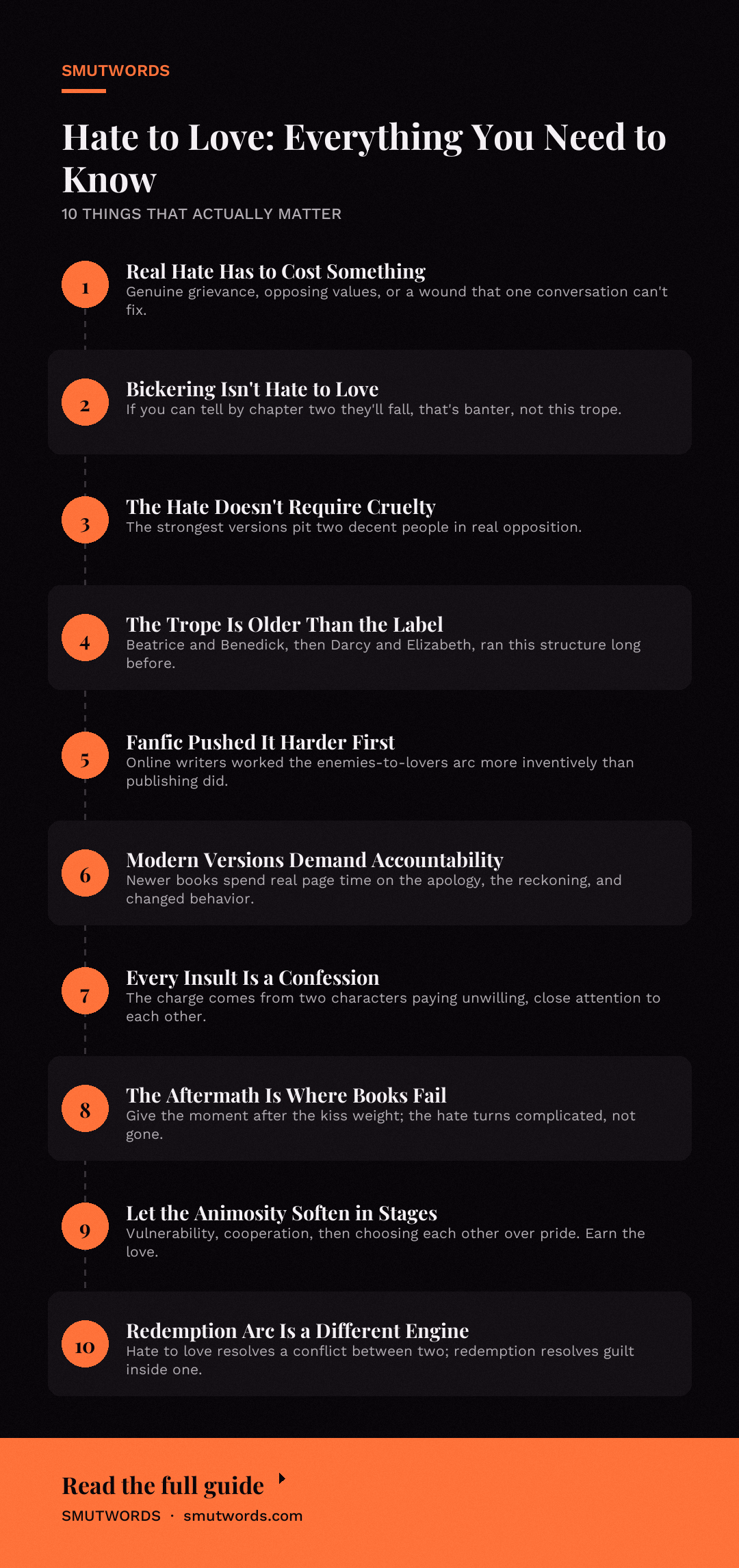
The name says it plainly: the relationship starts in hostility and ends in love. But the specific shape of that arc matters enormously, and plenty of books get labeled hate to love when they're doing something closer to mild annoyance or professional rivalry with a side of eye contact. The real thing requires genuine antagonism at the start, not just banter between two people who secretly like each other from page one.
The hate has to cost something. Two characters who dislike each other because of a misunderstanding that could be cleared up in one conversation are doing a lighter, fluffier version of the trope. The heavyweight version involves real grievance, opposing values, or a history that can't be hand-waved away.
What counts as hate to love, broadly:
- Enemies to lovers, the broadest label: characters on opposite sides of a conflict, whether personal, professional, or literal (rival kingdoms, opposing law firms, warring families).
- Rivals to lovers: direct competition, often in the same field, where each character's success partially depends on the other's failure.
- Antagonistic banter carried by two characters who provoke each other constantly, where the verbal sparring is the foreplay.
- Forced proximity setups that trap hostile characters together: shared apartments, snowed-in cabins, road trips, arranged marriages of convenience.
- Bickering couple dynamics, which sit at the lighter end, where the conflict is habitual friction rather than open warfare.
What doesn't count: characters who bicker affectionately from the first page. That's a different trope entirely, closer to the comfortable sparring you see between long-married couples in a marriage in trouble story. If the reader can tell by chapter two that these two are destined to fall in love and neither of them is really fighting it, you're reading banter, not hate to love. The trope needs a genuine possibility that these people will never resolve their differences.
A common misconception: hate to love requires the characters to be cruel to each other. It doesn't. The strongest versions often have two people who are fundamentally decent but whose goals, values, or wounds put them in direct opposition. The hate is situational and real, not a personality flaw.
Where Hate to Love Comes From
The enemies-to-lovers structure is as old as storytelling itself, and its romance-specific history runs through Shakespeare's Much Ado About Nothing (Beatrice and Benedick, the template for every bickering couple that followed), Austen's Pride and Prejudice (Elizabeth and Darcy, the first great hate to love novel in English), and Wuthering Heights if you like your romance with a side of gothic ruin.
But the term itself, and the genre conventions around it, is a much more recent publishing phenomenon. In the 1970s and 1980s, romance publishing was dominated by the "forced seduction" and "bodice ripper" model, where the hero was often outright hostile to the heroine and the "love" arrived after a lot of coercion.
The hate to love dynamic of that era was often genuinely ugly by today's standards, and much of what we now think of as the trope's darker end grew from that soil.
By the 1990s and 2000s, the contemporary romance boom rewired the trope into something more mutual: two people who spar as equals, whose hostility comes from pride, misunderstanding, or professional competition rather than from the hero's cruelty. The rise of online fanfiction communities in the 2000s and 2010s is worth noting here, because fanfic authors pushed the enemies-to-lovers structure harder and more inventively than mainstream publishing did for years.
Much of the terminology (including the shorthand "E2L") filtered back into traditional publishing's marketing language.
The 2010s and 2020s brought the trope's biggest commercial era. BookTok and Bookstagram turned enemies to lovers into a marketing tag that sells books before anyone reads a page, and the fantasy romance boom of the 2020s (fae courts, dragon riders, rival kingdoms) made it the dominant romance structure in speculative fiction. The hate to love trope is now one of the most-searched romance categories on retailer sites, and publishers market it as prominently as the plot itself.
The genre's own evolution has been toward more mutual conflict and more visible accountability. Where an older book might let a hero do something unforgivable and never atone, modern hate to love fiction increasingly spends real page time on the apology, the reckoning, and the changed behavior. That shift connects directly to the demand for a believable redemption arc romance, where the character who did wrong has to actually do the work.
How It Shows Up in Erotica
On the page, a strong hate to love scene runs on tension that has been cooking for chapters and finally boils over. The best authors understand that the sexual charge in this trope comes from the same source as the hostility: two characters who are paying extremely close, unwilling attention to each other. Every insult is a confession of how much they've noticed.
The kiss, when it happens, is often violent in its urgency because both characters have been fighting the attraction as fiercely as they've been fighting each other.
The scene-level craft in the best examples usually follows a recognizable shape:
- Escalation: a confrontation where the verbal sparring tips into physical proximity, and neither character backs away.
- The break point: one character says or does something that makes retreat impossible, usually by admitting, in anger, exactly how much they've been thinking about the other.
- The physical release: the first kiss or first touch carries the same aggression as the argument, often with clothes half-torn and the character's rational mind in open revolt.
- The aftermath: what follows is where many books get it wrong. The best versions give the characters a moment where the hate doesn't vanish; it becomes something more complicated.
Variations authors use to keep the trope fresh:
Enjoyed this? Get a free book.
Join the list and we will send a complete free story straight to your inbox, plus new releases every week after that. No credit card, no catch.
- The workplace rivals version, where two professionals competing for the same promotion or account fall into bed during a late-night deadline crisis.
- The forced-proximity version, snowed in, assigned together, or stuck on a long trip, where hostility has nowhere to go but attraction.
- The fantasy version, rival courts, enemies on opposite sides of a war, where the political stakes make the romance dangerous.
- The grumpy/sunshine mash-up, where one character's hostility is temperament and the other's is situational. The grumpy-hero dynamic has its own devoted following, and you can read more about how that trope works in our piece on why everyone loves the grumpy hero soft for her.
- The celebrity rivals version, two famous people feuding publicly whose private interactions tell a different story, a dynamic common in celebrity romance.
What separates a strong version of this trope from a flat one comes down to a handful of craft choices. The hate has to be proportionate and specific. Two characters who despise each other because of a single overheard remark at a party aren't really enemies, and readers know it. The best books give the hostility real weight: a past wound, a professional betrayal, a values clash that the story takes seriously.
The physical chemistry should follow from the conflict, not replace it. The charge comes from the fact that each character can't stop noticing how the other moves, how the other argues, how the other's mouth looks when they're furious. When an author writes that attention well, the reader feels the attraction building before the characters admit it.
Finally, strong hate to love books let the animosity soften gradually. There should be a scene where each character sees the other vulnerable, a scene where they cooperate against a common threat, and a scene where they have to choose each other over the pride that started the fight. When those beats land, the reader feels the love was earned.
The physical intimacy in these books runs the full range, from slow and tender to rough and urgent, and smart authors use the characters' hostility to shape the sex they write. Verbal sparring can tip into verbal degradation in a scene where the characters explicitly negotiate it, and the reversal of a fight into praise can be its own kind of payoff.
Rough physicality can also be tempered with praise kink once the characters are close enough to mean it. The trope gives the writer a lot of emotional range to play with, and the best authors use it.
Hate to Love vs Redemption Arc Romance
These two tropes get confused often because they overlap heavily, but they ask different questions. In hate to love, the central conflict is between two characters, and the love story is the process of them resolving it together. The "villain" of the story is the relationship itself.
In a redemption arc romance, the central conflict is internal to one character. They did something genuinely wrong, often before the book began, and the romance is the context in which they confront it, atone, and change. Their love interest may not hate them at all, and often doesn't. The engine is guilt and growth, not animosity.
The best books often run both structures at once, where two characters start as enemies and one of them has a genuine moral debt to work through. But if you pick up a book expecting hate to love and the two leads are already warm toward each other by chapter three, check whether the actual trope at play is our redemption arc romance entry. It's the more accurate label.
Frequently Asked Questions
What is the difference between enemies to lovers and hate to love?
They're the same trope in practice. "Enemies to lovers" is the more common publishing label, and "hate to love" is a close synonym used to emphasize the emotional hostility. Some readers use "enemies to lovers" for genuine adversaries with high stakes (war, politics) and "hate to love" for personal animosity in lower-stakes settings, but most retailers and authors treat them interchangeably.
Why is the hate to love trope so popular?
Because conflict is the visible proof of attention. Two characters who fight constantly are, in a very literal sense, thinking about each other all the time, which readers find more compelling than characters who are merely polite. The trope also offers a built-in emotional payoff: the reader watches the hostility soften into vulnerability, and the vulnerability into love, which lands harder than love that arrives easily.
How do authors make the hate to love transition believable?
The strongest writers make the animosity specific and earned, then show a series of scenes where the characters see past each other's defenses. A shared crisis, a scene of unexpected vulnerability, a moment of cooperation, a slow thaw. When the shift is won through those scenes, the reader believes it. When the hate disappears between chapters, the reader feels cheated.
Is hate to love the same as forced proximity?
No, though they often appear together. Forced proximity is a plot device: two people have to share space, whether a cabin, an apartment, or a business trip. It can power any romance trope. Hate to love is the emotional arc, and forced proximity is one of the most effective tools for executing it because it traps hostile characters in the same room until the hostility cracks.
What are some common hate to love variants in erotica?
Workplace rivals, professional competitors, and grumpy/antagonistic pairings are the most common. Fantasy enemies on opposite sides of a war and celebrity feuds show up constantly too.
A newer variation pairs the trope with childhood friends to lovers by having two people who grew up bickering reunite as adults who can't stand each other and then can't leave each other alone. The trope also gets combined with setup devices like a blind date romance, where two people who already can't stand each other find themselves matched by someone who doesn't know they share a history.
What's the best way to spot a genuinely good hate to love book?
Read the first three chapters and check whether the animosity feels earned. If the characters dislike each other for a specific, concrete, believable reason, and if their dialogue crackles with attention rather than flat insults, the book is likely to deliver. If the hostility is generic or the characters are clearly flirting under a thin layer of bickering, you're reading a lighter trope and should adjust expectations.
Final Thoughts
Hate to love endures because it delivers the most visible version of what every love story promises: two people whose defenses finally fall in the other's presence. When the animosity is specific, the attraction is mutual, and the surrender is earned through real scenes, the payoff lands harder than almost any other trope in romance.
Pick up a copy of the kind of book that pairs hate to love with tension at its sharpest or start with the ranked list below, and watch how quickly the grudge becomes something else.







Loading comments…