Macrophilia is a fetish for extreme size difference: a giant or oversized partner paired with a normal-sized or tiny one. In erotica it shows up as giantess fantasy, giant/macro romance, size kink, and monster-size couplings where one body dwarfs the other by feet or by stories. The kink is about scale as much as sex, and the erotic charge comes from being overwhelmed.
A lover tall enough to use your whole body as a handhold, a monster whose palm covers your back, a woman who could carry you in one fist: macrophilia takes that image and builds an entire erotic architecture on top of it.
What makes the genre endure is that the size gap changes every physical fact of a scene at once. Touch, weight, heat, sound, the sheer logistics of two bodies fitting together, all of it bends around the difference. Writers who understand that write scenes nobody forgets. Writers who treat it as a visual gimmick write forgettable ones.
This guide covers the whole picture: what the term means, where it comes from, and how to tell strong size-difference fiction from the flat stuff.
What Macrophilia Actually Means
The word is built from the Greek makros, meaning long or large, and -philia, meaning love or strong attraction. Macrophilia is the attraction itself, and it runs in both directions.
A reader can fantasize about being the giant, about being the tiny one, or about watching the pairing from outside. All three count. Most readers who love the fetish move between roles depending on mood.
What counts as macrophilia is a size gap big enough to reframe the whole dynamic. An inch or two of height difference is a preference, not a fetish. Once one partner is twice the other's size, or ten times it, or tall enough that a normal room stops fitting them, the story is doing something distinct.
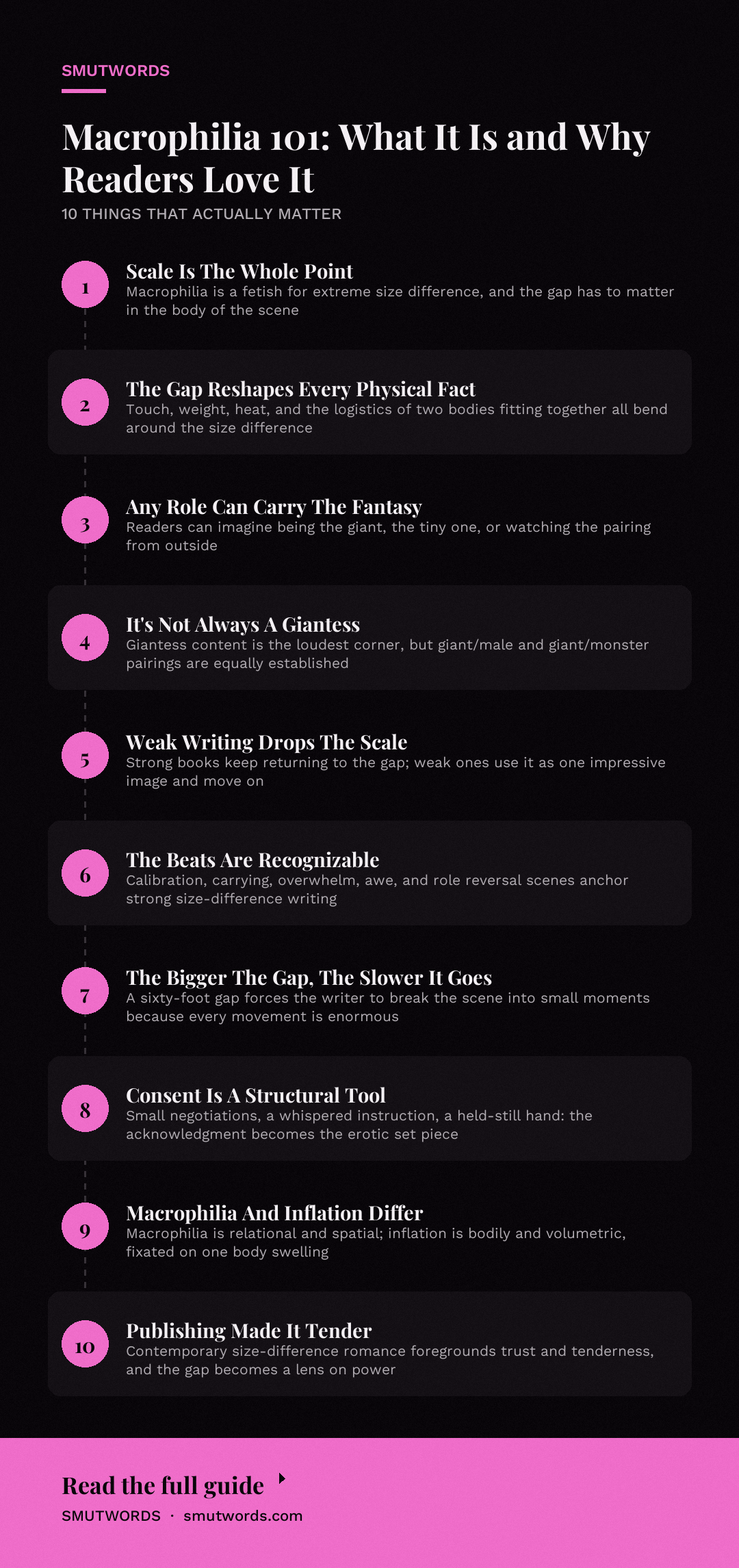
The gap has to matter in the body of the scene: how they touch, what the tiny partner can reach, whether the giant has to be careful. Mention the size difference and then ignore it, and it isn't really macrophilia.
Several misconceptions cling to the term. The first is that macrophilia is always about a giant woman. Giantess content is the loudest and most visible corner of the genre, and the vocabulary of the fandom skews that way, but giant/male and giant/monster pairings are equally established.
The second is that size kink is a subcategory of monster romance. It overlaps heavily with monster romance, but plenty of size-difference books feature human giants and giantesses with no monster content at all.
The third is that the fetish is inherently violent. Some of it is. A lot of it is tender, protective, and slow.
Two more terms get used loosely and are worth pinning down. Macro describes the giant side of the pairing, and micro describes the tiny side. Growth is a scenario where one partner gets bigger during the scene, a distinct variation with its own beats.
Titan romance is a publishing label that tends to mean a huge, often nonhuman partner with godlike scale. Readers use these words interchangeably in casual conversation and precisely in fandom spaces. A glossary is only useful if it acknowledges both habits.
Where Macrophilia Comes From
The fetish as a named thing has a surprisingly tidy paper trail. The word macrophilia entered circulation through online fetish communities in the 1990s, where early web forums needed handles for content that predated them by decades. The imagery is much older.
Mythology is loaded with giants and giantesses interacting with ordinary mortals, and pulp fantasy and science fiction spent the middle of the twentieth century building a library of oversized beings in erotic and terrifying roles. The fetish didn't invent scale. It organized a taste that had been scattered through myth, pulp, and exploitation film for a long time.
What shifted the genre was the internet's capacity for illustration and its appetite for transformation fiction. Giantess forums and macro art communities grew through the late 1990s and 2000s, and with them came a taxonomy: gentle giantess, cruel giantess, growth sequences, micro scenarios, unaware scenarios where the tiny partner goes unnoticed.
Authors who had written size difference as a single scene in a longer book started building entire serials around it. Self-publishing gave the genre a commercial backbone in the 2010s, and monster romance's mainstream rise in the 2020s pulled size difference toward a wider readership.
The publishing shift is worth naming, because it changed what the books are. Early size-difference fiction leaned hard on the shock of scale and often ended in disaster or awe. Contemporary titles built for romance readers foreground the emotional relationship between the two partners, and the size gap becomes a lens on trust, tenderness, and power.
That's the version most readers encounter on a bookstore shelf today: a monstrous or giant love interest who is careful with the small partner, and a small partner who wants to be handled.
The genre's history as a publishing phenomenon also explains its vocabulary. Giantess fiction grew alongside transformation and growth content, which is why so many terms overlap. Monster romance grew out of paranormal romance's expansion into nonhuman love interests, and size difference came along as one of the tools in that kit.
Readers who want the deep end can find decades of serials. Readers who want a single novel with a giant love interest and a slow-burn courtship have never had more choices. Both are macrophilia's lineage.
How Macrophilia Shows Up in Erotica
On the page, size-difference erotica lives or dies on physical specificity. A giant partner isn't a tall man with the same gestures. He has a different relationship to the room. Doors are too small. Beds are too short. His hand can encircle a thigh, or a waist, or a whole torso.
A giantess can lift a normal-sized lover onto a shelf, or hold him against her chest as though he were a keepsake. Strong versions of the trope keep the reader oriented in those physical facts for the length of the scene.
A common mistake in weak size-difference writing is treating scale as a single impressive image. The book opens with the giant partner ducking through a doorway and then everyone behaves as if they were the same size for the rest of the chapter.
Strong writers keep returning to the gap. Fingertips. Weight bearing down. The giant partner's effort to be gentle, the tiny partner's awareness of how little force it would take to be broken. Every touch gets re-described because every touch is different at that scale.
The other structural decision is tone. Size difference can be tender, dangerous, comic, or all three within a scene. A giant partner who spends the first act terrified of hurting his lover and the second act learning exactly how much pressure she likes carries an entire relationship arc on that axis alone.
Enjoyed this? Get a free book.
Join the list and we will send a complete free story straight to your inbox, plus new releases every week after that. No credit card, no catch.
Compare it to how a grumpy hero soft for her earns his softness through the heroine's specific effect on him. Same craft logic. The giant partner's care is only romantic if the book shows him making adjustments no one else makes for her.
A strong size-difference scene usually includes a few recognizable beats. Not all of them appear every time, but the good ones use three or more.
- The calibration scene where the giant partner learns the tiny partner's limits through touch, often with the tiny partner guiding him.
- The carrying scene where the tiny partner is moved without being asked, which sets up a negotiation about consent and being handled.
- The overwhelm scene where scale becomes erotic pressure: weight, heat, the inability to escape.
- The awe scene where the tiny partner simply looks and the narration lingers on what they see.
- The role reversal where the tiny partner takes charge of the giant through voice, instruction, or permission.
Variation matters as much as beats. Writers use growth for its own drama, and a scene of one partner getting larger mid-encounter produces a shifting physical relationship the book can use for both comedy and heat. Micro scenarios put the tiny partner at the scale of a hand or a lap, and the pleasure comes from total enclosure and safety.
Monster-size couplings tend to cast the giant partner as nonhuman, which pulls in the language of fangs, claws, and careful restraint. Titan romance leans on mythic register. Each variation wants different pacing and different emphasis.
One useful craft rule: the more extreme the size gap, the more the book needs to slow down. A pairing with a two-foot gap can move at normal erotic speed. A pairing with a sixty-foot gap forces the writer to break the scene into small moments because every movement is enormous.
Readers who love macrophilia specifically often want exactly that detail, and skipping it reads as lazy.
Overlap with adjacent fetishes is common and worth naming. Inflation and size difference sometimes share a scene when one partner swells, and a growth-adjacent inflation scene can use the same physical logic of expanding bodies and shifting weight.
A book that puts food or fluid into the scene, sometimes as a playful interlude, may lean on food play or on body fluid kink for sensory texture. Lingerie becomes a design challenge when nothing is the giant partner's size, which is a detail strong writers use, and the same logic shows up in any scene that uses lingerie fetish as a visual anchor.
If a scene slides into wet and messy territory, that beginner's guide to sploshing and wet and messy play covers practical considerations that fiction and real life share.
Voice matters enormously in this genre. The tiny partner's interior narration is where the reader lives. Awe, helpless arousal, tenderness, defiance: all of it sits in that headspace, and strong writers give all of it room.
Compare the way praise kink works. The reader lives in the reach of a specific kind of attention, not the concept. Same goes for size difference. The reader wants the specific sensation of being lifted by someone whose palm covers her entire back, not a general statement about bigness.
Consent is a structural tool in this genre, not a box to check. The giant partner's physical power means any scene has a built-in imbalance that the writer can either acknowledge or ignore. Strong books write the acknowledgment into dialogue and gesture, and small negotiations become erotic set pieces of their own. A whispered instruction, a hand held still, a tiny partner saying "a little more": among the hottest moments a size-difference book can produce.
In real-world size-play and roleplay, the same principle applies. Clear limits and a safeword matter more when the fantasy leans on being physically overwhelmed, and aftercare should be named before the scene starts rather than discovered afterward. Fantasy can be as extreme as the writing wants. The lived version benefits from planning.
Macrophilia vs Inflation Fetish
The two overlap often enough that readers confuse them. Macrophilia is about the relative size gap between two bodies. Inflation is about one body swelling, temporarily or permanently, for its own erotic charge. A story can contain both: a partner who inflates during sex and dwarfs the other by the end.
But the fetishes are distinct in what they fixate on. Macrophilia is relational and spatial. Inflation is bodily and volumetric. A reader looking for giantess content may bounce off a story that is really one body growing in isolation, and a reader who loves inflation may not care at all about a size-difference romance.
Useful distinctions when shopping for books: macrophilia promises a two-body dynamic with a scale gap, whether or not anything changes size during the scene. Inflation fetish promises a body that fills and changes, often solo or within an encounter. Overlap is welcome in some titles, and knowing which element matters most saves the reader a lot of frustration.
Frequently Asked Questions
Is macrophilia the same as a size kink?
In practice, yes. Size kink is the everyday phrase and macrophilia is the formal term, used in fandom and in clinical writing about the fetish. Both describe erotic attraction to significant size difference between partners. Some readers reserve macrophilia for extreme giant and micro scenarios and use size kink for a milder height gap, but the terms overlap heavily.
Do all macrophilia stories involve a giantess?
No. Giantess content is the most visible corner of the fandom, especially in illustration and forum communities, but giant/male and giant/monster pairings are equally established in fiction. Monster-size couplings and titan romance often feature a male or nonhuman giant partner. The fetish is about size, not about one gender being the giant.
Is size-difference erotica the same as monster romance?
They overlap but aren't the same shelf. Monster romance features nonhuman love interests and may or may not include a big size gap. Size-difference erotica can be entirely human.
Plenty of books do both, which is part of why the categories confuse readers. If the giant has fangs and fur, expect monster romance conventions. If the giant partner is human, expect pure size kink.
What is the difference between macro and micro?
Macro refers to the giant side of the pairing and micro refers to the tiny side. Both terms come from fandom shorthand and describe roles rather than genres. A reader who wants macro content wants the giant partner's perspective or presence foregrounded. A reader who wants micro wants the tiny partner's experience of being dwarfed.
Is macrophilia safe to explore in real life?
The fantasy is harmless. The roleplay needs standard precautions.
In real-world size-play, use clear limits, a safeword, and aftercare planned in advance. Physical overwhelm is part of the appeal, and the safest version is built through negotiation and restraint. Books can go as extreme as they like. Real play should stay carefully checked at every step.
Why do readers like size-difference erotica so much?
Extreme power imbalance is the main draw, along with the sensory contrast between a tiny partner and an enormous one. The genre gives readers awe, tenderness, and helpless arousal in a single scene. In strong books, the giant partner's carefulness turns the imbalance into romance, which is its own draw. Readers who love the trope often describe the fantasy as feeling cared for by someone with the power to hurt them and choosing not to.
Final Thoughts
Macrophilia has never been better served by publishing than it is right now, and the deep end is deep. The best entry point for new readers is a single-title giant or monster pairing with a slow, careful build. Look for one that opens with the size gap and keeps returning to it, so the scale carries the relationship instead of disappearing after chapter three. Start there and the whole genre opens up.







Loading comments…