
Most people's first attempt at wax play for beginners goes wrong in the same way. Someone grabs a decorative pillar candle from a nightstand, lights it, waits thirty seconds, and tips it over a partner's chest. What comes out is a scream that has nothing to do with pleasure. The wax is too hot, the distance is wrong, and the wax itself was never meant for skin.
The whole thing takes about four minutes and scares both of them off the kink for a year or more. Which is a shame, because wax play is one of the more accessible sensory practices out there. It requires a candle, a lighter, a towel, and a partner who's into it. The equipment costs less than dinner.
The skills are learnable in an afternoon. What separates the people who love it from the people who end up at urgent care is knowledge about a few specific variables: the wax, the temperature, the drop height, and the skin it's landing on.
This guide is for curious adults who want to try it and do it correctly. Nothing here is hypothetical. The numbers are real, the risks are real, and the good parts are real too, once you stop treating a scented three-wick like it's foreplay gear.
What Is Wax Play, Exactly?
Wax play (also called a wax kink, or simply candle play) means deliberately dripping melted candle wax onto a partner's skin as part of a scene. The sensation is heat, followed by a sharpness if you let it cool against tight skin, then the texture of peeling it away. People describe it as a fast, clean, small-pain kind of heat. Almost like a static shock that lasts longer.
It's popular as a sensory play entry point because it doesn't require rope expertise or a dungeon, and it can be done on a living room floor.
Most people who love it love it for the anticipation more than the drip. The wax coming down, the not-knowing exactly where, the way your partner watches it fall. It works well with power exchange dynamics because the person holding the candle controls timing and placement completely. If you're new to that whole framework, read the Complete Guide to Power Exchange first, since wax play scenes often live inside one.
Why People Get Into It
Three reasons come up most:
- Sensory intensity without impact. It's stimulation without a crop or flogger. Bit of heat, brief sting, the removal at the end.
- The visual. Watching wax pool and fall and harden down someone's chest or stomach is a scene in itself. A lot of people do it mostly for the picture.
- The control dynamic. The top holds the candle. The bottom holds still. That alone can carry a scene.
Some people combine it with temperature play involving ice or metal implements. Go one thing at a time. Trying to run hot and cold in the same first session is a good way to confuse your own signals about what's actually hurting versus what's working.
Which Candles Are Body-Safe (and Which Will Burn You)
This section matters more than any other. Not every candle can go on skin. Some will scar you. Here's the honest breakdown.
Candles You Can Use
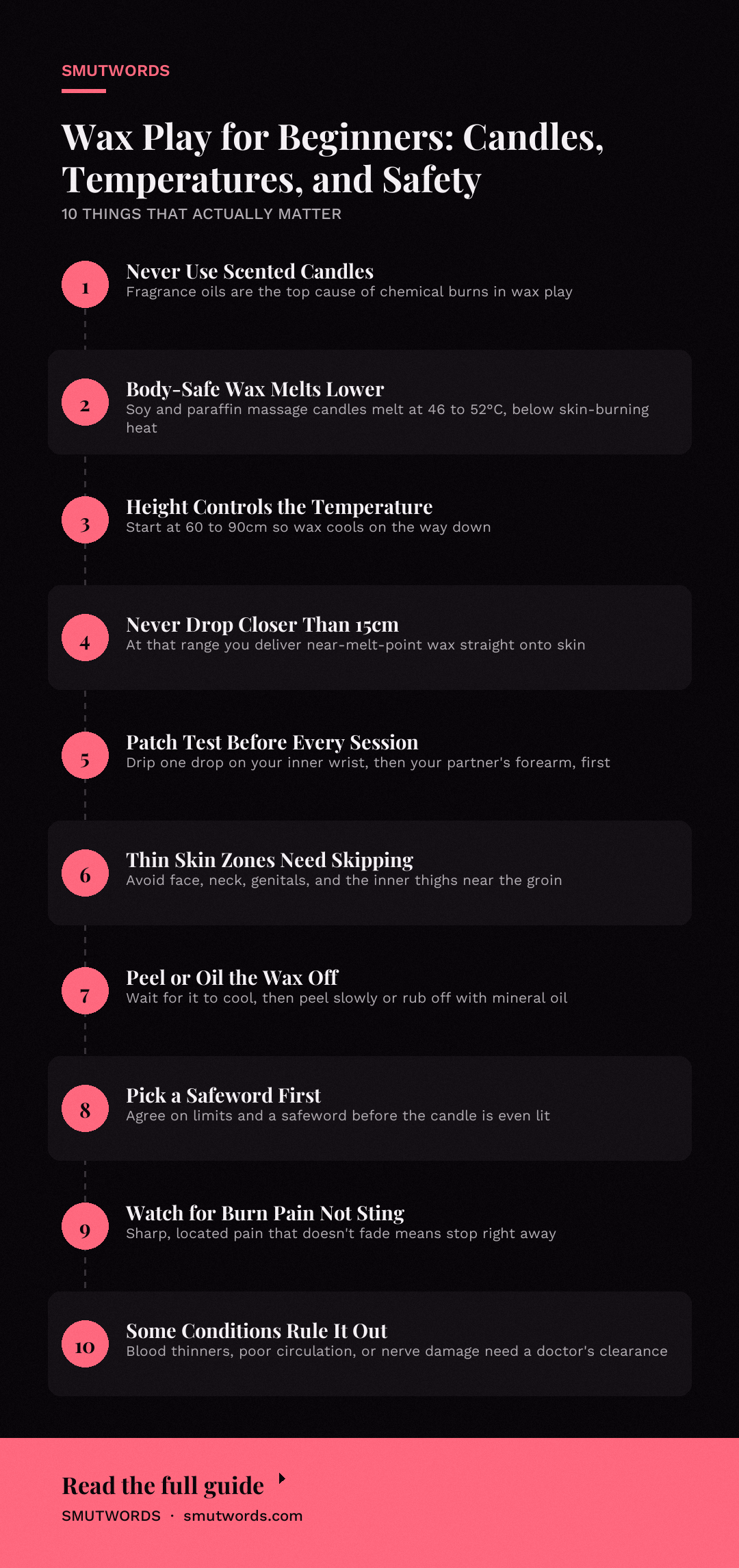
- Soy wax candles made for massage or wax play. The gold standard. Low melting point (roughly 46°C to 52°C), pours thin, cools slowly. Buy from a kink supplier that labels them "body-safe" or "low-temperature."
- Paraffin massage candles. Also good when labeled for skin. Slightly higher melting point but still safe if dropped from height. Common in drugstores labeled "massage candle."
- Plain white unscented tea lights in a pinch, if you've tested them first. Cheap and easy, and usually paraffin, which is fine when dropped carefully.
- Beeswax candles only if you know what you're doing. Melting point is higher (roughly 62°C) and the wax is denser, so the sting is sharper and the wax is harder to remove. Not a first-timer's choice.
Candles You Should Not Use
- Any scented candle, ever. Fragrance oils are the single most common cause of chemical burns in wax play. Even "natural" fragrance blends are suspect. Don't.
- Decorative pillar candles and anything with embedded objects. Metal flakes, glitter, dried flowers, and wooden wicks all come off in the wax and hit the skin as debris.
- Colored candles. Dyes can be irritating, and you can add molten colorant to the burn list depending on the pigment. Plain white is the standard for a reason.
- Beeswax or soy candles sold as "decorative" without a melt point or body-safe label. If the manufacturer doesn't say it's for skin, assume it isn't.
- Votives and religious candles from the dollar store. Often paraffin plus stearic acid and a high melt point. Some people get away with them; plenty of people get wax burns.
- Any candle currently in a glass jar. The jar gets hot. It can crack. Never drip from a vessel that's still in its container.
If you can't find body-safe wax locally, buy it online from a kink supply shop. Price is usually $15 to $30 for a pack, and the peace of mind is worth ten pillar candles.
Temperature: How Hot Is Too Hot?
Skin-burning starts around 60°C. Paraffin and soy body-safe candles melt between 46°C and 52°C. That margin is what makes wax play actually safe when you do it right, and it's also why the type of candle matters more than anything else.
The other huge variable is drop height. The higher the wax falls, the more air it passes through, and the cooler it arrives.
Distance Rules
- First session: hold the candle 60 to 90cm (about 2 to 3 feet) above the skin. Let the wax cool on the way down.
- Once you've tested and calibrated: you can go closer; most experienced people work around 30 to 45cm.
- Never hold a candle closer than about 15cm. At that distance you're delivering near-melt-point wax straight onto skin. That's how people get burned.
- Don't pour from directly above the face. Ever. Skip the neck, throat, and anything above the collarbone on a first session.
Ambient air temperature matters too. A freezing room will cool the wax faster and give you a gentler experience. A hot room will make it feel sharper. Many experienced players keep a bowl of cool water nearby for a quick cool-down on the skin between drips if things feel too hot.
How to Test Before You Commit
You don't skip this. Testing is the entire session-safety ritual. Here's how to do it properly.
The Inner Wrist Test
Light the candle. Let it burn until a wax pool forms, usually 15 to 30 minutes depending on the candle. Blow it out. Let it sit for 30 seconds.
Then, with the candle held at your planned drop distance, drip a single drop onto your own inner wrist, which has relatively thin skin. You'll know within a second if it's too hot. If it stings sharply or you feel a nerve pinch, it's not safe. If it's a brief warm sting that fades, you're good.
The Partner Patch Test
Once your own wrist passes, do the same thing on your partner, but on a smaller margin. One drop, on the inner forearm, from your planned height. Ask them to rate the sensation 1 to 10. Adjust the height and try again.
Three or four test drops will give you both a calibrated sense of what's happening. Patch test the same wax on any area of skin you plan to work on: stomach, back, thighs, chest. Some areas are much more sensitive than others.
Body Zones: Where It Works and Where It Doesn't
Skin thickness varies wildly across the body. Placement is a real safety decision, not just an aesthetic one.
Enjoyed this? Get a free book.
Join the list and we will send a complete free story straight to your inbox, plus new releases every week after that. No credit card, no catch.
Good zones for beginners
- Upper back and shoulders
- Stomach and lower back
- Thighs and calves
- Chest (avoid the nipple area on the first session, the tissue is sensitive and wax removal from it is unpleasant)
Zones to avoid
- Face, neck, and throat
- Genitalia and the inner thighs near the groin (very thin skin, very high nerve density, wax removal is a nightmare)
- Anywhere with a cut, abrasion, mole, or rash
- Broken skin after a previous session hasn't healed
- Anywhere the partner has never patch-tested
If a reader's more interested in the dynamic of being told where the drips land than in playing with wax itself, fiction handles that energy in a totally different register. What She Does in the Backrooms is a book for people who like a controlled environment and a little dread in their sensory play.
How to Actually Run a Wax Play Session
The setup is straightforward once you know the sequence. Plan for a session to take 20 to 45 minutes start to finish.
What you need
- Body-safe candle(s) and a lighter or matches
- A water-resistant or sacrificial sheet, or a drop cloth
- A bowl of cool (not cold) water
- A washcloth
- Mineral oil or baby oil for wax removal (more on this below)
- A fire extinguisher, or at minimum a fireproof surface for the candle to sit on between drips
The sequence
- Negotiate first. Both partners say what they want to try, what's off limits, and what the safeword is. If you don't have a safeword system yet, read Safewords Explained and pick one before the candle is even lit. A red/yellow/green traffic-light system works well for sensory play because you can call "yellow" without sounding panicked.
- Patch test on the person receiving. Do it in-scene if the mood allows, but do it.
- Lay down the drop cloth. Wax is a pain to get out of anything.
- Light the candle and let it pool. 15 to 30 minutes. Use this time for whatever comes first in a scene, since the anticipation is part of the fun.
- Start at 90cm. Drip slowly. One drop, pause, watch, drip again. Give the receiving partner time to register each hit before the next.
- Watch for signs. Flinching back, sharp intake of breath that doesn't soften, "yellow," or the receiver going quiet and tense. Any of those means stop and check in.
- Vary placement. Move around the body. The good version has rhythm and punctuation, not a single endless drip zone.
- Peel the wax when you're done. Wait for it to cool fully. Then either peel it away slowly (people love this part) or rub it off with mineral oil, which dissolves wax cleanly. Don't use water alone; wax doesn't dissolve in water.
Bringing It Up With a Partner
The best way to raise wax play is to introduce it as a specific thing you're curious about, not a vague request. "I've been reading about wax play and I want to try it with you, here's what I'd need" is a much better opening than "I want to try something new."
If they're hesitant, don't push. Wax play is a low-pressure kink because it doesn't require much equipment, but it does require someone to want hot wax on their skin. Explain what you actually want: the sensory aspect, the control dynamic, the visual, whatever's really driving it.
People who think wax play sounds gross are usually picturing a screaming 1970s bondage movie. A glass of wine and a properly calibrated body-safe candle look much more appealing.
For couples working through the negotiation more formally, the Complete Guide to Power Exchange covers the check-in structures that make scenes more comfortable for both people. If your relationship arc is more "renegotiating what we want" than "new kink," the glossary entry on marriage in trouble is a decent fictional companion to that conversation, since the genre is built on the same "we have to actually say what we want" beat.
The Real Risks and How to Lower Them
Wax play done wrong can scar. It's not a rare, theoretical risk. Here's what actually goes wrong.
Burns
The number one cause is scented wax or a candle without a body-safe label. The number two cause is holding the candle too close.
The number three cause is dancing into a paraffin pillar candle on the nightstand because the scene got enthusiastic. Third-degree burns require medical care. Second-degree burns leave marks for months. If a burn blisters, don't pop it, keep it clean, and see a doctor if it's larger than a coin or on the face.
Wax in Hair
Wax does not come out of hair. If you have long hair or a lot of body hair in the target area, either work around it, or accept that you're cutting a waxed patch out. A lot of experienced players shave the target zone before the session or don't let the wax anywhere near the scalp.
Fire
Yes, the obvious. Never carry a lit candle over a partner. Never drip next to a curtain, bedsheet, or drop cloth you've already soaked with something flammable. Blow the candle out before any position shift.
Keep a fire extinguisher or a large pot of water within reach of the play area. This all sounds paranoid until it isn't.
Slipping
Wax makes hard floors and the inside of a bathtub extremely slippy. Anyone doing wax play in a shower or on tile needs a rubber mat underfoot.
Complications from pre-existing conditions
People on blood thinners, with poor circulation, with diabetes-related nerve damage, or with any skin condition should not do wax play without a doctor's clearance. Same goes for anyone on a medication that increases skin sensitivity. This isn't a "check with your doctor if you're worried" situation; it's a genuine contraindication.
When to Stop: The Actual Signs
Not all discomfort is bad. Sensory play involves controlled discomfort by definition. The lines that matter:
- Stop immediately if the receiver reports burn pain, not sting pain. Burn pain is sharp, located, doesn't fade, and often comes with a flinch.
- Stop immediately if you see the skin turning bright red or whitening under wax.
- Stop immediately if a safeword is used. This is what it's for. No negotiating mid-scene, no "but it's just one more."
- Stop and check in if the receiver goes quiet and tense, pulls away, or starts holding their breath. Silence usually isn't enjoyment in this practice.
- Stop for the night if the top can't keep the candle steady. Wax play needs a stable hand; if you're too excited, too tired, or had a drink, put the candle out.
Where to Learn More
The physical practice is learnable in one session. The dynamic side takes longer. If you read erotica to get into the headspace, wax play tends to show up in stories where a controlled power exchange is the point.
The Pod Breeder's Bargain and The Crimson Breeding Order both lean into the "I'm in someone else's hands and my body is going to do what it's told" energy that wax play often lives inside. Wetware Slave is for the cyberpunk flavor of that dynamic, built on the same drip-by-drip control beats.
Two adjacent sensory guides are worth the read if wax play clicks for you. Cupping Kink: Everything You Need to Know covers a different style of heat play with its own temperature and skin-safety rules. The site's guide to oviposition kink is a good example of how a fantasy-heavy practice and a body-safe one can exist in the same scene structure when the negotiating is rigorous.
Final Thoughts
If you only buy one thing this week, buy a single body-safe paraffin massage candle and a lighter, and run the inner-wrist test before you do anything else. Patience and a proper candle get you 90% of the way to a session neither of you regrets. Start with He Left the Door Unlocked if you want a book where the "waiting, watching, controlled" energy that wax play runs on gets a full scene of its own.






Loading comments…