
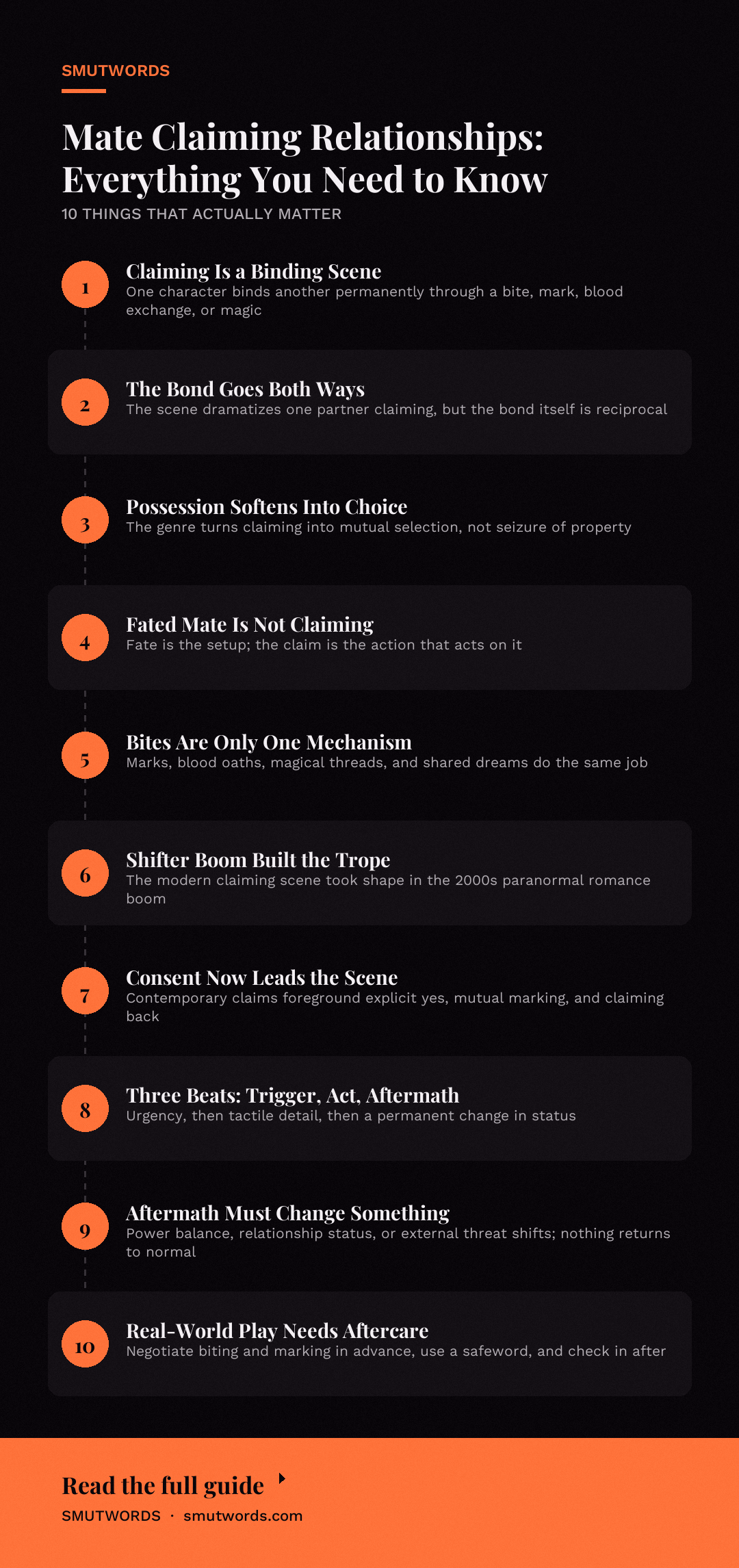
Mate claiming is the moment in a paranormal or supernatural romance when one character binds another to them as their mate, permanently and often visibly, through a bite, a mark, a blood exchange, or some magical equivalent. The bond goes both directions, though the scene usually dramatizes one partner doing the claiming and the other being claimed.
It's one of the most reliable and most searched dynamics in monster and shifter romance, and it's doing very specific emotional work on the page. This guide covers what mate claiming means, where the trope came from, how authors actually build the scene, and where it goes wrong.
What Mate Claiming Actually Means
At its core, mate claiming is a binding scene. One character, usually but not always the more powerful or more supernatural one, performs an act that declares the other as theirs. That act is physical and irreversible within the world of the story.
A claiming bite that scars. A mark that appears on skin and stays. A blood oath sworn over a wound. A magical thread that snaps into place between two chests.
The word "claiming" carries weight because it implies possession, but the genre almost always softens that into mutual selection. The claiming character is declaring intent, not seizing property. The claimed character is choosing to be bound.
When a book gets this balance right, the scene reads as the most romantic thing in the world. When it gets it wrong, readers notice immediately.
What counts as mate claiming is fairly broad. A werewolf sinking teeth into a shoulder and sealing a bond qualifies. So does a fae lord exchanging a drop of blood with a mortal and watching a mark bloom on her wrist.
An alien pressing a palm to a human's chest and feeling a resonance lock into place is claiming. A kraken wrapping a partner in ink and current and declaring them kept is claiming, in its own way.
What Doesn't Count
A one-time hookup between supernatural characters is not mate claiming, even if it's intense. Casual biting without permanence or intent doesn't qualify. Neither does a scene where one character simply decides someone belongs to them without any reciprocal bond forming. The reciprocal part matters enormously to readers.
Fated mate status also isn't the same thing as claiming. Fated mates can exist in a story without a claiming scene ever happening, and a claiming scene can happen between two characters who chose each other rather than being destined. The fate is the setup; the claim is the action.
Common Misconceptions
- It's always a bite. Bites are the most common mechanism, especially in shifter romance, but marks, blood oaths, magical threads, scent-marking, and shared dreams all do the same narrative job.
- It's always violent. Some claiming scenes are tender, almost ceremonial. The intensity comes from permanence, not from pain.
- It erases consent. The best versions foreground choice heavily. The claimed character says yes, or the scene halts.
- It's the same as a soulbond. A soulbond is a broader category of magical connection; mate claiming is a specific act that creates or seals one.
Where Mate Claiming Comes From
The trope has roots in two distinct places, and understanding both explains why it feels the way it does. The first is folklore and myth: werewolf legends, fae bargains, blood brotherhood rites, and the older European idea that a supernatural creature could mark a human as belonging to it. Those stories were warnings more than romances.
The second root is genre publishing. The modern mate claiming scene as readers know it took shape in the paranormal romance boom of the 2000s, when shifter series became a dominant commercial category. Authors needed a narrative climax that felt bigger than a marriage proposal and more permanent. The claiming bite answered that need exactly.
From there the trope spread outward. Vampire romance adopted blood oaths. Fae romance adopted magical marks and bargains. Alien romance adopted resonance bonds and biological compatibility.
Each subgenre kept the core structure (permanent, physical, chosen) while swapping the mechanism to fit its own world. If you want to see how far the mechanism can stretch, alien abduction romance is a good place to start.
How the Trope Has Shifted
Early shifter romance often treated claiming as something the male character did to the female character with limited negotiation. That model sold well and still appears, but it has lost ground steadily. Contemporary mate claiming scenes are far more likely to include explicit consent, mutual marking, or a claimed character who does some claiming of their own.
Another shift is emotional. Older claiming scenes emphasized dominance and territory. Newer ones emphasize recognition: the moment one character realizes the other is the only one who will ever fit. Authors now write the interiority of the claimed partner much more carefully, and readers reward that.
Indie publishing accelerated the trend. Serialized romance on subscription platforms made claiming scenes into reliable chapter-climax events, often teased for several installments before they happen. That pacing convention has bled back into traditionally published books as well, and it's part of why mate claiming scenes so often land at the 70 percent mark of a novel.
How Mate Claiming Shows Up in Erotica
On the page, mate claiming is a scene with a clear architecture. It usually has three beats: the precipitating trigger, the act itself, and the aftermath.
The trigger can be danger, proximity, heat, or a confession of feeling. The act is where the physical detail lives. The aftermath is where the bond gets confirmed, often through new sensory information one or both characters now receive.
Strong versions of the scene do something specific with each beat. The trigger creates urgency the reader can feel in the body. The act slows down into tactile detail (temperature, pressure, breath, the exact shape of the mark). The aftermath changes the characters' status permanently, often within a chapter or two.
Common variations include the claiming mark visible to others, the claimed character feeling phantom sensations through the bond, the claiming character experiencing protective instinct so intense it becomes a plot problem, and the second claiming scene (rare, but popular) where the previously claimed partner claims back.
Enjoyed this? Get a free book.
Join the list and we will send a complete free story straight to your inbox, plus new releases every week after that. No credit card, no catch.
What Strong Mate Claiming Scenes Do
- Earn the permanence. The reader has watched these characters struggle for a whole book. The claim feels deserved, not convenient.
- Stay in the body. Physical detail carries the emotional weight. The characteristic that makes it hurt, the taste of blood, the flare of heat at the mark site.
- Foreground mutual choice. Even dominant claiming characters usually wait for explicit yes, often in a spoken exchange right before the bite.
- Change something. After the claim, the relationship status, power balance, or external threat shifts. Nothing returns to normal.
- Keep it specific to its world. A werewolf claim reads differently from a fae claim, which reads differently from a merman claim. The mechanism should match the mythology.
What Makes a Flat One
Flat mate claiming scenes tend to do one of a few things. They treat the claim as an automatic consequence of fated mate status rather than a choice, which removes tension. They rush the physical detail, skipping straight from decision to aftermath. Or they ignore the claimed character's interiority completely, turning the scene into pure spectacle.
Another common problem is inconsistency. If the book establishes that claiming marks are permanent and visible, then the mark should remain throughout the rest of the story and matter to the plot. When it vanishes for authorial convenience, readers disengage.
Mate Claiming Across Subgenres
Shifter and pack dynamics romance is the trope's home turf. Here the claim usually interlocks with pack hierarchy, so the claiming scene often serves a secondary function: establishing rank, protecting the claimed character from other pack members, or ending a challenge.
Vampire and blood-oath romance uses the claim to build a political bond, sometimes as much about power as about love. Fae romance tends to treat claiming as a bargain with a cost. Magical marks, seasonal trades, and complicated enchantments make the claim feel like a contract.
Elf romance uses claiming scenes less often as physical bites and more as ceremonial oaths, which suits the genre's slower, more formal tone. Merman romance and kraken romance swap the bite for aquatic marks: a shared current, a resonance through water, a pressure mark left by a tentacle. The mechanism changes, the emotional structure doesn't.
Cryptid romance has become one of the most inventive spaces for mate claiming, because authors are free to invent new bond mechanics. A cryptid claim might involve a shared dream, a territorial scent, or a physical transformation triggered by the bond. Readers come to this genre specifically for the strangeness of the mechanism. Ogre stories pull the same trick in a different register; the complete guide to ogre romance relationships digs into how those claims get built.
The Write It Well Checklist
- Does the claim reflect something the reader could see coming from the established mythology?
- Is the claimed partner's interiority available on the page during the scene itself?
- Does the claim require an active choice from both characters?
- Does the aftermath change the story's status quo?
- Is the physical detail rendered with at least one full beat of sensory writing?
Real-World Play and Aftercare
Readers who enjoy mate claiming fantasies sometimes want to bring a version of it into bedroom play: biting, marking, scent play, or scenes that draw on the emotional intensity of the trope. That's fine, and it's worth being deliberate about.
Any physical biting or marking scene should be discussed in advance, with clear boundaries about where, how hard, and how visible the mark is allowed to be. Use a safeword and agree on what it means. Scene after scene of being bitten or held down is easier to negotiate than to improvise.
Anything that leans on the emotional charge of ownership or permanence should end with real power exchange aftercare: checking in, physical comfort, a return to ordinary selves. The fantasy of being claimed permanently is a delicious one. The real-world version works when everyone involved can walk out of it feeling cared for.
Mate Claiming vs Fae Romance
Mate claiming and fae romance get lumped together a lot, partly because fae books often use a claiming scene and partly because both sit in the broader paranormal category. The distinction matters, though. Fae romance is a subgenre with a specific flavor: bargains, courts, glamour, etiquette, and a wry, brittle tone. Mate claiming is a specific scene type that can happen inside fae romance or any other subgenre.
The confusion is understandable. Fae claiming scenes are often gorgeous and frequently more elaborate than their shifter counterparts. A fae lord tracing a mark on a mortal's wrist has a different flavor than a werewolf finishing a bite.
But a fae book with no claiming scene in it is still fae romance, and a shifter book can have a claiming scene without a single fae in it.
Frequently Asked Questions
Is mate claiming the same as a fated mate trope?
No. Fated mates describes the setup (characters who are destined for each other), while mate claiming describes the scene where that destiny gets acted on. A fated mate trope can exist without a claim scene, and a claim scene can exist without destiny.
What is a claiming bite?
A claiming bite is a specific mechanism of mate claiming in which one character bites the other, usually on the shoulder, throat, or wrist, leaving a permanent mark that signifies the bond. It's most common in shifter and werewolf romance, and the mark often carries plot significance after the scene ends.
Do mate claiming scenes always involve a physical mark?
Most do, because a visible mark is useful to the story. But some stories use magical threads, scent changes, shared sensations, or psychic links instead. The requirement is permanence and reciprocity, not a scar.
Why is mate claiming so popular in paranormal romance?
It delivers absolute certainty in a single scene. Readers get a love interest who is chosen entirely, permanently, and with overwhelming protective instinct. In a genre built around intensity, that certainty is one of the strongest emotional payoffs available.
Can mate claiming happen without consent in a good romance?
Almost never. Contemporary readers expect explicit choice from both characters, even in dominance-heavy scenes. Books that treat claiming as something done to a resisting character tend to draw strong criticism. The best versions foreground yes very clearly.
Is mate claiming a kink?
It functions as a fantasy trope more than a defined kink. The mechanics (biting, marking, permanent bond) overlap with several real-world kink practices, and some readers enjoy those in private, but the trope itself lives primarily in the fictional register.
Final Thoughts
Mate claiming works because it says "you are mine, permanently, and I would tear the world apart for you" in the language of a single scene. Get the consent, the physical detail, and the aftermath right, and it lands every time.
If you're new to the dynamic, start with a shifter romance; the bite version is the clearest entry point into everything mate claiming can do. Then read a fae claim and watch how much the mechanism can change without touching the emotional engine underneath. The SmutWords ranked reading list below has the strongest examples of the trope currently in print.





Loading comments…