Cuckqueaning is a kink in which a person, usually a woman, gets off on watching or knowing about her partner having sex with someone else. The turn-on sits in the collision of jealousy, humiliation, possessiveness, and arousal: she loses something in the moment and wants it anyway. The term describes the watcher's experience, and in erotica it powers entire plot arcs, from quiet voyeur scenes to marriages built around a rotating cast of other women.
If you found this page after a search, you probably want the actual mechanics of cuckqueaning rather than a one-line definition. That is what follows.
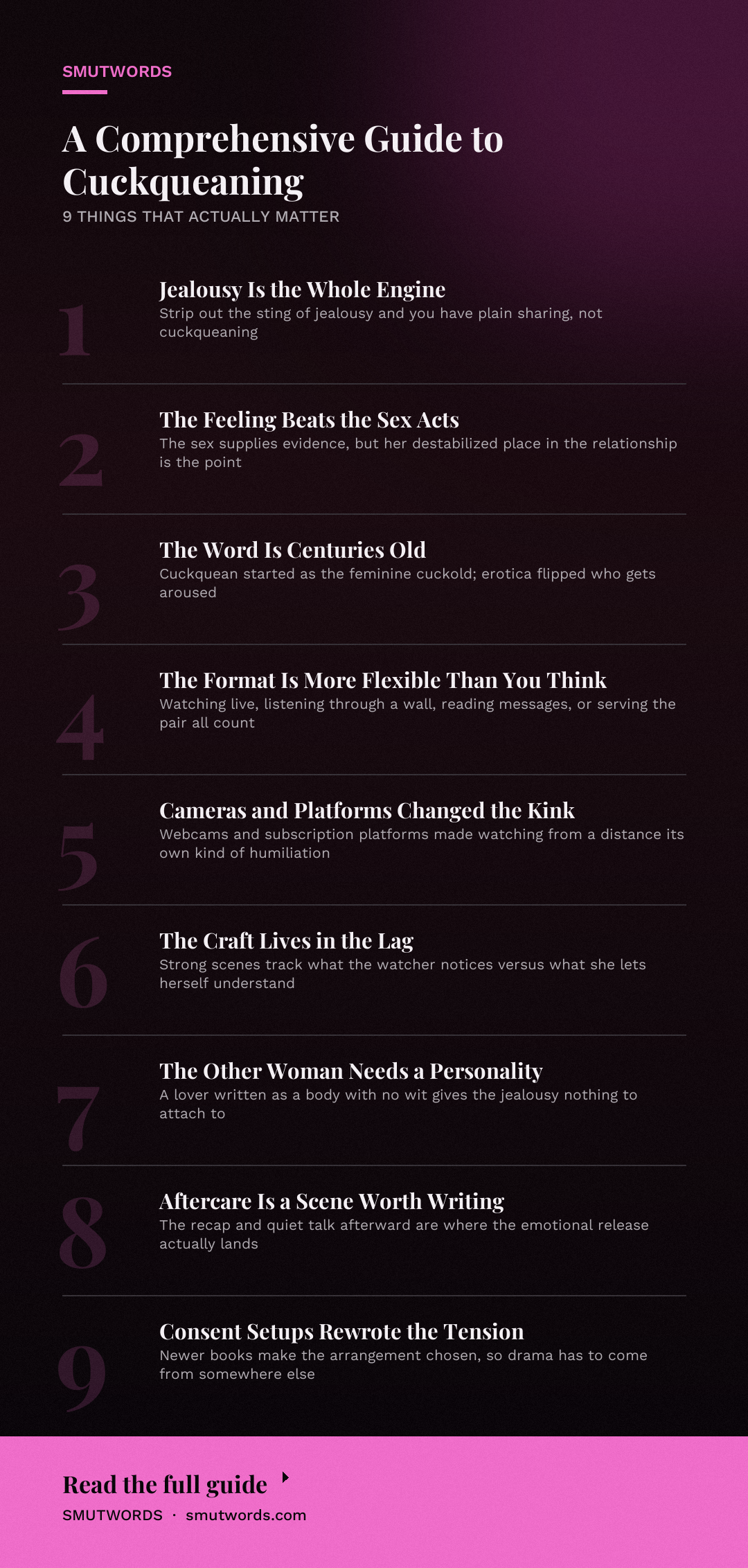
The dynamic is deeply emotional before it is physical. What a cuckquean gets off on is the proof: her partner's desire for another person, the visible evidence of it, and her own destabilized place inside the relationship. The sex acts supply the evidence, but the feeling is the point.
What Cuckqueaning Actually Means
The root of the word tells most of the story. A cuckold, historically, was a man whose wife strayed, with centuries of insult baked into the term. Cuckquean is the feminine form, documented in English since at least the seventeenth century as a word for a cheating wife and later for a wife whose husband strays. Erotica adopted the term and flipped its valence: the spouse being cheated on becomes the one who is aroused.
So cuckqueaning is the female-focal version of the broader cuckolding kink, with the woman as the cuckquean or cuckoldress (the term old erotica uses for the woman holding the power in the arrangement) and her partner as the one who sleeps elsewhere. In practice, readers use it for any configuration where one partner watches or hears about the other partner's outside sex, including same-sex pairings.
What counts as cuckqueaning is more flexible than newcomers expect. The watcher may:
- Watch the partner's encounter in person, at the foot of the bed or from the doorway.
- Listen from the next room and learn the details afterward, or only afterward, from the recounted version.
- Read messages, follow social media, or receive a running commentary.
- Bond with the other woman, comparing notes on the shared partner afterward or during.
- Choose the other partner herself, keeping control of exactly what happens.
- Serve the pair, literally or socially, during the event.
What does not count is anything a reader decides is not cuckqueaning. This is the main reason the kink confuses people. If the woman is simply not jealous, if nobody's place in the relationship is being tested, then the scene is general sharing, and it may sit closer to the sharing kink than cuckqueaning. Cuckqueaning needs the sting, or nothing is being risked.
So the working definition for readers is narrower than the definition for browsers: cuckqueaning is a kink in which a person gets off on their partner sleeping with someone else, and specifically on the sharp, unwanted-feeling jealousy that comes attached to it. Pride, humiliation, possession, and lust swirl together. Remove the jealousy and you have a different, more relaxed arrangement.
Where Cuckqueaning Comes From
The word is centuries old, but the kink as a recognizable book category is not. The cuckquean roleplay dynamic appeared in erotic fiction decades before it had a label readers could search for. Early portrayals treated it as a scandal or a punishment, with the woman suffering through a partner's affair. Readers found the material attractive anyway, often for reasons the writing did not intend to encourage.
The early 2000s internet changed the vocabulary. Forums and erotica sites built the first practical taxonomy, and writers could show cuckqueaning without cracking the word. The "hotwife" label also entered circulation, mainly for husbands who share wives, but the term is now used loosely for either direction of the arrangement. Many readers still prefer it because it sounds less clinical.
The digital era has produced one of the biggest shifts visible in modern publishing. Cameras came first, and webcams made private watching possible. OnlyFans and similar platforms then made a woman's account of her other lover a product: the cuckquean watches a livestream or a recorded video, and the distance adds a kind of humiliation that a live audience does not.
A searchable library also matters. Before ebooks, a reader wanting cuckqueaning had to sift through paperbacks and hope. Now it is a tag, a subtitle line, or a keyword, which lets the kink grow into named subgenres and gives authors a market.
The word still carries a lot of baggage to new readers, and that is why it is worth linking it directly to terms people already know, such as the voyeur husband trope or the older husband-watches angle in reverse.
There is also a related literary shift. The older erotica treated cuckqueaning as dramatic conflict or punishment. In the newer books, consent is part of the setup, which changes the entire feeling: the arrangement was chosen, and the dramatic tension now has to come from somewhere other than the choice itself. That is the balance the best writers hit.
How It Shows Up in Erotica
On the page, cuckqueaning runs through the watcher's head. Since the reader lives inside the watcher's point of view, the craft lies in the lag between what she perceives and what she lets herself understand. The prose lives in small sensory evidence: the sound of a door, a shifted tone, the sudden absence of attention. A strong scene makes her notice more than she can process.
The author manages that gap by controlling what the watcher knows. Three structural choices recur because they work:
- A live reveal that rearranges the reader's assumptions, so a scene the reader thought was about lovemaking flips into something else.
- A scene that builds slowly from small physical details and then hands the watcher proof she cannot explain away.
- An account she receives after the fact, which lets her imagination fill in far more than any description could supply.
The telling of the encounter matters as much as the event. Much of the steam in this kink comes from imagination and the watcher's mind filling in detail it cannot see, which is a specific strength authors can lean on across every variation.
A few things separate strong cuckqueaning from flat scenes. One is that the watcher's jealousy has to be genuine: she has to want this and to hate that she wants it. Flat scenes kill that conflict.
Another is that the other person needs to be a real character. If the partner's lover is a mannequin with a body, the jealousy has nothing to attach to. Give her wit, opinions, a reason to be there, and the tension tightens.
A third is the aftermath. The scene is not done at climax. The negotiation, the recap, the physical care, and the honest talk about what it felt like are where the emotional release lands, and where most of the kink's appeal lives. Writers who skip that epilogue leave readers with a half-finish.
Steam level is a dial to watch. Different books pull the same cuckqueaning dynamic at opposite temperatures. Some keep it light and flirtatious, the watcher watching with clever, nervous humor.
Others push the humiliation raw and explicit. A book's subtitle or opening pages should hint at where it sits so readers pick the right temperature.
Common Variations and Their Genders
The traditional cuckquean is a woman whose partner slept with a third party, with jealousy and value assigned to the act itself. Authors make her smart and capable, so the fall feels more surprising.
The cuckoldress with control casts the woman as the organizer rather than the victim. She selects the partner, sets the rules, and watches. The humiliation comes from her chosen role rather than surprise, which changes the entire tension.
The hotwife puts a wife's range at center and the husband's encouragement alongside it. These books sometimes contain cuckqueaning (the woman watches her partner with another) and sometimes not; readers chase the two interchangeably, and the trope is the hottest crossover point.
Enjoyed this? Get a free book.
Join the list and we will send a complete free story straight to your inbox, plus new releases every week after that. No credit card, no catch.
The service variation places the watcher in a supporting role during the event. A woman might hold a lover's hair, pass the towels, or sit where she sees everything with permission and instructed participation. The use kink dynamic overlaps here, and the watcher's sensation of being useful but not central is part of the turn-on.
The comparison variation lets the watcher compare her body, her technique, and her status to the other woman's. It is a reliable way to make her insecurities explicit that a plain watching scene cannot. The other woman's physical advantage can be played up, and the resulting catalog of insecurity is a source of its own steam. The dynamic sits close to the monster cock kink in exaggerated cases, but the focus stays on the watcher's reaction.
Media and distance turns the story into something she watches from afar: a photo, a video, a live stream. These scenes are built for readers who like the emotional bluntness of a screen with no immediate recourse. The partner swap foursome sits nearby as a crossover for readers who like two couples and witnesses.
Fantasy settings render cuckqueaning literal through arranged group sex in worlds where marriage is a political arrangement. A "shared wife" culture lets the page justify the watcher's passivity with custom rather than choice, and a strong author can use that to make consent a real question in the plot. The dragon romance relationships breakdown covers how these structures work in nonhuman settings.
Writing the Watcher as a Whole Person
The narration is where most of the emotional work happens. A "do" for authors is giving the watcher a mind that observes and mistrusts itself at the same time. The strongest version lets her tell herself one thing in one paragraph and act on the opposite in the next, while still driving the story.
A "don't" is treating her as a passive camera for the reader. If she has no interiority, the reader gets a report and no identification, and the kink, which is basically an interior experience, evaporates. The goal is to make her want, even as it hurts.
The other woman deserves the same care. A good book gives her a personality and her own reasons. The tension doubles when she is not a joke or a threat but a person the cuckquean can understand. That complication buys empathy for everyone involved and lets the ending land hard.
Aftercare is a scene, and a scene worth writing. The physical cleanup and the quiet talk afterward are where the emotional release largely happens. Authors who write the cool-down as well as the heat end up with books readers keep, because the reassurances stick longer than any exposition does.
Cuckqueaning vs Sharing Kink
The nearest confusion is with sharing, which is why the distinction is worth spelling out. Sharing kink is the broad umbrella: any arrangement where a partner's outside sex is a turn-on, including hotwifing, partner swaps, and open relationships carried out in the heat of the moment.
Cuckqueaning is the name for the specific flavor of sharing where the watcher's jealousy and reduced status are the central source of the heat. In a sharing book, the agreement might be relaxed, the couple amused, the extra partner appealing, with no one's place in question.
In cuckqueaning the watcher must feel the knife. It may be an actual risk to her confidence or the relationship's hierarchy, and the drama comes from her learning to want that knife twisted. That is why the two diverge in only the subtlest case: a couple that is perfectly secure can share all they like, but the woman whose knees go weak as her partner laughs over her is doing cuckqueaning specifically.
Frequently Asked Questions
What is cuckqueaning, for a newcomer?
It is a kink in which a person, most often a woman, gets turned on by their partner having sex with someone else, with jealousy and humiliation part of the appeal. The quean is present in a watcher or witness sense, in the room, in the house, or in the feed. The word can cover both the role and the story tag, for any gender pairing.
What does the word come from?
The term is centuries old, built as the feminine counterpart to cuckold, a word that historically meant a man whose wife had strayed. Erotica took it over and flipped the meaning, making the strayed-upon partner the one who is aroused. Cuckquean is the original form, though cuckoldress is used loosely for the same role.
Is cuckqueaning the same as cheating?
No. The two can look identical but the meaning differs completely.
In cuckqueaning the outside sex is agreed to in advance, and the arousal is part of the deal. Real-world play also needs specific, honest boundaries, continuing conversation, and aftercare to handle the jealousy safely. Skipping any of that turns a scene into a betrayal.
What about the cuckquean's jealousy? Not everyone feels it.
Some do, and for many that sting is the point, which makes the aftercare essential: talks, reassurance, and rebuilding closeness after the scene. Some couples play at jealousy in a negotiated way and feel none of it for real. That is a valid version, though it shifts the heat toward watching and toward the environment before and after, and makes the page more about the arrangement's logistics than raw feeling.
Can a man be a cuckquean?
The word itself refers to a woman, historically, but readers use it by extension for any partner who plays the watching, jealousy-struck role and wants the flavor of cuckqueaning in a story. A person can also play more than one role over time. In books the two sides get mirrored, and the total power exchange guide covers the trust and care needed when the relationships are real.
Which SmutWords terms overlap most?
The terms readers cross-shop most are sharing kink, the hotwife and voyeur husband tropes, and use kink, which handles the service aspect of being present at someone's pleasure. The harem romance and why choose romance labels also share shelf space, though those books center the protagonist's pleasure rather than a watching partner.
What is the difference between cuckqueaning and voyeurism?
Voyeurism is the general thrill of watching, and it can sit toward a single person or a couple with no partner involved. In cuckqueaning the person being watched is the watcher's own partner, and the excitement comes from possession and jealousy. Watching strangers is a broad category; this one is a relationship arrangement.
Where does cuckqueaning come from in real history?
As mentioned above, the term itself is ancient, but its history as erotica spans the twentieth and twenty-first centuries, chiefly in print and then online. The real story is the digital era, when self-publishing let authors take the dynamic further than magazines allowed, and readers discovered they could find each other by searching.
What should readers look for in a good cuckqueaning novel?
A watcher with interiority, a partner who is genuinely desirable instead of a blank, a third character with a personality, and an aftermath that pays off the buildup.
Skip the ones where the wife has no agency. Read a few pages first, checking how the first introduction of the other woman is handled. If she is described in flat physical terms and nothing else, the book will probably stay on the surface. If she says something sharp and unexpected, keep reading.
Final Thoughts
Cuckqueaning lives or dies on the watcher's interior world, and the books worth your time are the ones that let her feel both desire and dread without resolving them too early. Start with a story that gives the cuckquean a full mind, a partner worth watching, and a scene that earns its ending.
The beginners' picks in the related lists are another good entry point. When you are ready to go deeper, follow the ranked reading list below, which starts with the strongest version of exactly this dynamic.



Loading comments…