
SSC (Safe, Sane, Consensual) is the ethical backbone of BDSM play and, by extension, of most power-exchange erotica written today. It's a three-part agreement: any scene should avoid serious harm, be entered with a clear head, and be fully agreed to by everyone involved.
If you've ever read a kink romance where the dominant checks in before tying a wrist, or where a submissive says one word and everything stops, you've watched SSC doing its job on the page. The term shapes how consent gets written, how intensity gets justified, and why readers trust the characters enough to follow them into dark territory.
What SSC Actually Means
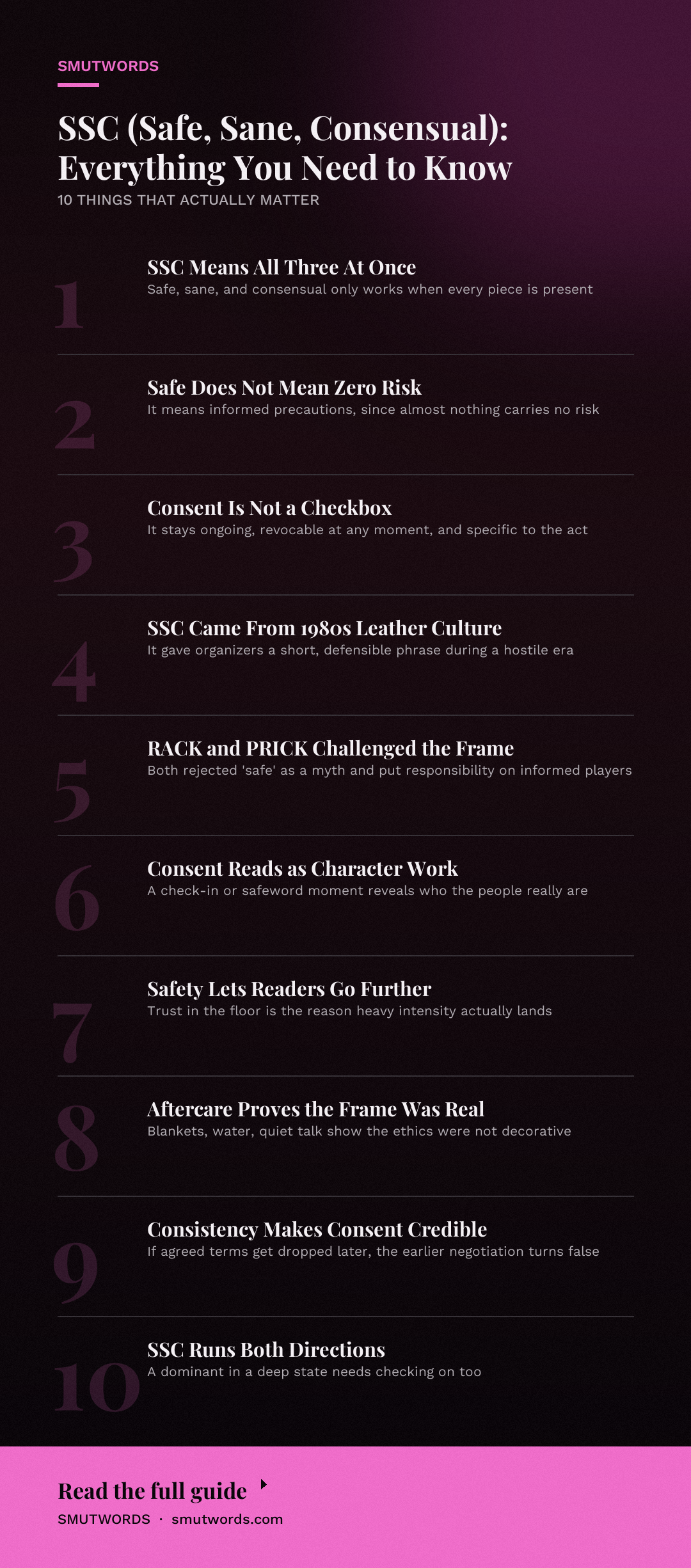
SSC stands for Safe, Sane, and Consensual. Each word carries weight, and the phrase only works when all three are present at once. Drop one and you're describing something else: an accident, an impulsive decision, or a violation.
Safe means the activity avoids serious physical or psychological harm. It doesn't mean zero risk, because almost nothing is zero risk.
A rope harness can pinch a nerve. A flogger can break skin. Safety here is about informed precautions, not a guarantee of no consequences.
Sane means the people involved are in a clear enough state of mind to make real decisions. Not drunk, not dissociating, not so emotionally raw that they can't say stop. This word has always been the most contested of the three, because "sane" is subjective and carries an ableist edge many practitioners dislike.
Consensual means everyone has agreed, freely, to what's happening. Consent for SSC is not a one-time checkbox. It's ongoing, revocable at any moment, and specific to the activities in question.
What does not count as SSC? Play with someone who's incapacitated. Play where a safeword exists in name only and gets ignored. Play where "consent" was extracted through pressure, guilt, or an authority imbalance outside the scene.
The three words rule all of those out.
Where SSC Comes From
SSC as a named principle emerged from the American BDSM community in the early 1980s, gaining traction through newsletters, leather conferences, and the small network of clubs that were starting to formalize safety standards. The phrase is most often credited to a group of gay male leathermen in the Bay Area, though multiple communities arrived at similar language around the same time.
The timing mattered. The 1980s were the height of the AIDS crisis and a period of aggressive policing of queer and kink spaces. SSC gave organizers a short, defensible phrase they could put on event flyers and workshop handouts. It signaled to outsiders that participants were adults making informed choices, and it gave insiders a shared vocabulary for calling out reckless behavior inside their own ranks.
By the 1990s, SSC had migrated from leather culture into heterosexual kink communities and then into the earliest online forums. It was the default ethical frame for a generation. Then, in the 2000s and 2010s, two rival frameworks started to displace it, or at least join it.
RACK, or Risk-Aware Consensual Kink, rejected the idea that any play can be genuinely "safe." Its proponents argued that pretending otherwise encouraged complacency. RACK asked players to acknowledge real risk and consent to it explicitly. Then PRICK (Personal Responsibility, Informed Consensual Kink) arrived with a related critique: the burden of safety should sit with informed individuals, not with a vague claim that everything is fine.
SSC didn't disappear. It became one option among several, and the phrase most likely to appear in mainstream romance publishing, where "safe, sane, consensual" reads as reassuring shorthand to readers who've never set foot in a dungeon.
How the Term's Role in Publishing Evolved
For most of the twentieth century, published erotica rarely showed negotiated consent at all. Power exchange appeared as fantasy without scaffolding. If a character was bound and taken, the narrative treated it as inevitable rather than discussed. That began shifting in the 1990s with authors who came out of the kink community and brought its ethics onto the page.
By the 2010s, "consent-forward" had become a marketing expectation in kink romance. Readers wanted to see negotiation, safewords, check-ins. Publishers noticed. The content guidelines that platforms actually enforce often reward stories where consent is legible, since clear agreement helps distinguish fiction that reads as edgy from fiction that reads as harmful.
Today SSC functions as both a real-world practice and a narrative convention. In fiction it's the device that lets a writer take a character to the edge of what feels dangerous and still bring them home.
How It Shows Up in Erotica
This is where SSC earns its keep as a craft tool. When you put two characters in a scene with real power imbalance, the reader needs somewhere to stand. SSC gives them a floor. It tells the reader that whatever intensity follows was chosen, which means they can relax into it instead of bracing against it.
Strong versions of this don't look like a legal waiver. They look like character. A dominant who asks, "Color?" in the middle of a scene is revealing something about who he is.
A submissive who answers "Green" without hesitation is showing trust that took pages to build. The ethics become dialogue.
Common variations authors use:
- Negotiation as foreplay. The conversation before the scene carries its own charge. Talking through limits, teasing about what's coming, watching one partner's reaction as the other names something specific. This overlaps heavily with anticipation play, where the buildup does most of the work.
- Safeword-driven plot turns. A character uses the safeword, and the scene pauses so the other character can check in. How each person handles that moment tells you everything about the relationship's health.
- The check-in mid-scene. A quick "Still good?" or a hand squeeze. Small, repeated, and often more intimate than the surrounding action.
- Aftercare as resolution. The scene ends and the characters come back to themselves. Blankets, water, quiet conversation. This is where a book often proves that the SSC frame was real rather than decorative.
- The negotiated exception. A character consents to something they'd normally refuse, specifically because they trust the partner. The tension comes from the size of what's being allowed.
What separates a good SSC scene from a flat one? Specificity. A flat version has a dominant announce that everything is consensual and then never mention it again.
Enjoyed this? Get a free book.
Join the list and we will send a complete free story straight to your inbox, plus new releases every week after that. No credit card, no catch.
A strong version weaves consent into action and reaction. The reader sees a character hesitate and gets an answer. They see a limit shift and know exactly why.
The other differentiator is consequence. In real scene play, safety work is ongoing. A character who gets dizzy during bondage gets released early.
A dominant who misjudges has to own it. Books that treat SSC as an unchanging fact sheet rather than a live negotiation tend to feel sterile, and readers notice.
One common mistake: authors write the negotiation scene and then forget it. The reader remembers. If a character agreed to one thing and then a totally different thing happens without any acknowledgment, the earlier consent work becomes a lie. Consistency is the whole point.
Where Intensity and Safety Meet
Readers drawn to extreme content often assume SSC framing will water it down. The opposite is usually true.
When the reader trusts that a scene has a floor, they'll go further with the characters. They'll accept a harsher flogging, a longer bondage session, a deeper power exchange, because the safety isn't decoration. It's the reason the intensity works.
Think about the last heavy kink scene you read that actually landed. Chances are it had a moment of stillness. A hand on a cheek. A character asking if the other is still with them.
Those beats aren't interruptions. They're load-bearing.
This connects to how domspace gets written. A dominant who drops into a focused, semi-trance state is more vulnerable than they look, and a well-written scene lets the submissive check on them too. Consent runs both directions, especially in high-intensity play.
SSC vs RACK
These two are the most commonly confused pair in kink writing, and the distinction is real rather than academic.
SSC claims that play can be safe, sane, and consensual, and that those three qualities are what make it ethical. RACK, or Risk-Aware Consensual Kink, starts from the position that "safe" is a myth. Every scene has risk, even if it's small. RACK asks players to identify the risks, understand them, and consent to them anyway.
In practice, the two overlap more than their slogans suggest. A good SSC scene involves real risk assessment. A good RACK scene involves real consent and care. The difference is mostly philosophical emphasis: SSC leans on the idea that the community can be careful, while RACK leans on the idea that honesty about danger is more respectful than pretending it away.
In erotica, SSC tends to show up in romance and mainstream kink writing, where the reassurance matters to readers who aren't practitioners. RACK tends to show up in darker work, where the writer wants to acknowledge that what's happening has real stakes and the characters chose it anyway. Neither is more sophisticated than the other. They're just different tools for different tones.
Frequently Asked Questions
Is SSC still the standard in BDSM communities?
It's one of several recognized frameworks rather than the sole standard. Many communities now teach RACK or PRICK alongside SSC, and some events use all three in their safety materials. SSC remains the most widely recognized shorthand, especially outside dedicated kink spaces.
Does SSC require a safeword?
A safeword is one of the most common ways to implement consent, but SSC itself doesn't mandate one specific mechanism. What it requires is that everyone has a clear, understood way to pause or stop. For some partners that's a word. For others it's a gesture, a bell, or a tap-out signal during scene play.
Can SSC apply to fiction where characters can't verbally consent?
Fiction often bends the frame by having a character consent in advance, or by establishing trust that lets a partner act without asking each time. Authors handle this through prior negotiation, magical bonds, or established relationships. The narrative still needs to signal that the choice was made freely at some point the reader can see.
Is "sane" an outdated word in SSC?
Many practitioners consider it the weakest of the three words because it implies people with mental health conditions can't consent, which isn't true. Critics prefer frameworks like RACK that skip the sanity judgment entirely. The acronym survives anyway because it's short and recognizable.
How does SSC relate to CNC (consensual non-consent)?
CNC is a specific kink where characters play out scenarios that look like non-consent, with full agreement underneath. SSC is the broader framework that makes CNC ethical: everyone involved knows what's happening, has agreed to it, and can stop it. The two aren't opposites. CNC is one activity that SSC can authorize.
What does SSC look like in a long-term dynamic?
It becomes less about formal negotiation and more about ongoing, near-constant communication. A long-term total power exchange still relies on the same principles, just expressed through habits rather than scripts. Check-ins get shorter, but they don't disappear. The negotiation is continuous.
Final Thoughts
SSC works because it puts ethics in plain language. Three words any reader or practitioner can hold onto when the rest of the scene gets complicated. On the page, it's the mechanism that lets heat and care coexist without either one undermining the other.
If you want to see SSC done well in fiction, look for books where the negotiation matters as much as the action. Start with something in the kink romance space that treats consent as character work rather than paperwork, and notice how much further the writer can push because the reader trusts the floor. The best examples don't announce their ethics. They earn them, scene by scene.








Loading comments…