
Every few weeks somebody in an erotica writers' group posts a screenshot of a KDP block notice and asks the same question: what does Amazon actually allow? The honest answer is that the amazon kdp erotica content guidelines are written in language vague enough to cover almost anything, and enforced by people (and increasingly, automated systems) who apply them inconsistently.
What follows is practical observation from watching books get blocked, banned, or quietly left alone. It is not legal advice, not policy advice, and not a guarantee of anything. Amazon changes its rules without announcement, reviewers disagree with each other, and a book that sails through today can get flagged six months from now when someone finally reads page 40. Treat everything below as pattern recognition, not a map with fixed borders.
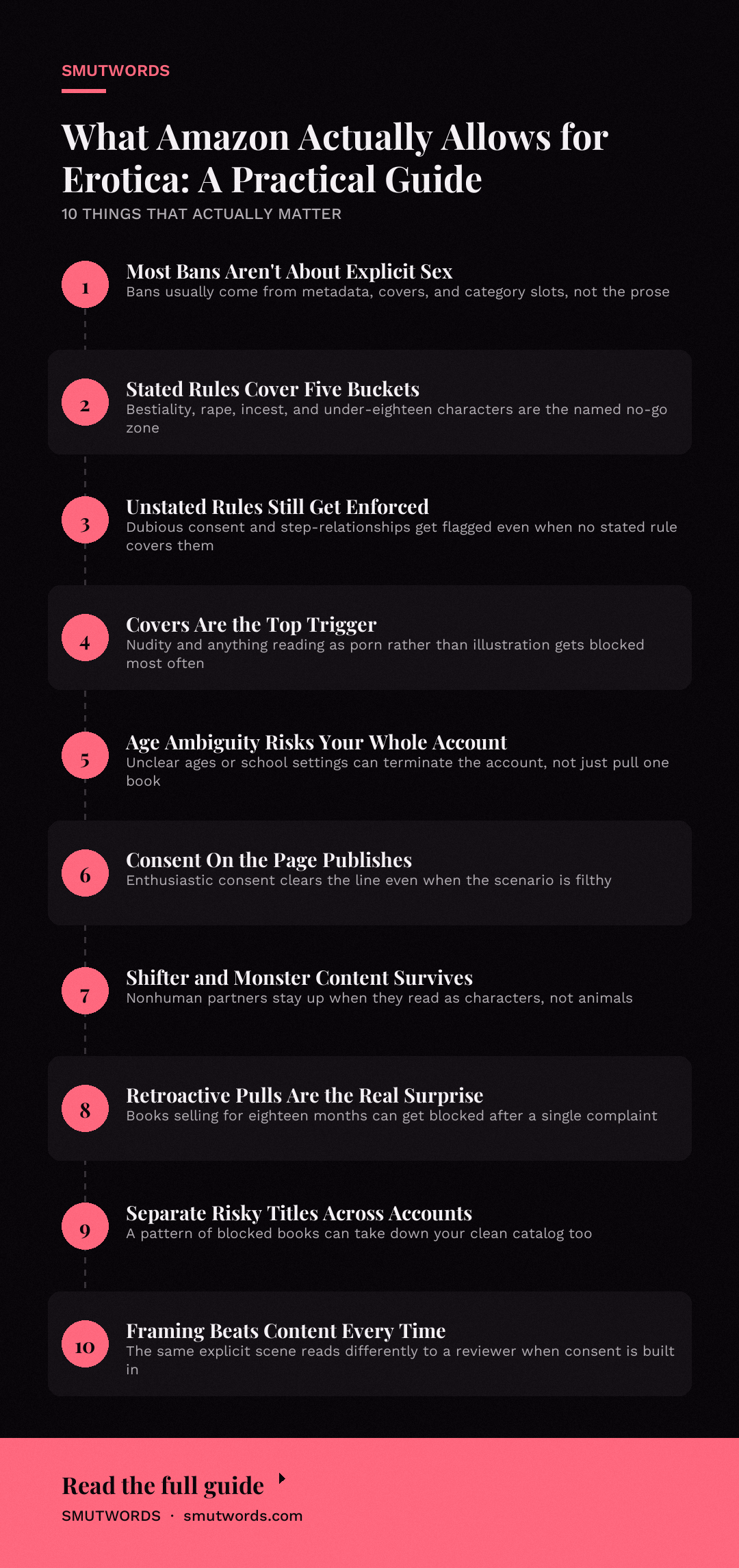
The other thing worth saying up front: most bans have nothing to do with how explicit the sex is. They come from metadata, cover images, category placement, and three or four specific content triggers that Amazon has decided it wants nothing to do with. Knowing which lever got pulled saves a lot of pointless rewriting.
How Amazon's Erotica Rules Actually Work
KDP's content guidelines are one document. The erotica-specific enforcement lives in a separate set of unwritten conventions that have hardened over roughly a decade of authors testing the fence. Nobody at Amazon will confirm them. You learn them the way anyone learns a bureaucracy: by watching what happens to other people.
The publishing agreement gives Amazon broad discretion to remove anything it finds objectionable, which means the practical question is not "is this allowed" but "is this likely to survive a reviewer's bad afternoon." That's a meaningful difference. Plenty of books that technically violate a stated rule stay up for years because nobody reports them. Plenty that violate nothing get pulled because a competitor clicked the report button and a reviewer skimmed the blurb too fast.
The rules that are actually stated
KDP forbids content that depicts or describes: bestiality, rape as eroticized content (the wording is fuzzy and the enforcement is fuzzier), incest, and anything involving characters who read as under eighteen in a sexual context. Those five buckets are the stated no-go zone, and most of the confusion authors run into traces back to how loosely "rape" and "incest" get interpreted in practice.
The rules that are not stated but enforced
There's a whole second tier. Dubious consent gets flagged constantly even when the story frames it as negotiated roleplay. Step-relationships fall into the incest bucket for a lot of reviewers, which is why so many authors have quietly renamed stepbrothers and stepsisters into wardens, roommates, and family friends.
Bestiality extends to shifters in a way that makes no logical sense. A werewolf who spends 90% of the book in human form is functionally a romance hero, but a cover with a wolf on it will still get pulled from certain categories.
And then there's the category system, which is its own minefield. If you're still figuring out where your book is even supposed to live, the guide to KDP categories for erotica authors covers how the browse paths work and why the wrong slot gets you filtered out of search entirely.
The Five Triggers That Cause Most Bans
Almost every block notice traces back to one of these. None of them are about prose quality, and only one is really about content.
- Cover images. Nudity, visible nipples, handcuffs rendered as literal bondage photography, anything that reads as porn rather than romance illustration. This is the single most common trigger and the easiest to fix.
- Blurb language. Words like "rape," "forced," "non-consent," "daddy" used in a sexual context, and anything that promises the reader content Amazon has decided not to sell.
- Metadata and keywords. Stuffing "taboo," "forbidden," "breeding," or "incest" into keyword fields is asking for a manual review. So is putting explicit terms in the title or subtitle.
- Category misplacement. Shelving hardcore erotica in Romance or Literary Fiction draws reports from other authors, and those reports get acted on.
- Age ambiguity. This is the one that gets entire accounts terminated rather than single books pulled. Any character whose age is unclear, in a school setting, or described as "barely eighteen" is a risk. Don't do it.
Notice how much of that list lives outside the manuscript. You can write the filthiest, most committed scene work on the platform and stay up for a decade, provided your cover looks like a romance novel and your blurb sounds like one too.
What Gets Through (and What Doesn't)
Explicit sex between consenting adults is allowed. That's the baseline and it's genuinely broad. BDSM, kink, power exchange, group scenes, exhibitionism, cuckold dynamics, hotwife arrangements, breeding kink played as fantasy, monster romance with an adult human partner: all of it publishes without issue if the surrounding package behaves itself.
Look at what actually sells well on the platform. He Paid Him to Fuck Me runs on a cuckold arrangement that is fully negotiated on the page, which is exactly why it clears the line.
A story like Shared Without Shame works the same way. The husband's consent is the engine of the fantasy, and consent is what keeps a story on the right side of the dubious-consent bucket. Compare that with Permission Slip, where the title itself signals the dynamic. Consent framed as explicit permission slips through, and consent framed as "she had no choice" does not.
The pattern is consistent enough to be a rule of thumb. Enthusiastic consent, even when the scenario is filthy, publishes. Coercion played for titillation gets flagged. This isn't a moral position, it's a description of where the enforcement line sits.
Monster and shifter content is its own subgenre of confusion. Lured by the Lizard Beast and Zorgon's Pet both survive because the nonhuman partner is a person with agency, language, and a name, not an animal. The line Amazon draws is about whether the creature reads as a character or as a beast, and that distinction lives almost entirely in the prose and the cover art.
Free use sits in a trickier spot. Free Use Casino is fine because the arrangement is a premise the participants opt into, with rules and a setting that makes it clearly fantasy. Free use written as "anyone can take her whenever they want and she has no say" starts looking like the non-consent bucket from a reviewer's distance. The setup does the work, so build the setup on the page.
Enjoyed this? Get a free book.
Join the list and we will send a complete free story straight to your inbox, plus new releases every week after that. No credit card, no catch.
A quick checklist before you hit publish
- Does the cover contain nudity, or anything that reads as porn rather than illustration? Fix it first.
- Does the blurb or subtitle use words like rape, forced, incest, or underage? Rewrite it, even if the book is clean.
- Are your keyword fields stuffed with taboo terms? Strip them.
- Is every sex scene between characters whose adulthood is established on the page and not just in your head?
- Is the consent on the page, or only implied? Put it on the page.
Where Authors Actually Get Surprised
Block notices rarely come with specifics. You get a form email citing a policy, a link to the guidelines, and no information about which page or pixel triggered it. That opacity is the real problem, because it means you can't fix the actual issue, only guess at it.
The most common surprise is the retroactive pull. A book sells for eighteen months, then gets blocked when a reviewer goes through your backlist after a single complaint. This is why authors who write in riskier niches keep their catalog separated across pen names, and why some of them keep their riskiest titles on Smashwords or their own storefronts rather than KDP.
The second surprise is account-level risk. One blocked book is a warning. A pattern of blocked books can take down a whole account, including the clean titles. If you write taboo content you're genuinely worried about, don't put it on the same account as the romance novels paying your rent.
And a general note on prose that applies regardless of where you publish: writing sex scenes that matter to the plot is the difference between a book that survives a manual review and one that gets skimmed, categorized as pure porn, and removed. Scenes that carry character and consequence read differently to a reviewer than wall-to-wall anatomy, even when the explicit content is identical.
Genre Tags That Don't Get You Flagged
Trope and genre metadata is safe territory as long as it's honest. You can tag enemies to lovers or hate to love without any risk, because those are romance conventions, not content warnings. Same with blind date romance or soldier romance: the tags describe structure, not heat level, and Amazon has no problem with structure.
If you want a useful comparison, look at how friends to lovers is categorized versus best friend's sister. Both are relationship dynamics. Both are fine.
The heat level of the actual scenes is what determines where the book should sit, not the trope tag on the cover. Confusing those two things is how authors end up shelved in the wrong category and reported.
The same logic applies to kink that sounds riskier than it is. Ice play, for example, reads as extreme in a blurb, but ice play is a sensation kink between consenting adults and publishes without friction. The word "ice" doesn't trigger anything. The word "non-consent" does, even in a title that's using it ironically.
Practical Habits That Keep Your Catalog Alive
Read your own blurb as if you were a reviewer looking for a reason to hit the block button. The framing matters more than the content. Then go look at how top-selling books in your niche describe themselves and copy the register, not the plot.
Keep your risky titles off your main account. Keep a plain-text backup of every manuscript, cover file, and metadata file outside KDP, because losing an account means losing access to everything on it. Vary your keyword fields instead of repeating the same five terms across forty books, since duplicated metadata across a catalog is a pattern reviewers notice.
And don't chase the line. Publishing the thing that gets flagged isn't a badge of authenticity, it's an expensive way to lose a backlist. The market for explicit erotica is wide enough that you can write exactly what you want and still stay inside the fence, provided you know where the fence actually is.
One more habit worth adopting: read your own work for the same reasons a reviewer would. If a scene would read as coercive to someone encountering it cold, or if the consent is doing all its work in your head instead of on the page, fix the scene.
A story that uses protective hero dynamics to frame a power exchange reads very differently than one where the power is simply taken. The framing is the safeguard, and it costs you nothing but two extra paragraphs.
Final Thoughts
Policies change. Reviewers rotate. What cleared moderation last spring might not clear it this winter, and the only defense is keeping your metadata clean, your covers conservative, your consent explicit on the page, and your best-selling catalog separated from the titles that skate close to the edge.
If you want a test case for kink that publishes without trouble, read Shared Without Shame. The dynamic is filthy, the consent is unquestionable, and it's still standing.






Loading comments…