Blindfold play is a sensory deprivation practice in which one partner covers the other's eyes during sex or intimacy, removing sight so every other sense has to work harder. Touch lands sharper. A whisper is suddenly loud. Anticipation stretches out until it's almost unbearable.
In erotica, blindfold play is one of the most reliable tools an author has for building tension, because it hands the scene a built-in engine: the blindfolded character cannot see what's coming next, and the reader can't either. The blindfold is a small piece of fabric with an outsized job. It changes who holds control, it changes how every caress gets processed, and it makes the person wearing it surrender their sense of safety to someone else's hands.
What Blindfold Play Actually Means
The term is literal. A blindfold is a covering over the eyes, and blindfold play is any intimate scenario built around wearing one. The fabric itself can be anything: a proper sleep mask, a silk scarf, a tie pulled from a dresser drawer, a strip of velvet ribbon. What matters is the function, which is the deliberate removal of sight during a moment when sight would normally be in charge.
That removal kicks off what kink circles call sensory deprivation, though the phrase makes it sound more clinical than it usually is in practice. Blindfold play rarely involves total darkness and isolation. It involves one sense switched off so the rest can crowd forward. The brain, deprived of visual information, starts filling in the gaps, and that filling-in is where most of the heat lives.
Where the name comes from is straightforward enough. "Blind" plus "fold," a fold of cloth over the eyes, in use in English for centuries as both noun and verb. The erotic charge attached to it is just as old. What's newer is the vocabulary: "blindfold play" as a named category, "masked pleasure" and "darkness play" as euphemistic cousins, "sighted guide" for the partner who keeps their eyes open and leads.
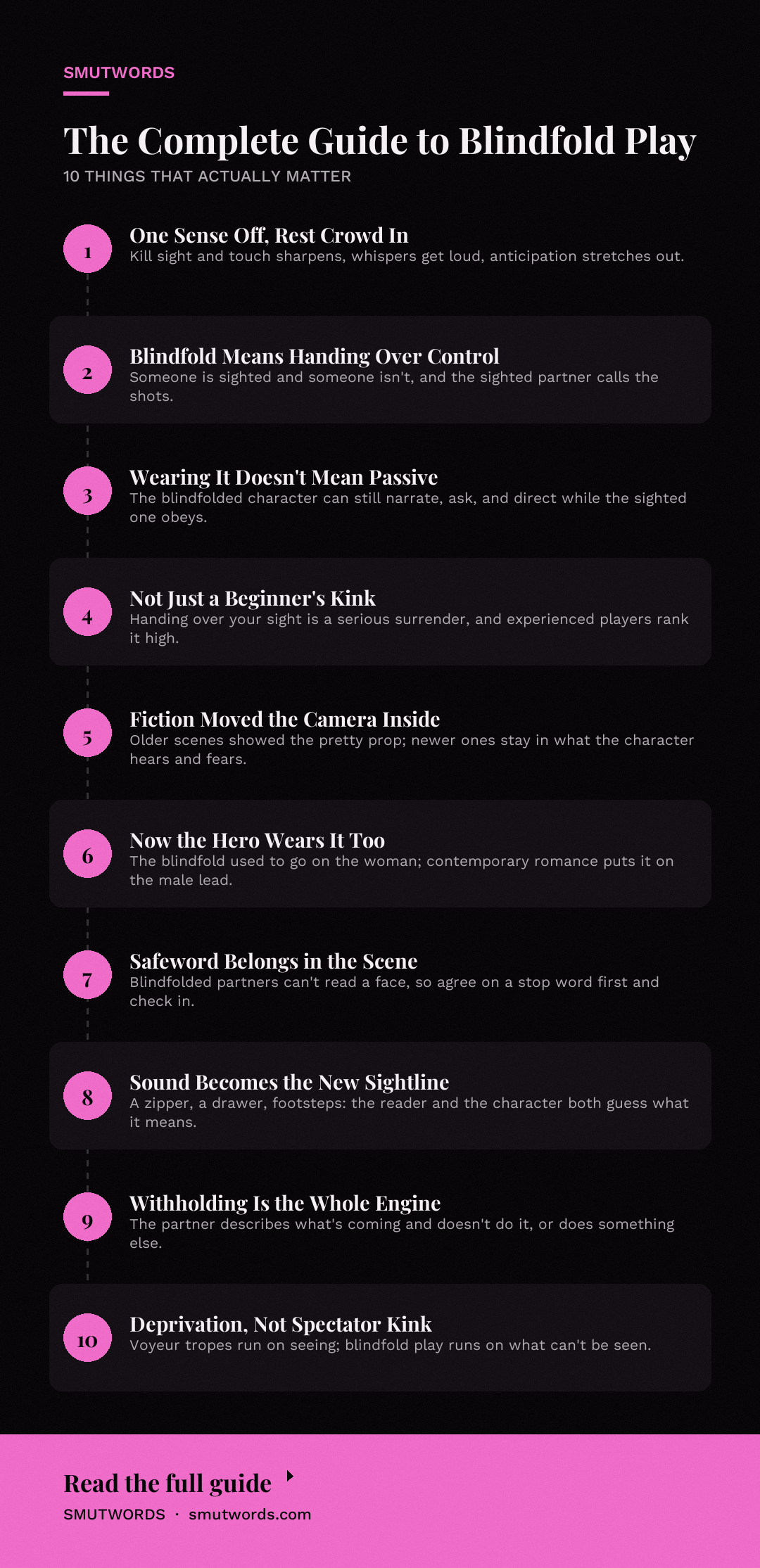
What doesn't count is worth naming too. A character who simply has something tied over their eyes but keeps full control of the encounter isn't really in blindfold play as the kink understands it. The point is the transfer of authority. Someone is sighted and someone isn't, and the sighted partner is calling the shots.
Three misconceptions show up constantly in reader questions. First, that blindfold play is always about restraint. It isn't. A partner can be blindfolded and completely free to move.
Second, that it's a beginner's kink, somehow milder than "real" power exchange. In practice, handing over your sight is a significant surrender, and plenty of experienced players rank it among the more intense things they do.
Third, that the blindfolded partner is passive. Plenty of scenes put the blindfolded character in charge of narrating, asking, or directing while the sighted partner obeys. The blindfold controls who can see, not automatically who is in charge.
Where Blindfold Play Comes From
Blindfolds have a long, non-erotic history: prisoners, executions, games of pin the tail on the donkey, hypnotism shows, party games at weddings. The erotic life of the blindfold grew out of that same cultural stock, borrowing the object's associations with helplessness, trust, and surprise and pointing them at the bedroom.
In published erotica and romance specifically, the blindfold is old enough to be almost invisible as a trope, which is a mark of how thoroughly it's been absorbed. Nineteenth-century erotic literature used blindfolds in scenes of mistaken identity and seduction. Mid-century pulp paperbacks leaned on the blindfold image heavily, often on the cover as much as in the text. By the time explicitly kinky publishing took shape in the 1970s and 1980s, the blindfold was already standard equipment.
The bigger shift came with the mainstreaming of BDSM romance in the 2010s. Before that, blindfold play in fiction tended to appear as a single hot beat in a scene, one move among many. After it, authors started treating the blindfold as a structural device, something a book is built around rather than something a chapter contains.
You can see the evolution in how the scene gets framed. Older versions emphasized the visual: the blindfold as something beautiful the partner puts on, a prop for the reader to picture. Newer versions emphasize the interior: what the blindfolded character hears, feels, imagines, fears. The camera has moved inside the character's head, which is where the real work was always happening anyway.
There's also been a shift in who wears it. Historically the blindfold was almost always on the woman, in fiction written by and for men. Contemporary romance and erotica increasingly blindfold the male lead, either to equalize power or to play with the specific charge of a big, controlled man rendered uncertain. A blindfolded hero who has to trust feels different on the page than a blindfolded heroine, and readers respond to both.
Another real publishing shift: the safeword made it onto the page. Older erotica tended to skip the negotiation entirely, treating consent as implied. Modern blindfold play scenes routinely include the conversation beforehand, and the best of them make that conversation part of the heat. Agreeing on a safeword before play is the standard practice in real life, and readers notice when a book respects that.
If your partner's sight is gone and anxiety spikes, they need a way to call a stop that doesn't depend on reading a face they can't see. The safeword does that job. Any blindfold scene, real or fictional, should establish one first and check in during, since losing sight can heighten pleasure and fear in the same breath.
How It Shows Up in Erotica
The craft problem with blindfold play is that removing sight removes the easiest descriptive tool a writer has. You can't tell the reader what's happening if the character can't see it. The strong scenes solve this by shifting the whole scene onto the character's other senses, and by making the reader's ignorance match the character's.
Here's what the best blindfold scenes actually do on the page:
- They lead with sound. A zipper, a drawer, footsteps crossing a room, the click of a belt. The blindfolded character hears everything, and so does the reader, and neither knows which sounds mean what. Sound becomes the new sightline.
- They use touch as a surprise. A fingertip on the wrist lands like a jolt when the character couldn't see it coming. Skilled authors delay contact, moving slowly through a room so the anticipation compounds before anything touches skin.
- They stage small cruelties of withholding. The partner describes what they're about to do and then doesn't do it. Or does something entirely different. The gap between expectation and reality is the whole engine.
- They put the blindfold on fast and take it off slow. Removing sight is a dramatic beat. Restoring it is another one, and how a character reacts to seeing again can carry more charge than the scene itself.
- They make the blindfolded partner do the talking. Forced to describe what they want, name what they feel, ask for the next thing. This is where blindfold play collides with verbal kinks and produces some of the hottest dialogue in the genre.
Common variations authors reach for:
Enjoyed this? Get a free book.
Join the list and we will send a complete free story straight to your inbox, plus new releases every week after that. No credit card, no catch.
- Silk ribbon and scarves. The classic. Soft fabric, often tied with a bow, sometimes with the loose end trailing for the partner to hold. Silk ribbon bondage overlaps with this, using the same material for both blindfold and restraint.
- The borrowed tie. The partner's own necktie, removed and repurposed. Efficient, intimate, and a staple of spontaneous scenes in which nobody planned anything.
- The proper mask. A padded sleep mask or a leather blindfold with a buckle. Signals that someone prepared for this, which opens up the "this was planned all along" reveal.
- Trust games. Blindfold plus a task the character has to perform without seeing: finding their way across a room, drinking from a glass, undressing at a pace the partner dictates. The task is where the fear and the fun overlap.
- Sighted guide. The blindfolded partner is led physically through a space or a sequence by the sighted one. Often used for its emotional weight as much as its erotic one.
- Blindfolded in company. Scenes in which the blindfolded character is surrounded by other people they can't see, which plays on the same helpless excitement as an orgy or a crowded group marriage setup. The blindfold turns a room full of people into an unknown quantity.
What separates a strong blindfold scene from a flat one comes down to a few specific choices. The strong version trusts the sensory shift and stays inside the blindfolded character's perception. The flat version cuts back and forth to a sighted partner's viewpoint too often, which drains the suspense because the reader suddenly knows more than the person in the blindfold.
The strong version also uses the blindfold to raise the emotional stakes, not just the physical ones. A blindfolded character who has to trust a partner they've been fighting with is doing something different than one who simply can't see. The blindfold forces a decision: surrender to this person or don't.
And the strong version includes the negotiation. A scene that opens with someone tying a scarf over their partner's eyes without a word is thinner than one that opens with a conversation about what's about to happen. The conversation is foreplay. Readers know it, and the couple swapping guide makes the same point about a much bigger leap: talk first, and the talking turns out to be part of the turn-on.
There's a particular subcategory of blindfold play built around being used without being able to see who's doing it. That dovetails neatly with use kink, where the charge comes from being an object of someone else's pleasure rather than a participant with a vote. The blindfold makes the use more complete, because the used partner can't even track who's where.
Blindfold play also pairs well with shibari and other rope work. The shibari aesthetic of visible rope against skin gets partly undone by a blindfold, which is exactly the point: the blindfolded partner feels the rope without seeing how they look in it. What they can't see becomes something they have to imagine, and imagination runs hotter than vision almost every time.
One more craft note. A blindfold is a great way to write a scene in which the character loses track of time. Nothing clocks how long they've been waiting, how long the partner has been circling, how long the touch has been building. Authors who use that uncertainty deliberately can stretch a scene's tension past where it would normally go flat.
Blindfold Play vs the Voyeur Husband Trope
These two get tangled up in reader searches because both are about who can see what. The voyeur husband trope is built on a husband who watches his wife with other people, and the charge comes from visibility: he sees, and the seeing is the point. Blindfold play runs the opposite direction. Sight is removed, and the charge comes from what can't be seen.
One is a spectator kink. The other is a deprivation kink.
They can coexist in the same scene, where a blindfolded wife can't see her husband watching, but the mechanisms are distinct. If you're looking for stories about a man who gets off on watching, that's the voyeur husband trope. If you're looking for stories about someone whose sight is taken away, that's blindfold play.
Frequently Asked Questions
Is blindfold play safe?
It's as safe as the negotiation around it. Agree on a safeword before anything goes over anyone's eyes, and check in regularly during play, since losing sight can intensify anxiety along with pleasure. Avoid covering the nose or mouth at the same time, and keep a hand or a word ready that means stop immediately.
What should I use as a blindfold?
A sleep mask, a clean silk scarf, a folded tie, or a purpose-made leather blindfold. Anything soft that doesn't press on the eyes or catch in hair. Avoid anything that ties too tightly or restricts breathing, and skip materials that shed or scratch.
Can blindfold play work without any other kink involved?
Yes. Plenty of couples use a blindfold purely for heightened sensation and anticipation, with no restraint, no power exchange, and no other kink in the scene. The blindfold alone changes enough to make the encounter feel new.
What's the difference between blindfold play and sensory deprivation?
Sensory deprivation is the broader category, covering anything that reduces one or more senses: darkness, earplugs, hoods, restraints that limit movement. Blindfold play is the sight-only version, which is the most common and most accessible form. Darkness play and masked pleasure are other names for roughly the same thing.
Who wears the blindfold in blindfold play?
Whoever wants to surrender sight. Traditionally the blindfold went on the woman in fiction written for men, but contemporary erotica blindfolds everyone. Some couples switch who wears it scene by scene. Some pair it with an explicit agreement that the blindfolded partner gives the orders while the sighted one carries them out.
Why is blindfold play so common in romance novels?
Because it generates tension cheaply and reliably. Removing sight forces a character to trust, which is the emotional core of most romance. It also lets an author write a whole scene from inside one character's uncertainty, which reads as suspense and feels like intimacy at the same time.
Final Thoughts
Blindfold play earns its place in the genre because it makes the reader do the work. You can't see what's coming, the character can't see what's coming, and the scene runs on that shared blindness until someone takes the fabric off.
If you want a book that handles it with real craft, the ranked list below is a good place to start. For a scene where the blindfold is doing genuine structural work rather than just sitting on someone's face, any of the top picks will show you what the device can do.





Loading comments…