
Most couples who talk about couple swapping never do it, and the conversation is still worth having. That's the first thing to know before we go any further. The talking itself does something to a long relationship that has gone a little quiet, and it does that whether or not anyone ends up in a hotel room with another pair.
Couple swapping, for the uninitiated, means two partnered people agreeing to have sex with other people, usually together or in the same room, often with another couple, sometimes with a single person, and always with the other partner's full knowledge and consent. Soft swap stops at kissing and touching above the waist. Full swap goes all the way.
Some couples meet once and never again. Others build a standing arrangement with the same two people for years. The variety is bigger than the porn suggests.
What follows is how to actually open this up with a partner you've been with for a while, without wrecking the good thing you already have.
Why the Conversation Matters More Than the Swap
Ask anyone who's been doing this for a decade what separates the couples who thrive from the ones who blow up. Same answer every time. The ones who blow up skipped the hard parts of the conversation because they were excited and didn't want to kill the mood. The ones who last had the boring, awkward, unsexy talk first.
That talk covers four things, roughly in this order: what each of you actually wants, what jealousy looks like for each of you and where it comes from, what the rules will be, and what happens if one of you changes their mind mid-scene. Nobody gets through all four in one sitting. Plan for several conversations over weeks.
If your partner needs a month to think about it, that month is not a delay. It's the whole point.
One warning before you start. Don't open this conversation on a Saturday night after three glasses of wine because the topic came up while you were both horny. Bring it up on a Tuesday afternoon on a walk, when neither of you is trying to get laid. You want the version of your partner who can think clearly, not the version who says yes to anything at 1 a.m.
How to Bring It Up Without It Sounding Like a Verdict
The single worst way to open this is "I think we should see other people." Even the most secure partner will hear "I'm bored of you" underneath that sentence, and you'll spend the next six months digging out from under it.
Try starting from curiosity instead of a proposal. Something like: "I read something about couples who swap, and I got curious. Not saying I want to do it. I want to know what you think about the idea." That framing gives your partner room to have an opinion without immediately defending their position.
If you've been together a long time and the sex has drifted into a routine, name that directly. Say what's actually true: "I love our life. I miss the feeling of being wanted by someone new, even just as a fantasy. I don't want to lose you. I want to talk about this with you."
That lands very differently than "I need more."
Expect one of three reactions. Enthusiastic curiosity, which sounds great but usually cools off once the reality sets in. A flat no, which is information you needed. Or the most common response: "I don't know, tell me more."
That third one is where most productive conversations live. Don't push past it. Sit in it.
Bringing it up when you already suspect a no
Some partners are never going to be into this. That's fine. The conversation can still improve your sex life, because it forces you both to say out loud what you want and what scares you.
Plenty of monogamous couples come out of this talk with a new shared fantasy, a better understanding of each other, and a renewed appetite for each other. If your partner says no, that's the end of the swapping question. It is not the end of the conversation about desire.
What You're Actually Asking For
Be specific about what you want before you ask your partner to imagine it. "I want to swap" is too vague to react to. Do you mean watching each other with someone else? Being in the same room with separate partners?
A full swap where you're both actively involved with the other couple? Do you want a one-time experience, a regular arrangement, or a fantasy you never actually act on?
Write it down for yourself before the conversation. It's much easier to say "I'm turned on by the idea of watching you with someone else while I'm in the room" than to try to assemble that sentence mid-argument. The more precise you are about the specific thing you want, the less your partner has to fill in the blanks with their worst fears.
And be honest with yourself about the fantasy-versus-reality gap. Lots of people find couple swapping hot in fantasy and discover that watching their partner kiss someone else is a completely different animal. That's normal. Fantasy is a movie.
Reality has smells and awkward pauses and the other guy's deodorant. Knowing that in advance helps.
Jealousy: The Real Thing, Not the Buzzword
Every couple who tries this has at least one moment of jealousy. The question is not how to avoid it. It's how to know what shape yours takes before it shows up.
Jealousy in swapping usually isn't about sex. It's about the small stuff: your partner laughing at someone else's joke, someone touching them in a way you thought was yours, your partner looking at someone the way they used to look at you before the mortgage and the kid and the third-shift schedule.
Name those specific things out loud before you go anywhere. "I'd struggle if you held hands with someone" is a boundary you can work with. "I'd feel weird" is not.
Do the same for your partner. And do it without arguing about whether the feeling is reasonable. Jealousy doesn't have to be reasonable to be real, and a partner who tells you your jealousy is silly has just guaranteed you'll hide it next time.
Enjoyed this? Get a free book.
Join the list and we will send a complete free story straight to your inbox, plus new releases every week after that. No credit card, no catch.
Reading about this stuff, or watching the dynamic play out in fiction, can be a low-stakes way to feel out your own reactions. A lot of people get their first honest intuition about their jealousy limits from stories that explore it, the way some readers work through their feelings about control and surrender through things like soldier romance or the slow-burn tension of a good tutor/student romance.
Use the fiction as a mirror. If a scene in a story makes your stomach drop, that's data about what's off-limits for you in real life.
Boundaries You Actually Need to Spell Out
Vague boundaries are not boundaries. They're hopes. Here are the ones couples tend to fight about later, phrased as questions to answer before you go:
- Same room or separate rooms? Most couples want same room, at least the first time, because the whole point for them is the shared experience. Decide whether watching each other is required or optional.
- Who is allowed to be involved with whom? Some couples have a rule that one partner can't do a specific act with someone else that they won't do at home. Some don't care. Say it out loud either way.
- Contact after the fact. Are phone numbers exchanged? Texts? Group chat only? A lot of people assume no contact is the default and discover their partner was texting. Decide the rule before you need it.
- Kissing. This one catches people out because they dismiss it as trivial. Kissing is intensely intimate for a lot of people. Don't assume it's on the table.
- What happens on a night where one of you isn't feeling it? The answer is the plan stops. No swapping just because the other couple drove two hours.
- How you'll check in. A code word, a look, a hand on the shoulder. Something that means "I need to slow down" that doesn't require a full sentence in front of other people.
Two more rules. First, everybody can call it off at any time, and calling it off is never a negotiation in the moment. Second, "we don't leave the room alone with anyone until we've talked about it" has saved more relationships than any other sentence in this article.
Choosing the Other Couple: First-Date Nerves
The meet-up before a swap is basically a first date, and the nerves are the same. Most people who do this meet in a bar or a café with no expectation that anything happens that night. They talk, they see if they actually like each other as people, and they go home. The couples who rush from a dating app message to a hotel room are the ones who end up with one partner crying in the bathroom.
You're evaluating more than attraction. You're looking for people who will respect a stop word, who don't get weird when you say "we want to take it slow," and who don't pressure. A couple who seems a little too eager is a couple to say no to. Trust that instinct.
Vetting is its own skill and it isn't glamorous. Ask about their experience level. Ask what their rules are and whether they've done this before. Ask if they've had a bad experience and what caused it.
People who can talk about this stuff calmly and specifically are safer than people who talk about it in a constant state of horny excitement. The tantra session approach to slowing down and paying attention isn't a bad model here either. The whole thing should feel deliberate.
Alcohol and the one drink rule
One drink, max, before a swap, and many couples do zero. You need your full brain for this. The couples who get into trouble tend to be the ones who had three cocktails to calm the nerves and then couldn't tell when their partner was fine and when their partner was holding it together by a thread.
You're going to be nervous. That's fine. Nervousness doesn't impair your judgment the way two more drinks will.
The Night Itself and the Morning After
On the night, check in with each other before anything starts. Agree on how you'll check in during, and agree that if one of you says stop, everybody stops and nobody negotiates. Then check in again before you leave the room. A hand squeeze, a look across the room, a whispered "you good?" That's usually all you need.
The morning after does more damage than people expect. Some couples feel closer than they have in years. Some feel a quiet unease neither of them wants to name. Some feel both within an hour.
Have the debrief conversation the next day when you've both slept, and make it about feelings first, not scorekeeping. "How are you feeling about last night?" is a much better opening than "Did you like it?"
If one of you has a rough reaction, don't panic. Jealousy after the fact is common and it passes. What doesn't pass is a partner who dismisses it or gets defensive.
Offer reassurance without arguing about whether the feeling is fair. If the feeling persists for weeks, or if it starts turning into resentment, that's the point to stop swapping entirely and possibly to talk to a couples therapist. There's no shame in the therapist conversation.
When to Stop, and When Never to Start
Stop if one of you is going along with it out of fear of losing the other. Stop if one of you needs three drinks to do it. Stop if the debrief conversation consistently produces fights.
Stop if either of you has to hide part of the experience from the other. All four are signs the plan has outgrown the relationship's capacity to hold it, and the fix is time off, not more experience.
Some situations are never a good idea. If one of you is using swapping to avoid a conversation about a real problem, that problem will come back and bring friends. If there's been an affair, this is not the place to rebuild trust. If either of you is being pressured, directly or indirectly, the whole thing is off.
Never involve anyone who is married without their spouse's knowledge, and never involve anyone who is not in a position to give full consent. Those are not fine-print rules. They're the whole thing.
If the fantasy alone is enough, and often for long-married couples it is, then enjoy the fantasy. Books and stories about complicated dynamics are a perfectly good place to put that energy. A rockstar romance or a sharp revenge romance can scratch the itch for someone who can't get enough of the "watching someone dangerous be wanted by everybody in the room" feeling, and a good wolf pack romance carries a similar charge without any of the real-life logistics.
A lot of couples find that reading together and talking about what turns each other on does more for the relationship than swapping ever would.
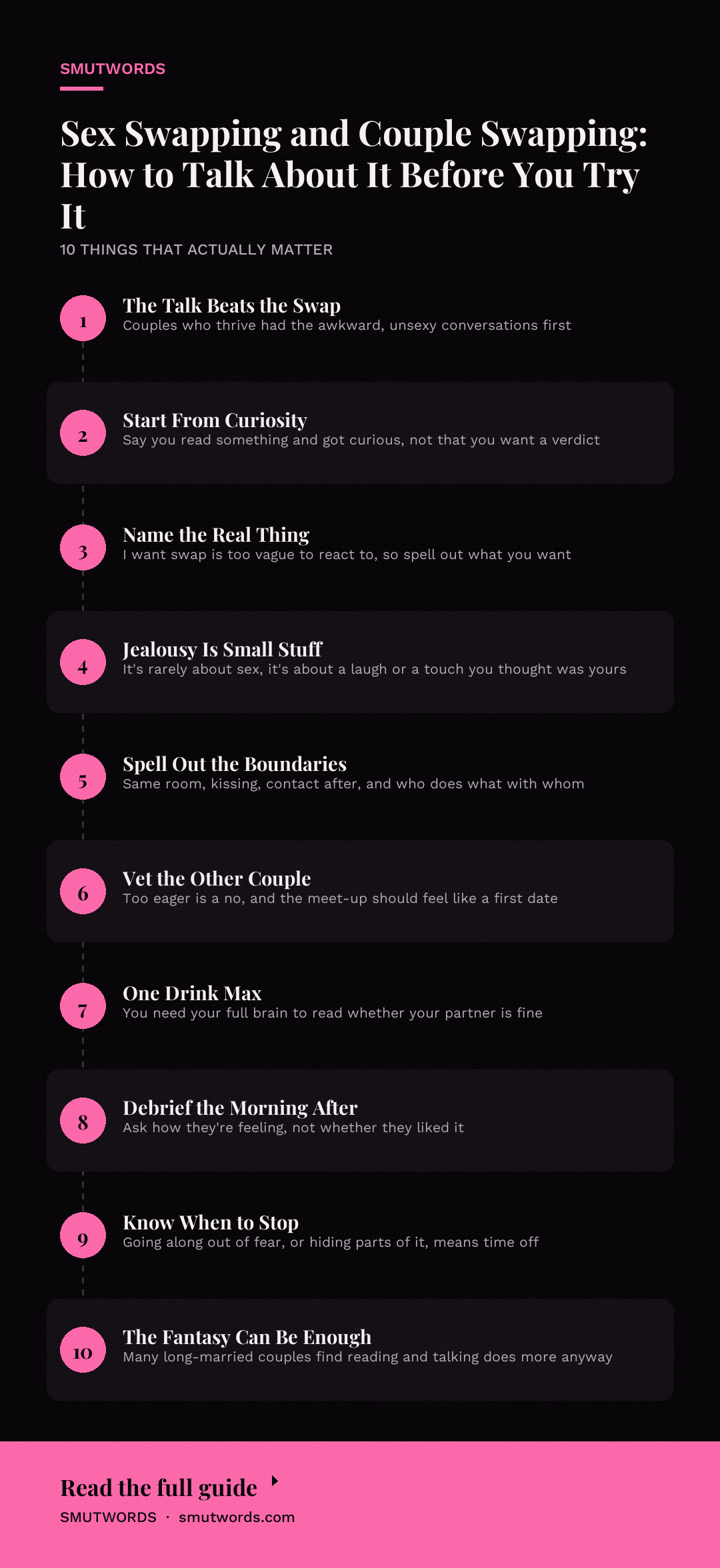
Final Thoughts
Talk first, talk long, and expect the conversation to be better than the swap. If you want a specific place to start, try a shared read on the topic before you ever bring up a dating app.
Pick up a well-written dynamic romance, read a chapter each, and use it as a way to say out loud what turns you on and what scares you. You'd be surprised how much that does. And if you get all the way to a hotel room and the thing you actually feel is relief that you and your partner are still holding hands, that's a complete success too.





Loading comments…