Breath play is a kink where partners intentionally restrict or control airflow during intimacy. The deliberate manipulation of breathing sharpens every sensation, turning the most automatic bodily function into an instrument of arousal. In erotica, it appears as a hand on a throat, a palm clamped over a mouth, or a command to hold still and not breathe until permission is granted.
The appeal lives in the razor-thin line between danger and devotion. One person holds literal life force in their hands; the other surrenders it willingly. This guide covers what breath play actually means on the page, how authors write it well, and why the risk baked into the fantasy is exactly what makes it land so hard.
What Breath Play Actually Means
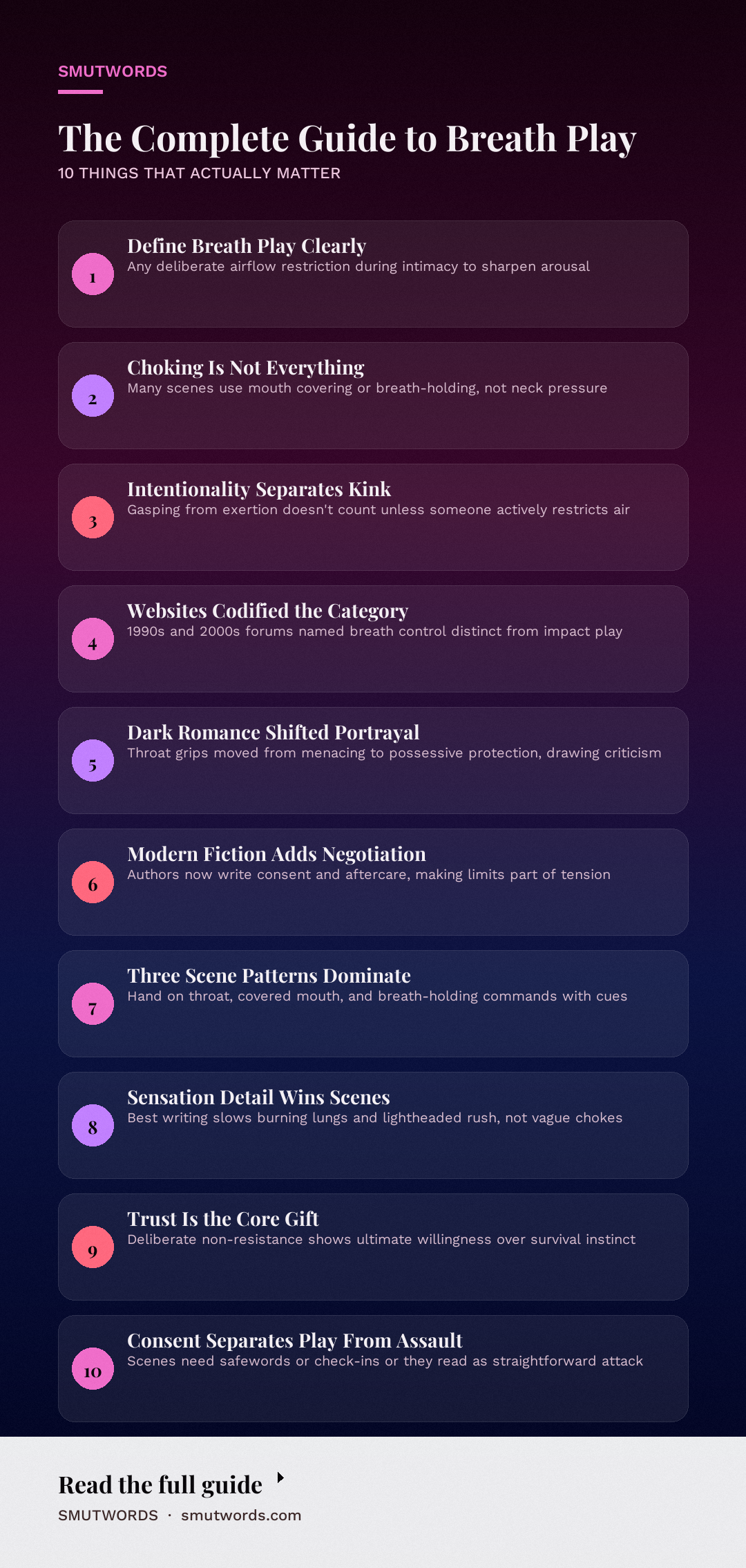
Breath play is the umbrella term for any sexual or erotic scenario where airflow gets deliberately restricted to heighten arousal, sensation, or the sense of surrender. The restriction can come from hands, forearms, pillows, plastic wrap, or simply a command to stop breathing.
The point is never suffocation for its own sake. It's the controlled, consensual edge where the body's most automatic function becomes a tool of intimacy.
The term covers a wide spectrum. Choking, which specifically refers to pressure on the neck, is the most common shorthand people use, though medically it describes blocking the windpipe. Strangulation is the clinical word for the same act, and it carries heavy real-world weight because it is also a form of assault.
Breath control widens the scope to include holding breath on command, breathing in tandem, or paced inhales and exhales directed by a partner. Suffocation play covers covering the nose and mouth with hands, fabric, or objects. Airway restriction is the technical phrase for any method that narrows or blocks the passage of air.
Common misconceptions muddy the waters. Many readers assume breath play always involves the neck, but a significant portion of written scenes focus on mouth and nose covering instead. Another misconception is that any loss of breath during sex counts, like gasping during orgasm or getting winded from exertion.
It does not. Breath play requires intentionality. A partner has to be actively doing something to restrict airflow, not simply breathing hard.
What does not count is equally important. Accidental moments where someone holds their breath during intense arousal are not breath play. Neither is the natural panting of vigorous sex.
The kink requires a deliberate actor and a willing recipient. In written fiction, that deliberate quality is what gives the scene its charge. The power exchange sits at the center, not the physical mechanics.
Where Breath Play Comes From
Breath play has existed as long as humans have had sex, but its recognizable form in erotica and romance is a recent phenomenon. Historical erotica rarely depicted airway restriction directly. The taboo nature of the act kept it mostly in underground or anonymous texts, often framed as violent fantasy rather than consensual kink.
The shift toward portraying it as a negotiated, trusting practice tracks with the broader BDSM visibility wave of the late twentieth century. The term itself entered common kink vocabulary through the internet.
Early online forums dedicated to BDSM in the 1990s and 2000s codified breath control as a specific category, separating it from general impact play or restraint. That categorization helped writers name what they were depicting, which in turn let the trope spread through self-published erotica and eventually into mainstream romance with the rise of dark romance in the 2010s.
The publishing shift is notable. Dark romance authors began using breath play as a shorthand for a hero's dangerous nature, often pairing it with a possessive grip on the heroine's throat during climactic scenes. That pattern exploded on platforms like Kindle Unlimited, where readers actively search for "choking" as a keyword.
The portrayal has evolved from purely menacing to something more layered. Contemporary dark romance frequently frames throat-grabbing as a gesture of protection and ownership rather than threat, which has drawn criticism from some readers who find it romanticizes a genuinely lethal act.
What changed most in recent years is the acknowledgment of risk within the fiction itself. Older depictions treated breath play as thrilling danger without consequence. Modern authors increasingly build consent negotiation and aftercare into the scene, even in dark settings, reflecting a readership that wants the fantasy without pretending the risk does not exist. That negotiation has become its own source of erotic tension, with characters setting limits before the action starts.
How It Shows Up in Erotica
Breath play scenes in erotica generally follow one of three structural patterns. The first is the hand on the throat. One partner grips the other's neck during sex, often from behind or on top, with steady pressure rather than a hard squeeze. The scene emphasizes the visual of fingers spanning a windpipe plus the vulnerability of an exposed throat.
The second pattern is the covered mouth, where a hand or palm silences sound while restricting airflow, frequently paired with a command to stay quiet. This one shows up a lot in stories with a secrecy angle, like a matchmaking mother kink scenario where staying silent matters. The third is breath-holding commands, where the dominant partner tells the submissive to hold their breath and only releases them on cue, sometimes counting down to make the anticipation sharper.
Strong versions of breath play writing succeed through specificity about sensation. The best authors describe the burning in the lungs, the lightheaded rush when air finally comes, the way sound distorts or vision narrows at the edge.
They slow the moment down, stretching a few seconds into a full paragraph because that is how it feels to the character. Flat versions skip the physical detail and rely on vague phrasing like "he choked her" without ever conveying what restriction does to the body's awareness.
Enjoyed this? Get a free book.
Join the list and we will send a complete free story straight to your inbox, plus new releases every week after that. No credit card, no catch.
The emotional register matters as much as the physical. Breath play in romance almost always signals trust, and the strongest scenes make that explicit. The recipient is not merely enduring the act.
They are actively choosing it, often framing it as proof of how far they trust their partner. That trust can be verbalized or shown through stillness, through keeping eye contact, through not fighting the hand at their throat. Survival instinct demands struggle, so deliberate non-resistance reads as the ultimate gift of control.
Variations across genres add texture. In dark romance, breath play often appears during a first intimate encounter, establishing the male lead's dominance and the heroine's unusual acceptance of it. In pure erotica without romantic framing, it functions more as a sensation amplifier, a way to spike intensity in an already explicit scene. In BDSM-focused fiction, breath play tends to appear as a formalized scene with safewords and aftercare, sometimes negotiated on the page in extensive detail that itself builds arousal.
What makes a scene work versus fall flat often comes down to consequence. The character doing the restricting needs visible weight behind their actions, an awareness that they hold something precious and could destroy it by accident.
That awareness creates the tension. A partner who casually chokes without any flicker of gravity reads as sociopathic rather than erotic.
The recipient's internal state matters too. Terror is not the goal in most written breath play. The goal is a heady cocktail of fear, arousal, and complete absorption in the present moment, and the writer has to show all three ingredients mixing.
- Hand on throat during sex, steady pressure rather than squeezing
- Palm over mouth and nose, often silencing while restricting
- Breath-holding commands with explicit permission to inhale
- Pillow or fabric over the face in more extreme scenes
- Timing breath to a partner's rhythm as a form of submission
Breath Play vs Choking vs Consensual Non-Consent
The confusion between breath play and consensual non-consent (CNC) is understandable because both involve a surface appearance of force. CNC is a negotiated scenario where one partner roleplays resistance or refusal that they have previously agreed to, often acting out scenarios of being overpowered. Breath play can appear within a CNC scene as part of the forced dynamic, especially when the fiction emphasizes the dominant partner's physical advantage in pinning or restraining.
The distinction matters in the negotiation. A scene can be pure breath play with no resistance roleplay at all. The recipient actively and eagerly participates in their own restriction, holding still while the hand closes around their throat.
That scene is not CNC because there is no pretense of unwillingness. Conversely, a CNC scene might not involve any airway restriction whatsoever, relying entirely on verbal resistance and physical struggle without touching the throat.
Breath play also gets paired with feral play and primal play, since both involve the rawest, most instinct-driven impulses surfacing during intimacy. In primal play, partners tap into animalistic hunger and domination, and breath control can emerge as a natural extension of that predatory energy. The key distinction is framing. Primal breath play emphasizes instinct and possession, while standalone breath play leans harder into the mechanical control of the breath itself.
What links all of these is the centrality of explicit agreement. Whether the fiction shows a safeword negotiation scene or communicates consent through body language and verbal check-ins, the reader needs to understand that the recipient chose this. In contrast, a scene with no such signals tips over from breath play into straightforward assault. That is a fundamentally different story, one more at home in a forbidden beast tamer romance context where the power dynamic is the whole point.
Frequently Asked Questions
Is breath play the same as choking in erotica?
Choking is the most common specific form of breath play, referring to pressure applied to the neck. Breath play is the broader category that includes choking, mouth-covering, breath-holding commands, and suffocation methods. Romance novels often say "choking" when they mean any airway restriction, but the accurate umbrella term is breath play.
Why is breath play so popular in dark romance novels?
Dark romance heroes are often written as dangerous, possessive men. Gripping a partner's throat visually communicates total dominance in a single gesture. The throat is the body's most vulnerable point, so a heroine allowing that grip signals absolute trust in a hero who is fundamentally untrustworthy. That contradiction creates intense dramatic stakes that dark romance readers seek out.
Does breath play always involve the neck in written fiction?
No. Many written scenes focus on a hand covering the mouth and nose, especially when the narrative involves secrecy or forbidden encounters where staying quiet matters. Commanding a partner to hold their breath is also common and involves no physical contact with the neck at all. The throat grip gets the most attention, but it is only one method.
How do authors show consent for breath play without breaking the mood?
Skilled authors weave consent into dirty talk, having the dominant partner ask "Can I?" in a low voice while already hovering at the throat, or having the recipient pull the hand into place themselves. Some stories use a formal safeword negotiation scene earlier in the relationship and then reference it briefly with a phrase like "green" during the action. Both approaches preserve erotic tension while establishing agreement.
Is breath play dangerous in real life?
Yes, seriously. Restricting airflow can cause brain damage within minutes and death even faster, and neck pressure carries specific risks of arterial damage or triggering a dangerous reflex. Even brief restriction can be lethal depending on individual health factors. Fiction rarely depicts these consequences because fantasy and reality operate under different rules, but any real-world experimentation demands extreme caution, a safeword, and avoiding pressure on the front of the neck.
What is the appeal of reading about breath play?
Readers respond to the intensity of trust it requires. A character who allows someone to control their breathing is offering a level of vulnerability that few other acts can match. The danger amplifies every sensation, making orgasm feel earned and the partner's care feel profound. It also creates a strong visual and visceral image that lingers after the scene ends.
Final Thoughts
Breath play endures as a written kink because it compresses the entire power exchange into a few seconds of held air. The best portrayals balance the physical sensation with the emotional meaning, showing a character who gives up the most automatic function of their body as the ultimate proof of trust.
If you want to see a masterclass in writing restriction with tenderness and heat, look for a scene where the safeword is established before either character undresses, then watch how the author makes every inhale after that feel like a gift. The good stuff never forgets that the breath coming back is the real payoff.






Loading comments…