A forbidden beast tamer romance is a story where the person who must control, subdue, or bond with a magical creature falls in love with that creature, or with a person cursed into a beastly form, against every rule of their world. The "forbidden" part does the heavy lifting: taming is supposed to end in domestication, obedience, or death, not mutual desire.
The "beast" can be a literal monster, a shifter, a dragon, a creature of shadow, or a prince trapped in fur and fangs.
What makes this trope work is the collision between duty, which demands the beast be conquered, and want, which demands it be loved exactly as it is. The tension is structural. Every moment the tamer spends learning the beast's nature makes her better at her job and worse at her fate, because the more she understands him, the less she can destroy him.
When the beast starts understanding her in return, the power dynamic flips into something far more intimate than dominance and submission. This is the fantasy: a love so dangerous it is outlawed, and so inevitable it happens anyway.
What Forbidden Beast Tamer Romance Actually Means
At its core, this trope pairs a tamer, someone trained or destined to control beasts, with a creature that defies control. The tamer is usually the protagonist, often a woman, because the genre leans heavily on the contrast between her perceived softness and the brutal work she does.
The beast is the romantic interest, typically a male-coded creature even when he is not human, and their relationship starts as captor and captive, handler and subject, or hunter and prey.
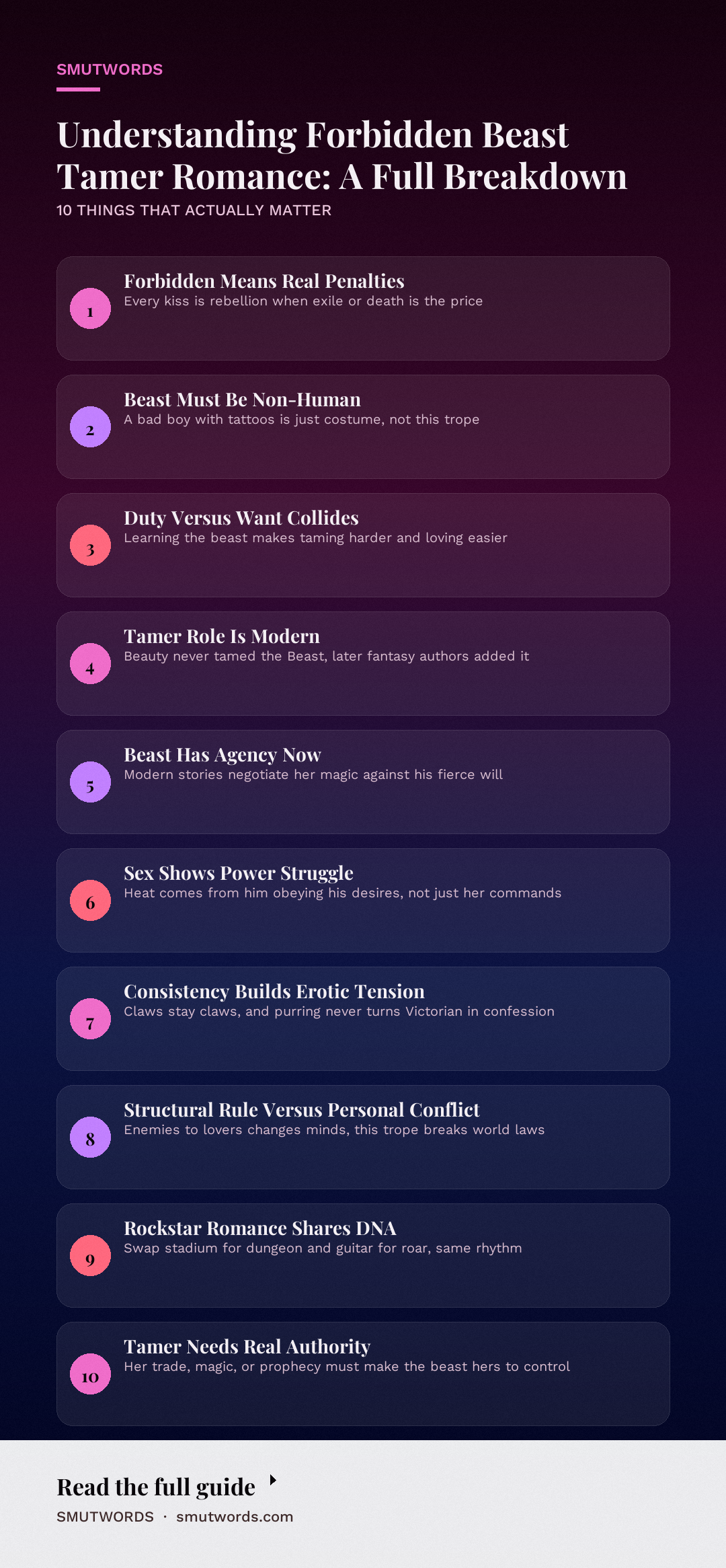
The "forbidden" element is what separates this from a standard monster romance or shifter romance. Attraction is not just socially frowned upon in these worlds. It is actively prohibited by taming orders, magical contracts, religious doctrine, or royal decrees.
The penalties are severe: exile, execution, loss of magical power, or the beast's death. Every kiss is a rebellion.
What does not count as this trope: a story where the tamer simply trains a creature that happens to be human on the side is not this. A story where the beast is a metaphor for a bad boy with tattoos is not this; that is a biker romance or a bad boy romance wearing a costume.
The beast must be genuinely non-human, genuinely powerful, and genuinely uninterested in being owned until the tamer arrives. The tamer must have real authority over him, historically and magically, and that authority must be what stands between them.
Where Forbidden Beast Tamer Romance Comes From
The roots are mythic, stretching back before the romance novel existed as a category.
The Greek myth of Psyche and Eros is the ur-text: she is told she must never look at her husband, he is a divine being she is forbidden to know, and her curiosity leads to separation and then a quest to win him back. The fairy tale "Beauty and the Beast" is the most direct ancestor, but in the original French version by Gabrielle-Suzanne de Villeneuve, the Beast is a prince under a curse, and Beauty's love is the specific key to breaking it.
The tamer framing, however, is a modern addition. Beauty never tames the Beast. She simply loves him, and his transformation is external.
The tamer figure arrives with the rise of fantasy romance in the 1980s and 1990s, when authors started borrowing from tabletop gaming, mythology, and sword-and-sorcery fiction. Anne McCaffrey's Dragonriders of Pern series, while not strictly romance, popularized the idea of a psychic bond between a human and a dragon. That bond carried erotic undertones that later authors made explicit.
The term "tamer" itself comes from this tradition, where a mage or warrior literally trains a magical beast for combat. The twist of making that beast the love interest was a natural evolution for romance authors who wanted the power dynamics of a master-and-servant story without the human baggage.
The genre-specific shift happened in the 2010s with the explosion of self-published fantasy romance and monster romance on platforms like Amazon and SmutWords. Authors realized there was an audience starving for heroes who were not just emotionally unavailable billionaires but actually non-human.
The tamer framework gave them a built-in reason for the hero and heroine to be chained together. The forbidden element deepened as authors explored worlds where taming was an industry, a sacred duty, or a political tool, and where falling for the beast was tantamount to treason.
The most notable shift in portrayal is the beast's agency. Early versions treated him as a force of nature to be redirected.
Modern forbidden beast tamer romance gives him interiority, trauma, and a fierce resistance to being saved. He often does not want to be tamed, and the romance becomes a negotiation between her magic and his will rather than a one-sided conquest. This mirrors the broader move in romance toward consent-forward storytelling, where even the most dominant hero must say yes.
How It Shows Up in Erotica
In erotic scenes, the forbidden beast tamer romance has a signature shape: the tamer's magic or training compels obedience, but the beast resists, and their sex is the proving ground for that resistance. A strong scene will show her invoking her authority, often with a command or a ritual phrase, and him obeying with a growl that signals he could break free at any second.
The arousal comes from the precariousness, from the sense that she is riding a tiger that could turn and consume her.
Common variations include:
Enjoyed this? Get a free book.
Join the list and we will send a complete free story straight to your inbox, plus new releases every week after that. No credit card, no catch.
- The Cursed Prince: the beast is a human man trapped in animal or monstrous form, and only a tamer's willing submission can break the curse. The irony is that she must tame him enough to accept her love, not to obey her.
- The Genuine Monster: the beast is an actual creature with no human form, and the romance is about building a language of trust between species. These are the rarest and the most adventurous, since the sex requires explicit worldbuilding around anatomy.
- The Rogue Tamer: the protagonist has betrayed her order by hiding a beast she was sent to kill. The romance is conducted in secrecy, with each encounter risking discovery by the tamer guild hunting them.
- The Soul Bond: the taming magic creates a psychic link, and the erotic scenes become telepathic duels where neither partner knows whose feelings are whose.
- The Reluctant Beast: the beast has given up on being loved and attacks anyone who tries to tame him. The heroine must survive his aggression long enough to prove she wants him free, not leashed.
What makes one of these scenes work versus fall flat comes down to the power exchange. A flat version has the tamer snapping her fingers and the beast crawling forward, which is just dominance play with no stakes.
A strong version shows the beast obeying his own desires even as her magic demands he obey hers, and that conflict between two pulls creates the heat. The same principle applies to the forbidden angle. A scene is only erotic if the reader feels the risk. If the only consequence of their coupling is embarrassment, it is not a forbidden beast tamer romance; it is a light BDSM scene with fur.
The craft trick that separates professional writers from amateurs is consistency in the beast's nature. If he has claws, they are in every scene. If he purrs when aroused, he does not suddenly speak in perfect Victorian prose during a love confession.
The best authors treat the beast's body as a constraint and an opportunity, and they let the tamer's knowledge of that body, learned through her trade, become a form of intimacy in the bedroom. She knows where to touch because she knows how to control, and that overlap is the emotional core of the genre.
Readers who enjoy the possessive edge of this dynamic will often find themselves drawn to possessive sex stories, and the structural tension between hunter and hunted has clear parallels in the psychology explored in office sex narratives, where authority and desire collide in a similar way.
Forbidden Beast Tamer Romance vs Enemies to Lovers Romance
The comparison to enemies to lovers is real, because most forbidden beast tamer romances are also enemies-to-lovers stories at the plot level. The tamer and the beast are on opposite sides of a war, a contract, or a magical decree.
But the difference is the source of the conflict. Enemies-to-lovers is driven by personal history, war, or misunderstanding, and the resolution is learning to see each other clearly. Forbidden beast tamer romance is driven by structural prohibition, and the resolution is breaking the rules of the world, not just changing personal opinions.
There is also common ground with prince/princess romance, since so many cursed beasts are royal blood held in animal form. That subgenre is about duty to a kingdom, and the forbidden beast tamer version adds the species barrier to that duty.
The tamer is often from a lower class or an oppressed order, and the beast is a fallen monarch, which creates a class dynamic on top of the magical one. The core fantasy is the same: being chosen by someone above you, even when that someone is currently covered in fur and dripping fangs.
A more unexpected comparison is the rockstar romance. On its face, a musician and a dragon share nothing, but structurally they are twins.
The rockstar is untamable, adored by crowds, and fundamentally inaccessible to a single person. The romance is about a woman who gets behind the public persona. The forbidden beast is exactly that. The tamer is the only person who sees him outside the myth, and her willingness to touch him without fear is what makes her different from everyone else.
If you have read a rockstar romance, you already understand the rhythm of a forbidden beast tamer romance. Just replace the stadium with a dungeon and the guitar with a roar.
Frequently Asked Questions
Is forbidden beast tamer romance always explicit?
No, there are closed-door and fade-to-black versions, but the genre leans heavily toward explicit scenes because the physical difference between the tamer and the beast is the point. Many readers want the anatomy questions answered on the page.
What is the difference between forbidden beast tamer romance and monster romance?
Monster romance is a broader umbrella that includes any story with a non-human hero. Forbidden beast tamer romance is a subset with a specific power structure: the heroine must have authority over the hero by trade, magic, or prophecy, and that authority must be considered wrong to wield romantically.
Can the beast talk in these books?
Yes, and the best ones give him full language, either telepathically, through a magical bond, or because he is a shape-shifter who chooses to stay in animal form. A silent beast is harder to write and rarer in the genre, since romance requires banter and negotiation.
Does the tamer always have to be a woman?
The genre overwhelmingly features female tamers and male beasts, but there are male-tamer, female-beast stories, and same-sex pairings. The popularity of the female tamer version reflects romance market demographics more than any internal rule of the trope, since the power dynamic works in any configuration.
What makes the love "forbidden" if the beast is a person?
In most versions, the beast is legally or magically not a person. Taming orders classify him as property, livestock, or a weapon, and loving him is considered a form of criminal misconduct or a violation of a magical oath. The beast's personhood is part of what the heroine must prove to the world, and that proof is the romance.
Final Thoughts
The forbidden beast tamer romance endures because it combines two of the most reliable engines in erotic fiction: the fantasy of control and the fantasy of being seen. The tamer wants to master the untamable, and the beast wants to be mastered only by someone who loves him for what he is, not for what he can be turned into.
That mutual recognition under impossible pressure creates a heat that human heroes rarely match.
If you want one example to see the trope done right, start with a book where the tamer order is an actual bureaucracy with rules and punishment, where the heroine has to file paperwork on a creature she is secretly sleeping with. The absurdity of that bureaucratic terror applied to a fanged lover is exactly the tonal mix that makes this genre sing.
Read it with the lights low and the worldbuilding manual open. The best of these books reward you for paying attention, and then reward you again for turning the page.






Loading comments…