
Demon romance is a love story where one half of the couple is a demon, a fallen being, or something close enough to one that the distinction stops mattering. The other half is usually mortal, sometimes an angel, occasionally another supernatural creature who should know better.
The genre runs on forbidden desire, moral imbalance, and the specific erotic charge of wanting something that is openly, unapologetically bad for you. It is one of the oldest dynamics in dark fantasy and one of the fastest-growing corners of monster romance, and it has very little to do with the swooning devils of older gothic fiction.
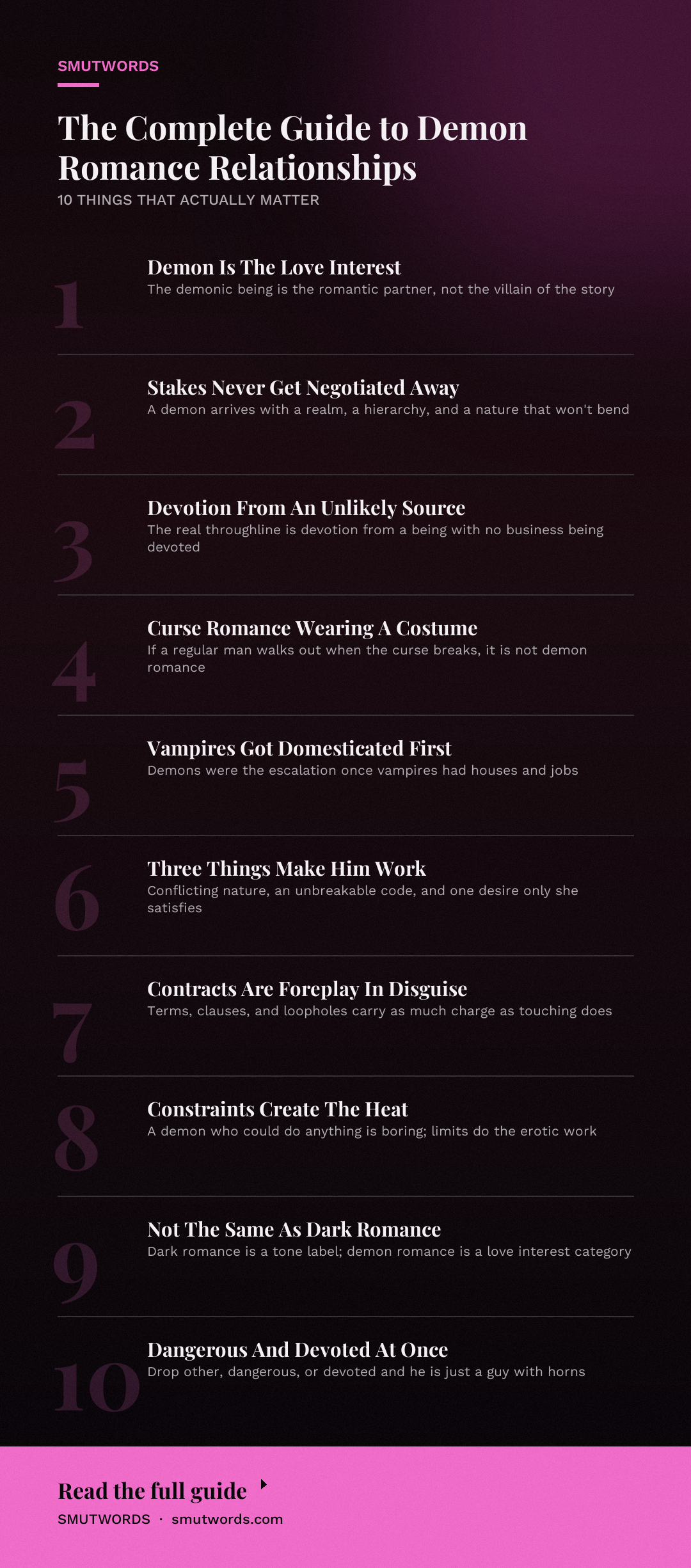
What separates demon romance from generic paranormal romance is the stakes problem. A vampire can be cured, a werewolf can be tamed, a fae can be reasoned with.
A demon arrives with a realm behind him, a hierarchy above him, and a nature that does not negotiate. The romance has to happen anyway. That tension is the whole engine.
What Demon Romance Actually Means
The term covers any romance where a demonic being is the love interest rather than the villain. That sounds simple until you start sorting through what counts.
A demon prince who courts a mortal woman across three books counts. A summoned incubus who accidentally bonds with the witch who called him counts. A fallen angel who never technically lived in Hell gets filed here too, because readers search by vibe more than by theology.
The word "demon" itself comes from the Greek daimon, which originally meant a divine spirit or guiding force, neither good nor evil. Christian theology flattened that into the modern definition: a fallen entity, aligned with Hell, hostile to humanity. Erotica inherited the flattened version and then did what erotica does, which is ask what happens if you fuck it.
Three things reliably do not count, even though readers sometimes lump them in:
- A human villain with a demonic aesthetic. Leather, red eyes, and a bad attitude are not a demon. The being needs an actual nonhuman nature with its own rules.
- A monster who is secretly a cursed human. If the curse can be broken and a regular man walks out the other side, you are reading a curse romance wearing a costume.
- A purely symbolic devil figure in a literary novel with no romantic arc. Demon romance requires the romance.
The most common misconception is that demon romance is inherently nonconsensual or purely dark. Plenty of it is dark. Plenty of it is also surprisingly tender.
Look at what it's built on: contracts, bargains, a demon who keeps every clause of a deal because his honor runs on different physics than a human's. The genre's actual throughline is not cruelty. It is devotion from a being who has no business being devoted to anyone.
Where Demon Romance Comes From
Demons have been romantic figures in Western literature for centuries, but the modern demon romance as a commercial category is a publishing phenomenon with a fairly short, traceable history.
The 1800s gave us the Byronic hero with hellfire attached: Milton's Satan as a sympathetic figure, Goethe's Mephistopheles as a charming negotiator, and a whole tradition of fallen angels who were more interesting than the men. None of that was romance in the genre sense. It was tragedy with good lighting.
The actual shift happened in the 1990s and 2000s, when paranormal romance exploded and readers started demanding love interests who were more dangerous than a vampire. Vampires had been domesticated by then. They had houses, jobs, and a tendency to brood rather than bite. Demons were the next escalation, and they arrived with built-in stakes: damnation, soul contracts, and a partner who genuinely might not be redeemable.
Two things accelerated the trend. First, urban fantasy and paranormal romance authors in the 2000s built demon hierarchies that readers could learn like lore, complete with princes, dukes, and courts.
Second, the self-publishing boom of the 2010s let authors go much darker and much more explicit than traditional publishers would touch, which is where demon romance really found its audience. The subgenre's center of gravity moved from "demon as brooding love interest in a mostly human world" to "demon as full protagonist with his own realm, politics, and appetites."
By the 2020s, demon romance had absorbed elements of monster romance, dark romance, and omegaverse-adjacent worldbuilding. The result is a category that now contains everything from cozy demon-next-door romcoms to extremely explicit hell-court sagas. If you have read a cryptid romance and enjoyed the "this being is genuinely not human and that is the point" energy, demon romance runs the same engine with higher heat and higher stakes.
How It Shows Up in Erotica
On the page, demon romance lives or dies on one question: what is the demon actually like? Authors who answer that with specificity write books readers reread. Authors who answer it with "he was dark and powerful and had black hair" write books readers forget by chapter three.
A strong demon love interest usually has three things working at once. A nature that genuinely conflicts with the heroine's wellbeing. A code, however twisted, that he will not break. And a specific desire that the mortal partner satisfies in a way no one else can.
That third element is where the erotic tension comes from. The demon is not slumming. He is obsessed, and the obsession has an object. It's the difference between a possessive hero in a no strings attached setup who's just territorial, and a being whose entire cosmology has reorganized itself around one person.
Common variations authors use:
Enjoyed this? Get a free book.
Join the list and we will send a complete free story straight to your inbox, plus new releases every week after that. No credit card, no catch.
- Demon prince or demon king. Political power plus romantic pursuit. The heroine becomes a problem the entire hell court has opinions about.
- Summoning and contract. The mortal calls him up, negotiates terms, and the terms get steadily more favorable to feelings. Excellent for slow burn and for scenes where the demon honors the letter of a deal in ways nobody intended.
- Demon and angel. Usually enemies-to-lovers with cosmic stakes. The angel half often carries as much moral weight as the demon, which is the point.
- Incubus or succubus. The feeding kink version. Here the dynamic is hunger management, and the romance is about whether desire can be separated from survival. If the hunger-as-romance angle is your thing, there is real overlap with the possession themes in alien abduction romance, which runs a similar "this being needs something from you" structure.
- Demon hunter romance. The love interest is the thing the protagonist is supposed to kill. Best when the book commits to the hunter actually being good at the job.
- Hellbound love. The mortal knowingly trades something real, a lifespan, a soul, a memory, and the story is about living with that choice rather than escaping it.
What makes a weak version: the demon is dangerous in narration but harmless in behavior. He growls about his darkness and then acts like a standard-issue brooding boyfriend with a slightly hotter temper. Readers spot this instantly. The stakes have to actually constrain the plot, not just decorate it.
What makes a strong version: the demon's nature costs the couple something. He cannot enter her church. He cannot lie, but he can omit. He cannot love her without marking her in a way the rest of the world will notice.
Constraints create heat. A demon who could do anything is boring. A demon who wants one thing and cannot pursue it the normal way is a book you stay up for. The same logic drives breeding kink versus impregnation kink stories, where the biological constraint does the erotic work the plot can't.
Worth noting for readers who like the possessive angle: the intensity here is closer to the territorial loyalty you get in pack dynamics than to anything in traditional romance. The difference is that a demon's possessiveness is usually singular. He is not joining a pack. He is claiming one person and rearranging his entire existence around her.
Heat level and pacing
Demon romance skews hot. The category's commercial center is explicit, and the pacing usually front-loads the tension rather than the sex. The first act builds the bargain, the second act delivers the first physically overwhelming encounter, the third act forces the couple to choose each other against the demon's own realm.
Authors who write it well understand that the demon's restraint is more erotic than his release. A demon who could take anything and instead asks, or barters, or waits, is doing far more work than a demon who simply does whatever he wants.
Contract mechanics as foreplay
One craft element worth calling out: the deal. Demon romance has a structural advantage no other monster subgenre really matches, which is that the couple can negotiate desire in writing. A contract scene is a sex scene in disguise. Terms, clauses, loopholes, and signatures carry as much charge as touching, and a good author milks every line.
If you are writing one, be specific. "Your soul" is vague. "One memory of your choosing, surrendered at midnight, and you will not be told which memory until it is gone" is a scene. Specificity is what separates a contract readers skim from a contract readers screenshot.
Demon Romance vs Elf Romance
These two get compared a lot because both involve nonhuman love interests with long lifespans and magic, and both sit inside the broader monster romance shelf. The actual difference is moral orientation. Elf romance typically pairs a mortal with a being whose nature is neutral to benevolent. The conflict comes from culture, longevity, or elven law, and the elf is usually on the side the reader is rooting for.
Demon romance flips that. The love interest is aligned with something the reader is at least half expected to fear, and the conflict comes from whether that alignment can coexist with love. Elf romance asks can we bridge our differences? Demon romance asks should you want the thing that will ruin you, and what does it mean that you do?
They share readers constantly. If you like one and not the other, the split is almost always about whether you want your supernatural partner to be safe or dangerous.
Frequently Asked Questions
Is demon romance the same as dark romance?
No, though they overlap heavily. Dark romance is a tone and content label that can apply to any pairing, including two humans. Demon romance is a specific love interest category. A demon romance can be cozy and low-angst, and a dark romance can have zero supernatural elements.
Are demon romance books always explicit?
Not always, but the category leans hot. Most traditionally published demon romance is open door at minimum, and the self-published center of the market is very explicit. If you want fade-to-black, it exists, but you have to hunt for it.
What is the difference between a demon and a fallen angel in these books?
Fallen angels are usually demons who retain angelic traits: wings, divine magic, guilt, and a complicated relationship with Heaven. Demons proper tend to be native to their realm with no prior allegiance to anything holy. The distinction matters for the redemption arc, since a fallen angel has something to fall back to and a demon usually does not.
Why do so many demon romances involve a contract or bargain?
Because a contract gives the couple a legitimate reason to spend time negotiating intimate things before they trust each other. It is a plot device that generates erotic tension without requiring the characters to act out of character. It also gives the demon a rule to follow, which makes him more interesting than a villain with no code.
Can the human partner be male?
Yes, and it is an increasing share of the market. M/M demon romance is well represented, as is F/F, and the dynamic works the same way regardless of who is doing the summoning.
Do demon romance books always have a happy ending?
Most do, because the category sits inside romance and romance promises an HEA. Some dark romance entries push that promise to the edge, and a small subset of what readers call demon romance is really dark fantasy with a romantic core and no guaranteed happy ending. Check the content warnings if the ending matters to you.
Final Thoughts
Demon romance works because it lets readers want something they have been told not to want, and then gives that wanting a story where the wanting turns out to be right. The category's best books understand that the demon has to be genuinely other, genuinely dangerous, and genuinely devoted, all three at once. Drop any one of those and the whole thing collapses into a guy with horns.
If you are new to the subgenre and want a starting point, spend some time with the demon prince romances before you go looking for anything darker. That is where the tropes are cleanest and where the warmth that sets this category apart from straight horror is easiest to see. From there, the descent into hell-court epics and full-blooded contract horror is a short and very enjoyable fall.




Loading comments…