Stag and vixen is a committed-couple dynamic in which a husband or long-term partner (the stag) takes active pleasure in watching his wife or partner (the vixen) have sex with other men, and she takes equal pleasure in being watched and wanted by both of them. The arrangement sits at the center of a whole family of erotic fiction about wife-sharing, hotwifing, and consensual non-monogamy.
It's one of the most reliable engines in modern smut because it lets a story run on two fuels at once: raw lust and unshakeable trust.
The man isn't losing anything. He's hosting the party, pouring the drinks, and getting harder every time someone tells him his wife is the best thing in the room.
If you've landed here from a glossary entry, this is the long version. We'll cover what the term actually means, where it came from, how it plays out on the page in published erotica, what separates a great stag and vixen story from a limp one, and the real-world guardrails that keep the fantasy from curdling.
There's a version of this dynamic that's nothing but a jealousy machine, and there's a version that's a genuine celebration of a partnership strong enough to hold a third person. The good books know the difference.
What Stag and Vixen Actually Means
The names are animal metaphors doing real work. A stag is the mature male of the deer family: antlered, watchful, head up, surveying his territory. A vixen is a female fox. Quick, clever, sexually self-possessed, the one who decides what happens next.
Neither animal is passive. That's the whole point of the terminology, and it's why the stag and vixen label has largely displaced older, heavier words in contemporary erotica.
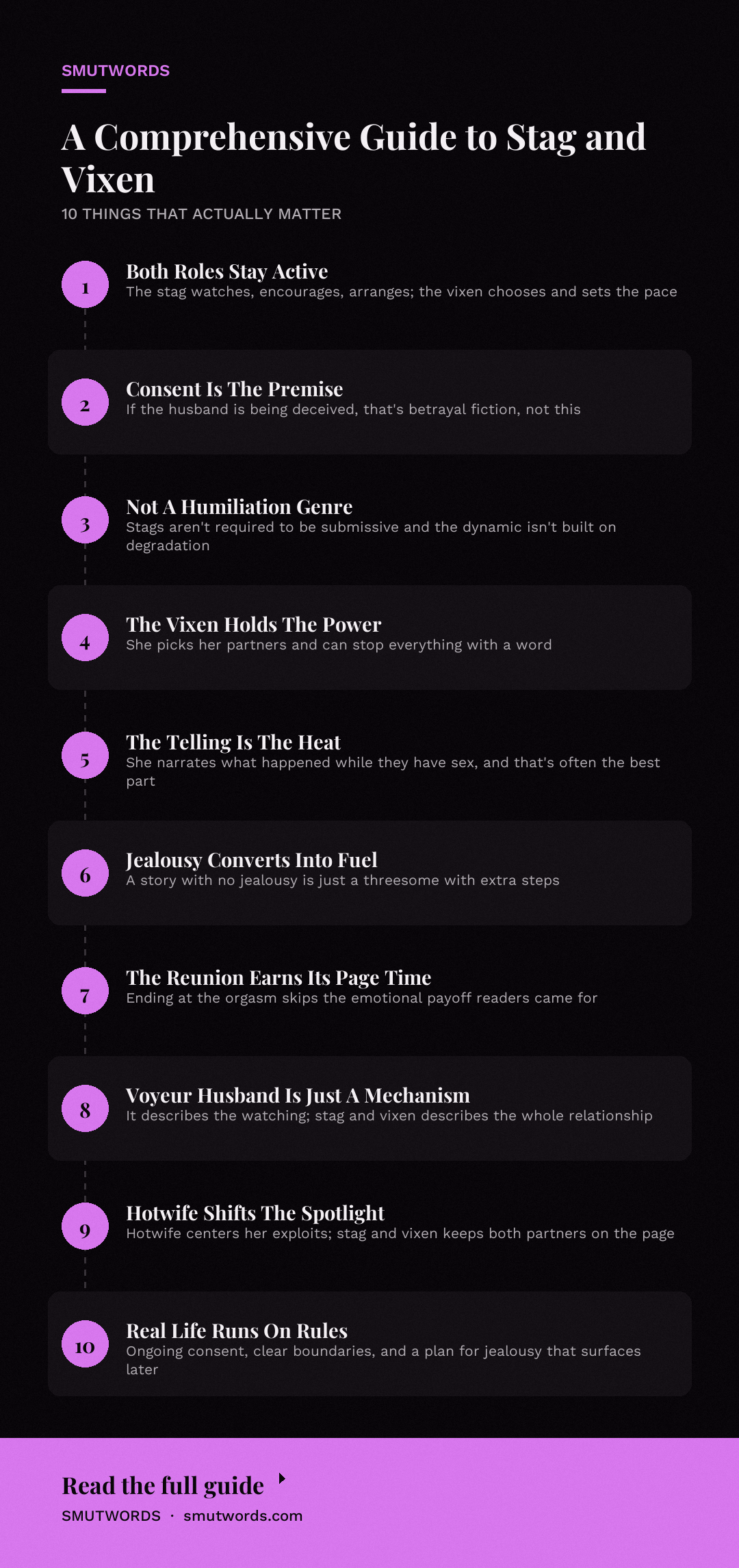
The stag is not a spectator in the bored sense. His role is active. He watches, he encourages, he sometimes arranges the encounter, he may participate, and crucially, he is turned on by the fact that his partner is desired and enjoying herself. His pride is the engine.
The vixen's role is equally active. She chooses her partners, she sets the pace, she comes back to her stag and tells him everything, and the telling is often as erotic to both of them as the event.
What counts as stag and vixen fiction:
- A married or seriously committed couple at the emotional center of the story
- The wife or female partner having sex with someone else, with her primary partner's enthusiastic knowledge and blessing
- The husband's arousal, pride, or joy at watching, hearing about it, or facilitating it
- Aftercare, reunion, and reaffirmation of the bond as the emotional payoff
What doesn't count: infidelity played straight. Cheating stories have a completely different emotional architecture. In a stag and vixen story, the husband is inside the loop.
If he's being deceived, you're reading a betrayal story with a voyeur husband trope flavor layered on top, which is a legitimate subgenre but not this one. The consent is not a technicality here. It is the premise.
A common misconception is that the stag must be submissive or that the dynamic automatically involves humiliation. It doesn't. Plenty of stag and vixen stories feature dominant husbands who organize everything, select the other man, and issue instructions.
The pleasure comes from ownership that is so secure it can afford to share, which is a very different psychological texture from a submissive cuckold scene built on degradation kink. Those are related genres, and they overlap, but they are not the same genre.
Another misconception: that the vixen is being handed around. She isn't. In well-written stag and vixen fiction, she is the most powerful person in the room.
She picks. She can stop everything with a word. The stag's excitement depends entirely on her choosing this, freely, again and again.
Where Stag and Vixen Comes From
The behavior is ancient; the vocabulary is modern. The underlying fantasy of a husband enjoying his wife's desirability in front of other men shows up in nineteenth-century erotic writing and earlier, and the word "cuckold" carries centuries of associations, most of them humiliating. Historically, cuckolding in literature was usually a comedy or a tragedy: the husband was a fool or a victim.
The stag and vixen reframe is a twentieth and twenty-first century publishing development. It arrived in force through swinging-community culture in the mid-twentieth century, where couples began describing a husband who enjoyed watching his wife as something closer to a proud spectator than a mark. The term "candaulism," coined in the late nineteenth century, describes the erotic pleasure of exposing a partner to others' gaze, and it's the clinical ancestor of all of this.
In erotica specifically, the shift was driven by the internet. Online erotica archives in the 1990s and 2000s gave hotwife and wife-sharing stories a massive, vocal readership, and readers pushed back hard against the humiliation framing. They wanted the husband respected. They wanted the wife's desire centered, not just her body used.
Authors responded. By the 2010s the "stag and vixen" label had emerged as the self-identifying term for the version where everybody is having a great time.
The romance publishing side moved slower. Traditional romance has a strong monogamy default, so stag and vixen content lived mostly in erotica and in indie publishing, where authors could write the reunion scene without a category romance editor asking them to cut it.
Over the last decade, hotwife and wife-sharing stories have become a substantial category in self-published romance and erotica, with their own review sites, newsletters, and reader communities. Audio erotica has been especially kind to the genre, because the dynamic is so heavily built on the stag hearing what happened.
One more shift worth noting: the rise of the shared-universe and serial format has changed how these stories are structured. Instead of one encounter and a closing scene, you get multi-book arcs where the couple's rules evolve, a regular third becomes a fixture, and the emotional stakes widen.
That's a genuine evolution in how this trope is published. It's also why the genre now supports long-form arcs that would have looked strange to a 1990s erotica reader expecting a short story.
How It Shows Up in Erotica
On the page, stag and vixen fiction lives or dies on structure. The sex is often excellent, but what makes readers finish these books is the arc from "she's going out" to "she's back in his arms and telling him every detail." The best authors treat the encounter itself as the middle act, not the ending.
Enjoyed this? Get a free book.
Join the list and we will send a complete free story straight to your inbox, plus new releases every week after that. No credit card, no catch.
Here's the anatomy of a strong scene sequence, which most well-built stories follow in some order:
- The negotiation or anticipation. The couple talks, or doesn't need to because the rules are established. Tension builds in the gap between decision and event.
- The selection. The vixen chooses her partner, or the stag picks a candidate and she approves. This is where her agency gets demonstrated, and it's the step weak stories skip.
- The event. Sometimes the stag is in the room, sometimes he's watching from a distance, sometimes he's waiting at home. Sometimes he's participating alongside the other man. The staging choice changes the entire flavor of the scene.
- The telling. Frequently the hottest section in the book. The vixen narrates what happened while the couple has sex, or while the stag listens in the dark. This is oral history as foreplay.
- The reunion. Reaffirmation. She's still his, he's still hers, and the trust has been tested and confirmed rather than damaged.
The intimate scenes themselves vary a lot. Some authors write the other man as a stranger who never returns, closer to a one night stand in emotional register, servicing the couple's fantasy and vanishing. Others build a recurring third who develops his own personality and even his own relationships with both partners, which trends the story toward group marriage territory or polyamory. Still others go full orgy, with the vixen as the centerpiece of an event the stag hosts.
One common variation worth calling out: the "watcher" arrangement. The stag never touches the third party. He sits in a chair, fully dressed, and watches. This version leans hard on the voyeur husband trope and often produces the most intense prose, because everything happens in the stag's perception: what he sees, what he can't quite see, the sounds, the jealous flicker he has to breathe through before it turns into arousal again.
The opposite discipline is the "participating stag," where the husband is physically involved the whole way through. Holding her, directing her, sharing her, occasionally a scene built around her being taken by both men at once. That approach leans into use kink and works well when the emotional framing stays warm. The moment the partner stops being a partner and becomes only a tool, the story slides into a different genre, and readers notice.
What makes the strong versions work versus the flat ones:
- Strong: The vixen has interiority. She's deciding, enjoying, and evaluating, not just receiving.
- Flat: She's a prop who exists to be watched. The stag is the only character with a POV.
- Strong: Jealousy appears, gets handled, and becomes fuel. The scene includes a moment of doubt or fear.
- Flat: No friction at all. Everyone is blissful from paragraph one, which drains the story of stakes.
- Strong: The rules matter. A boundary gets respected, or a small one gets ignored and addressed afterward.
- Flat: Rules are never established, which makes the consent feel decorative.
- Strong: The reunion scene gets as much page time as the encounter.
- Flat: The story ends at the orgasm. Emotional payoff skipped.
The jealousy factor is the craft crux. A stag and vixen story without any jealousy is just a threesome with extra steps. The heat comes from the stag feeling that possessive grip in his chest, recognizing it, and choosing to let it convert into desire.
Readers who like the possessive partner archetype in other subgenres will recognize the same machinery here. If you enjoy stories where ownership and jealousy get dramatized rather than solved, our breakdown of territorial shifter versus possessive monster digs into how that tension gets written across genres. Our dominant versus submissive breakdown is worth a look too, since the stag's confidence and the vixen's control get misread as a standard power exchange all the time.
Voice matters enormously too. Some authors write these scenes with rough, plain language. Others write them with an almost literary precision, treating the stag's inner monologue as the real subject.
Either works. What doesn't work is a narrator who keeps apologizing for the premise, or a prose style that flinches every time it gets close to the actual desire.
Stag and Vixen vs Voyeur Husband Trope
These two get confused constantly, and they're close relatives, so here's the clean distinction. The voyeur husband trope describes the *mechanism*: a husband who gets off on watching. It's a device, and it can attach to a lot of different dynamics.
It can show up in a story about a husband watching his wife undress for someone at a party, or in a story where the wife doesn't even know, or in a purely cuckold narrative. The voyeur husband trope tells you what's happening in the room.
Stag and vixen is the relationship frame. It includes the watching, but it also specifies that the couple is committed, that the arrangement is consensual and known to both of them, that the vixen has her own agency and stake in the scenario, and that the sexual event is a shared adventure rather than a secret. A voyeur husband story might be a stag and vixen story's opening scene, but the reverse isn't automatically true.
Practical test: if the wife doesn't know her husband is watching, or if the entire premise would collapse the moment the two of them talked about it, you have the voyeur husband trope and not the stag and vixen dynamic. Communication is what converts one into the other.
Frequently Asked Questions
Is stag and vixen the same as cuckolding?
They're adjacent, and many readers use the words loosely, but the emotional core differs. Cuckolding fiction traditionally centers humiliation and often frames the husband as lesser, frequently leaning on degradation kink. Stag and vixen fiction centers the husband's pride and the couple's strength.
The husband is elevated by the arrangement instead of diminished, and the vixen chooses him right back. Some stories blend the two deliberately, but they're distinct starting points.
What's the difference between stag and vixen and hotwife?
Hotwife fiction concentrates on the wife's exploits, sometimes with the husband as a background figure or even absent. Stag and vixen requires the husband's active, enthusiastic presence in the story, even if he's home waiting. If you want a close cousin that shifts the spotlight entirely onto the woman, hotwife is the label to search. If you want both partners on the page and emotionally involved, you want stag and vixen.
Can the vixen have sex with the same man more than once?
Absolutely, and recurring partners are a popular variation because they open up long-form arcs. A regular third develops history with both partners, which raises the emotional stakes and lets the author explore jealousy in more complicated ways. It can also drift the story toward polyamory or group dynamics, which is its own thriving territory.
Why do people read this if jealousy is supposed to hurt?
Because in small, controlled doses, jealousy is a high-arousal emotion that fiction lets you feel safely. The stag's possessiveness gets triggered and then resolved into pleasure, which is a very satisfying emotional loop. Feeling that grip in your chest and discovering it converts into desire is a popular fantasy precisely because it requires total trust, and trust communicated through something risky lands much harder than trust asserted in dialogue.
Does the dynamic have to involve penetration with another person?
Not necessarily. Plenty of stag and vixen scenes involve only visual exposure, flirting, watching her be desired at a party, or another person watching the couple have sex. The erotic core is the husband sharing his partner's desirability with an audience, and the physical escalation can stop anywhere along that path.
What does a healthy stag and vixen arrangement require in real life?
Explicit, ongoing consent from every person involved, not a single conversation that gets grandfathered in forever. Couples who practice this for real typically establish clear rules about who chooses partners, what's permitted, what happens during the encounter, and what gets shared afterward.
They also need a plan for jealousy that surfaces mid-scene or days later, and a way to talk about it without either partner treating the emotion as a disqualifying failure. Fiction usually skips the rules; reality runs on them.
Final Thoughts
The stag and vixen dynamic rewards writers who respect both halves of it. The vixen has to be a person with appetites and opinions. The stag has to feel something real when he watches, and he has to be secure enough to sit with it. Get those two things right and the scenes nearly write themselves, because you're writing trust moving through a body instead of an abstract speech about trust.
If you want a starting point, pick up Watch Me Come Home by Dana Kade, a book that built its entire emotional arc around a stag who has to learn what he actually enjoys versus what he assumed he would. The vixen in it runs her own show from the first page to the last.
It's a good place to see the dynamic done as a full-length relationship story instead of a single scene, and it's the kind of book that shows exactly why this trope keeps pulling in new readers.






Loading comments…