The gatekeeper kink is a power dynamic in erotica where one partner controls access to sex itself, often by withholding, rationing, or granting intimacy according to their own rules. In plain language, it is the eroticization of being the one who says yes or no, and the equally potent charge of being the one who has to ask.
This dynamic gets confused with simple denial play, which usually centers on the person being denied. The gatekeeper kink puts the person holding the keys at the center of the story. Their whims, moods, and decisions become the engine of every scene.
What Gatekeeper Kink Actually Means
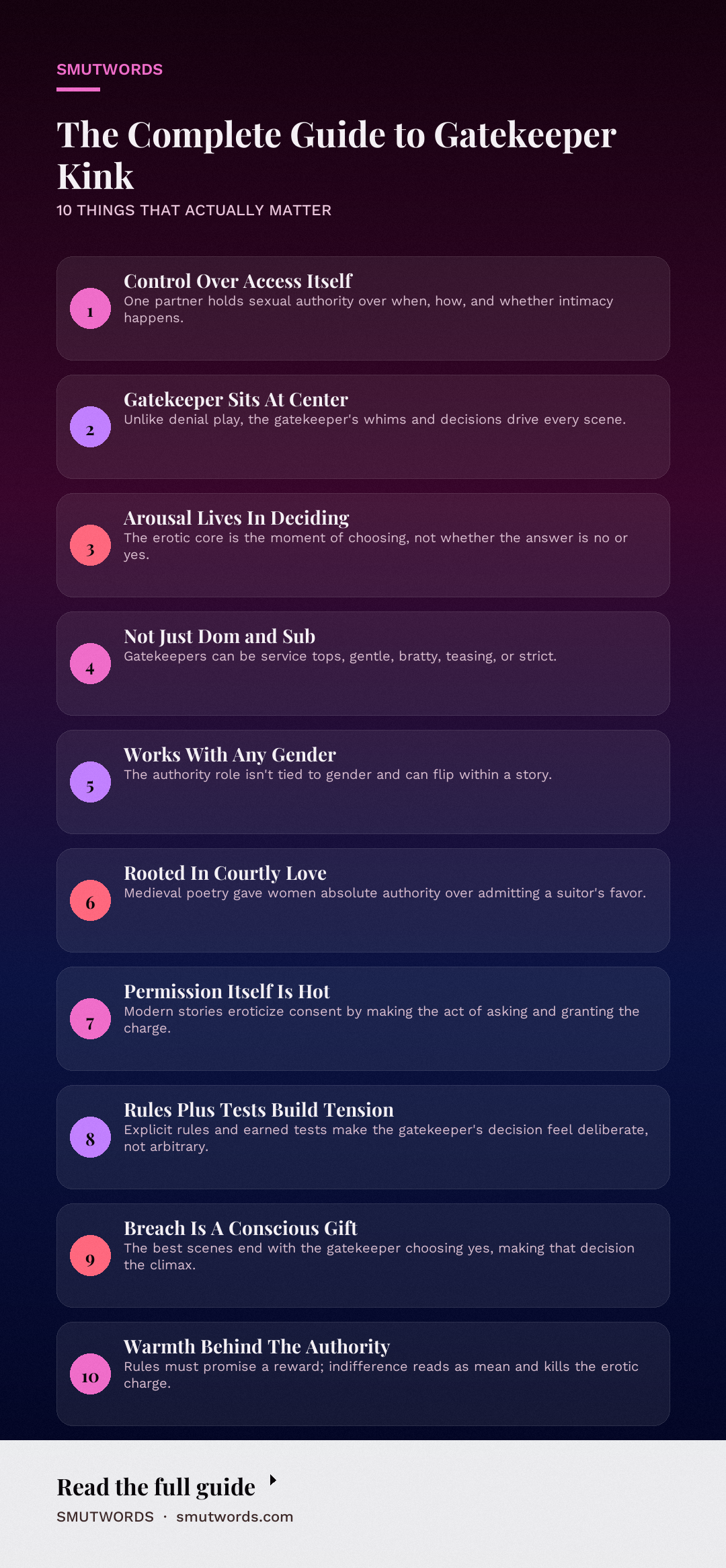
The gatekeeper kink describes a consensual arrangement where one partner holds what we'll call sexual authority over when, how, and whether intimacy happens. The name frames that authority as a literal gateway: the gatekeeper stands at the entrance to shared pleasure and decides who passes through.
That entrance can be physical, like a locked bedroom door or a hand pressed against a chest. It can also be conversational, like a rule that permission must be asked for and granted out loud.
What counts as this kink comes down to where the arousal is located. In a standard denial scene, the denied partner is the protagonist, and their frustration or desperation carries the story.
In a gatekeeper kink scene, the protagonist is more often the one in control. Their satisfaction comes from exercising that control, not from the denial itself. That distinction matters.
A gatekeeper might say no, or they might say yes, but the erotic core is the moment of deciding, not the outcome. The true measure of the kink is the asymmetry of information and power around sexuality. The gatekeeper knows more, or is allowed to choose more, and the other character's entire experience is shaped by waiting on that choice. That asymmetry is the source of the erotic charge.
A few common misconceptions surround this term.
First, the gatekeeper kink is not a synonym for a dominant and submissive dynamic, though it overlaps with one. The gatekeeper can be a service top, someone whose authority is about pleasing their partner. They can be bratty or gentle, teasing or strict.
Second, the gatekeeper is not necessarily the woman in a heterosexual pairing, even though that is the most common configuration in mainstream erotica. The kink works with any gender combination, and the authority can flip within a single story.
Third, this is not a real-world lifestyle structure that anyone is obligated to maintain outside a scene. It is a fiction-first trope, and most of what appears on the page is heightened for drama rather than transcribed from anyone's actual relationship rules.
Where Gatekeeper Kink Comes From
The gatekeeper kink does not have a long documented history as a recognized trope, unlike something like a latex fetish that traces its visual lineage through fetish photography and fashion. Instead, the kink emerges from a much older literary tradition: the idea of the beloved as a holder of keys.
Medieval courtly love poetry placed the woman on a pedestal and gave her total authority over whether her suitor was admitted to her favor. Her "no" was absolute, and her "yes" was a gift. That structure, stripped of its chivalric dressing, is the ancestor of the modern gatekeeper in romance and erotica.
In the mid-20th century, romance novels codified this dynamic around marriage and chastity. The hero pursued, the heroine resisted, and the plot's central question was whether she would finally grant him access. The erotic charge of that dynamic was usually muted, but it laid a clear template. What changed in the late twentieth and early twenty-first centuries is the point of view.
Modern gatekeeper erotica increasingly tells the story from the gatekeeper's side, or from a place that openly celebrates the authority rather than treating it as a prelude to surrender.
Publishing shifts drove this evolution. The rise of indie erotica and platforms that allowed authors to write niche dynamics without a mass-market gatekeeper of their own meant stories about female sexual authority could exist without a redemption arc that ended with the woman relinquishing control.
Erotica anthologies and short-form serials in the 2010s popularized titles like "The Landlady," "The Den Mother," and "The Warden," where a woman's control over men's access to her body is the fantasy, not a problem to be solved.
More recently, the kink has absorbed language from broader conversations about consent. Fictional stories now often emphasize that permission is hot, that the act of asking and receiving a clear yes is itself part of the sexual charge. The gatekeeper kink is the eroticization of that consent structure. It takes what could be a dry procedural concept and makes it the foreplay.
How It Shows Up in Erotica
On the page, the gatekeeper kink works through a handful of recurring mechanics that authors deploy to keep the tension high.
The first is the explicit rule. The story establishes early on that one partner has a rule about access: no sex on weekdays, no penetration until you say the magic word, no coming until I've had my turn first. The rule gives the gatekeeper something to enforce and gives the reader a clear sense of what is being withheld.
The second mechanic is the test. A strong gatekeeper scene puts the other character in a position where they must prove themselves worthy of access. This could be as simple as asking properly or as elaborate as completing a task.
The test raises the stakes because it makes the gatekeeper's decision feel earned rather than arbitrary. Weak versions of this trope skip the test and have the gatekeeper say no repeatedly with no clear logic, which reads as frustrating rather than tantalizing. Strong versions make the reader root for the gatekeeper's terms.
The third mechanic is the breach or the negotiation. At some point, the gatekeeper's authority is challenged, either because the other character pushes back or because the gatekeeper chooses to lower their own defenses.
The most satisfying versions of this trope make the breach a conscious choice by the gatekeeper. They are not overwhelmed or tricked into surrender. They decide that this time, the answer is yes. The decision itself is the climax, more than any physical act that follows it.
Enjoyed this? Get a free book.
Join the list and we will send a complete free story straight to your inbox, plus new releases every week after that. No credit card, no catch.
A fourth mechanic is the visible contrast between the gatekeeper's public and private selves. A character who is permissive and accommodating to everyone else, but who becomes ruthlessly selective with their partner, creates a delicious tension. The erotic weight lands on the fact that this person chooses to gatekeep only for you.
Variations on the kink are plentiful. A softer version involves the gatekeeper as a tease, who grants access in stages, doling out a kiss now and a touch later.
A harder version involves a gatekeeper who sets humiliating or demanding terms, leaning into body fluid kink or other edge-play as the price of admission.
A third version is the warden archetype, common in office or institutional settings, where the gatekeeper is a boss, a landlord, or a dorm supervisor whose legitimate authority over space translates into sexual authority. That framing borrows heavily from office sex stories, where the power imbalance of the workplace is the engine of attraction.
What separates a memorable gatekeeper story from a forgettable one is the interiority of the gatekeeper character. Readers stay engaged when they understand what the gatekeeper gets out of the arrangement. A flat gatekeeper is a plot device who says no for no reason.
A strong gatekeeper is a person who savors the moment of being asked, who feels the weight of their own yes, who maybe struggles with wanting to say yes too quickly and holds back because the waiting is sweeter for both of them. The best authors write the gatekeeper's restraint as its own kind of arousal.
For authors writing this trope, the common pitfalls are monotony and cruelty without consequence. If the gatekeeper says no every single time for three chapters, the reader loses hope.
Good gatekeeper fiction alternates between prolonged denial and sudden, generous permission. The unpredictability is what keeps the dynamic alive.
Similarly, the gatekeeper's rules should carry an implicit promise of reward. If there is no warmth behind the authority, the character reads as simply mean, and the erotic charge dissipates into discomfort.
Gatekeeper Kink vs High Heel Fetish
The gatekeeper kink is occasionally confused with a high heel fetish because of a common visual shorthand in cover art and scenes. A woman in towering heels, often with one leg crossed, is frequently used as a visual symbol of authority and selective access. The heel signals that she has the upper hand and that access to her is a privilege.
The confusion is superficial. A high heel fetish is specifically about the shoe, the foot, and the leg as erotic objects. The attraction is to the body part and its adornment.
The gatekeeper kink can function with no clothing element at all. The visual overlap exists because heels are culturally coded as powerful and sexual, making them a handy costume for a gatekeeper character.
The kink itself is about the control structure, not the footwear. In practice, the two can blend. A scene might feature a gatekeeper who insists her partner remove her heels with their teeth before any further access is granted, making the heel an instrument of the gatekeeping. But that scene is still a gatekeeper kink scene because the power dynamic is doing the work. The heel is just the prop.
Readers who search for gatekeeper scenes specifically usually want the argument over access to happen in dialogue and decision, not in wardrobe changes. If you're exploring related power dynamics, possessive sex stories share some DNA here: the possessive partner also frames access as something they grant, though the motive shifts from authority to ownership. The gatekeeper wants to be asked; the possessive lover wants to be the only one who can ever ask.
For a completely different flavor of control, office sex plays out the same gatekeeper structure with institutional authority as the frame, which is why the two tags show up together so often in story searches. The boss controls the promotion; the gatekeeper controls the bedroom door. When one person holds both keys, the fantasy compounds.
Frequently Asked Questions
Is a gatekeeper kink the same as being a "tease"?
Not exactly. Teasing is a behavior that can serve the gatekeeper dynamic, but the kink itself is about sustained authority over access. A tease might string someone along incidentally. A gatekeeper maintains a structural role as the decider, and the authority often outlasts any single interaction.
Can the gatekeeper kink be part of a healthy real-life relationship?
Yes, as long as the control is consensual and confined to agreed-upon contexts. Real-world gatekeeping usually looks like negotiated denial play or a scheduled "ask and receive" ritual. Outside of those agreed scenes, normal mutuality should apply. The kink is a costume, not a lifestyle mandate.
Why is the gatekeeper usually a woman in most erotica?
That pattern comes from the trope's roots in romance fiction and cultural assumptions about female sexual selectivity. The fantasy of a woman who is choosy and rewards a deserving partner is a direct inversion of older narratives where women were pursued prizes. Authors also write it this way because it flips a perceived power imbalance, giving women characters agency over the story's sexual pacing.
What is the difference between gatekeeper kink and orgasm denial?
Orgasm denial is a subset of the gatekeeper dynamic, focused narrowly on controlling when a partner can climax. The gatekeeper kink is wider and controls all access to sexual activity, including kissing, touching, and undressing. Orgasm denial often has the person in control trailing their partner's arousal closely. A gatekeeper might not even be in the same room as the denied party, or might be granting or refusing entry to a bed or a body.
How do I write a gatekeeper scene that doesn't feel mean?
Give the gatekeeper a visible investment in the other character's pleasure. The best gatekeeper fiction makes clear that the withholding is a route to a better payoff. The gatekeeper's no should be accompanied by a promise of a future yes, or by an alternative form of intimacy that still honors the rule. If the gatekeeper is entirely indifferent to their partner's experience, the scene loses its erotic warmth.
Is gatekeeper kink related to mirror play?
They can overlap when the gatekeeper uses a mirror to make their partner watch their own state of need. The gatekeeper might force the other character to look at how desperate they appear as part of the "test" before granting access. But mirror play is a visual technique, while gatekeeper kink is a structural power dynamic. They are compatible tools, not synonyms.
Final Thoughts
The gatekeeper kink rewards readers who enjoy watching someone hold all the cards and choose the exact moment to play them. Its best stories are not about refusing a partner but about the exquisite weight of the moment before the yes. When the gatekeeper finally opens the door, the payoff should feel like a gift chosen deliberately, and that deliberate choice is the whole fantasy.
For a strong example of the dynamic in action, look for stories where the gatekeeper's authority is tested by a partner who knows exactly how to ask. The tension between their control and their desire is where the kink runs hottest.






Loading comments…