
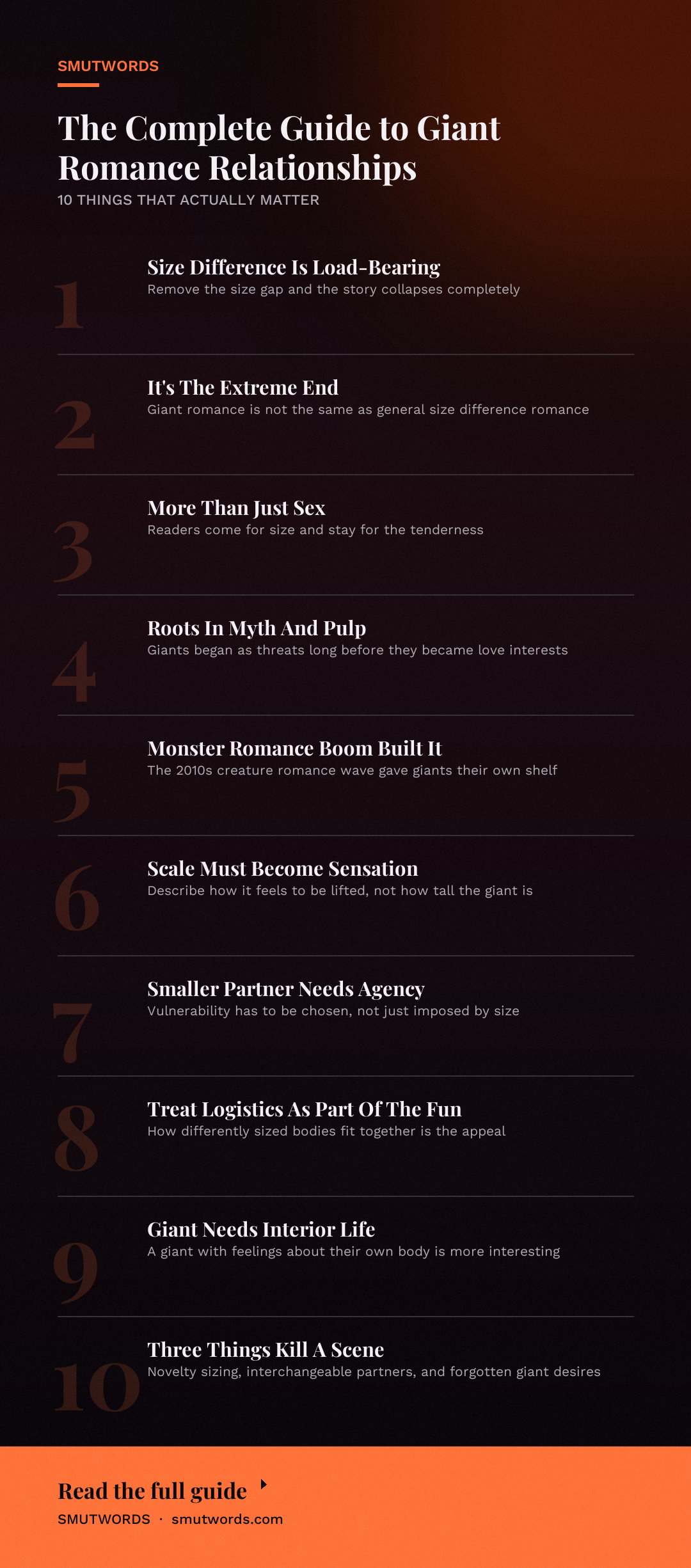
Giant romance is the subgenre where one romantic partner stands eight feet tall or more and the other is closer to human scale, and that gap is the whole engine of the story. It shapes how they touch, how they fight, how they have sex, and how they understand each other.
If you searched for giant romance because you want a book where a seven-foot woman can cradle a grown man in one palm, or where a mountain of a creature treats a small lover like something precious, you're in the right place. This guide covers what the term means, where it came from, how it works on the page, and why it has quietly become one of the most reliable fantasies in monster and paranormal romance.
What Giant Romance Actually Means
A giant romance is any love story built around a partner of extreme height and mass paired with someone of ordinary or smaller size, where that disparity is central rather than incidental. The "giant" could be a giantess, a male giant, a monstrous humanoid, a mythic being, or something stranger.
What matters is that the size difference is load-bearing. Take it out and the story collapses.
Worth being precise here: giant romance overlaps heavily with size difference romance, but the two aren't identical. Size difference is the broader umbrella, covering tall-short pairings, height gaps of a foot or two, and even supernatural growth. Giant romance is the extreme end of that spectrum, the territory where the larger partner is meaningfully non-human in scale.
What counts:
- A hero or heroine who is genuinely giant in the world of the story, not just tall for a human.
- A smaller partner whose physical vulnerability is acknowledged and explored.
- Sex scenes that treat scale as an engineering problem with an erotic solution.
- Emotional beats about protection, awe, and the strange intimacy of being held by something enormous.
What doesn't count: a six-four love interest and a five-two protagonist in a standard contemporary. That's size difference, not giant romance. The term needs a genuine break from human proportions, whether the giant is eight feet, twelve feet, or the size of a house.
The most common misconception is that giant romance is only about sex and scale tricks. Readers come for the size, but they stay for the tenderness. The giant who could crush a lover but chooses instead to cup them carefully is doing the same emotional work as any protective alpha, just at a bigger scale. That protective tenderness is where the genre earns its keep.
Where Giant Romance Comes From
Giant romance as a named subgenre is relatively recent, but its roots stretch back through myth, folklore, and a century of pulp fiction. Giants appear in nearly every mythological tradition, usually as adversaries or obstacles. The shift from threat to lover is what turned giants into romance material.
In the twentieth century, the giantess became a recurring figure in fetish art and underground comics, particularly through the 1970s and 80s. These weren't romance; they were pure size fantasy, often focused on destruction, capture, or domination. The emotional architecture came later.
The real turning point in publishing was the monster romance boom of the 2010s. As readers embraced non-human love interests across kraken romance, cryptid romance, and every other corner of creature romance, giants finally got their own shelf. Indie publishing drove this faster than traditional houses, because indie authors could write extreme size difference without a marketing department worrying about whether readers would buy the premise.
Online communities, particularly on platforms where size fantasy had lived for decades, supplied the earliest audiences. Authors who wrote giant romance in the 2010s were often writing directly for readers who had been waiting their whole lives for a book that treated the fantasy with real romantic seriousness. Those readers showed up in force, and the subgenre has expanded steadily since.
What's changed in the last few years is the range. Early giant romance leaned hard into either gentle-giant tenderness or dark capture dynamics. Now there are cozy giant romances, sci-fi giant romances, historical giant romances, and crossover stories where the giant's scale is one element of a much larger fantasy world.
How It Shows Up in Erotica
On the page, giant romance lives or dies on one craft choice: how the author converts scale into sensation. A giant who is just described as tall is boring. A giant whose body heat warms a room, whose heartbeat is loud enough to feel through a palm, whose hands are large enough to cup a lover's entire ribcage, is doing the work the genre needs.
Strong giant romance authors specialize in sensory translation. They don't tell you the giant is huge; they tell you how it feels to be lifted, how the voice rumbles through the smaller partner's chest, how kissing something with teeth the size of a forearm requires trust. The eroticism comes from that sensory gap, not from measurements.
Common variants worth knowing:
- Gentle giant. The larger partner is patient, careful, and reverent. The tension is between their strength and their restraint.
- Captive giant. The giant is bound, imprisoned, or otherwise constrained, and the smaller partner holds the leverage. Power inverts.
- Giantess. The giant is female and the smaller partner is male, female, or nonbinary. Often more dominant in tone.
- Sci-fi giant. The giant is alien, cloned, or genetically engineered. Scale becomes a species characteristic.
- Monster giant. The giant is a creature, often with claws, horns, or non-human anatomy. Crosses over with monster romance.
- Fated giant. The size difference comes with a magical or biological match, similar to how soulbond works in shifter and fae stories.
What separates strong giant romance from flat giant romance is usually the smaller partner's interiority. In a weak version, the smaller partner is a passive receptacle for the giant's presence, mostly there to be dwarfed. In a strong version, the smaller partner has agency, opinions, and a specific reason for wanting this specific giant. The vulnerability has to be chosen, not just imposed.
The best sex scenes in the subgenre treat logistics as part of the fun. How do bodies that different actually fit together? What has to be positioned, stabilized, supported?
Authors who write this carefully make the reader feel like they're solving the puzzle alongside the characters, and the payoff lands harder because of it. Authors who skip the logistics and go straight to the finish lose the specific pleasure of the genre.
Emotionally, the arc usually has to answer one question: what does the smaller partner get besides protection? The answer in good books is usually some form of being truly seen. The giant, who could have anyone or anything, chose this one small person. That's the fantasy at its core, and it's the same appeal that drives the hottest dark romance, just with a different physical vocabulary.
Another craft note: giant romance rewards specificity about the giant's interior life. Do they feel like a monster? Do they get tired of being treated as furniture? Is their size a source of shame, pride, or simple fact?
Enjoyed this? Get a free book.
Join the list and we will send a complete free story straight to your inbox, plus new releases every week after that. No credit card, no catch.
A giant with a real emotional relationship to their own body is dramatically more interesting than a giant who exists purely to be large. The same principle applies to angel romance, where the non-human partner's relationship to their own nature usually drives the plot.
What Kills a Giant Romance Scene
Three things flatten this subgenre faster than anything else. First, treating the size difference as a novelty the scene moves past once the sex starts. The size should stay present throughout, in every contact point and every shift of weight.
Second, making the smaller partner interchangeable. If you could swap them for anyone else, the scene isn't really about them. Third, forgetting the giant's own desires and boundaries. Even the one doing the cradling needs to want something specific.
Giant Romance vs Size Difference Romance
This is the comparison readers actually get confused about most often, so it's worth drawing clearly. Size difference romance is the category that includes giant romance, but it's much wider.
A six-foot-four cowboy and a five-foot-one heroine is size difference. A werewolf and a human is usually size difference, sometimes with a giant element if the shifted wolf is enormous. A straight-up giant, eight feet or more, in a story where their scale drives the plot, is giant romance specifically.
The practical test: can you replace the giant with a normal-sized very tall person and keep the story intact? If yes, it's size difference.
If the story only works because the partner is genuinely gigantic, it's giant romance. Readers who love one usually enjoy the other, but they scratch different itches. Size difference is about the gap; giant romance is about the gap being too big to close without help.
Frequently Asked Questions
Is giant romance the same as monster romance?
Not exactly. Monster romance is broader and includes any non-human love interest, from orcs to demons to tentacled horrors. Giant romance can be monster romance if the giant is monstrous, but plenty of giants are human-shaped or mythic rather than monstrous. The two overlap heavily but aren't synonyms.
Do giant romance books always have the giant as the dominant partner?
No. Captive giant stories invert the power dynamic, with the smaller partner holding the leverage. Giantess stories sometimes do the same. Dominance in giant romance is about who has control in the specific scene, not about who is physically larger, which is part of what makes the subgenre flexible.
How explicit is giant romance usually?
It runs the full spectrum. Some books are tender and closed-door, focusing on emotional intimacy and the fantasy of protection. Others are extremely explicit and treat the logistics of sex with a much larger partner as a central feature. Readers can find whatever heat level they want within the subgenre.
Are there female giants in giant romance, or is it mostly male?
Both exist, and giantess content has a long and distinct history within the fantasy. Male giant romance is more common in the mainstream indie romance market right now, but giantess books have a dedicated and growing readership. The dynamic plays very differently depending on which partner is larger, and both versions have their own conventions.
What's the difference between giant romance and dinosaur romance?
They're cousins, not twins. Dinosaur romance usually involves a shapeshifter who can take a dinosaur form or an actual prehistoric creature, with the animal nature front and center.
Giant romance can include non-human giants, but the humanoid or near-humanoid form is usually central. A giant who is clearly a person at giant scale is giant romance; a T. rex love interest is dinosaur romance.
Can giant romance work as a subplot instead of the main premise?
Yes, and it often does. Plenty of fantasy and sci-fi romances feature a size-different love interest as one element among many. That said, readers specifically searching for giant romance usually want the size difference to matter throughout the book, not to fade into the background after the meet-cute.
What makes a giant romance scene feel real instead of silly?
Specificity. Concrete sensory detail about how the size difference actually affects touch, weight, sound, and temperature. Grounding the giant's emotions in their own body.
Giving the smaller partner real agency. When those three things are present, the scene reads as intimate rather than absurd, and that's the whole game.
Is giant romance related to breeding kink romance?
Sometimes. Because giant romance often involves fertility, size-based biological differences, and protective partners, it can overlap with breeding kink content. Many giant romance books lean into "what would children look like" questions as part of the emotional arc.
Final Thoughts
Giant romance is doing something most subgenres can't: it takes an imbalance so extreme it should be impossible and turns it into the reason two people want each other. The size difference isn't a problem to be solved. It's the specific texture of the love story, and the books that understand that are the ones worth reading twice.
If you want a next step, look for a giant romance that commits to the logistics, gives the giant an interior life, and lets the smaller partner want something beyond being small. That combination is where this subgenre hits hardest. The list below has real options to start with, ranked by what SmutWords readers actually finish.







Loading comments…