
Service submission is a consensual power exchange in which a submissive expresses devotion to a dominant through practical acts of care: cooking, cleaning, running errands, managing a household, tending to the small machinery of daily life. The work itself looks ordinary. What makes it service submission is the frame around it, where the labor becomes a ritual offered to a specific person and received as a gift.
It's one of the quietest dynamics in erotic fiction, and one of the most intimate, because it turns grocery lists and folded laundry into the language of devotion. If you've read a book where the submissive irons a shirt with reverent attention or cooks a meal as an offering, you've already met this kink on the page.
What Service Submission Actually Means
The term combines two ideas that don't obviously belong together. Submission implies yielding, giving over control, placing yourself beneath someone. Service implies labor, usefulness, output.
Service submission fuses them: the submissive yields through ongoing, tangible care rather than through obedience in a single scene. The dominant receives that labor as an expression of the submissive's devotion.
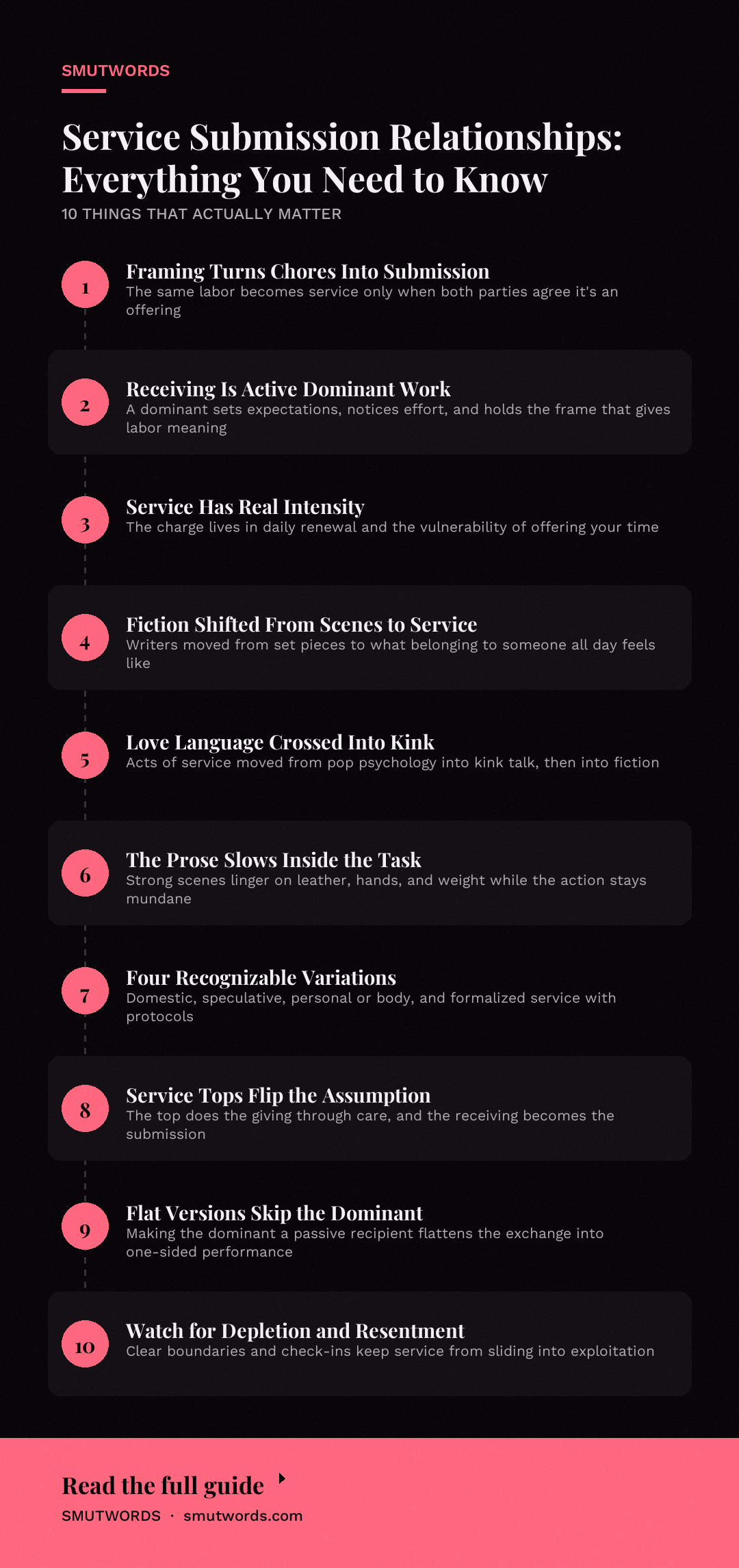
The crucial distinction is consent and framing. Anyone can do the dishes. In service submission, the dishwashing carries meaning because both parties have agreed that this act is an offering.
Without that agreement, it's just chores. The dominant's acceptance of the service is what completes the exchange.
What counts:
- Ongoing practical tasks performed for a dominant's benefit and received as an act of submission
- Domestic labor (cooking, cleaning, laundry, household management) offered with intention
- Personal service (running errands, managing schedules, tending to a dominant's comfort) framed as devotion
- Foot service, grooming, dressing, bathing a dominant as ritual care
- Service-oriented rituals that mark the submissive's role throughout the day, not just in a scene
What doesn't count: a partner who happens to do more housework because of an unbalanced relationship, an agreement with no consent or no acknowledgment, or any arrangement where the submissive's labor is extracted rather than offered. Service submission depends on mutual recognition. The dominant has to see the service as a gift, and the submissive has to choose it freely.
A common misconception reads service submission as the "safe" or "vanilla" version of submission, a low-stakes entry point with nothing intense about it. Readers who think this miss the whole engine. The intensity lives in the sustained commitment, the daily renewal of the choice, and the vulnerability of offering your labor and attention to someone who might not treasure it. There is nothing tame about handing someone your time.
Another misconception treats the dominant in this dynamic as passive, a person who simply receives. In practice, the receiving is active work. The dominant sets expectations, notices effort, acknowledges service, and holds the frame that gives the labor meaning. A dominant who ignores the service breaks the dynamic faster than any punishment could.
Where Service Submission Comes From
The history here is mostly a publishing history, and a strange one. Service submission as a named trope emerged from a broader shift in how erotica and romance wrote power exchange. For decades, published BDSM fiction emphasized scenes: the whipping, the binding, the dramatic set pieces that gave a chapter its structure. The power exchange happened in bursts, bookended by ordinary life.
That started changing in the 1990s and 2000s as writers pushed into the psychological interior of submission. The question shifted from "what happens in the scene" to "what does it feel like to belong to someone all day."
Once writers asked that, service became unavoidable. Real submission, the more thoughtful authors realized, happens on Tuesdays, at the sink, over a stack of bills. The scene is the highlight. The service is the relationship.
Online kink communities sped this up. From the early 2000s onward, forums and later social platforms gave submissives and dominants space to discuss the parts of their dynamics that never made it into fiction: the checklists, the daily rituals, the negotiations over who handles what.
The vocabulary of "acts of service" crossed over from the pop-psychology language of love languages into kink discussion, and from there into fiction. The term itself is a genre coinage, a label that let readers find the thing they already wanted.
The most recent evolution is the explosion of domestic service in romance, particularly in monster and fantasy subgenres. A fae lord's consort who tends his household, an alien commander's mate who learns the ship's routines as an act of devotion, a shifter packmate who cooks for the den: the structure translates effortlessly into speculative settings because it survives any amount of worldbuilding. The chores change. The dynamic underneath doesn't.
One trend worth flagging: modern service submission fiction is far more likely to show the negotiation than older work was. The conversation where the submissive states what service means to them and the dominant agrees on scope is now often written on the page, and readers respond to it.
Negotiation has become part of the eroticism. If you want a model for how that conversation can work, Negotiating a Scene: The Conversation to Have Before You Start lays out the mechanics an author can borrow wholesale.
How It Shows Up in Erotica
This is where service submission gets interesting for a reader who has been through a lot of these books. The trope is deceptively hard to write well, because its surface has no drama. Nobody is tied to anything. The stakes are invisible to an observer, which is precisely why the successful versions make the internal stakes so legible.
The strongest service submission scenes share a structural move: the narrative slows down inside the task. A submissive kneels to lace a dominant's boots, and the paragraph lingers on the feel of the leather, the position of the hands, the weight of the moment.
The action is mundane. The prose insists on its significance. That discrepancy is the whole craft.
Enjoyed this? Get a free book.
Join the list and we will send a complete free story straight to your inbox, plus new releases every week after that. No credit card, no catch.
Authors tend to work in a handful of recognizable variations:
- Domestic service is the classic form: household labor, meals, cleaning, the submissive running a home as an offering. It's where the "mundane becomes sacred" effect hits hardest.
- Service in a fantasy or speculative setting relocates the trope: a consort tending a fae court, a mate learning a ship's protocols on an alien vessel, a pack member cooking for the whole den. The chores are alien. The dynamic is identical.
- Personal or body service narrows the focus to grooming, dressing, bathing, or tending a dominant's body in specific ritual ways. This version sits closest to the erotic center and usually carries the heaviest charge.
- Formalized service adds structure: protocols, titles, uniforms, checklists, expected standards, a schedule the submissive follows. The formality makes the submission visible and gives the dominant something to acknowledge.
The service top variant is worth naming separately, because it's often misunderstood. A service top is someone who takes the dominant role by performing acts of care, usually topping through service rather than through command. The framing flips the usual assumption: the top is doing the giving, and the receiving is the submission.
It's a favorite of authors who like role ambiguity, and it produces the satisfying friction of a character who insists they're in charge while visibly bending themselves around someone else's needs.
What separates a strong version from a flat one? A few tests.
A strong version shows the submissive's interior experience of the service, the meaning it carries, the private satisfaction or ache of offering it. A flat version narrates the task and assumes the reader will find the kink on their own; it treats the service as set dressing between scenes.
A strong version gives the dominant something to do: noticing, accepting, correcting, appreciating. A flat version makes the dominant a passive recipient who provides a title and nothing else, which flattens the exchange into a one-sided performance.
A strong version uses the service to build toward a turn or a revelation, the moment either character recognizes what the arrangement has become. A flat version uses the service as texture and moves on. The good authors know a service dynamic is a slow-burn engine: every small task raises the pressure a little, until the characters have to name what they're doing.
Some of the most effective versions borrow from other established tropes to raise the charge. Put a service dynamic inside a territorial shifter trope, where a packmate's labor reads as belonging and protection, and the domesticity lands with a growl under it. Move it into an alien romance and the submissive's learning of strange domestic protocols becomes a study in cultural devotion.
Set it in a fae romance and the service takes on the weight of old bargains, where everything given has a price and the household is a court. All three work for the same reason: service submission is fundamentally about belonging, and speculative settings have their own languages for belonging.
Readers who want to see the conversation written as its own erotic scene should watch how the best books stage a negotiation early and let us watch the two characters decide what the labor will mean. Done right, that conversation is hotter than most of what follows it. For a deeper read on belonging as a romantic engine, Understanding Feral Hero Trope Relationships covers adjacent ground.
A key real-world consideration for authors and readers alike: service submission depends on clear negotiation of task boundaries and regular check-ins, so the service never slides into exploitation or resentment. The easiest failure mode in this dynamic is a dominant who keeps taking and a submissive who keeps giving past the point of depletion.
Good fiction acknowledges the emotional load of the work. Aftercare on that load, the emotional recovery from sustained servitude, matters as much as physical recovery. The most satisfying books show the dominant tending the submissive after a day of service, and that reversal lands hard because the reader has watched the labor accumulate.
Frequently Asked Questions
Is service submission the same as acts of service love language?
The two overlap but aren't identical. Acts of service is a broad way of expressing affection, available to anyone in any relationship. Service submission adds a power exchange frame: the labor is offered to a dominant and received as submission. You can have one without the other, but many submissives discover their kink through the love language.
Can a dominant do service submission?
Yes, through the service top variant. In a service top dynamic, the person in the dominant role performs acts of care and the receiving becomes the submission. The roles are defined by who holds authority and who offers, not by who does the labor. It's a popular twist for writers who like ambiguity.
Does service submission have to involve sex?
No. Plenty of service dynamics are nonsexual and focus entirely on practical care and ritual. In fiction, though, service usually runs alongside erotic tension, because the intimacy of the labor creates the charge. Many authors treat the service as foreplay and the sex as the acknowledgment.
What makes service submission different from a normal relationship with chores?
Consent and framing. In a normal relationship, chores are just tasks split between partners. In service submission, both people have agreed that the labor carries a specific meaning: it's an offering of devotion, received as such. The same action becomes a ritual because of the agreement around it.
How does negotiation work in this dynamic?
Task boundaries get discussed explicitly: what service is expected, what limits exist, what happens when the submissive can't meet an expectation. Regular check-ins catch resentment or depletion early. The best-written versions of this happen on the page, and they're often the most erotic part of the book.
Why is service submission so popular in monster and fantasy romance?
Because the structure survives any worldbuilding. Swap the kitchen for a fae court, the laundry for a ship's protocols, the grocery run for a pack hunt, and the dynamic still reads. It also gives speculative authors a way to write intimacy through worldbuilding, which is why it pairs so well with alien, shifter, and fae settings.
Final Thoughts
Service submission rewards patience. The kink lives in accumulation, in the quiet stacking of small offerings until both characters have to admit what they've built together. If you want a book that takes that slow burn seriously, with the negotiation, the daily rituals, and a dominant who actually notices the labor, put one of the ranked titles below at the top of your list. The good ones will leave you watching your own Tuesday sink with new eyes.








Loading comments…