
A prince/princess romance is a love story built around royalty: one or both protagonists hold a title, and the relationship has to survive the machinery that comes with it. Crowns, succession, treaties, courtiers who smile while they calculate your ruin. The fantasy is specific and physical. Silk, guards at the door, a person with real power choosing you over the continent.
Prince/princess romance is one of the oldest engines in the genre, and it still outsells almost everything else. The stakes are never only two hearts. A marriage can end a war. A refusal can start one.
What Prince/Princess Romance Actually Means
The glossary version is short: royal protagonists, arranged marriages, palace intrigue, the fight between duty and desire. That covers the load-bearing beams. It misses what the trope actually does on the page.
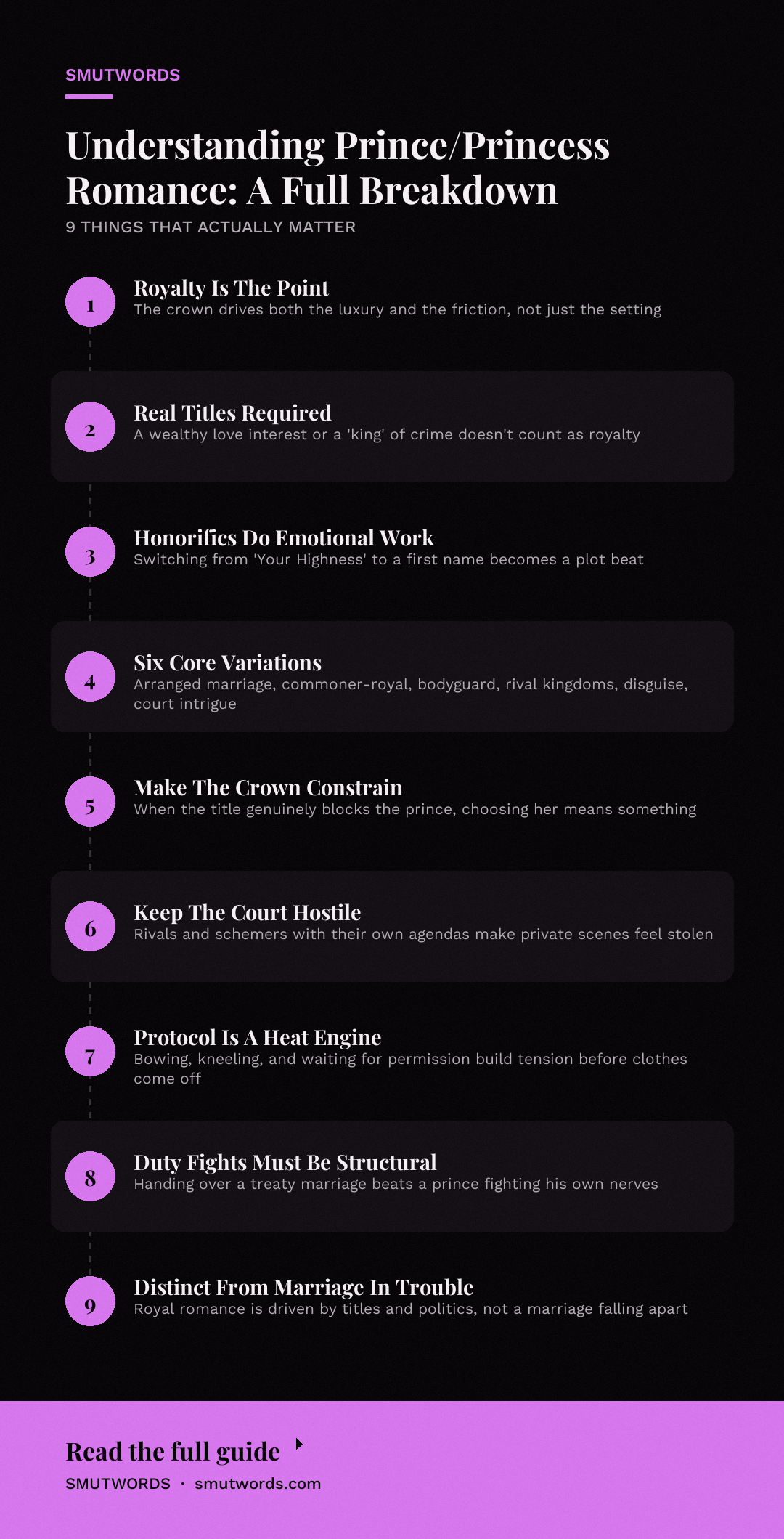
A prince/princess romance places its leads inside a system where love is a public act. Every kiss has witnesses eventually, every alliance has a cost, and every private decision ripples through a country's politics. The royalty is the point. It's the source of both the luxury and the friction that keeps readers turning pages.
What Counts and What Doesn't
Any story where a genuine titled heir sits at the center of the relationship counts. Kings and queens, dukes and duchesses, emperors, crown princes, princesses in exile, the illegitimate heir to a contested throne, fictional kingdoms with invented titles. If the character's position carries real political weight and the romance has to answer for it, it belongs here.
What usually doesn't count: a love interest who turns out to be wealthy, a "prince of a tech empire," a mafia romance with the boss styled as a "king" of the city. The trope needs actual royalty. The word "prince" is doing work in the term, and erotica is precise about its labels.
The Misconceptions
- "It's all historical." Plenty of prince/princess romance is set in contemporary or even science-fantasy worlds. Fictional kingdoms, modern constitutional monarchies, galactic empires ruled by an heir in exile. The trope travels across time periods.
- "It has to be sweet." Plenty of it is blisteringly explicit, sometimes with real cruelty in the power games. The royalty provides a framework where the dark stuff makes sense.
- "The royals are passive." The strongest versions make the titled lead active, calculating, and often ruthless. Weak royalty reads as wallpaper; strong royalty reads as a dangerous person who happens to be in love.
- "Arranged marriage is required." It's the most common structure, but the trope includes plenty of forced-proximity setups that aren't marriage contracts. See below.
A Note on Titles and Address
One of the underrated pleasures of prince/princess romance is the vocabulary. Honorifics do work that names cannot. A character who calls his betrothed "Your Highness" in private is either taunting her or revealing exactly how much of the arrangement he's already accepted.
The change from formal address to a first name becomes a plot beat. Authors who use that transition deliberately turn a small courtesy into a declaration. It's one of the cleanest tools in the trope.
Where Prince/Princess Romance Comes From
Royalty is the deepest root of the romance genre. The medieval romances that gave the genre its name were about knights and noble ladies, and the fairy-tale tradition codified the prince as a romantic figure before the novel existed as a form. The Grimms and Perrault loosed Cinderella, Sleeping Beauty, and a dozen variations into European storytelling, and the prince-as-rescuer template survived long after the actual monarchies that produced it.
The modern genre form has narrower origins. Category romance publishers in the 1970s and 1980s built entire lines around sheikhs, kings, and Mediterranean princes, almost always in contemporary settings with invented kingdoms. The covers promised titled heroes and high drama, and the books delivered a specific reading experience: a heroine dropped into a world of protocol and wealth, and a hero whose power made him both attractive and dangerous.
How the Trope Has Evolved
The 1990s and 2000s pushed princess fiction toward diaries and designer labels, polishing the fantasy with modern hooks (a hidden heir, an ordinary woman who learns she's royal). By the 2010s the contemporary prince/princess romance had split into two streams. One leaned into the escapist fantasy, all yachts and coronations and tiaras. The other pivoted to a darker register, with arranged marriages written as political cages and the prince or princess as something closer to a threat than a rescuer.
The most visible shift came with social media, where editorially chosen TikTok and Instagram clips teased the trope's specific shock beats: an arranged marriage announced without warning, a spouse in the wrong bedroom, a ball interrupted by a hero who shouldn't be there. Sites like SmutWords and the broader online romance community built visible fandom identities around these chunks of text. The trope didn't change its mechanics so much as learn how to be marketed in fragments.
Fantasy romance's recent boom matters here too. Fictional kingdoms and fae courts have become a dominant home for prince/princess romance. Speculative settings let authors build a monarchy from the ground up with whatever rules make the love story hardest.
How It Shows Up in Erotica
Royalty isn't decoration. It changes what a scene can do. A prince has guards outside a door and a schedule that isn't his to break. A princess has a wedding night booked years in advance with someone she may have never met.
Both are watched. That watching is the trope's engine, and it's where erotica does its best work.
The Core Variations
Most prince/princess romance fits one of these shapes:
- Arranged marriage. The contract exists before the affection. Weddings, consummation obligations, the negotiation of a marriage that neither party chose.
- Commoner and royal. The class gap becomes the tension. The plebeian lead is pulled into a world where every gesture is read, and every intimacy carries implications for the palace.
- Bodyguard romance. The titled lead is protected, followed, and repeatedly put within reach of a person paid to stay at arm's length. The protocol itself becomes foreplay, because the bodyguard cannot touch and never stops wanting to.
- Rival kingdoms. Two royal houses in opposition. The marriage or alliance is a weapon, and the bedroom becomes a negotiating table. This often overlaps with the hate to love register, since a real political grievance makes the hatred legible.
- Royal in disguise. The prince or princess hides the title and is loved without it. The reveal is the payoff.
- Court intrigue with an explicit center. A spy, a consort, a courtesan, a lover brought into the royal household for reasons the crown hasn't disclosed. The relationship is caught up in succession politics.
What Strong Versions Do on the Page
An editor reads dozens of these a month, and the flat ones are easy to diagnose. The weak prince/princess romance treats the crown as atmosphere. It gives the prince a castle and a title, then runs a standard grumpy-sunshine plot with a few references to the kingdom.
The strong versions do four things:
1. Make the title a source of genuine constraint
A prince in a strong royal romance is not free. His mother is negotiating a treaty. His marriage is a currency. He may want the heroine, but the state has a say in his choices.
When the crown actually blocks him, his eventual decision to choose her means something.
Enjoyed this? Get a free book.
Join the list and we will send a complete free story straight to your inbox, plus new releases every week after that. No credit card, no catch.
2. Keep the court populated and hostile
The most effective royal plots include minor characters with their own agendas. The queen's secretary with ambitions. The rival duchess with a grudge. A full court makes every private scene feel like a stolen moment.
That's the same mechanism that drives the marriage in trouble trope, where a relationship on unstable ground feels intense because the whole social order is pressing on it.
3. Use protocol as a sexual device
Formality is one of the trope's most underrated heat engines. Bowing. Kneeling. Waiting for permission. Titles. An author who wields protocol deliberately can generate enormous tension without a single explicit scene, because ritualized distance is one step from ritualized surrender.
That's where the trope overlaps with the negotiation ethos of real BDSM. SmutWords has covered that side of it in Negotiating a Scene: The Conversation to Have Before You Start. Royal romance is fantasy, not a manual, but the language of limits and consent maps well onto a relationship structured around the state's rules.
4. Pay the duty-versus-desire fight honestly
The core conflict needs to be structural, not emotional. A prince who simply has to stop being nervous isn't fighting duty. He's fighting insecurity.
A prince who has to hand over the marriage he's promised in a treaty in order to be with the person he loves is fighting duty, and that conflict earns the resolution.
What's Usually Missing in Weak Versions
- The political stakes are decorative and collapse as soon as the leads want each other.
- The heroine is a commoner with no life or skills aside from being loved.
- The prince or princess has no personality harder than "protective" or "cold."
- Consummation obligations are used as a plot convenience rather than a genuine negotiation.
- Court intrigue is announced but never staged: no rivals, no informants, no one scheming on the page.
Great royal romance is essentially a story about people whose affection has to compete with an entire society. That's exhausting for them and useful for us.
Prince/Princess Romance vs Marriage in Trouble
Readers often mix these two up, because royal romance frequently opens with an already-arranged marriage, and the question is whether the story belongs in one camp or the other. The distinction is real.
A prince/princess romance is defined by the royal position. The titles, the palace, the political pressure, and the duty-versus-desire fight are the engine. The marriage can be new, old, or not yet formalized. The relationship is under pressure from the crown.
A marriage in trouble story is defined by the relationship being at a breaking point. The couple is already married, and the tension comes from that marriage coming apart. It can absolutely include royalty, but the royalty is set dressing for a relationship problem, not the source of it.
How to Tell Which You're Reading
- If the titles, palace, and political stakes are driving the plot: prince/princess romance.
- If the couple is already united and the story is about the separation: marriage in trouble.
- If both are true: the story is a royal marriage in trouble, and it borrows from both.
Frequently Asked Questions
What is prince/princess romance?
It's a romance subgenre where one or both protagonists hold royal titles, usually with a political or dynastic reason the couple can't simply be together. Common structures include arranged marriage, commoner-and-royal class conflict, and court intrigue with a bodyguard or rival royal. The romance and the government are rarely separable.
Is prince/princess romance always explicit?
No. It spans the entire heat range, from sweet fairy-tale romances to very explicit fantasy royalty with open-door scenes. The trope's structure tolerates any heat level. What ties it together is the political pressure on the couple rather than the explicitness of the bedroom.
Does prince/princess romance have to be historical?
No. Contemporary royal romance, fantasy royal romance, and even royal science-fiction romance are all common. Fictional kingdoms are especially popular, because inventing the monarchy lets writers set the rules to maximize the romantic stakes.
What is the difference between prince romance and royal romance?
"Royal romance" is the broader umbrella. It covers any story with noble or titled leads: dukes, queens, empresses, heirs to a throne. "Prince/princess romance" narrows the focus to those specific titles, which usually means the lead is close to the seat of power but not yet on it. That near-miss is what allows the heir to be young, dangerous, and not yet fully in control.
Why do readers like bodyguard romance within royal settings?
Because the title and the role create a natural prohibition. A bodyguard can't touch the person he's been hired to protect, but he also can't leave her side. The forced proximity and the professional rule against intimacy are built into the premise, and the story gets tension without contrivance. It's the same pleasure the one bed trope delivers: two people placed in an impossible situation with no exit.
Is arranged marriage the same as forced proximity?
Arranged marriage is one form of forced proximity, but plenty of forced proximity in royal romance comes from other setups: a shared journey, a diplomatic mission, a shared safehouse. The distinct feature of the arranged marriage version is that the pair is legally bound, with public expectations and a consummation obligation that the plot has to address.
Final Thoughts
The prince/princess romance endures because the stakes are as big and as public as love gets. A person with everything and everyone watching chooses one person anyway, and the cost is real. The best versions stage that choice with a court full of interested parties and a protagonist who has to give up something he or she can't actually afford to lose.
Start with the royal romance where the marriage contract isn't a fantasy but a negotiation, and the moment of choosing takes up half the book. That's the version that will ruin you for the rest.







Loading comments…