
Friends with benefits is a sexual arrangement between two people who genuinely like each other, sleep together on purpose, and agree that neither of them is signing up for a romance. The friendship stays the frame; the sex happens inside it.
In erotica, friends with benefits is one of the most reliable engines in the genre because it manufactures the exact thing readers want: two people who already have intimacy, chemistry, and history, forced to decide whether the sex is the whole point or a doorway into something bigger. It runs from breezy hookup stories to slow-burn devastation. It almost never stays casual for long.
What Friends with Benefits Actually Means
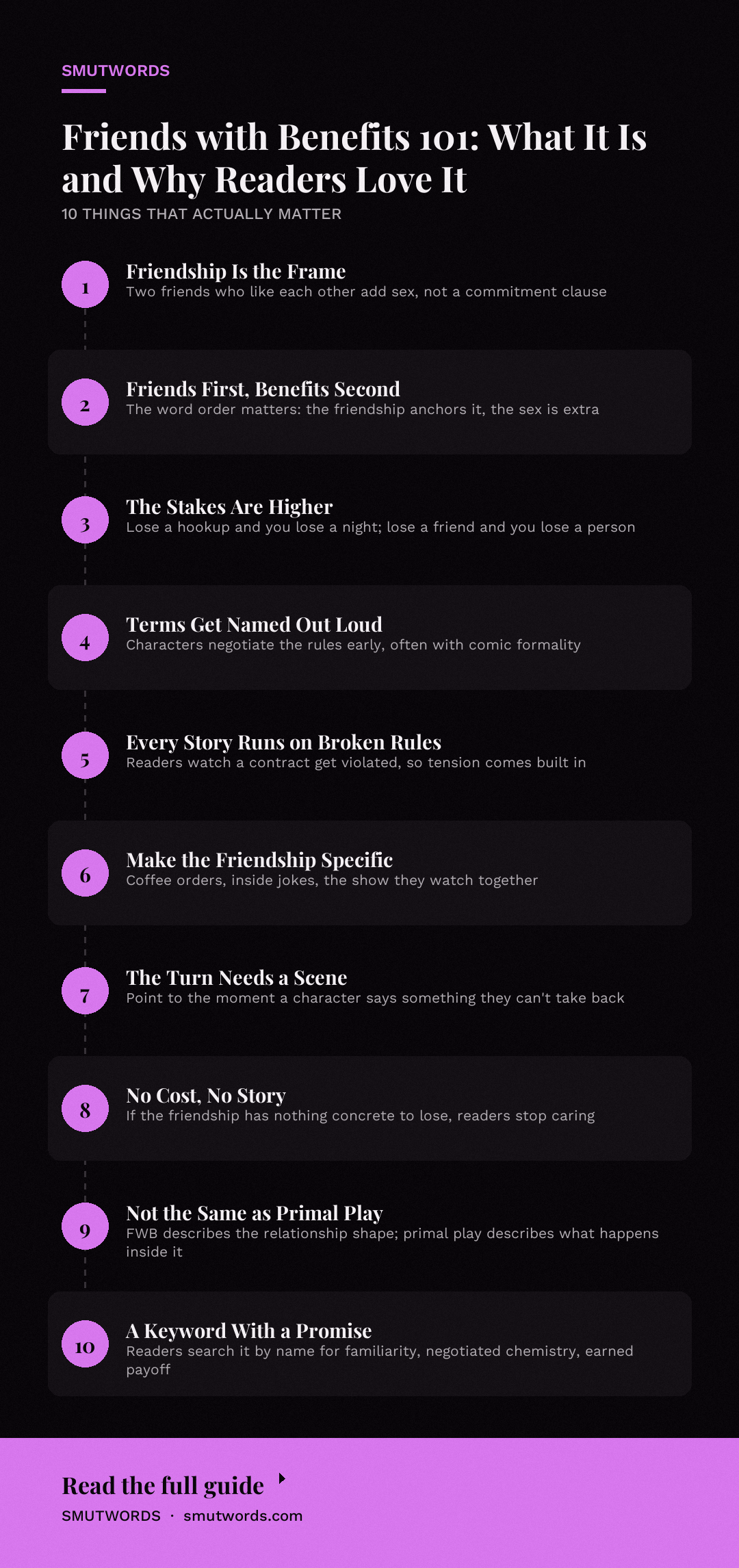
The phrase names the arrangement plainly. Two friends, sexual access, no commitment clause. The order of the words matters: friendship first, benefits second. In a real FWB setup the friendship is the anchor and the sex is the extra, and both people are supposed to know it.
In fiction the term covers a wide spread of ground. That includes the classic no-strings-attached pact between two adults who are attracted to each other and tired of dating, the long-standing best friends who fall into bed once and then keep falling, and the arrangement struck out of convenience (roommates, coworkers, someone home for the summer).
It also covers variants that shade into romance: friends to lovers, casual hookups that turn serious, sex friends who never quite manage to keep feelings out of it.
What doesn't count is worth spelling out. A one-night stand between strangers is a hookup, not FWB. A paid arrangement is something else, and a couple in an open relationship who each have outside partners has a different structure. The label requires mutual agreement, ongoing contact, and an honest baseline of friendship.
A "friends with benefits" situation where one person never agreed to the terms is just someone getting hurt in slow motion. That's the version nobody writes as a romance because it isn't one.
Readers often misread the trope as low-stakes. The opposite is true.
FWB stories carry more emotional risk than most romance premises because the two people already have something to lose. Break up a hookup and you lose a night. Break up a friendship and you lose a person you talk to every day.
Where Friends with Benefits Comes From
The phrase itself is a late-twentieth-century American coinage. It spread through casual speech in the 1980s and 1990s, got a boost from a 1990s Alanis Morissette lyric, and landed as a mainstream film title in 2011. By then the concept was already a decade-deep trope in romance publishing and had been running through erotic fiction for even longer under other names.
Romance has been writing this dynamic since long before the label existed. The friends-to-lovers arc is one of the oldest and most durable structures in the genre, and the sexual version of it sits right in the middle of that tradition. What changed in the late twentieth century was the language: a term that let characters name the arrangement out loud, negotiate it, and then break their own rules.
The genre's history with the trope tracks a broader shift in how romance handled sex outside of courtship. Older category romance treated premarital sex as a crisis point; the FWB premise treats it as a decision adults make. The rise of contemporary romance in the 2000s and 2010s pushed the arrangement into the foreground, and the indie erotica boom of the same era stripped it of any residual hand-wringing.
The most notable evolution is in who gets to have the arrangement. Early FWB stories were overwhelmingly straight and centered on two people who would eventually marry. Modern versions are broader: queer arrangements, polyamorous configurations, older characters, characters who genuinely want the sex without the relationship and get a happy ending that respects that choice. The trope has stretched, not shrunk.
There's also a publishing story here. FWB is a keyword readers search for by name. It signals a specific promise: established chemistry, negotiated sex, feelings sneaking in.
Authors lean on that promise deliberately. Covers and blurbs flag the trope explicitly because it sells. The label has become a marketing category as much as a plot device.
How It Shows Up in Erotica
The engine of every good FWB scene is a rule the characters set and then break. The craft lives in that gap.
A strong FWB story establishes the terms early and in plain language. Two friends agree: sex, yes; sleepovers, maybe; feelings, no. The reader now has a contract to watch get violated. Every subsequent scene gains tension from the fact that someone is about to bend the agreement, and the author doesn't have to explain why that matters.
Enjoyed this? Get a free book.
Join the list and we will send a complete free story straight to your inbox, plus new releases every week after that. No credit card, no catch.
Here are the variations that show up most often in the genre:
- The explicit pact. The characters negotiate terms out loud, often with comic formality. The scene where they lay out the rules carries the erotic charge before any sex happens. See negotiating a scene for how this works in practice.
- The accidental fall. One night of ill-advised sex between friends that neither of them planned to repeat, followed by a second time, then a routine. The slow realization replaces the negotiation.
- The convenience arrangement. Roommates, coworkers, or two people stuck together for a season who decide the logistics make sense. Proximity does the work.
- The reunion. Friends who had an arrangement years ago, drifted apart, and pick it back up. The history is already loaded.
- The jealousy spike. One of them starts dating someone else and the arrangement cracks. This is where the feelings surface.
- The no-feelings rule that collapses into full romance, usually with one character having known the whole time and the other catching up.
The strongest version of the trope makes the friendship specific. Readers need to see what these two people actually do together outside of bed: the show they watch, the inside joke, the way one of them knows the other's coffee order. A flat FWB story gives the reader two attractive people who happen to be acquainted. A strong one gives them a real friendship and then puts it at risk.
The sex itself should carry emotional information the dialogue won't. A scene where a character who swore off kissing breaks and kisses them anyway does more work than a paragraph of internal monologue. Physical details get meaning because the reader knows what the character is refusing to admit. A hand held too long, a morning-after that neither of them planned for, a favorite position that becomes a private language between the two of them.
Editors see the same failure mode over and over: the arrangement has no cost. If nothing is at stake, the reader has no reason to care whether they break the rules. Give the friendship something concrete to lose, whether that's a shared social circle, a business, a decade of history, or a promise one of them made to somebody else.
The other failure is a rushed turn. If the feelings arrive without a visible breaking point, the payoff reads as a foregone conclusion. The turn should be locatable in the text: a specific scene, a specific moment, a specific thing one character says that can't be taken back.
Friends with Benefits vs Primal Play
These get confused because both can involve established partners and both use negotiated rules. The difference is what the rules are about.
Friends with benefits describes the shape of a relationship: two friends who have sex without a romantic commitment. Primal play describes what happens inside a sexual encounter: consensual chase, wrestling, biting, animalistic energy. A primal scene can happen between FWB partners, and a chapter of FWB negotiation can set up the rules for primal play. They sit at different levels.
It's worth naming the distinction because FWB stories sometimes borrow kink vocabulary for spice without changing the structure. A scene labeled FWB that's really a feral play encounter is doing two things at once, and readers notice when the two get muddled.
Frequently Asked Questions
What does friends with benefits mean in a book?
Two characters who already have an established friendship agree to have sex without a romantic relationship, and the story typically follows what happens when one or both of them start to want more. The arrangement is usually named out loud early in the book, and the plot runs on the breaking of those rules.
Is friends with benefits the same as friends to lovers?
Closely related but not identical. Friends to lovers is the broader romantic arc, where two friends realize they're in love. FWB adds an explicit sexual arrangement in the middle: the sex comes first, and the feelings catch up.
What makes a good friends with benefits romance?
A specific, believable friendship the reader can feel is under threat, a negotiated set of rules the characters will visibly break, and a turning point you can point to. The physical scenes should reveal something the dialogue doesn't.
Is friends with benefits always a kink?
No. It's a relationship structure, not a kink, and plenty of FWB stories are entirely vanilla. It only shifts into kink territory when the arrangement includes negotiated power exchange, sensory play, or something like use kink or degradation kink.
Can friends with benefits stories end without romance?
They can, though book-length versions rarely do. Short erotica often closes on the arrangement continuing or ending cleanly; full-length romance almost always turns it into a romantic ending. Writers benefit from knowing which one they're delivering before the first chapter.
Why do readers search for friends with benefits specifically?
Because the label promises a specific reading experience: familiarity before the sex, negotiated chemistry, and an emotional payoff that's earned. It's a keyword that saves readers a lot of filtering.
Final Thoughts
The friends with benefits trope works because it puts two people in a room with something they've already built and asks whether they can hold on to it.
Read one where the friendship is as vividly drawn as the sex: the coffee orders, the running jokes, the ugly fights, all of it. Start with the one bed trope if you want a dialed-in version of the same intimacy-first tension, or best friend's brother if you want the friendship complicated from the outside. Both deliver the same core charge, and both pair well with anything you already love in the FWB lane.








Loading comments…