
A marriage of convenience is a romance plot where two people get legally married for reasons that have nothing to do with love, then spend the rest of the book failing to keep it that way. The visa is expiring. The grandmother's will demands a spouse. The failing ranch needs a second signature on the loan.
Whatever the excuse, the couple signs the paperwork, moves in together, agrees to keep feelings out of it, and immediately starts losing that argument. It is one of the oldest and most reliable engines in the genre, and when it's built right, every cooked dinner and shared bathroom becomes foreplay.
What Marriage of Convenience Actually Means
The name describes the arrangement, not the outcome. A marriage of convenience is defined by its opening conditions: the wedding happens for a practical reason, both parties know it, and at least one of them believes they can walk away emotionally unscathed. The story is what happens when that belief collapses.
What counts: a green card marriage, a marriage to satisfy a trust fund clause, a merger between two business rivals, a marriage that keeps a character on a family ranch or in a specific country, a marriage that shields someone from scandal or debt.
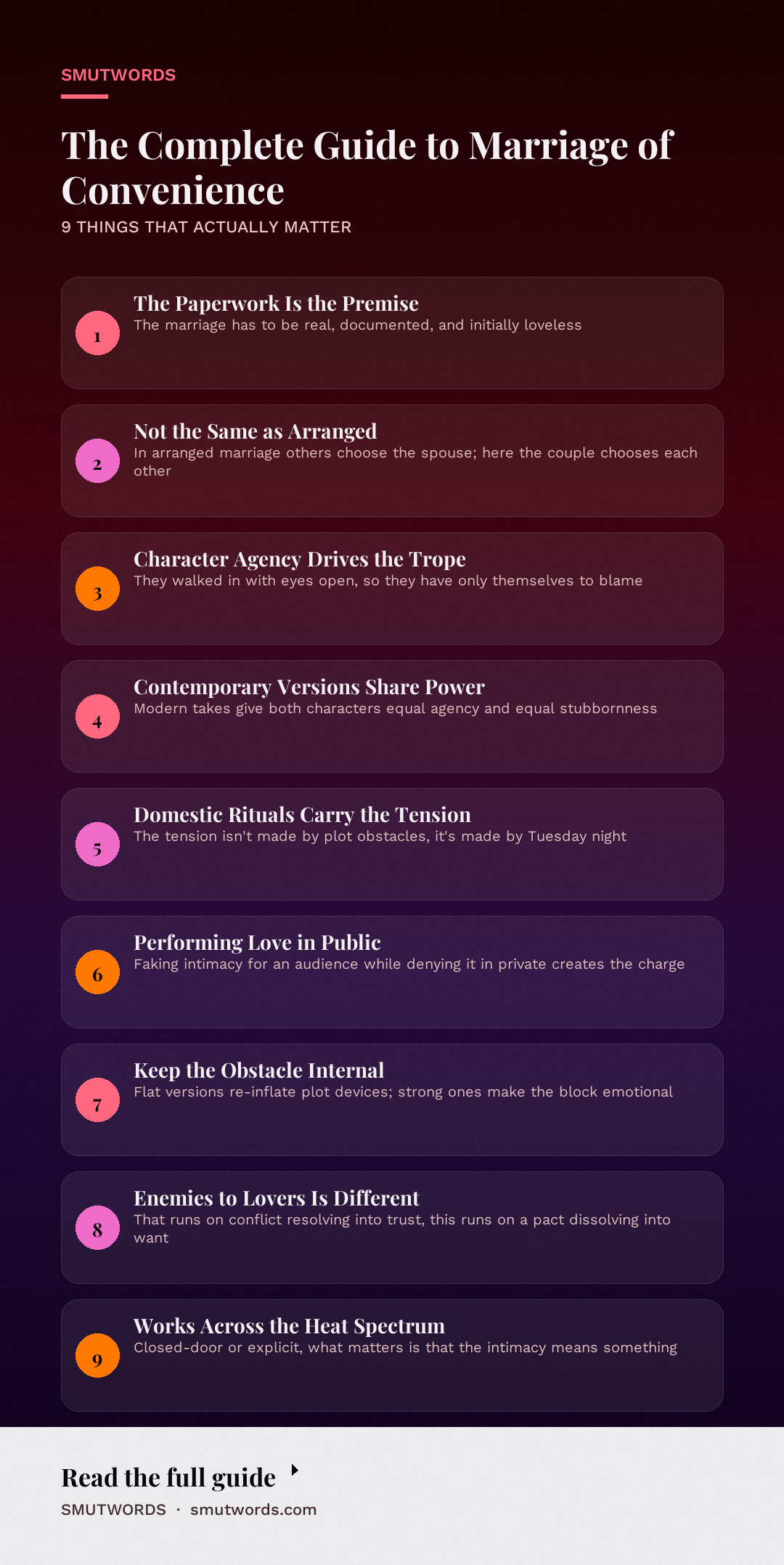
What doesn't count: a couple who marries for love and hits trouble later (that's marriage in trouble), or two people forced into proximity without a legal tie. The marriage has to be real, documented, and initially loveless. The paperwork is the premise.
The most common misconception is that this trope is the same as arranged marriage. They overlap, but they're not identical. In an arranged marriage, other people choose the spouse. In a marriage of convenience, the couple usually chooses each other, just for unromantic reasons.
The agency sits with the characters, which is exactly why the trope works: they walked into it with their eyes open, which means they have no one to blame but themselves when the feelings arrive.
Another misconception: that the trope is inherently chaste or slow. Plenty of marriages of convenience are consummated in chapter three, sometimes as part of the deal itself (an heir clause, a "make it look real" clause). The heat doesn't depend on waiting. It depends on the gap between what the characters are doing and what they're admitting.
Where Marriage of Convenience Comes From
The arranged marriage is ancient, but the marriage of convenience as a recognizable romance plot is a product of the genre's own history. It shows up throughout twentieth-century category romance, especially in the Harlequin and Mills & Boon lines, where it was a workhorse setup: the tycoon needs a wife for appearances, the secretary needs the money, and 180 pages later they're in love. Those books ran on duty, obligation, and the slow erosion of both.
The trope's modern shape owes a lot to two shifts. The first was the rise of contemporary romance in the 1980s and 90s, which moved the excuse from inheritance law into immigration law, corporate contracts, and small-town property disputes.
The second was the indie publishing boom of the 2010s, which turned the marriage of convenience into a series engine. Fake marriage, contract marriage, and marriage of necessity all became their own searchable subcategories, each with readers who wanted a slightly different flavor of the same tension.
Something else changed too: the tone. Older versions leaned on duty and sacrifice, with the heroine often enduring the arrangement more than choosing it. Contemporary versions give both characters equal agency and equal stubbornness.
They negotiate terms. They write clauses. They agree to separate bedrooms and then keep ending up in the same one. The trope kept its bones and grew a sense of humor.
There's also been a quiet recalibration around queerness. The marriage of convenience has always been a natural fit for same-sex couples who need legal cover or family approval, and the last decade of publishing has leaned into that, using the trope to explore chosen family, visibility, and the specific weight of a marriage that has to perform for an audience.
How It Shows Up in Erotica
On the page, the marriage of convenience is a pressure machine. The forced proximity is baked in (they live together, they share a kitchen, they share a bed if the deal requires it), and every domestic ritual becomes a site of escalation. The tension isn't manufactured by plot obstacles. It's manufactured by Tuesday night.
Here's what a strong version does with that:
- Sets clear terms and breaks them slowly. The best novels write down the rules (separate rooms, no kissing, no telling anyone it's real) and then violate them one at a time, in order, with the reader keeping score.
- Uses the performance of marriage as a kink engine. The couple has to appear in love at a dinner party, a family wedding, a business gala. Performing intimacy in public while denying it in private creates a charge that a lot of readers find hotter than the act itself. This pairs naturally with voyeurism in erotica, since the audience watching the performance becomes part of the thrill.
- Makes the denial deliberate. Characters who want each other and refuse to act on it generate a specific kind of ache that resembles chastity and denial, except the restriction is psychological instead of enforced.
- Lets the first kiss be a contract violation. The moment one of them breaks a stated rule is the hinge of the whole book, and it should land like a dropped glass.
- Delays the confession longer than feels polite. The pleasure is in watching two people insist on the fiction while every action contradicts it.
The most common variants authors use: the green card marriage (the ticking clock is a government agent), the inheritance marriage (the ticking clock is a will reading), the business merger marriage (the ticking clock is a board vote).
There's also the small-town property marriage, where the ticking clock is a development deal and the setting often does as much work as the plot, and the protector marriage, where one character marries the other to keep them safe from an ex, a debt, or a family. That last one slides easily into redemption arc romance territory if the protector has something to atone for.
Enjoyed this? Get a free book.
Join the list and we will send a complete free story straight to your inbox, plus new releases every week after that. No credit card, no catch.
What makes a flat version: characters who forget their own arrangement. If the couple could simply confess on page forty and the only thing stopping them is a plot device the author keeps re-inflating, readers notice.
The strongest books keep the obstacle internal. She doesn't say it because saying it means admitting she was wrong about being able to stay detached. He doesn't say it because he thinks he's a burden. The legal excuse fades and the emotional one takes over, and the reader is watching a person lose a fight with themselves.
This trope can also shadow enemies to lovers closely, especially in the business-merger and corporate-rival variants. The difference is the starting temperature. Enemies to lovers starts hot and hostile; marriage of convenience often starts polite and cool, and the hostility arrives later, if at all.
Variants and Alternate Names, Mapped
Fake marriage and contract marriage are the closest synonyms, with fake marriage emphasizing the deception angle and contract marriage emphasizing the negotiated terms. Marriage of necessity suggests external pressure, often danger or poverty. Forced proximity marriage is really a description of the mechanism rather than the trope itself, and shows up in a lot of blurbs because it tells the reader exactly what they're buying.
Marriage of Convenience vs Enemies to Lovers
These two get compared constantly, so it's worth being precise. In enemies to lovers, the obstacle is resentment: the characters start in opposition and have to earn their way to warmth. In a marriage of convenience, the obstacle is self-deception: the characters start in agreement and have to break their own rule.
The overlap happens in the merger and arranged marriage variants, where two rivals marry for business reasons and the resentment is already in place.
But the engine is different. Enemies to lovers runs on conflict resolving into trust.
Marriage of convenience runs on a pact dissolving into want. If the book's central question is "will they stop hating each other," it's the former. If it's "will they admit the marriage became real," it's the latter.
Frequently Asked Questions
Is a marriage of convenience the same as a fake marriage?
Close, but not identical. A fake marriage usually involves a deception aimed at a third party (family, immigration, an employer). A marriage of convenience can be completely honest in its terms, with both parties knowing exactly what they're getting and why. Many books use the terms interchangeably, which is why readers see both on the same cover.
Why do readers find marriage of convenience so compelling?
Because it compresses everything into one space. The couple is already legally bound, already living together, already committed to a shared future they claim not to want. There's nowhere to hide, and every domestic moment carries weight. The reward is watching ordinary intimacy, coffee, arguments about dishes, a shared bed in a hotel room, become the thing that breaks them open.
Does a marriage of convenience have to include sex?
No. The trope works across the heat spectrum, from closed-door to explicit. What matters is that the physical intimacy, when it happens, means something the characters won't say out loud. Some of the best versions use sex as the exact moment the "arrangement" stops being believable to either of them.
Can a marriage of convenience be a slow burn?
It's built for it. The trope's natural pacing is a long simmer with a handful of explosive breaks, which is why it pairs so well with slow-burn structures. The trick is giving the reader small wins along the way so the wait feels earned rather than stalled.
What's the difference between marriage of convenience and arranged marriage?
Who chooses. In an arranged marriage, the couple (or one of them) is usually placed in the match by outside forces. In a marriage of convenience, the characters generally agree to the match themselves, for reasons like money, citizenship, or protection. The agency difference changes the entire emotional arc.
Is marriage of convenience always a contemporary trope?
No. Historical romance uses it constantly, especially with inheritance laws and title requirements that made a loveless marriage a practical necessity. Contemporary versions swap wills and titles for visas and contracts. The mechanics change; the tension doesn't.
Final Thoughts
The marriage of convenience endures because it stages the genre's oldest question in the most confined possible setting: can you live next to someone, sleep beside them, legally belong to them, and keep your feelings in a box?
The answer is always no, and the pleasure is in watching the box come apart seam by seam. If you want a book that understands how to weaponize a shared kitchen and a signed contract, the recommended list below has your next read.






Loading comments…