
A post-coital scene debrief is the conversation partners have after a kink scene ends, and it's the part of the encounter where everything that just happened gets laid out on the table and examined with care. They talk through what worked, what landed wrong, what left a mark in the good way versus the alarming way, and how each of them is actually doing now that the endorphins are settling.
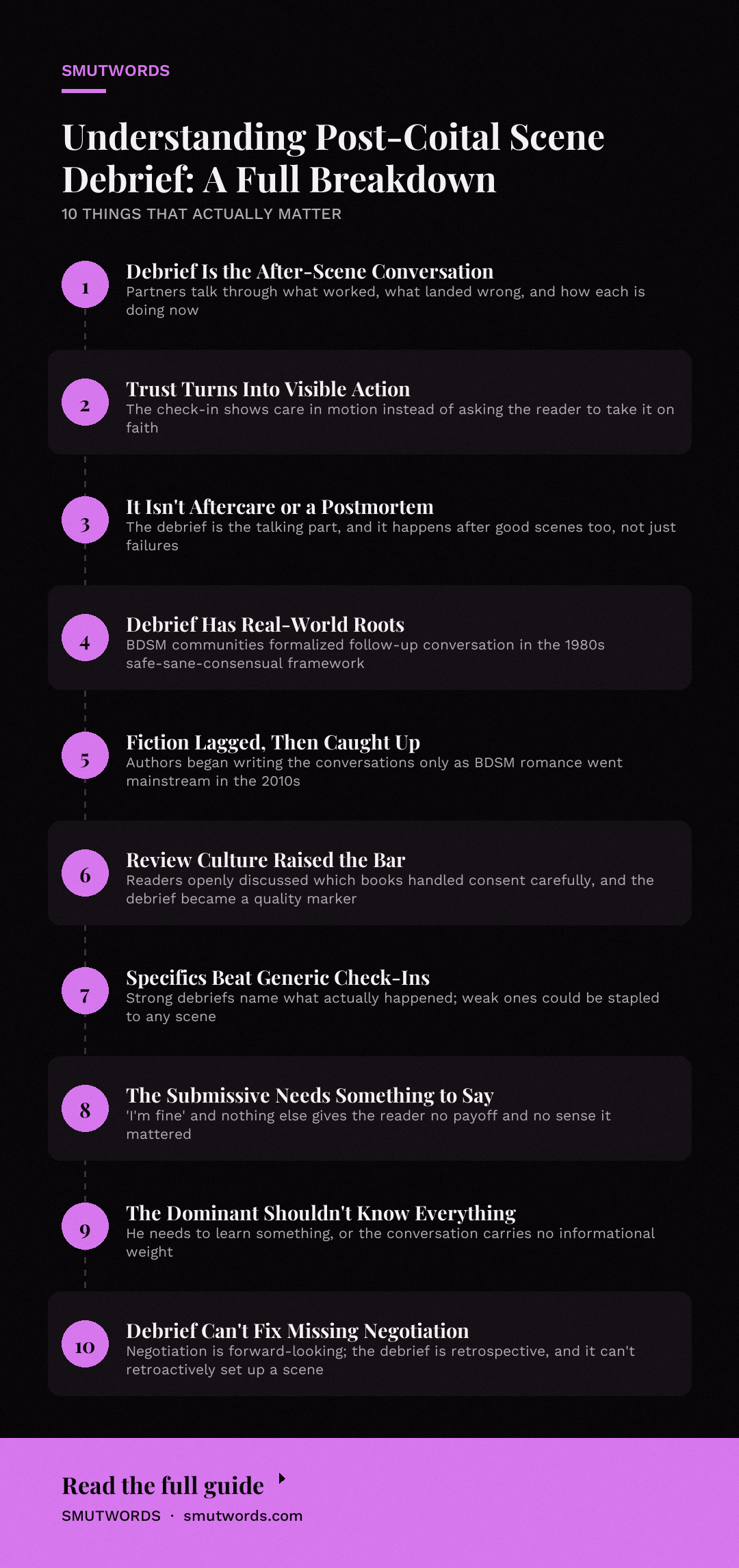
In romance and erotica this conversation has become one of the most reliable intimacy beats in the genre. It's where trust turns into visible action instead of a feeling the reader is asked to take on faith. A strong post-coital scene debrief makes the kink feel earned, grounded, and romantic in a way that a beautiful sentence about candlelight never quite manages. It's the reason so many readers say the check-in is their favorite page of the whole book.
That's the short version. What follows is the long one: how the trope works on the page, where it came from, how it's evolved, and what separates a debrief that makes you put the book down to catch your breath from one that reads like a health-and-safety pamphlet stapled to the end of a scene.
What Post-Coital Scene Debrief Actually Means
The phrase combines four ordinary words into a fairly precise piece of jargon. "Post-coital" places it after sex or after a scene that involves sex or erotic intensity. "Scene" carries the kink-specific meaning: a negotiated, time-bounded encounter with roles, rules, and often specific acts agreed in advance, which is what scene play refers to.
"Debrief" comes from military and operational language, where it means the structured review that happens once an operation is complete. Put together, the term describes the conversation partners have once the scene is formally over: a period of sorting, checking, and reconnecting.
What counts as a debrief is broader than it might sound. A debrief can be:
- A full formal conversation, often the next day as well as the same night, with real questions about consent, pain levels, emotional residue, and anything either partner wants to change next time.
- A short check-in right after, a couple of minutes of "how are you, what do you need, are you okay" before the talking deepens later.
- A wordless version with talking folded in, where one partner holds the other, brings water, dresses a small cut, and asks quiet questions while they do it.
- A written or texted follow-up, common when partners separate after a scene and want to confirm everyone's still okay.
What doesn't count, despite what the term might suggest: a polite goodbye, a shrug, or a character rolling over to sleep with no acknowledgment of what just happened. The debrief has to involve actual communication about the scene. It also isn't the same thing as the aftercare itself, though the two are so entangled that many books treat them as one continuous sequence.
Common misconceptions are worth clearing up. The debrief is not a postmortem of failure; it happens after scenes that went well, too, because "that was good" is worth saying out loud. It's also not a sign that something went wrong, and it isn't clinical. Characters who sound like they're filling out a form defeat the point.
Where Post-Coital Scene Debrief Comes From
To understand where this trope came from, look at the history of the genre rather than the history of kink practice, because the two developed on different tracks. In real-world BDSM communities, the debrief has been a recognized part of practice since at least the 1980s and probably earlier, part of a broader safe-sane-consensual framework that formalized aftercare, negotiation, and follow-up conversation as core elements of responsible play.
Fiction lagged behind. Through the 1990s and into the 2000s, published BDSM romance and erotica treated aftercare as either absent or implied. The scene ended, the characters fell asleep, and the emotional accounting happened through the narrative's own narration rather than through dialogue between partners.
The shift came with the mainstreaming of BDSM romance in the 2010s. As the genre's audience grew and readers began asking more sophisticated questions about consent and psychological realism, authors started writing the conversations that had previously happened off the page.
A second factor accelerated this: the rise of review culture and reader communities that openly discussed which books handled consent carefully and which felt careless. Authors noticed. The debrief became a marker of quality, a signal that a book understood what it was depicting. Around this time, community shorthand developed for the trope, including "candor after the collar," a term that wraps kink-specific imagery around the concept of honest disclosure after a scene.
Over the past decade the debrief has widened beyond its origins. It now appears in contemporary romance with light kink, in dark romance as a counterweight to extreme setups, and in debut novels written by authors who've either done the research or lived the experience.
How It Shows Up in Erotica
This is the section where the craft matters most, because the debrief is a hard-won scene type. It has no built-in physical action. It's two or more people talking, and if that sounds easy, it isn't. Here's how it works when it works.
What a Scene or Book Actually Does With It
In a well-constructed book, the debrief usually occupies a specific structural slot: after the scene's climax, before the chapter ends or before the narrative moves to the next beat. It serves several functions at once. It discharges the emotional charge of the scene by giving the characters time to process it aloud. It deepens intimacy by showing what each partner's interior experience was like.
It also establishes the relationship as a continuing negotiation rather than a single event. When a dominant asks his submissive how she feels about what he said during the scene, he's demonstrating that the power exchange is a system with feedback loops, not a one-way grant.
Authors handle the emotional and physical logistics differently. Some render the debrief as a long, quiet conversation with the characters physically overlapping, the submissive wrapped in a blanket and the dominant making tea or running a bath. Others compress it into a few lines of staccato questions and answers, letting the rhythm of the dialogue do the work.
Some scenes intercut the debrief with a slow physical aftercare sequence: hands moving through hair, a bruise being traced, a kiss placed on the shoulder or wrist. The strongest versions keep the talking textured. It might juggle multiple things at once, like a debrief in which one character has retreated into a dissociative fog and is barely responsive, and the other has to stay calm and keep asking.
Common Variations Authors Use
The variants are where the trope gets interesting, because each one reframes the power dynamics of the conversation itself.
- The asymmetric debrief: one character does most of the talking while the other listens, usually because the dominant is monitoring the submissive's state and asking questions she can't easily refuse. The power imbalance is still present, and the author has to show that the debrief is a protected zone where the submissive can say "actually, that was too much."
- The role-reversal debrief: the dominant is the one who's shaken, and the submissive provides the reassurance. This is often the moment a character in domspace crashes, and the scene shows the dominant as vulnerable and the submissive as the grounded one. It's the same engine that drives a lot of alphahole heroes, who spend the whole book insisting they don't need anyone and then fall apart the second someone offers to hold them.
- The pre-emptive debrief: occasionally written before the scene, where partners rehearsing their check-in becomes its own form of erotic tension. Less common, but effective when the characters are negotiating a scene that hits something sensitive.
- The debrief that goes badly: one character says the wrong thing, or the submissive isn't actually okay, or the dominant's pride makes him dismiss a concern. The scene doesn't end in resolution, and the tension carries into the next chapter.
- The texted follow-up: a debrief conducted remotely, sometimes the morning after, sometimes weeks later. Good for long-distance dynamics and for scenes where one character leaves abruptly.
- The collective debrief: in group scenes, the conversation happens among three or more participants, and the author has to juggle each person's check-in with everyone else's.
- The candor-after-the-collar variant: a form where the debrief involves the submissive speaking plainly about a dominant's behavior during the scene, naming what landed, what didn't, and what the dominant should do differently.
What Makes a Strong Version Versus a Flat One
A strong debrief feels specific. The characters mention the actual things that happened. They refer back to moments the reader witnessed, which makes the conversation feel like a genuine continuation of the scene rather than a thematic overlay.
Enjoyed this? Get a free book.
Join the list and we will send a complete free story straight to your inbox, plus new releases every week after that. No credit card, no catch.
A weak debrief feels generic. It could be attached to any scene, and the language is all "are you okay" and "that was amazing." The characters gain no new information about each other.
Strong versions also give the submissive real agency. A common failure is a debrief in which the submissive character is asked how she's doing, answers "I'm fine," and the scene ends. The reader gets no emotional payoff and no sense that the conversation mattered. She needs something to actually say, even if it's a small correction or a confession.
Strong versions also resist the temptation to make the dominant omniscient. When the dominant character already knows everything the submissive experienced, the debrief has no informational value. He should be learning something, whether it's a detail she was too overwhelmed to say during the scene or a misread signal he didn't catch.
There's a real-world anchor underneath all of this. In actual practice, a debrief is a genuine consent and care conversation, not a plot device, and it works best when partners reserve time for it and don't skip past the awkward parts. Fiction that remembers this reads truer than fiction that treats the debrief as a cute three-line epilogue to the spanking.
Where It Sits Inside a Wider Scene
One thing worth flagging: the debrief doesn't have to be a separate scene. It can be embedded in the scene's own ending, as the physical action winds down and the dialogue starts.
This works especially well in scenes involving higher-risk play, where the emotional texture needs to shift from intensity to care with the same physical grammar. Consider scenes involving genital torture play or suspension bondage, where the body has been stressed in ways that require careful follow-up. A debrief that follows a suspension scene, for example, has to address the physical logistics of coming down safely as well as the emotional ones, and strong authors don't separate the two.
The same is true for scenes involving breath play JOI, where the debrief gives the author a chance to show that the characters understand the stakes of what they've done. In practice, this level of play demands the most careful debrief of all, and readers who know the real-world territory appreciate books that don't skip it.
Post-Coital Scene Debrief vs Consent Negotiation
The debrief is frequently confused with consent negotiation, and the two do overlap, but they happen at different points and serve different functions. Negotiation is forward-looking: the partners agree on what will happen, what limits apply, what safe words they'll use. The debrief is retrospective: the partners discuss what did happen, how it landed, and what should change next time.
In a well-structured sequence, negotiation comes first, then the scene, then the debrief. Some books interleave later negotiations into the debrief, so the conversation doubles as preparation for next time. That's a strong move, and it's where the overlap is real.
The distinction matters because a book that skips negotiation but writes a good debrief still has a consent problem. The debrief can't retroactively fix a scene that was never properly set up. Readers notice the gap, and so do reviewers.
If you're checking whether a book handles consent well, look for both conversations, not just one. The same care shows up in how a book handles recovery arcs, too, like the slow work of coming back from a dry spell without pretending it was easy.
Frequently Asked Questions
What is a post-coital scene debrief?
It's a conversation between partners after a kink or power-exchange scene ends, where they talk through what happened, how each person felt, and what worked or didn't. In erotica and romance, it doubles as an emotional intimacy beat that demonstrates care and trust.
Is a debrief the same thing as aftercare?
No, though they're closely related. Aftercare is the physical and emotional care a scene partner gives afterwards: blankets, water, holding, quiet presence. The debrief is the conversation portion of that care. Good books usually run them together as a single sequence.
Why do romance readers like the debrief so much?
Because it makes trust visible. A character who just did something intense is now choosing to check in, listen, and adjust. That's a romantic act, and it gives the kink emotional grounding that a purely physical scene doesn't provide.
What should a debrief scene actually cover?
Real debriefs cover how each person felt physically and emotionally, what they liked, anything that worried them, and what should change next time. In fiction, the strongest scenes focus on a specific detail or two rather than a checklist, so the conversation feels human and not procedural.
Can a debrief ever be written as a bad scene?
Yes, and it often should be. A debrief where the dominant dismisses a concern, or where the submissive says everything was fine when it wasn't, creates real tension. The unresolved debrief can carry a relationship arc across multiple chapters.
Does the debrief have to happen right after the scene?
In fiction, timing varies. Real practice recommends a check-in right away and a fuller conversation later. Books sometimes delay the debrief deliberately, with one character leaving the room before the conversation can happen. The delay becomes the tension.
Final Thoughts
A book's debrief tells you what it actually thinks the kink was worth. If the characters get to talk, listen, and adjust, the scene mattered. If they don't, it was decoration.
Watch how a writer handles the ten minutes after the scene ends and you'll know within a paragraph whether the heat was built on anything. The best ones make those ten minutes as charged as everything that came before.








Loading comments…