
Mind control kink is the erotic charge that comes from one person getting inside another person's head and rearranging what they find there. It covers hypnosis, telepathy, conditioning, compulsion, brainwashing, and any other mechanism (supernatural, technological, or plain psychological) that lets a character override someone's will and rewrite their desires. In practice, the mechanism matters less than what it makes possible: total surrender, and the fiction that nobody has to negotiate for it.
It is one of the oldest workhorses in speculative erotica, and one of the most reliably popular. Readers who wouldn't touch a real-world power exchange will happily read four hundred pages of a villain turning a heroine's mind inside out, because the fantasy runs on a very specific engine: the wish to be wanted so badly that consent itself becomes irrelevant.
What Mind Control Kink Actually Means
The term pulls together a sprawling category of fantasy, and the edges are fuzzy by design. At its core, mind control kink is any erotic scenario in which a character's thoughts, feelings, or actions are influenced or dictated by another character through means the target cannot resist. The key ingredient is the loss of volitional control over one's own mind.
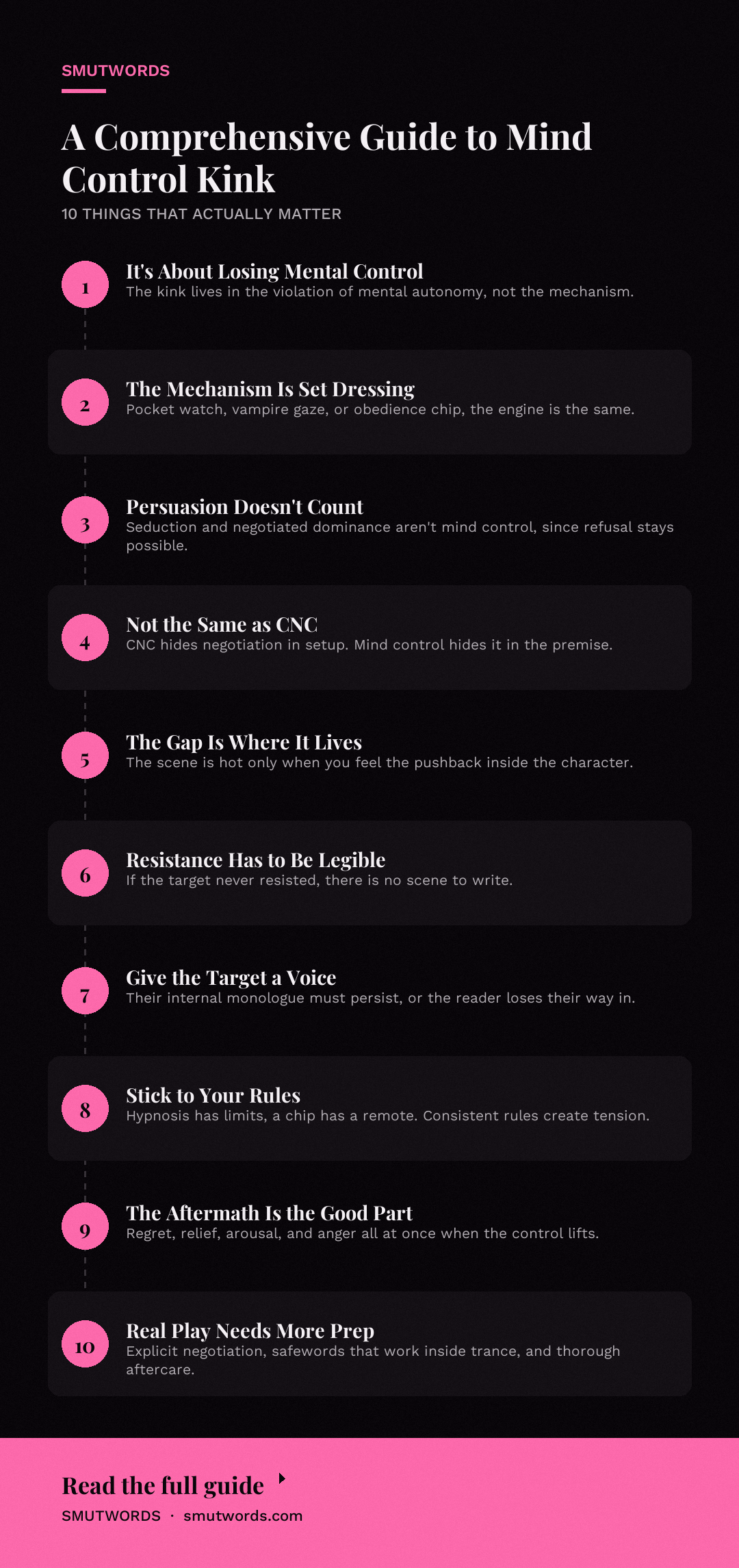
It counts whether the mechanism is a hypnotist's pocket watch, a vampire's gaze, a psychic bond, an obedience chip, a magic collar, or a god's compulsion. The mechanism is set dressing. The kink lives in the violation of mental autonomy and the pleasure that violation produces.
What does not count: ordinary persuasion, seduction, or dominance. A character who talks someone into bed is not exercising mind control. Neither is a dominant who gives orders in a negotiated scene, because the submissive can refuse. Mind control erotica removes the capacity to refuse, and that removal is the entire point.
The name itself is borrowed from science fiction and spy fiction, where "mind control" described everything from Cold War hypnosis panic to pulp telepathy. Erotica adopted the phrase because it was already shorthand for the fantasy. The genre didn't invent the concept. It just pointed it at the bedroom.
A few common misconceptions are worth clearing up:
- It's not the same as consensual non-consent. CNC is a negotiated framework in which refusal is roleplayed but still possible. Mind control erotica removes the choice from inside the fiction.
- It's not always dark. Plenty of mind control romance is playful, comedic, or tender. The mechanism can be coercive in theory and loving in practice.
- It's not strictly about sex. The turn-on is often about desire itself: being made to want something, being unable to hide what you want, watching someone's wants get rewritten.
- It's not a niche. Hypnosis, telepathy, obedience collars, and "fated mate" compulsion are all variations on the same engine, and they show up across nearly every subgenre of romance.
Where Mind Control Kink Comes From
The honest history here is a publishing history. Mind control as a fantasy has been around as long as stories about hypnotism and mesmerism, but its life as an erotic genre is shorter and easier to trace. Victorian stage hypnotists and fin-de-siècle novels about mesmerism gave readers the first template: a powerful operator, a suggestible subject, and a scene where willpower visibly folds.
Pulp science fiction in the 1930s through the 1950s turned mind control into a stock plot device. Alien telepaths, sinister scientists, and gothic villains all used it to take over heroines, and the erotic subtext was rarely subtle. By the time paperback originals arrived in the sixties and seventies, the device was fully eroticized.
The internet changed the genre more than any single author did. Fanfiction communities in the 1990s and 2000s built vast archives around "hypnosis," "mind control," "brainwashing," and "possession" tags, and they developed the vocabulary that still structures the field: mindbreak, compulsion, conditioning, free use mind control. Those tags became a tagging system for a whole subgenre, and the conventions they established bled back into published romance.
The last fifteen years have pushed the trope into mainstream paranormal and dark romance. Vampire bonds, fae glamour, alpha compulsions, and "fated mate" instincts are all mind control kink wearing different clothes. Indie publishing accelerated the trend because it could move quickly on reader demand without worrying about what a traditional publisher would accept.
One genuine shift worth naming: modern mind control erotica increasingly insists on titrating the fantasy with an eventual return of agency. Earlier stories often ended with the character permanently controlled. Contemporary romance tends to resolve into mutual choice, or at least into a moment where the controlled character gets to say yes for real. That shift tracks broader reader preferences, and it's worth understanding when you sit down to write one.
How It Shows Up in Erotica
Craft-wise, mind control kink is one of the hardest categories to write well because the stakes have to be felt on the page, not just stated. A scene where someone is controlled is only as hot as the reader's sense of what control costs them. If the target was never resisting, there's no scene.
The strongest versions build tension in the gap between the character's outward behavior and their inward awareness. She is doing exactly what he wants. Inside, she's horrified, or thrilled, or both.
The reader sits in that gap and feels the drop. When the interiority disappears and the character just goes along happily, the scene flattens immediately.
Here are the variations authors use most often, and what each one is doing:
- Hypnosis kink. The classic pocket-watch scenario, often modernized into relaxation or therapy settings. Works best when the induction is drawn out and the reader can feel the subject slipping.
- Psychic domination. Telepathy, empathy, or a mental bond that lets one character feel and steer another's thoughts. Common in paranormal romance and science fiction.
- Mindbreak. A darker variation where the target's resistance is broken down over time until they comply. Demands careful pacing and warning labels; when done well, it's a slow erosion, not a switch.
- Compulsion and conditioning. The fantasy of being trained into obedience. Sits close to primal play in its instinct-and-surrender energy, though the mechanism is verbal or ritual rather than physical.
- Free use mind control. A variation where the target's body remains available without further permission. Extremely high intensity; usually paired with a universe-level justification.
- Obedience collars, chips, and artifacts. The mechanism is a physical object. This overlaps with shibari in its fetishization of the object as a tangible restraint, even though the restraint runs on the mind rather than the body.
- Fated mate compulsion. The bond itself functions as mind control. Common in why choose romance, where the protagonist is pulled toward multiple partners and the compulsion justifies the arrangement.
What separates a strong mind control scene from a flat one usually comes down to three things. First, whether the target's resistance is legible. Can the reader feel the pushback?
Second, whether the controller's desire is specific. A villain who wants to bend a heroine's mind because he wants her, precisely, is hotter than one who just wants a body. Third, whether the scene escalates in smaller steps.
Mind control that goes from zero to total in a paragraph reads like a summary. The good versions stretch the induction across pages.
The controller's interiority matters just as much. The most popular mind control stories give the dominant character a perspective that is at least partly sympathetic, or at least fascinating. Readers want to be inside the head of someone powerful enough to do this, and feel the tension in a person who could take everything and is choosing (or failing) to restrain themselves. It's the same engine that makes an alphahole hero work.
Enjoyed this? Get a free book.
Join the list and we will send a complete free story straight to your inbox, plus new releases every week after that. No credit card, no catch.
If you're writing in this space, a few practical moves make the difference:
- Choose a mechanism and stick to its rules. Hypnosis has limits. A chip has a remote. A bond has distance and decay. Consistent rules create tension; vague magic creates nothing.
- Give the target a voice. Even inside the control, even when they can't speak for themselves, their narration or internal monologue must persist. Otherwise the reader loses their way in.
- Use the aftermath. What happens after the control lifts is often the most interesting scene in the book. Regret, relief, arousal, anger, all at once.
- Label your intensity. Mind control erotica runs from fluffy hypno-play to full mindbreak. Clear tags and content warnings protect readers and help the right readers find the right book.
- Earn the resolution. If the book ends with mutual choice, make the choice visible and costly. If it ends with permanent control, commit and make that ending feel earned within the internal logic.
The kink also pairs naturally with other tropes. It supercharges hate to love plots because it raises the stakes on why two characters who despise each other are still bound. It works beautifully inside contract marriage plots where the controlling mechanism is paperwork and proximity as much as any psychic influence.
It can also give a friends with benefits scenario an unexpected dark edge, if one friend uses a mental mechanism the other doesn't know about. Makeup sex after a mind control scene hits particularly hard, because the reader has just watched one character's autonomy get played with and now sees it restored.
Real-world play is a different conversation. Because this kink blurs consent lines by design, anyone experimenting with hypnosis or trance-adjacent play needs explicit pre-scene negotiation, safewords that override the fantasy (and are agreed on before anyone goes under), and careful aftercare that separates the fictional control from the real autonomy of everyone involved.
Hypnotic play can also have unpredictable effects on mood and memory, and it's worth reading up on before you try it. The fiction costs nothing. The reality deserves attention.
Mind Control Kink vs Consensual Non-Consent
These two are often filed together, and readers frequently assume they're synonyms. They're not, and the difference shapes how a scene gets written. Consensual non-consent is a framework: two characters agree in advance that one will behave as though the other has no choice, and they both know the arrangement is voluntary.
Mind control kink inside fiction removes that agreement from inside the story. The target cannot consent, because consent has been taken from them.
That difference is why mind control plots tend to make heavier world-building demands. CNC needs a conversation before the scene. Mind control needs a mechanism in the story that explains why consent isn't available in the first place. Hypnosis, a magic bond, a brain chip, a villain's power: the story has to supply the scaffolding.
It's a smaller gap than it looks. Both tropes give readers the same core fantasy, which is surrender without negotiation.
The difference is where the negotiation went. CNC hides it in setup. Mind control hides it in the premise.
Frequently Asked Questions
Is mind control kink the same as hypnosis kink?
Hypnosis kink is one popular variation. Mind control kink is the larger category and covers hypnosis, telepathy, magical compulsion, conditioning, obedience devices, and everything else that lets one character override another's will. Many readers use the terms interchangeably when the story is hypnotic, but mind control is the umbrella term.
Why do people find mind control erotic?
The most common answer readers give is that it delivers total surrender without the awkwardness of negotiating it. A close second is the ego charge of being so desired that another person's will bends around yours. Both sides of the exchange offer something the reader might not ask for out loud.
What is mindbreak in erotica?
Mindbreak is a darker subgenre where the target's resistance is broken down over time rather than switched off at once. It usually runs long, focuses on erosion, and often carries content warnings heavier than the rest of the category. Done well, it's a slow-burn psychological story rather than a single scene.
Is mind control kink safe to explore in real life?
Hypnotic play and trance-adjacent play are possible but demand more preparation than most kinks. Explicit pre-scene agreement, safewords that still function inside trance, and thorough aftercare are non-negotiable. Anyone blurring consent lines in real life needs to be extra certain the arrangement is voluntary on all sides.
Where can I find good mind control romance books?
Paranormal romance and dark romance are the two shelves where the trope is most developed, though science fiction romance and fantasy romance both use it heavily. Look for books tagged with hypnosis, fated mates, compulsion, or obedience collars to start. The catalog list below this article is a solid place to begin.
What's the difference between mind control kink and forced proximity?
Forced proximity is a plot device: characters are stuck together, and the forcedness is spatial or situational. Mind control kink operates on the mind, not the environment. Both push characters into situations they wouldn't have chosen, but only one rewrites what the character wants from the inside.
Final Thoughts
Mind control kink works for the same reason the best power-exchange stories work. It gives readers permission to want something they wouldn't ask for, and then gives them a safe, fictional place to sit inside that want for a while. Write it with clear rules, legible resistance, and a resolution that pays off whatever the setup promised. Then write it hot.
If you're new to the trope, start with a book that balances the dark and the tender rather than one that dives straight into the deep end. The macrophilia guide is a useful companion read for anyone interested in the broader genre of erotica that plays with enormous power imbalances, since many of the same craft lessons apply: the reader needs to feel the drop, and the writer has to earn it.







Loading comments…