
Spy romance is the subgenre where the love interest has a cover identity, a handler, and at least one gun in a drawer, and the reader gets to watch two people fall for each other while lying about almost everything. That is spy romance at its most basic: a story where one or both protagonists work for an intelligence service or a shadow outfit that runs the same way. The romance has to survive the lying, the missions, and the fact that a real answer to "where were you last night" would get someone killed.
It is one of the most reliable engines in erotic and romantic fiction for one reason. When every intimacy can be tactical and every confession can be a trap, the smallest gesture of honesty becomes an act of nerve.
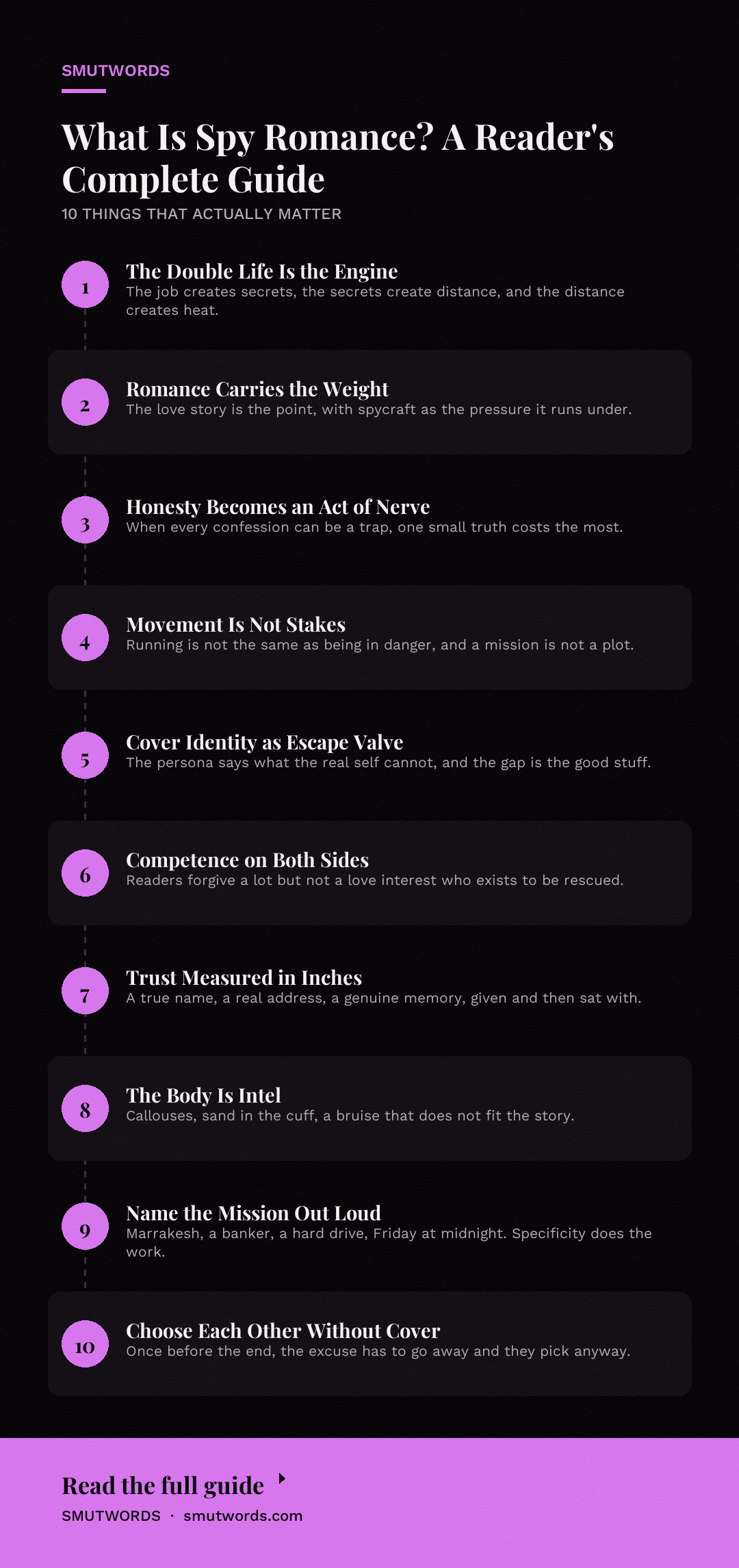
The category runs from glossy international thrillers with lush hotel rooms to gritty domestic stories about an operative who came home and cannot stop looking over a shoulder. Both ends work the same machinery. The job creates secrets. The secrets create distance. The distance creates a need to get close, and the getting close is where the heat lives.
What Spy Romance Actually Means
The name is straightforward: spy plus romance. The "spy" half means cover identities, operational secrecy, agencies or their equivalent, interrogations, surveillance, and missions with consequences past the bedroom door.
The "romance" half means the central relationship carries the emotional weight of the book. A thriller can have a love interest. A spy romance needs the love story to be the point, with the spycraft as the pressure the love story runs under.
The definition covers a lot of ground. A few things count as spy romance even when they bend the edges:
- Undercover romance: an operative embedded in a target's life, sometimes in the target's bed, while the mission runs underneath. The loved one may be the mark, a fellow operative, or a civilian who stumbled in.
- Spy vs. spy: two professionals on opposing sides who recognize each other immediately and start the relationship already knowing the other is dangerous.
- Ex-spy second chances: a retired or burnt operative whose past comes back, and the former partner or former lover tangled up in it.
- Forced proximity in the field: one safe house, one bed, one fugitive extraction, and two people who cannot leave each other's sight for operational reasons.
- Civilian caught in the field: a regular person who ends up tied to an operative, usually through a sibling, a witness role, or a very bad first date.
What does not count: a mafia romance with a couple of hired guns, a corporate drama where someone is "a little secretive," a romantic suspense book where the only covert element is a stalker. Those can still be excellent. They just do not run the specific spy-romance engine, which is the persistent double life and the question of what the person in your bed is actually doing for a living.
The common misconception is that spy romance means constant explosions and car chases. It does not. A strong spy romance uses maybe two action set pieces. The rest of the tension has to be built out of conversations where both people are managing their facial expressions.
The most common reader complaint in this subgenre is a book that mistakes movement for stakes. Running is not the same as being in danger, and a mission is not the same as a plot.
The other misconception: spy romance must end with one of them leaving the service. It does not, and some of the best-established pairings end with both still on the payroll, just working for a better-funded side of it.
Where Spy Romance Comes From
Spy fiction as a mass-market form took off in the Cold War and stayed planted there for decades. The 1950s and 1960s built the shape most readers still recognize: a lone operative, a foreign posting, a betrayal from inside the agency, and a woman who shows up in a cocktail dress. The romance in those early stories was almost never the point. Love interests were there to be seduced, deceived, or killed, and sometimes all three in the same chapter.
The shift happened in parallel across publishing. Category romance publishers in the 1980s and 1990s ran romantic suspense lines that pulled spy material into a format with a guaranteed central couple and a guaranteed ending. That act of translation did a great deal. Once a spy could be the hero rather than the antagonist, the double life turned into a source of emotional tension instead of suspense mechanics alone.
The 1990s and 2000s brought the female operative as a central protagonist, and with her a bigger field of play. Rather than the love interest waiting undercover at the bar, she could be the one running the mission. That change pushed the subgenre toward spy-vs-spy structure, where both partners are professionals, both are lying, and the reader has to figure out which one is more honest about wanting the other.
The digital publishing years of the 2010s changed the trope's scale. Self-published serials, boxed sets, and a very healthy appetite for romantic suspense pushed out a huge volume of spy and quasi-spy stories, from full agency thrillers to security-firm romance where the "spy" appears wearing a PMC polo shirt. The trope spread sideways: private security, contractors, asset retrieval, deniable operators. All of it reads as spy romance because the underlying double life holds.
What changed most, and what matters to anyone writing or reading this subgenre today, is where the intimacy sits. The older tradition held that the woman was a target. The newer tradition keeps asking the harder question: what happens to a relationship when the person you love is the target, and doing the job means lying to them every single day.
How It Shows Up in Erotica
A spy romance on the page handles the spycraft through three tools. Surveillance, in which small details of a room, a car, or a corridor become physically loaded. Cover identities, in which the protagonist gets to do and say things they would not do as themselves. And forced intimacy through operational necessity, which is where this trope produces the scenes readers open the book for.
The reason the trope lends itself so well to erotic writing is structural. The job supplies plausible reasons for behavior that would otherwise feel unearned. A shared hotel room because the target has eyes on the lobby. A kiss that has to land because the cameras are rolling on the street outside.
A physical check for a tracker, performed with hands and no preamble, that turns into more. The characters can tell themselves they are just doing the job. The reader knows better, and the gap between those two readings is where the heat comes from.
Editors who have worked this shelf talk about the same handful of things that separate a strong spy romance from a useless one.
Cover Identity as Escape Valve
The best spy romance uses the cover to let a character be someone they cannot be as themselves. The persona has a sharper tongue, a lower voice, fewer rules. Underneath, the real self watches with a mix of envy and alarm. That split gives an author honest material to work with when the two characters finally drop the act and the real person comes through.
Competence on Both Sides
Spy stories with two professionals who are each good at the job create real parity. The tension has to be built from mutual danger and mutual skill. The book fails when one partner has been made useless. Readers of this subgenre forgive a lot but not a love interest who exists solely to be rescued.
Trust, Measured in Inches
Trust in a spy romance cannot be declared. It has to be purchased scene by scene. The classic version: someone gives up a tiny piece of real information, a true name, an actual address, a genuine memory, and then has to sit with what it means to have told. The relationship advances one small truth at a time.
The Body as a Clue
The trope rewards writers who treat physical detail as intel. The callous on the trigger finger. The sand in the cuff. The bruise that does not fit the story.
When the narrator is reading their partner's body the way they would read a dossier, intimacy becomes investigative, and this is a very effective way to write a scene that is simultaneously a sex scene and a stakeout.
One Specific Mission
Vague "national security" stakes are poison. Give the job an actual object in an actual place with an actual deadline. The safe house is in Marrakesh, the asset is a banker with a hard drive, the window closes Friday at midnight. Specificity does the emotional work that pages of tension cannot.
A short list of things that flatten this trope on contact:
- The handler as narrator. A full book of debrief transcripts and long paragraphs of internalized threat analysis tends to read like procedure. Spy romance needs a body in a room with a person they want.
- Sex used as deniable cover every time. Once or twice, excellent. Every time, tedious. The reader wants to see characters choose each other without a plausible excuse at least once before the end.
- Cover identity as the whole personality. A cover should reveal the real self. A protagonist who is only ever the cover has no interiority to fall in love with.
- A villain whose motive is "the West" or "business." The most convincing spy romances give the antagonist a smaller, more petty, more human reason than ideology.
The kind of sex writing that lands hardest in this subgenre tends to have a specific quality, which is that the characters are paying attention. Undercover operatives notice things. Where a hand goes. What a voice does on a particular word.
Enjoyed this? Get a free book.
Join the list and we will send a complete free story straight to your inbox, plus new releases every week after that. No credit card, no catch.
A scene written from inside that attention can be ferociously hot without a single over-the-top gesture, because the reader is watching two people read each other with professional levels of observation.
For more on writing a hero who combines competence with danger, see A Beginner's Guide to Alphaholes. Spy romance heroes are frequently a variant on that energy, and the article spells out what makes the type work versus what makes it exhausting.
The enemies-to-lovers spine turns up in a large portion of the subgenre, especially the spy-vs-spy version where the two operatives start out assigned to take each other down. The mechanics are the same as any hate to love story, with the added advantage that in spy fiction, the enemies part is literal and the reader knows one or both of them will have to switch sides to make the ending work.
There is a wealth of backstory available. Someone on the last mission got burned. Someone got a partner killed. That former partner's sibling is now the handler, and is not interested in a reunion.
A second reliable engine in spy romance is the revenge romance shape. A mission goes bad, someone dies, and an operative returns from the field with a target list and a former lover who wants back in. The romance has to carry both the grief and the goal, and the sex tends to arrive with a hard edge. Done well, that structure produces some of the tightest emotional plotting in the whole subgenre.
The forced proximity angle frequently runs into the contract marriage trope, especially when the cover identity requires a spouse. A fake wedding, a genuine consummation, and an extraction date sitting on the calendar is one of the most dependable setups in spy erotic writing.
The reader knows exactly what the obstacle is. The characters each think they can walk away at the end. Nobody is right.
Second-chance spy stories rely heavily on what the two partners remember about each other. This connects to a broader dynamic explored under childhood friends to lovers, where shared history becomes the argument the reader believes.
When spies were rookies together, when one of them pulled the other out of a bad year in the field, when someone went dark without warning and reappeared six years later at the back of a bar: those shared memories are what the sex scenes draw from.
A quieter variation involves the civilian who never signed up. A brother's best friend who turns out to work for an agency. A translator on a business trip who happens to speak the right language. A woman whose apartment faces the wrong window.
The strongest version of this variant keeps the civilian's competence at ordinary things. She cannot fight. She can read a room, handle a suspicious neighbor, and throw a very good dinner party as cover. That combination gives the reader something to root for besides the operative's biceps.
Spies who are also deeply damaged are a frequent pairing with redemption arc romance. The operative who did something appalling under orders and now wants to make it right, with the love interest as both witness and judge.
That structure works best when the redemption is not theatrical. The character does not need a grand apology scene. They need one small act that costs them something real.
The cyberpunk end of the field is having a moment too. Hacking, corporate espionage, deniable operators in neon cities: those stories combine spy mechanics with the surveillance aesthetics of the cyberpunk romance category. The romance is the same. The hardware is different.
Frequently Asked Questions
What is spy romance?
Spy romance is a romance subgenre in which one or both protagonists work as covert operatives, and the relationship has to endure the professional secrecy, cover identities, and mission pressure that come with the job. The love story carries the emotional weight of the book. The spycraft supplies the pressure it runs under.
Is spy romance the same as romantic suspense?
Romantic suspense is the broader category and spy romance fits inside it, alongside stalker stories, procedural thrillers, and small-town danger plots. Spy romance specifies the mechanics: cover identities, an agency or equivalent, and a recurring double life. A tale of romantic suspense does not have to be a spy romance, but a spy romance is almost always also romantic suspense.
Do spy romances need a happy ending?
In standard romance publishing, yes. Spy romance is a romance subgenre and readers expect an emotionally satisfying close for the central couple, usually with both of them still breathing. Authors who want a darker ending tend to market the book as a thriller with a romance element instead.
Why do readers love the spy-vs-spy version so much?
Because both characters are competent, both are lying, and neither is waiting to be rescued. The relationship has to be built through mutual observation rather than mutual confession, and every real moment between them has been earned at some cost. That produces a tighter, hungrier dynamic than a lot of readers get in other subgenres.
Where should a reader start with spy romance?
Start with the flavor that sounds best. Enemies to lovers suits readers who want the chase. Ex-spy second chances suits readers who want the emotional weight of shared history.
Civilian caught in the field suits readers who prefer a protagonist close to their own life. All three are strong entries into the subgenre.
Can spy romance be steamy?
Very. The trope is one of the most reliable setups in erotic romance because the job itself supplies plausible reasons for proximity, privacy, physical contact, and intensity. The only rule is that somewhere before the end, the two characters have to choose each other without a plausible excuse in reach.
Final Thoughts
Spy romance works for the same reason any durable trope works: it puts two people in a position where the thing they want most is also the thing that could get them killed, and then it makes them want it louder. Crime stories give you a case. Spy romances give you a case with a body already in the room, and the body is the person you cannot stop looking at.
If you are reading your first spy romance and want an entry point that shows the trope operating at full power, start with a book in the recommendations below that leans hard on the spy-vs-spy structure. That is the version where both protagonists play the same game with the same skill, and the reader gets to watch two professionals choose to be honest with each other one small, dangerous truth at a time.







Loading comments…