
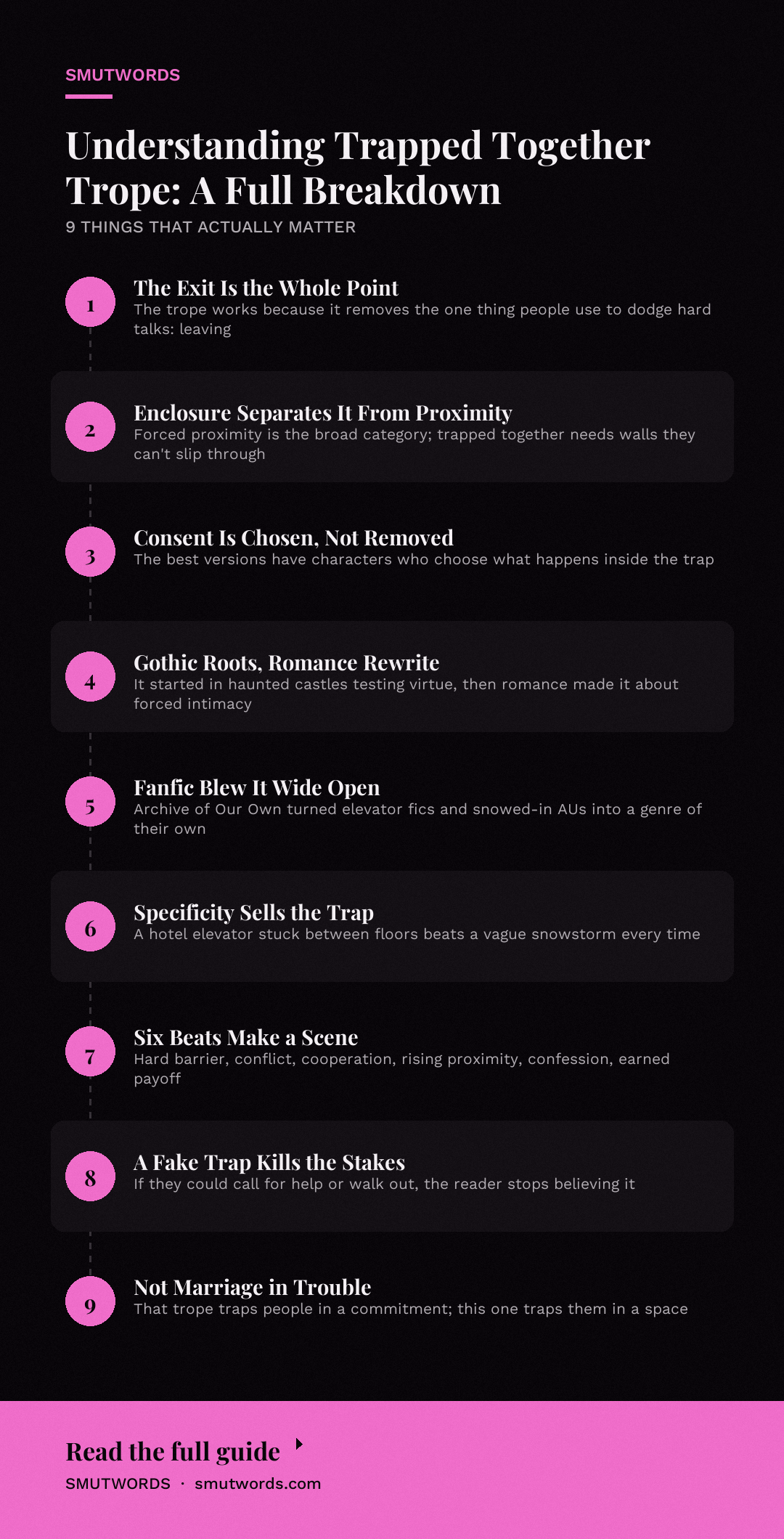
The trapped together trope is one of the oldest, most reliable pressure cookers in romantic and erotic fiction: two characters get stuck in a space they can't leave, and the only thing left to do is deal with each other. A stalled elevator. A snowed-in cabin. A hotel room with a broken lock and a storm outside.
The enclosing walls strip away every escape route. What's left is proximity, tension, and the slow burn of wanting someone you physically cannot get away from. The trope works because it removes the one thing real people use to avoid a difficult conversation: the ability to leave.
This guide covers the whole thing, from what the trope actually means to how it plays out on the page. If you want the mechanics, the history, the variants, and the reasons some versions of this setup sizzle while others fall flat, this is the place to start.
What Trapped Together Actually Means
At its core, the trapped together trope locks two characters into the same enclosed space for an extended period. The barrier can be physical (a blizzard, a busted car, a power outage), architectural (a locked room, a stuck elevator, a cabin with no road out), or social (a remote job site, a handcuffed mission, a mandatory quarantine). The point is that leaving isn't an option.
The trope gets its name from the literal situation. Two people. One space. No exits.
What happens next is the story.
The meaning has shifted a little over the years. In older romance, the trap was often external and total: the only way out was rescue or cooperation. In modern erotica, the trap is often narrower, sometimes only a few hours long, and the interesting part is how quickly the characters realize they could leave but are choosing not to.
What Counts and What Doesn't
Not every close-quarters story is a trapped together story. What separates this trope from general forced proximity is the sense of enclosure. It needs walls, real or figurative, that the characters can't slip through at will.
What counts:
- A genuine physical barrier that prevents exit (weather, damage, location, locked doors)
- A time frame long enough to force real interaction, not just a single awkward scene
- Both characters aware they're stuck with each other and unable to avoid it
- An emotional or sexual tension that builds because avoidance is impossible
What doesn't:
- A brief conversation in a small room the characters can leave whenever they want
- Two characters who happen to share a workspace but go home separately every night
- A trap that only lasts one scene and never forces them to deal with each other
- Any story where the escape is irrelevant to the emotional stakes
Common Misconceptions
People sometimes assume trapped together means non-consensual or forced situations. It doesn't. The best versions of this trope are built on characters who might not have chosen the proximity but who absolutely choose what happens inside it. The enclosure creates opportunity; the characters decide what to do with it.
Another misconception is that the trope only works in a single-location setting. Plenty of great versions involve characters who are trapped in motion, moving across a frozen landscape or stuck on a ship that can't dock. The enclosure can be as small as a closet or as large as an island, as long as the boundary holds.
A third misconception is that trapped together and forced proximity are the same thing. Forced proximity is the broader category. Trapped together is the sharper, more specific version where the barrier is impossible to ignore and impossible to leave.
Where the Trapped Together Trope Comes From
The trope has roots in both Gothic fiction and early romance publishing. In the 18th and 19th centuries, Gothic narratives loved to strand characters in haunted castles, abandoned abbeys, and remote estates. Those earlier versions of the trope were about survival and virtue; the tension was spiritual more than sexual. The trapped together setup was a way to test a heroine's character under extreme conditions.
Romance publishing changed that. Starting in the mid-20th century, category romance and pulp fiction started using the trapped together setup as a device for forced intimacy. The isolation cabin, the snowstorm, the broken-down car on a deserted road: these became standard tools for getting characters into bed before the third act.
Early category romance used the trope heavily because it solved a structural problem. How do you get two respectable people into a compromising situation without making them look foolish? You trap them. Then they have no choice.
By the 1980s and 1990s, the trapped together trope had become a recognizable publishing shorthand. Readers knew what a snowed-in cabin on the cover meant. The trope was so familiar it almost didn't need setup.
What did change, gradually, was consent and agency. Older versions often treated the trap as a convenient excuse for the hero's behavior. Modern versions are much more careful about making sure the characters are active participants in whatever happens once the door closes.
The Internet Era and the Expansion of the Trope
Online erotica and self-publishing blew the trope wide open. Writers could take trapped together into weirder, more specific territory: a locked server room with two rivals in love, a cyberpunk basement with a stuck security door, a pair of handcuffs that turn out to have lost their key. The trope flexed because it was no longer bound by physical realism in the same way.
It also became shorter. A trapped together short story can be ten thousand words and hit every beat a reader wants.
Fanfiction deserves credit here too. Archive of Our Own and similar platforms turned trapped together into a billion-word genre of its own. Elevator fics. Snowed-in aus. Handcuffed-together mission fic.
The trope became a way for fan writers to force characters who normally wouldn't admit anything to finally say it. That influence is all over contemporary trad-pub romance and erotica today.
How It Shows Up in Erotica
On the page, the trapped together trope has a predictable rhythm that works: establish the trap, establish the animosity or unresolved feeling, let the proximity do its slow work, break the resistance, escalate. The best writers make the barrier feel real and the payoff feel earned.
What makes a strong trapped together story work is the specificity of the enclosure. Vague traps are forgettable. A hotel elevator that stops between floors with a faulty alarm? Readers can feel the space.
A fishing cabin with one bed and a woodstove that hasn't been lit in a decade? The details do the work. The colder, the smaller, the more specific, the better the tension builds.
The Anatomy of a Strong Scene
Here's what a great trapped together scene does, beat by beat:
- Hard barrier. The characters can't leave. Not won't, can't. The stakes are clear within a page or two.
- Explicit conflict. They don't like each other, or they're hiding something, or there's unfinished history between them. The trap holds because the avoidance was the whole point.
- Forced cooperation. They have to work together on something small (keeping warm, finding a fuse, rationing food) to survive the situation. The cooperation cracks the door to intimacy.
- Physical proximity that ramps. A shared jacket, a shared blanket, a shared bed. The physical barrier of the enclosure gets smaller as the emotional barrier drops.
- Confession or confrontation. Somebody says the thing they've been avoiding. The trap finally does its real work.
- Sexual payoff that feels earned. The reader has been waiting for this. The scene delivers.
Say you're writing a snowed-in story. That's a classic trapped together variant, and the reason it's had a hold on erotica for decades is because it lets you write long, ambient scenes of characters cooking together, sleeping in the same small space, and slowly losing their minds. You can also borrow the heat-to-love energy from a hate to love arc if the characters start out openly hostile. The confined space amplifies whatever friction is already there.
Enjoyed this? Get a free book.
Join the list and we will send a complete free story straight to your inbox, plus new releases every week after that. No credit card, no catch.
If you're writing two soldiers stuck in the field together after an ambush, you can draw on the specific weight of soldier romance to make the intimacy feel hard-won. The trope pairs especially well with survival settings where the trap is literal danger. The two characters aren't just stuck; the getting out is going to take everything they have together.
Common Variations
Writers cycle through a familiar set of traps because each one carries a slightly different flavor. Elevator heat is quick, urban, and often short. Snowed-in is slow, domestic, and long. Stranded on an island is extreme and survivalist.
Locked in a room is often paired with a mystery or a heist going wrong. Handcuffed together is comedy and tension at once. A broken-down car is the saddest, most intimate version, because the car itself is a coffin-sized space.
Some writers combine variants within the same book. You can start with a snowed-in cabin and add a handcuff complication once the characters get to safety. Or open with a locked room and turn the escape into a cross-country drive where the trap only gets tighter. The trope plays well as a first act setup or as a recurring engine through the whole book.
Where It Goes Flat
The most common failure mode is a trap that feels fake. If the characters could obviously call for help or walk out the door, the reader stops believing the stakes.
The second failure is when the emotional conflict is weaker than the trap. A great deal of trapped together fiction pulls the physical trap off and then drops the ball on the reasons these two people were avoiding each other in the first place. The trap is only as interesting as what the characters were hiding.
A third failure is rushing the escalation. Trapped together works on slow burn. If they're ripping each other's clothes off in chapter two, the enclosure is wasted.
You want to spend time on the small details: the way they argue over the thermostat, the way she catches him staring over breakfast, the way they keep accidentally touching. That is the engine.
What makes a version strong is a clear sense of which walls are real and which are emotional. The physical trap does its work early. The emotional trap is what really keeps them enclosed.
Trapped Together vs Marriage in Trouble
These two tropes feel similar because both are about two people forced into a situation they can't just walk away from, but the mechanism is completely different. Marriage in trouble is about a couple whose relationship is already established and now failing. The trap is a marriage, a mortgage, a shared family, sometimes literally a shared house they can't sell yet. The tension is whether they'll repair what's broken or finally end it.
Trapped together is about the trap doing the relational work in the first place. The characters are trapped in a space, not in a commitment, and the story is usually about how the space creates the intimacy.
Some books blur the line. A couple whose marriage is falling apart gets snowed in at a mountain cabin and has to talk. That's a hybrid, and it's a good one. But they're not the same engine.
If you're in the mood for the slow dismantling of a relationship that still has something worth saving, marriage in trouble is your trope. If you want to watch two characters develop feelings in real time under impossible pressure, trapped together is the one.
Frequently Asked Questions
What is the trapped together trope?
Two characters are stuck in an enclosed space with no way to leave, forced into extended proximity. The trap forces them to deal with each other, and the resulting tension usually escalates into either confrontation or physical intimacy. The trope is a subtype of forced proximity.
Why is trapped together so popular in romance and erotica?
The setup removes every escape route, which means characters can't avoid the conversation or the attraction they've been dodging. Readers get forced intimacy and high-stakes emotional payoffs without needing elaborate external conflict. The trap does the work of pushing two people together.
What are the best trapped together variants?
Snowed in, stuck in an elevator, broken down on a remote road, stranded on an island, locked in a room, and handcuffed together are the most common. Each variant has a slightly different tone: elevator is fast and urban, snowed-in is slow and domestic, handcuffed is comic and tense.
Is trapped together the same as forced proximity?
No. Forced proximity is the broader category. Trapped together is the specific version where the barrier is a literal enclosure the characters cannot leave. All trapped together stories are forced proximity, but not all forced proximity is trapped together.
Does trapped together always lead to sex?
No. Some versions are emotional or romantic only, and plenty of them end with a confession rather than a sex scene. In erotica the trope usually does escalate to physical intimacy, but the trap itself only sets up the possibility; the characters and the writer decide what happens next.
How long should a trapped together scene last?
Long enough to feel real. A single conversation in a stalled elevator is not a trapped together story. Most effective versions spend a beat or two on the trap, then linger on the small details of shared space, and let the tension build over multiple scenes before escalating.
You'll also find this trope doing interesting work in ghostwriter romance, where a reclusive client and a writer get snowed in at a remote estate with a manuscript to finish. The trap in that case is creative as much as physical, and the pressure of a deadline is part of the enclosure.
If you're writing something with a redemption arc romance backbone, the trapped together setup can be a useful mid-book move: a character who has been holding back gets stuck with the person they wronged and can't avoid the conversation anymore. The trap forces the redemption into the open.
The trope also pairs naturally with a lumberjack romance setting, where isolation is already baked into the premise. A remote cabin and a blizzard is basically the trope's home address. If you want to see what the trope looks like at its most atmospheric, that intersection is where to look.
Readers who love that loud, aggressive, dominant hero energy will find that trapped together and the alphahole hero pair very well. The enclosure limits his options and pushes the conflict the reader came for.
And for anyone using the trope as a device to reignite a relationship that's gone quiet, the trapped-together reset works because it strips away routine and forces two people to focus on each other. That's the same principle covered in reclaiming the bedroom after a dry spell: sometimes the fastest way back to desire is removing the distractions and forcing proximity.
Final Thoughts
The trapped together trope is a pressure cooker with a proven track record. It gives writers a way to force two characters into the exact situation they've been avoiding: close enough to touch, close enough to confess, close enough that every accidental brush has to mean something. Done well, it delivers some of the most satisfying intimacy in the genre.
If you want a book that runs the trope at full power, look for the snowed-in cabin or stranded-in-the-wild versions that give the enclosure room to breathe. The list below has the best of them ready for you.







Loading comments…